
Young People Voting For Left-Wing Parties Is Not Evidence Of Marxist Brainwashing Camps

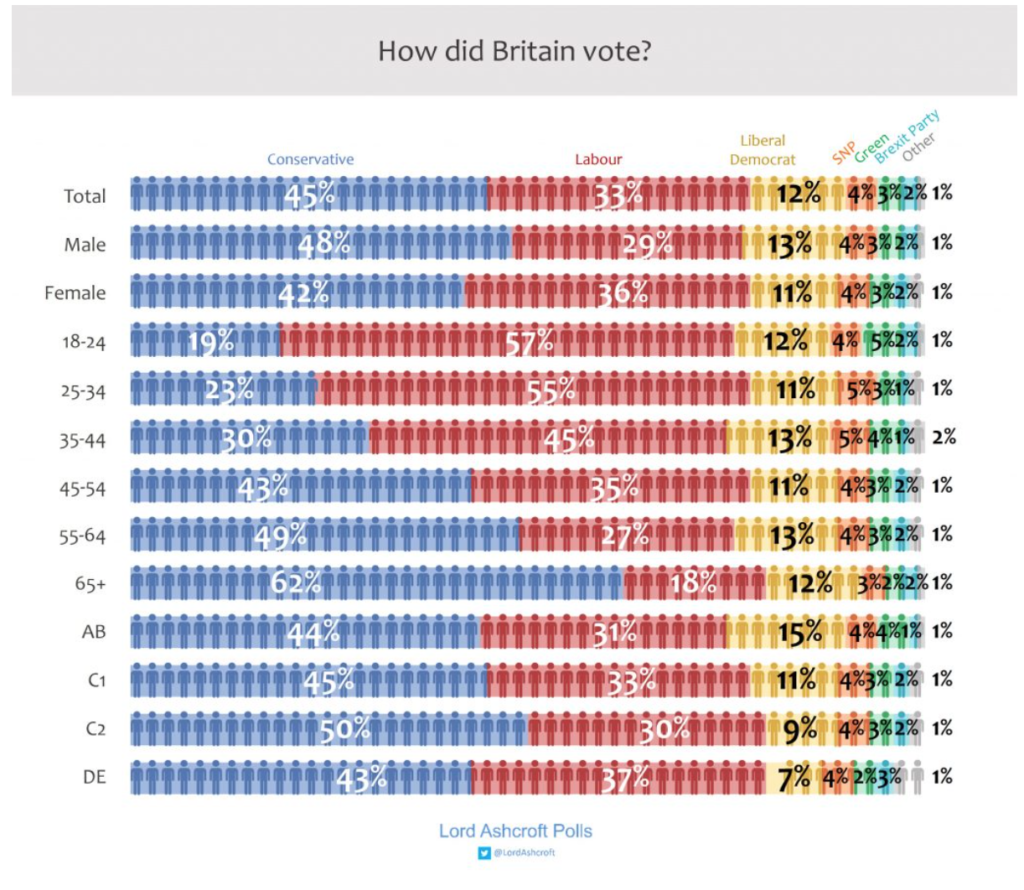
A popular meme going around at the moment shows an electoral map of Britain if only 18-24 year olds had voted in the General Election earlier this month. The map is almost completely red, leading many to conclude that these young people have all been brainwashed into voting Labour, but this conclusion does not follow evidentially. Demographer Dan McGlashan, author of Understanding New Zealand, explains.

Most adults are intelligent enough to know that people don’t cast their votes depending on which set of policies best serve the nation, or even depending on which set of politicians appears to be the most competent. The reality is that politics is pure, naked self-interest, and people cast their vote based on that.

One of the basic rules of democratic elections is that the less resources a person controls, the more they will want resources to be redistributed. This isn’t merely a law of politics, or even a law of psychology, but a law of ethology, brought about by evolution.

It can be observed in primate troops that the primates with the weakest capacity for gathering resources from nature are the same ones that are the most strongly in favour of sharing. This is not surprising, because the weaker one’s capacity for gathering resources, the more reliant one becomes on the gathering capacity of others.

When a person is aged between 18 and 24, it’s almost inevitable that they are poor, at least as an individual. At the absolute most they will have earned a postgraduate degree, and even if they managed to avoid a student loan they will not have had enough time to earn any real money. Assuming they haven’t inherited a fortune already, the best of them will be working an entry-level position and renting, with little real savings.

People in this age bracket find that it’s older people who own everything already. In New Zealand, the correlation between living in a freehold house and being aged between 20 and 29 was -0.60. If one considers that many people in this age bracket will be living in a freehold house owned by a family member, it suggests that very few of them will own their own homes.

Not owning your own home means that you will get extorted out of rent money in order to not die of exposure. Because it’s the old who own most of the homes, society is therefore structured in a way that funnels wealth away from the young workers and into the pockets of the old owners. Because society is set up this way, young people are always likely to vote for the party that promises to give workers a bigger share.

This is no more surprising or immoral than the old voting to not redistribute wealth owing to the fact that they already own everything. Voting for a Conservative party is the same as voting to uphold the Police and their enforcement of property claims, and this is almost always done when a person charges rent. In other words, it’s also voting purely in one’s self-interest.

Further evidence for the statement that young people don’t vote for left-wing parties because of Marxist indoctrination comes from observing young university students. Young people who go to university are more likely to vote for a right-wing party than those who did not go to university. If young people voted for left-wing parties because of Marxist brainwashing camps, then those not exposed to the camps would vote for right-wing parties more often.

The opposite is the case. This is because young people who go to university are more likely to come from the middle class than those who do not, and are therefore wealthier than the average of their age cohort, despite that their age cohort is relatively poor. Consequently, they are more likely to vote Conservative out of self-interest.

On the other hand, it is true that our university system has been reduced to a network of Marxist indoctrination camps. Evidence for this doesn’t come from the voting patterns of young people, though – it comes from the movements against free speech, the promulgation of anti-white philosophies and the distorted views of history and of human nature that are promoted for political reasons and not because of a love of truth.

The voting pattern of young people voting for left-wing parties that promise to redistribute wealth is not because these young people have been brainwashed – it’s because they’re poor. The kind of low-IQ person susceptible to Marxist brainwashing would usually vote left anyway on account of that they were poor.

*

Understanding New Zealand, by Dan McGlashan and published by VJM Publishing, is the comprehensive guide to the demographics and voting patterns of the New Zealand people. It is available on TradeMe (for Kiwis) and on Amazon (for international readers).

*

If you would like to support our work in other ways, please consider subscribing to our SubscribeStar fund.


British Labour Lost The White Working Class – And New Zealand Labour Is Making The Same Mistake

The British General Election this week produced a crushing defeat for Jeremy Corbyn’s Labour Party, their worst since World War II. Analysis of voting patterns showed that the genesis of the Labour loss came in their low polling among the British working class. This result has ominous overtones for New Zealand Labour, Dan McGlashan will argue, because they are repeating the same mistakes that their British counterparts did.

Modern Britain was built by the white working class.

The white working class ploughed most of the fields, dug most of the ditches, cleared most of the scrub, laid most of the drains, paved most of the roads – and took most of the artillery fire. For every endeavour carried out by the British Empire and its descendants for hundreds of years, the white working class was the spearhead, the tool with which British will worked the Earth.

Today, the white working class man is excoriated for being a racist. He is expected to crawl into his hovel and die as he is replaced by cheap labour from foreign nations. He voted for Brexit, mostly because he understands that globalism only serves those with the ability to operate globally, i.e. the rich. For this he was called racist, backwards, bigoted, stupid, short-sighted and incapable of acting in his own best interests.

The same Establishment that oppressed him for centuries abandoned him the moment they could find someone more profitable to oppress. Since then, the white working class has rapidly lost ground. Predictably, there are many bad sentiments held by the white working class towards the Establishment and towards the people who give it power.

Jeremy Corbyn came to represent that Establishment. Not only did Corbyn oppose Brexit, which had become emblematic as a rare and long-awaited win for British workers, but he also favoured other things the Establishment favoured. One of these things was woke politics.

Every working-class person hates woke politics.

The working class is about honesty. It has to be, because if you’re working with your hands and getting dirty you can’t also wear a costume. Therefore, you can’t pretend to be anything other than what you are. The working class doesn’t care about your illustrious ancestor that was the Baron of somewhere, only what you’re capable of right here and now. What you see is what you get – dishonesty is for criminals (both poor and rich ones).

Therefore, there is little that is less working-class than woke politics. The whole idea of puffing one’s chest out and pretending to care deeply about great swathes of people, when in reality you don’t give two shits about them, is anathema. The whole idea of continually posturing to demonstrate one’s moral superiority seems ridiculously fake. It’s a preoccupation for middle-class dandies.

When the Labour Party comes out and announces that it has secured more mental health funding for Maori and Pacific Island people, the white working class in New Zealand can only interpret that as a slap in the face. Betrayal is the only word to describe the Labour Party lifting up one group of people, whose ancestors have been here at most 60 years, and leaving another group of people, whose ancestors have been here for 160 years, in the shit.

As this magazine has argued previously, the New Zealand working class is destined to turn to fascism in the long term. This is because they are being, and will continue to be, abandoned by the social democrats in favour of virtue signalling, globalist obligations to the Third World and woke politics.

Much like Britain, there is no fascist option in New Zealand at the moment (New Zealand First does not realistically fulfill that role). In other European countries, some sort of neo-Nazi movement exists to absorb the dissenting working-class voters. But these countries all run on a Mixed Member Proportional electoral system – the British First-Past-The-Post system prevents any such movement from gaining traction.

In Britain, these dissenting working-class voters switched to the Conservatives. This was deduced from calculating the correlation between the size of the swing towards the Conservatives in an electorate and other variables. The strongest correlations with the size of the swing towards the Conservatives were in white, working-class areas.

Few want to admit it, but the fact that the white proportion of Anglo countries is inexorably shrinking means that white voters are all but guaranteed to end up circling the wagons. They will do this under the auspices of the conservative movements, whether liberal or authoritarian. Many white people who identify strongly with being white see men like Donald Trump and Boris Johnson as avatars of their interests.

The New Zealand Labour Party is making all the same mistakes the British Labour Party did. They don’t have a centrepiece betrayal such as Brexit, but they have a number of smaller ones, such as raising the refugee quota, signing the TPPA, tightening the gun law, cracking down on free speech and the Operation Whakahumanu Police harassment campaign of social media free thinkers.

If the New Zealand Labour Party likewise gets abandoned by the white working class, those voters may follow the now established trend in other Anglo countries of switching loyalties to the conservatives. This will likely see an ever higher proportion of white people vote for National, and an ever lower proportion of white people vote for Labour.

Because white people are forecast to remain a majority in New Zealand until at least 2083, this process will work to shift the balance of Parliamentary power in National’s favour. The Sixth Labour Government already has a very weak grip on power, and even a small shift in loyalties among the white working class could see them lose power in 2020.

The British Labour Party made a fatal strategic error by abandoning the white working class in favour of woke politics of all kinds. The natural resistance of the working class to such pretentious dishonesty cost them this week’s General Election. The New Zealand Labour Party follows closely in the footsteps of their British counterparts, and they look all but certain to make the same strategic error. Will it cost them next year?

*

Understanding New Zealand, by Dan McGlashan and published by VJM Publishing, is the comprehensive guide to the demographics and voting patterns of the New Zealand people. It is available on TradeMe (for Kiwis) and on Amazon (for international readers).

*

If you would like to support our work in other ways, please consider subscribing to our SubscribeStar fund.
Who Are The Forces Of Evil In The Cannabis Referendum Debate?

Now that the cannabis referendum question has been announced, the real battlelines have finally been drawn. Every decent person understands that the forces of evil are lined up against the Cannabis Legalisation And Control Bill, but the question remains: who are they? Dan McGlashan, author of Understanding New Zealand, describes the opponents to cannabis law reform in New Zealand.

The easy way to tell who is for and who is against cannabis is by looking at the correlations between various demographics and their support for the Aotearoa Legalise Cannabis Party in the 2017 General Election.

This can be done by importing the demographic data from the Electoral Profiles on the Parliamentary website into a statistics program such as Statistica, and then calculating a correlation matrix. Such an approach was the basis of my analysis in Understanding New Zealand, in which I calculated the correlations between all demographics and voting preferences and every other.

The strongest correlation between voting ALCP in 2017 and being in any demographic is the one between voting ALCP in 2017 and being Maori. This was a gigantic 0.91, which suggests that the vast bulk of Maori people are in favour of cannabis law reform. The strength of this relationship can be seen from looking at the ALCP vote in the Maori electorates, which is around twice as high as the ALCP vote in general electorates.

Maoris are strong supporters of cannabis law reform for several reasons. The primary reason is because cannabis suits them better than alcohol, to which they have little genetic resistance. The fact that white people have thousands of years of genetic resistance to alcohol, and Maoris don’t, mean that the normalisation of alcohol culture is grossly unfair.

The other super-powerful correlation with voting ALCP in 2017 was with regular tobacco smokers. This was 0.89, suggesting that if a person is a regular tobacco smoker they are all but certain to be a supporter of cannabis law reform.

The reason for this correlation is that it’s mostly only people with mental problems who smoke tobacco, and these same people smoke cannabis for its medicinal effects. If a person has PTSD or anxiety, it’s often the case that tobacco and cannabis both have a similar medicinal effect.

One less strong, but still powerful, correlation was between supporting the Aotearoa Legalise Cannabis Party and being New Zealand born – this was 0.73. It will come as a surprise to many, but cannabis use is an implicit part of the New Zealand identity. It’s as much a part of who we are as rugby, beaches, barbeques and ethnic confusion. Therefore, people who are born and raised in New Zealand are much more likely to support cannabis law reform than those born elsewhere.

These correlations suggest that the average cannabis user is the salt-of-the-earth working-class Kiwi. This is proven by the correlation between voting ALCP in 2017 and being employed in working-class professions, such as community or personal service worker (0.77), labourer (0.71), machinery operators and drivers (0.70) or technicians and trades workers (0.43).

The pro-cannabis forces, then, are basically the people who are at the coal face of the tough jobs in New Zealand. People who work repetitive jobs or jobs with heavy social contact are the ones who tend to have the strongest need to destress at the end of the day, and it’s for them that cannabis law reform would be the most beneficial.

This gives us a good idea of who the forces of evil are.

Many of the opponents to cannabis law reform are old people. The correlation between voting ALCP in 2017 and median age was -0.57. It’s necessary to note, however, that the correlation between voting ALCP and being on the pension was only -0.18, i.e. not statistically significant. This means that the relation to age and support for cannabis law reform is not linear – it rebounds among pensioners.

This replicates a pattern seen overseas. People tend to be anti-cannabis the older they are, up until the point where they are so old that their life starts to revolve around medicines and doctors. At this point it’s common for people to get exposed to cannabis and to come to appreciate its medicinal effects. So the brainwashing only lasts until there’s an element of personal interest in it, at which point it’s discarded.

Christians make up another strong anti-cannabis bloc. The correlation between voting ALCP in 2017 and being Christian was -0.37. Christians have always hated cannabis users, in particular because cannabis is the natural spiritual sacrament of the Eurasian people. This is why Bob McCoskrie, funded by Church money, is taking the leading role in the anti-cannabis campaign.

Jews, Muslims, Hindus and Buddhists are all significantly opposed to cannabis law reform as well. The correlation between voting ALCP in 2017 and belonging to any of these religious groups was at least -0.30. As mentioned above, this is because cannabis is a spiritual sacrament, and therefore its use is directly against the interests of organised religion.

Predictably, then, there is a strong negative correlation between voting National and voting ALCP. Interestingly, the correlation between voting ALCP in 2017 and voting National in 2017 (-0.70) is more strongly negative than the correlation between voting ALCP in 2017 and voting Conservative in 2017 (-0.40). This underlines the degree to which National voters are not motivated by conservatism so much as actual malice.

The forces of evil, then, in the cannabis law reform debate are the same old, religious bigots who have opposed every other attempt at making society better. They’re essentially the same people who opposed homosexual, smacking and prostitution law reform, and they’ll oppose everything in the future too, because any change makes them piss their pants.

*

If you enjoyed reading this essay, you can get a compilation of the Best VJMP Essays and Articles of 2018 from Amazon for Kindle or Amazon for CreateSpace (for international readers), or TradeMe (for Kiwis). A compilation of the Best VJMP Essays and Articles of 2017 is also available.

*

If you would like to support our work in other ways, please consider subscribing to our SubscribeStar fund.

The Cannabis Legalisation And Control Bill: A Weak But Realistic Compromise

The Government released news this week about the exact form of the cannabis referendum question at next year’s General Election. The Cannabis Legalisation and Control Bill, currently in draft form, will serve as the basis for next year’s referendum question. Long-time cannabis law reform campaigner Vince McLeod, author of The Case For Cannabis Law Reform, gives his thoughts on the proposal.

The proposed law is weak, but it’s a realistic compromise with the forces of evil.

Most importantly, it makes the possession of up to 14 grams of cannabis, a small homegrow and licensed retail cannabis sales all legal. As far as the cannabis-using community is concerned, this achieves most of the long-stated goals of cannabis legalisation. It’s broadly in line with what other states and territories in North America have introduced.

Section 18 of the Cannabis Control Bill will allow up to 14 grams of cannabis to be possessed in a public place, and for cannabis to be smoked at home. People are allowed to possess more than this if they are transporting it from one person’s home to another. There appears to be no limit on how much cannabis one is allowed to possess at home.

This will mean that it will no longer matter if a Police officer smells cannabis on you in public or while during a visit to your house. Evidence of cannabis will no longer, by itself, be a sufficient cause for the Police to attack you. Even if the case of smoking cannabis in public, which will still be illegal, the punishment is only a $200 infringement fee.

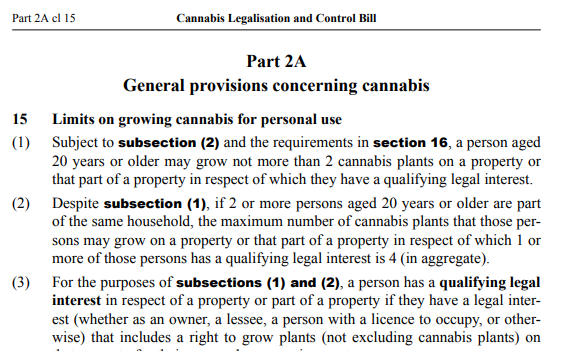
Section 15 of the Bill will allow for two plants to be grown at home per person, and up to four plants to be grown per household.

Two plants is not a lot. However, if you grew four plants in a small grow tent under a 600W light you could get ten or twelve ounces per grow. Assuming that you’re able to get hold of clones, this would mean ten or twelve ounces every eight to ten weeks. In other words, a household could meet its demands for recreational cannabis easily enough by growing it themselves.

Moreover, there is no proposed restriction on the size of the two plants, as has been the case in some North American jurisdictions. This suggests that people will be allowed to put down a couple of honking sativas in an outdoors greenhouse and get them both up to ten feet tall. Such an arrangement would make it legal to grow a year’s worth of cannabis in one season, sparing the need for the environmentally-unfriendly grow tents.

Section 19 of the Bill allows for recreational cannabis sales. Purchases will be limited to 14 grams per day, but this is at least two weeks’ worth by any reasonable measure. Aside from this, it appears the proposed model will be fairly similar to the cannabis cafe model that has existed in the Netherlands since the 1970s.

In other words, it appears that the proposed model is intended to allow for recreational cannabis sales in cafes in a similar fashion to how alcohol is already sold in pubs. Section 49 of the Bill makes reference to “consumption licences” which will allow certain premises to allow people to consume cannabis in public. Such premises will not be allowed to also sell alcohol, and will therefore follow closely to the Daktory model that Dakta Green has already established in New Zealand.

Despite these major wins, the Bill has a number of flaws from the perspective of the average member of the cannabis-using community.

Nowhere in the Bill has provision been made for running a mother plant that clones can be taken from. If one household can only have four plants, it makes having a mother plant that one can take clones off difficult. Against this criticism, however, is that it appears the Bill will allow for retail sale of feminised seeds.

It’s also a mistake to set the legal limit at 20. For one thing, it implies that cannabis is more dangerous than alcohol, which is entirely false. For another, it means two years where young Kiwis will be legally allowed to drink booze but not smoke weed, which will mean two years of exposure to the more destructive of the two drugs. Legal cannabis has been shown to lower rates of alcohol use overseas, and the sooner an alternative to alcohol was available the better.

Perhaps unsurprisingly, the Bill doesn’t address our right to use cannabis for spiritual purposes. Absolutely zero acknowledgement is made of the fact that cannabis is a spiritual sacrament, but this is not unexpected if one considers that New Zealand has been ruled by completely godless people since the turn of the century, and that for their sort spirituality is mental illness.

Also predictably, there is no provision for an official Government apology for conducting a war against them without their consent. The War on Drugs has been the worst human rights violation to occur in the West since World War II. The Government’s role in this war has involved decades of lying to the public about the effects of cannabis and putting people who defy them in cages. Their conduct has been obscene, and an apology should be part of legalisation – but it won’t be.

Perhaps worst of all, the Government is still committed to minimising cannabis use from the standpoint of cannabis use being inherently harmful. It’s possible that they have calculated that legalising cannabis would make it possible to strangle cannabis culture through ever-increasing taxes and red tape, as they have almost successfully done for tobacco. More likely, however, is that they have shifted thinking so that cannabis is now (rightly) grouped with alcohol and tobacco and not heroin and methamphetamine.

There are many possible criticisms of the Bill, but ultimately it is definitely worth supporting. All of the legitimate criticisms relate to aspects of cannabis law that could best be fine-tuned after the referendum has been passed.

Realistically, what the proposed Cannabis Leglisation And Control Bill means is an end to the fear. It would be taking away that dark, nauseating feeling that comes with being marked as a criminal. People smoking or growing cannabis at home will no longer have to fear saying the wrong thing or inviting the wrong person to their house, and the net result will be a reduction in the suffering of the New Zealand people.

*

If you enjoyed reading this essay, you can get a compilation of the Best VJMP Essays and Articles of 2018 from Amazon for Kindle or Amazon for CreateSpace (for international readers), or TradeMe (for Kiwis). A compilation of the Best VJMP Essays and Articles of 2017 is also available.

*

If you would like to support our work in other ways, please consider subscribing to our SubscribeStar fund.