
Why Inequality Destroys Nations

One often hears the argument that inequality destroys societies, but it isn’t easy to understand why. The mainstream media tells us that a rising tide lifts all boats, and so people ought to enjoy the bounty of the modern day without worrying about how other people have more. But the economic psychology of inequality is complicated. This essay explains.

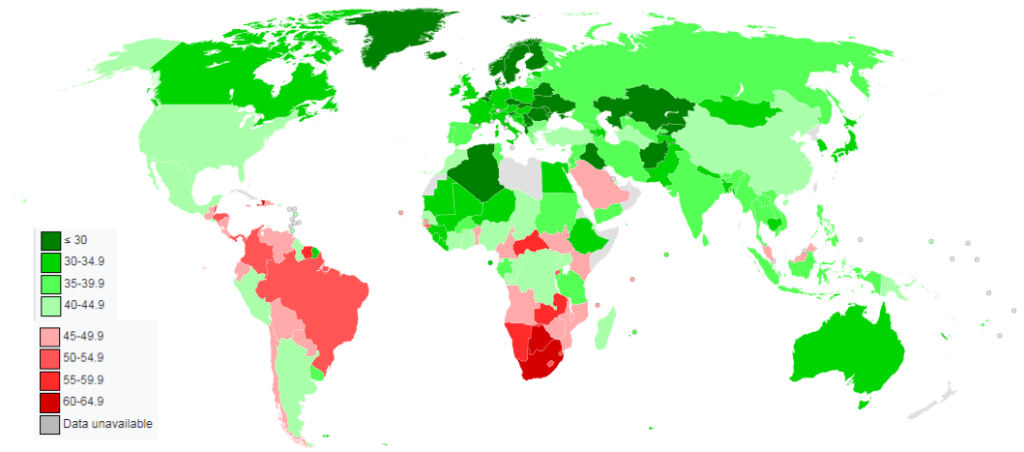
Casting an eye over a list of countries ordered by their degree of income inequality, one trend leaps out: unequal countries tend to be shitholes, and egalitarian countries tend to be decent.

Among the most unequal countries are places like Brazil, Mexico and the majority of African countries. Among the most equal countries are the European ones, Canada, Australia, Japan and South Korea. The pattern is obvious: a strong correlation exists between economic equality and overall quality of life.

The reasons for this can be understood if we compare the motivations of individuals in equal societies to individuals in unequal ones. The simple rule is that once inequality gets to the point where you no longer have a stake in society, then you no longer have a stake in society. This has behavioural consequences.

In an equal society, the members closer to the bottom of it still have enough of a stake to feel engaged. They are not so far from the decision-making level that their desires are ignored. Having a meaningful chunk of power, they are incentivised to work towards society’s betterment (or at least its upkeep).

In equal societies, all members feel a sense of ownership. A sense of pride at the quality of life offered by the society follows naturally. With ownership and pride, a person will take action to uphold that society. This is why people in countries like Sweden, Canada and Australia tend to perform prosocial behaviours like putting their shopping trolleys away and disposing of their litter in bins.

In an unequal society, the members closer to the bottom are without influence. Decisions are made so far above their heads that they aren’t consulted. As such, the people at the bottom are not incentivised towards prosocial behaviour. They perform antisocial behaviours, like aggressive panhandling, theft, robbery, sex crimes and murder.

In a society like this, not everyone feels a sense of ownership. Those who don’t tend to not contribute to society’s upkeep. In exactly the same way that rented cars and houses are treated much worse than personally owned cars and houses, a society in which people can only rent a stake (at best) will be treated much worse than a society in which people can own one.

The inevitable result of increasing inequality is a decline in prosocial behaviour and an increase in antisocial behaviour. You might as well throw that Coke can in the gutter, because it isn’t you that will have to pay to clean it up. In fact, the more damage you can do to society the better, because it will take the bastards who locked you out down a peg or two.

New Zealand might be in the middle of the inequality pack, but it’s still practically impossible to own a home here without inheritance. The average wage today has less than 40% of the housebuying power that it had 26 years ago. Our society is now so unequal that what used to be the elementary sign of having a stake in it – owning a home – is practically a dream unless you’re born rich.

This inequality has all but destroyed our society. It’s easy to see why if one imagines how it has affected people’s motivations.

As a non-landowner who will never own land while the average wage cannot buy the average house, I don’t care what happens to society. I have no stake in it and will never have one as long as the prevailing economic circumstances continue. New Zealand is someone else’s property, and as such I don’t feel motivated to defend it or to do any work to maintain it.

It’s said that if too many people drop out of society, then our economy would collapse, leading to New Zealand becoming ungovernable, perhaps even to civil war. I say: “Good!” If civil war means that I can afford a house in five years, then bring on civil war!

Many people will be appalled to hear such reasoning. But such reasoning is inescapable once a person has no stake in society. If the order of society as being maintained at my expense, then bring on the chaos! It’s irrational to reason otherwise unless one is content to be the slave of the rich, effectively a serf whose labour will never allow them to own land.

Given this psychological calculus, it’s apparent that increasing inequality will inevitably lead to society collapsing as fewer and fewer people feel like they have an interest in keeping it going. Prosocial behaviour will decline, and antisocial behaviour will rise, to the point where the fabric of society no longer exists, and we are back in Hobbes’s state of all against all.

Eventually, inequality will get so bad that intelligent people born poor will realise from early childhood that they never had a chance. These people will be hardened revoutionaries by the time they become adults, and will know nothing other than hate. They will be exceptionally dangerous and capable of ushering in a new order of the world.

*

If you enjoyed reading this essay, you can get a compilation of the Best VJMP Essays and Articles of 2019 from Amazon for Kindle or Amazon for CreateSpace (for international readers), or TradeMe (for Kiwis). A compilation of the Best VJMP Essays and Articles of 2018 and the Best VJMP Essays and Articles of 2017 are also available.

*

If you would like to support our work in other ways, please consider subscribing to our SubscribeStar fund. Even better, buy any one of our books!

National Cannot Win While They Oppose Cannabis Law Reform

The latest Reid Research poll was a disaster for the National Party. They hit their lowest polling numbers since the 2017 General Election, a dismal 25.1 percent. This result raised fears of an electoral humiliation like 2002. In order to avoid this, National will have to convince the electorate that they have learned the lessons of the past.

The Labour Party scored over 60% in the Reid Research poll, an incredible result less than two months out from a General Election. Unless there are major changes in sentiment between now and then, a second term for the Sixth Labour Government is all but assured. The same poll also suggested that Jacinda Ardern is seen as a much more competent leader than Judith Collins.

The reason why Labour and Ardern are doing so well is primarily because of their leadership during the COVID-19 pandemic. It might sound simple, but when faced with a medical crisis, Ardern’s Labour listened to the scientists. The spread of an infectious virus is too complicated a subject to be understood by someone with a public relations degree, so they listened to people with medical degrees.

It does sound simple, but it’s not always that case that politicians follow the advice of relevant experts. Often they put political considerations ahead of reality.

It’s impossible to know whether a Judith Collins-led National Party would have listened to the scientists on the matter of COVID-19. What we do know is that she is currently completely ignoring the scientists on the matter of cannabis law reform. This attitude does not inspire confidence.

The scientists have been saying, for many years now, that the medicinal properties of cannabis are sufficiently well understood to know that the plant is not dangerous if used correctly. Even when used irresponsibly, it’s not worth locking people in cages over. The danger comes from prohibition, which creates a black market with no quality control.

The National Party has resolutely ignored these experts, opting instead for the politics of hate that served the Fourth and Fifth National Governments so well. National has always known that a large proportion of crusty old Boomers hate cannabis users and are happy to see the law destroy them. It is to them that Collins is signalling when she supports prohibition.

The problem for National is that many of those people are now dead.

It’s not the 1990s anymore. Opposing cannabis law reform has always been wrong, but in the 1990s it looked prudent. Back then, there was so little available science that it made some sense to err on the side of caution. Cannabis was always medicinal, but in the absence of a body of empirical evidence precisely detailing its effects, it seemed wise not to open the floodgates.

By 2020, opposing cannabis law reform seems pointlessly antagonistic and vindictive. Today there’s ample evidence that, not only is cannabis not really harmful, it’s a beneficial medicine to a great many people. It’s clear now that cannabis prohibition achieved nothing but cause misery to the many people who needed it to alleviate suffering.

If the National Party would change their approach on cannabis, from a “punishment and pain” model to one that put business interests first, they could win back a lot of the centrist voters that they have lost since the previous election. Abandoning their commitment to cannabis prohibition would signal that National is letting go of old prejudices and is ready to move forwards.

Already, some 67% of Americans want legal cannabis, and more Australians want it than don’t want it. Cannabis law reform in New Zealand is inevitable – National will not win another General Election while they oppose it. If they were smart, they’d steal a bunch of centrist voters off Labour by coming out in support of it today.

*

Vince McLeod is the author of The Case For Cannabis Law Reform, the comprehensive collection of arguments for ending cannabis prohibition.

*

If you enjoyed reading this essay, you can get a compilation of the Best VJMP Essays and Articles of 2019 from Amazon for Kindle or Amazon for CreateSpace (for international readers), or TradeMe (for Kiwis). A compilation of the Best VJMP Essays and Articles of 2018 and the Best VJMP Essays and Articles of 2017 are also available.

*

If you would like to support our work in other ways, please consider subscribing to our SubscribeStar fund. Even better, buy any one of our books!

Debunking The “Structural Racism” Conspiracy Theory

The most prevalent conspiracy theory of our time is so prevalent that it’s accepted as truth by most media entities. This theory has it that black and brown academic and economic underachievement can best be explained by structural racism and white supremacy. The truth is that, like most conspiracy theories, this theory goes directly against the relevant science, and can be disproven by it.

When 9/11 happened, a popular conspiracy theory said it was an inside job. One particular version claimed that, as the melting point of steel is higher than the burning point of jet fuel, the twin towers could not have collapsed on account of being struck by aeroplanes (the official explanation). They had to have been taken down by explosives placed within the structure of the buildings.

The way to refute this theory was to ask people qualified in the relevant science. You could say to a civil engineer or a physicist “Jet fuel can’t melt steel beams,” and they would tell you that it doesn’t have to melt the beams, it just has to heat them up enough so that they become too soft to support the weight of the building, at which point it will collapse. This is what happened in the case of the twin towers. Conspiracy theory debunked.

Anyone wanting to test other conspiracy theories can do likewise. If you want to know whether the Earth is flat you could ask an astronomer. If you wanted to know whether the Earth was 6,000 years old you could ask a geologist. If you wanted to know whether humans landed on the Moon you could ask an aeronautical engineer. And if you wanted to test whether the structural racism conspiracy theory was bullshit, you could ask a psychologist.

This is what a psychologist would tell you.

The science of IQ is the most robust and heavily supported of any social science. There is more evidence backing the validity of it than there is backing anything else. Most importantly, IQ also has more predictive power than any single other variable known to Psychology.

If you disagree about its predictive power, consider the following analogy.

You have two 13-year old boys. One is tested to have an IQ of 115, i.e. one standard deviation above average. The other is tested to have an IQ of 85, one standard deviation below average. The two boys are followed up ten years after the test. Without knowing which boy is which, you’re told that one has recently completed an accounting degree, whereas the other dropped out of school and drifted into petty crime.

Can you guess which is which?

Almost everyone would guess that the boy with an IQ of 115 became the accountant. And, in the vast majority of such cases, they’d be right. Accountancy is intellectually challenging: far more accountants have IQs closer to 115 than to 85. Likewise, far more petty criminals have IQs closer to 85 than to 115. Almost everyone knows this, and almost no-one questions it.

The fact is that IQ is so powerfully predictive that we can already get a rough idea of how a person’s life will turn out just from accurately measuring their IQ. The average person with an IQ of 85 will have much greater trouble learning and recalling information than the average person with an IQ of 100. Their impulse control, measured by ability to delay gratification, will be significantly inferior.

Because their intellectual ability and their discipline are poorer than than of the average person, they will be less able to meet the demands of the modern workplace. As such, they will be marginalised into unemployment and underemployment more often. Any population of people with an average IQ of 85 will be much poorer and much more criminal than any population with an IQ of 100 or higher.

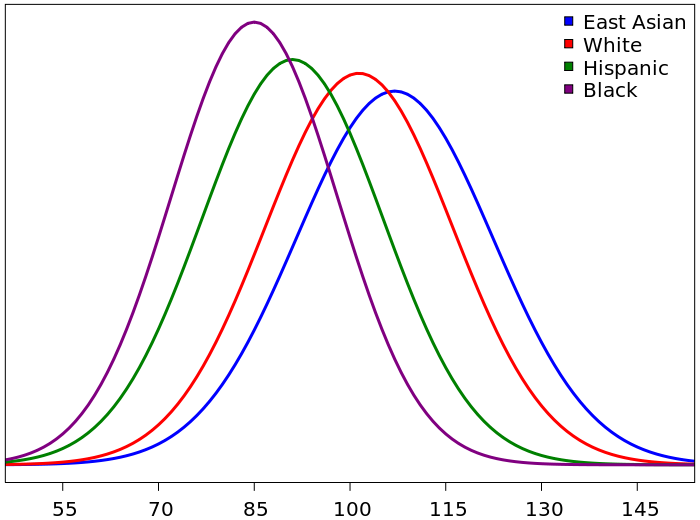
85 is also the average IQ of black Americans and Pacific Islanders, with Maoris being slightly higher (around 90). This we know from the research compiled by researchers like Richard Lynn in books like Race Differences in Intelligence.

Psychological science, therefore, can predict on the basis of IQ alone that black Americans and brown Kiwis will be poorer and will be more involved in the criminal justice system than white Americans and white Kiwis. This can be confidently predicted even in the total absence of structural racism or white supremacy.

At this point, a believer in the structural racism conspiracy theory will argue that structural racism not only makes blacks and browns poorer and more likely to be involved with the criminal justice system, but it also makes their IQs lower on account of things like teachers ignoring them more often during class or discouraging them from study. Therefore, even if they do have lower IQs, it’s still white people’s fault.

For one thing, we know that this contention can’t be true because intelligence is mostly genetic and not environmental. Although the environment can have a powerful effect on the intelligence of young people, the effect of environment on IQ is no more than 0.2 by adulthood – a phenomenon known as the Wilson Effect. Therefore, low adult IQ is primarily a genetic phenomenon.

For another thing, we can observe the experience and outcomes of other racial groups who have similar IQs to white people.

105 is the average IQ of Far East Asians. The structural racism conspiracy theory would predict that Far East Asians do worse than white people, on account of that white people deny them opportunities for advancement and discriminate against them in business and politics. After all, white supremacists don’t like Asians any more than they like blacks.

The psychological science theory would predict that Far East Asians do as well or better than white people, on account of that their high IQs lead to successful careers and less criminality. Being high IQ and having good impulse control, they should study hard and get decent jobs.

As it turns out, Asian Americans earn 7% more than whites at the median. They are also significantly less criminal, despite that more of them are from poor families and many are even refugees. This directly refutes the structural racism conspiracy theory and directly supports the psychological science theory.

Ultimately, the main reason why blacks do worse than whites in America, and the main reason why browns do worse than whites in New Zealand, is because of low IQ. This low IQ leads them to make more impulsive decisions, which leads to poverty. This isn’t at all controversial among those who have studied the relevant science.

The conspiracy theory that says blacks and browns do worse because of white racism is bullshit. This means that the poorer outcomes of blacks and browns cannot be explained by white racism, but by factors inherent to the blacks and browns themselves.

*

If you enjoyed reading this essay, you can get a compilation of the Best VJMP Essays and Articles of 2019 from Amazon for Kindle or Amazon for CreateSpace (for international readers), or TradeMe (for Kiwis). A compilation of the Best VJMP Essays and Articles of 2018 and the Best VJMP Essays and Articles of 2017 are also available.

*

If you would like to support our work in other ways, please consider subscribing to our SubscribeStar fund. Even better, buy any one of our books!

Who Are The New Zealand Public Party?

The New Zealand counterculture has been surprised recently by the sudden rise of Billy Te Kahika and his New Zealand Public Party. His appearances on the Vinny Eastwood Show have brought his name to everyone’s awareness, but who is Billy TK and what is his party about? This article explains.

Most of the details about the party can be found at their website. This offers a fairly comprehensive overview of NZPP policy.

The NZPP is transparently a protest movement. The ‘About Us’ section of their website states “The New Zealand Public Party was formed by Billy Te Kahika in response to the blatant injustice and tyranny being hurled upon the New Zealand people by the Labour/NZ First/Green government.” Their main intention appears to be to change the system.

Billy TK himself is a mysterious man. Rumours swirl that he was an SAS soldier, a 33rd-degree Freemason, a former United Nations lackey and even an NZSIS operative who is acting to mislead anti-Establishment voters. His rise has been swift, and out of the blue – there is no indication that he has previously been a member of any other party.

Te Kahika has recognised the difficulty of surmounting the 5% threshold, and to that end has made an effort to unite the smaller parties. The NZPP has already absorbed the Reset New Zealand Party, who had many of the same aspirations regarding a national Bill of Rights. He has also approached the New Zealand Outdoors Party, the Aotearoa Legalise Cannabis Party and the Social Credit Party with offers to unite.

The bulk of NZPP philosophy can be found on the ‘What We Stand For‘ page of their website.

Their commitment to “Rebuild New Zealand Back Into A Democracy” promises to write a new New Zealand constitution, one for the people. This process will involve writing a “real Bill of Rights”. This Bill of Rights would underpin all other laws, so that other laws would have to accord with it. This would be very different to today’s system, where any supposedly guaranteed human rights can be abrogated whenever the government feels like it.

It seems from this, and from the disinclination to appear in the mainstream media, that the NZPP is a people’s movement and not another Establishment vehicle. Other minor parties have blatant agendas: the Maori Party wants to stir up racial tensions; the New Conservatives want a theocracy where everyone is forced to worship Jesus. The NZPP has no obvious agenda.

The NZPP would enshrine in law the superior importance of human rights over corporate profits. This would mark a radical departure from today’s model, where the people are effectively serfs who exist solely to meet the labour needs of the projects dreamed up by the ruling classes. No doubt such a proposal will be met with horror by New Zealand’s wealthy, for who human rights are impediments to profitability.

Housing is another major priority for the NZPP. They have identified the poor standard of New Zealand housing as one of the primary contributors to the suffering of the New Zealand people, stating that “healthcare begins at home”. This, when coupled with the human rights drive, would seem to pigeonhole the NZPP as an alt-left party.

This would be inaccurate, though, as they also have conservative policies, such as their stance on abortion. They think that the law recently passed by the Sixth Labour Government (which allows abortion up to birth) is extreme. Here they emphasise that people have the right to prevent unwanted conception, but also that they “cannot grant the killing of a person as a method of birth control”.

Christianity perhaps also influences Billy TK’s stance on legal cannabis, which he thinks New Zealand is “not quite ready for.” Despite this reluctance, he was more than happy to relate an anecdote to Vinny Eastwood about a family member benefitting from the use of it, and was more than happy to admit smoking it himself when younger. He may be lukewarm on legal cannabis, but is no Bible-thumping New Conservative.

It might also influence their most obviously alt-centrist policy, which is opposition to usury. Billy Te Kahika is strongly against usury, which means that he will be despised by the Establishment. However, in opposing usury he has the potential to win the support of large number of Kiwis, in particular the more conspiracy minded.

The NZPP approach seems like it is to cast a wide net, with the intention of bringing a large number of people together for the sake of forcing change on the Establishment.

What the NZPP offers is a centrist and anti-Establishment platform. This means that they avoid the major weaknesses of the previous anti-Establishment movements, who have shown themselves to be either too left-wing for the public (The Opportunities Party, the Aotearoa Legalise Cannabis Party, Social Credit) or too right-wing for the public (New Conservatives, ACT to a lesser extent).

Predictably perhaps, Billy TK has already generated a few enemies. These are mostly members or supporters of other parties who feel that the NZPP is acting to split the anti-Sixth Labour Government vote.

The NZPP’s most aggressive enemies are the New Conservatives, who, until now, had a lock on the anti-United Nations and anti-abortion voters. It’s likely that the NZPP steals many of these voters from the New Conservatives, on account of that Te Kahika is clearly more intelligent than either Leighton Baker or Elliot Ikilei. The NZPP also doesn’t have any awful policies, like New Conservatives’ proposal to increase penalties for cannabis use.

As of right now, it’s hard to say how well the NZPP would do in the election. They are striking all the right chords among New Zealand’s alternative thinkers, but it’s not certain that they will be able to register in time to contest the vote. Nominations for the election close on 21 August, about six weeks away. If Billy TK and the NZPP are to contest it, they will need to build momentum fast.

*

If you enjoyed reading this essay, you can get a compilation of the Best VJMP Essays and Articles of 2019 from Amazon for Kindle or Amazon for CreateSpace (for international readers), or TradeMe (for Kiwis). A compilation of the Best VJMP Essays and Articles of 2018 and the Best VJMP Essays and Articles of 2017 are also available.

*

If you would like to support our work in other ways, please consider subscribing to our SubscribeStar fund. Even better, buy any one of our books!