Part II is titled ‘The Solution of the Economic Problem: Socialism’. This is divided into seven chapters.
In the first, ‘The Economic Basis Of The Third Universal Theory’, Gaddafi calls for the abolition of the wage system. He states that “Wage-earners are but slaves to the masters who hire them.” The producer has a right to that which they produce – a secondary benefit through the improvement of society or through wages is inadequate. Inequality cannot be tolerated as it leads to exploitation.
Gaddafi repeats Adam Smith’s rule that economic production is the result of raw materials, capital input and human labour. He claims that all three of these components are necessary to produce anything, and therefore all three should get an equal share. Gaddafi also notes that the working class is declining owing to scientific and technological advancement. People are, however, the basic component in any production process.
In the second, ‘Need’, Gaddafi notes that a person cannot be free if their needs are controlled by others. Need leads to the enslavement and exploitation of those who need. Conflict is caused by one group controlling the needs of a second, giving that second an incentive to rebel. Need is a problem inherent to life.
In the third, ‘Housing’, Gaddafi opens with “Housing is an essential need for both the individual and the family and should not be owned by others”. A person cannot be free while living in a home owned by someone else, whether or not they’re paying rent. Fiddling with rents won’t help – the important thing is ownership. People won’t have the right to own multiple houses, because to do so is to control the needs of others, which is exploitation and cannot be permitted.
In the fourth, ‘Income’, Gaddafi declares that income is an imperative need. In a socialist system, there are no wage-earners, only partners in the production process. Income should not be a wage in exchange for having one’s production taken away.
In the fifth, ‘Means Of Transportation’, Gaddafi declares that transportation is also a necessity. Therefore, it’s subject to the same restrictions from being controlled as housing and income. Like housing, transportation may not be owned for the sake of renting it out.
In the sixth, ‘Land’, Gaddafi begins by stating that “Land is the private property of none.” He believes that the land ought to belong to whoever works it. Gaddafi’s aspiration is to create a society that is happy because it is free. This comes about via the liberation of people’s material and spiritual needs from the control of others.
Gaddafi is aware that wage-earners have little incentive to work. Neither do poeple who work for the common good. The self-employed, however, have plenty of incentive to do so. Gaddafi sees the economy as a zero-sum game, because, for him, there is no reason to produce beyond one’s needs. The industrious and skillful have no right to lever this advantage to take from the shares of others.
An especially diligent or intelligent person may meet their needs with less effort, but they may not acquire more than they need. Happiness is a matter of material and spiritual freedom. Profit itself must be eliminated, as it inevitably will be as the socialist process continues to evolve.
In the seventh, ‘Domestic Servants’, Gaddafi states that domestic servants are a type of slave. The Third Universal Theory offers freedom to both wage-earners and domestic servants. Household services should be carried out by employees, not by domestic servants. He concedes that it isn’t easy to assign a share of production to service workers.
Kiwis were disappointed last month to hear that the Sixth Labour Government is taking away our rights to free speech. Any speech that the Government hates will now be “hate speech” and subject to criminal sanction. As is the case in Scotland, an immigrant Justice Minister, from a culture that doesn’t value free speech, has stripped those rights away from a population that has cherished them for centuries. But, as this essay will show, free speech is just one of the many rights we’ve lost thanks to mass immigration.
Free speech is the fundamental value of Western civilisation. Without it, society cannot self-correct. So without free speech, small problems snowball into catastrophes. Legal recognition of the importance of free speech is one of the main reasons why Western countries are so stable in comparison to others.
But the value of freedom is generally only understood by Westerners.
The reason why men like Kris Faafoi and Scotland’s Humza Yousaf can so glibly annihilate one of the most important aspects of Western culture is that they weren’t raised to respect it. Their cultures do not have a history of struggling to assert freedom at all, and so they were not raised to value free speech. It was inevitable that making these men Justice Ministers would lead to a loss of those freedoms.
Import the Third World, become the Third World – and the Third World does not have a culture of free speech. If the Justice Minister of New Zealand had been a proper Kiwi, raised in Kiwi culture to appreciate the Greco-Roman-Anglo heritage that made New Zealand worth living in, we would still have our rights to free speech today. But that’s only the beginning.
Our right to use cannabis was also lost because of immigration.
In the 2020 cannabis referendum, the No side of the vote got 1,474,635 votes, and the Yes side got 1,406,973. This equals a difference of 67,662 votes. This narrow margin was enough for the Sixth Labour Government to declare that Kiwis wanted to keep locking themselves up for growing medicinal plants. But that margin would have been in favour of Yes if it wasn’t for immigrant voters.
An article in the South China Morning Post referenced a survey that found 80% of ethnic Chinese voters intended to vote No in the cannabis referendum. Some simple maths is enough to show that these Chinese voters alone tipped the overall outcome from a Yes to a No.
There are some 231,000 ethnic Chinese people in New Zealand. If we assume that 80% of them are eligible to vote, and that 80% of those actually did vote, that suggests some 147,840 ethnic Chinese voters voted in the cannabis referendum. If 80% of those voted No, that means 118,272 ethnic Chinese voted No and 29,568 ethnic Chinese voted Yes, for a balance of 88,704 more No voters than Yes voters.
The maths tells us that non-Chinese Kiwis voted Yes in the cannabis referendum, by a margin of some 21,000 votes. But these votes were cancelled out, and more, by the heavy Chinese opposition to cognitive liberty. And the Chinese weren’t the only immigrant group to vote to imprison cannabis-using Kiwis.
Pacific Islanders also voted against cannabis freedom, mostly out of religious sentiments.
The three electorates with the most Pacific Islanders in 2020 were Mangere at 59%, Panmure-Otahuhu at 46% and Manurewa at 39%. These were also among the electorates with the lowest Yes vote in the cannabis referendum: Mangere 38.7%, Panmure-Otahuhu 41% and Manurewa 39.5%. Many of the Pacific Islanders who voted against cannabis freedom were mindlessly following the orders of their pastors.
Religion also inspired Muslim immigrants to vote our rights away. The New Zealand Muslim Association came out in favour of Kiwis getting locked in cages for using cannabis, and the Federation of Islamic Associations of NZ proudly allowed their logo to be displayed on the Say Nope to Dope supporters page. For them, tolerance and respect is an entirely one-way street: Kiwis are obliged to tolerate and respect Islam, but Islam is in no way obliged to tolerate and respect cannabis-using Kiwis.
If the cannabis referendum had been left up to white people and Maoris, it would have passed with around 60% in favour. But the mass importation of cheap labour from backwards cultures ultimately tilted the balance in favour of a No vote.
Our rights to use other spiritual sacraments are likewise gone. As a recent article in the Australian and New Zealand Journal of Psychiatry noted, there is now ample evidence that sacraments such as psilocybin have immense therapeutic potential, “However, Australia and New Zealand are currently failing to acknowledge such evidence and, as a result, are falling behind in this crucial time of biomedical research and innovation.”
As noted in the article, the refusal to acknowledge the evidence for psychedelic therapy is political. Sadly, because conservative Third World immigrants now make up a significant proportion of our voters, we can kiss all research into psychedelic therapy goodbye. The Islanders don’t want it because of Jesus, the Muslims don’t want it because of Allah and the Asians don’t want it because drugs are bad.
Immigration also cost us our rights to free assembly, as was observed when Lauren Southern and Stefan Molyneux tried speaking about the consequences of mass immigration in Auckland.
Even though the NZ Bill of Rights Act explicitly states that Kiwis have both the rights to receive information and to free assembly, we were banned from assembling to listen to the Canadian duo at Auckland Council venues because Phil Goff, the Auckland mayor, was afraid of losing support from Muslim voters. Thanks to the mass immigration of conservative cheap labour, we’re no longer free to gather to discuss certain topics in public.
Most of our firearms rights were stripped from us after an Australian immigrant shot up a mosque full of Muslim immigrants on March 15, 2019. Even though no Kiwis were involved until Brenton Tarrant was arrested, the incident was used as an excuse to confiscate semi-automatic rifles all across the country.
Had we not opened the borders to the same cult of hate responsible for the Rotherham rape gangs and for the Drottninggatan truck attack, and had we not sat impotently while the Al Noor Mosque produced multiple terrorists, we would never had suffered such an atrocity on our shores. But, as many other Western nations had already learned, mass immigration from violent, supremacist cultures inevitably leads to violence.
The worst loss of freedom from mass immigration, however, was the loss of our right to own a home and raise a family.
In 1992, the average New Zealand house cost around $105,000, and the average wage was close to $15, which meant that a person had to save about 7,000 hours of labour at the average wage to own the average house. After three decades of mass immigration, the average house now costs $820,000, while the average wage has only risen to $35. This means a person now has to save over 23,000 hours of labour at the average wage to own the average house.
Mass immigration means more people competing to bid up the price of housing, as well as more people competing to bid down the price of wages. Anyone with a high school economics education could have told you that mass immigration would lead to higher house prices and lower wages. The combined effect of these two phenomena is that it’s now impossible for the average Kiwi worker to buy a house and to support a family with their own wage.
The loss of the freedom to buy a home and to support a family with one’s wage is the worst loss of all, because it effectively makes us the slaves of the bankers who hold our mortgages, and of the employers whose $20/hour we need to pay those mortgages off. Yet this loss is the inevitable consequence of mass immigration, the last thirty years of which has reduced us to this wretched condition.
We were told that mass immigration wouldn’t cause the loss of any freedoms because the immigrants would become like us – appreciative of the freedoms of Western culture and willing to defend them. However, we were lied to. The immigrants we let in never had any intention of respecting our culture and our values. In reality, we lost everything. We lost all our rights, all our freedoms, we lost our entire culture.
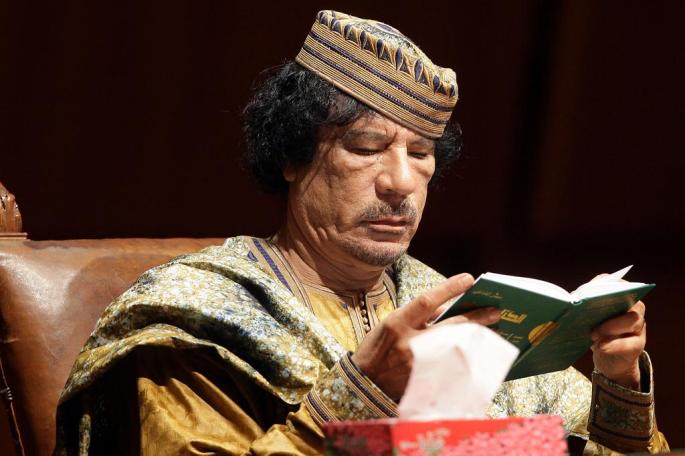
Muammar Gaddafi’s The Green Book was published in 1975, and was intended to be read by everyone. Gaddafi was murdered in 2011 for opposing the same people that Abraham Lincoln and John F Kennedy opposed, i.e. globohomo. This book is therefore of immediate interest to anyone else who opposes globohomo.
Part I is titled ‘The Solution of the Problem of Democracy: The Authority of the People’. This is divided into ten chapters.
In the first, ‘The Instrument of Government’, Gaddafi points out the inherently tyrannical nature of electoral democracy as practiced in the West today. Up to 49% of the population can have a government that they did not vote for imposed on them. He writes that “dictatorship is established under the cover of false democracy.”
In the second, ‘Parliaments’, Gaddafi decries the parliamentary system as a “misrepresentation” of the people. Democracy must mean the authority of the people, and not an authority that presumes to act on behalf of the people. As soon as the election is over, the representative assumes sovereignty from the people. The people have the right to destroy the parliamentary assemblies that have taken their sovereignty away.
“The most tyrannical dictatorships the world has known have existed under the aegis of parliaments.”
In the third, ‘The Party’, Gaddafi decries the modern political party as “the dictatorship of the modern age”. He states that “A party’s aim is to achieve power under the pretext of carrying out its program.” Any party not in power will seek to harm the nation so as to undermine their opposition. Moreover, a country governed by one party is not meaningfully different to countries governed by one sect or by one tribe.
In the fourth, ‘Class’, Gaddafi argues that leadership based on class suffers the same problems as leadership based on party, tribe or sect: it can only ever represent a minority. Even if the working class replaced the others, differences in material wealth or prestige between working-class factions would soon lead to the old class system reasserting itself. As before, so after.
In the fifth, ‘Plebiscites’, Gaddafi observes that the people’s expression is limited to ‘Yes’ or ‘No’. Referendums are often used to cover up for the failures of democracy. The solution lies, he writes, in finding an instrument of government that is not subject to either internal conflict or underrepresentation of the people it governs. This instrument can only be the authority of the people.
In the sixth, ‘Popular Conferences And People’s Committees’, Gaddafi declares that direct democracy is indisputably the ideal form of government. It’s just impractical. Gaddafi’s Third Universal Theory divides the population into Basic Popular Conferences, each of which chooses a secretariat from among their number. The population then appoints People’s Committees to replace government administration.
In the seventh, ‘The Law of Society’, Gaddafi contends that the natural law of any society must be based in either tradition or religion. Constitutions are artificial, thus invalid. He argues that human beings are essentially the same everywhere, and therefore natural law is applicable to all. Ruling systems must follow natural law, and not the reverse. So all laws must be grounded in tradition or religion.
In the eighth, ‘Who Supervises The Conduct Of Society’, Gaddafi appeals again to his Basic Popular Conference model. No one group can claim the right to police society, therefore society has to police itself. If the people organise themselves into Popular Conferences, however, they can supervise themselves.
In the ninth, ‘How Can Society Redirect Its Course When Deviations From Its Laws Occur’, Gaddafi notes that if a system is dictatorial, resistance to it must take the form of violence. Because the use of Basic Popular Conferences and People’s Committees means that the system is not dictatorial, it can be reformed without violence. Because the system encompasses all, there are no outsiders to direct violence against.
“Violence and revolution are carried out by those who have the capability and courage to take the initiative and proclaim the will of society.”
In the tenth chapter, ‘The Press’, Gaddafi states his belief that the press is primarily a means for society to express itself, and therefore does not belong to individuals or corporate interests. He points out that media sources can only ever speak for their owners and not for society. As such, private publishing or information enterprises must be banned. Only People’s Committees are permitted to act as the media.
Gaddafi finishes this first part of the book by noting that the strongest party in the society is always the one that rules.
The greatest controversy in psychological science today – perhaps in all science – is that regarding the heritability of intelligence. Although the science itself is reasonably clear, the topic is so heavily politicised that certain positions have become entrenched.
The anti-hereditarian side can be dubbed the Jewish Position. This is for two reasons. One – the foremost supporters of the position are all Jews, and two – almost all Jews adhere to this position. Both of these assertions become clear if one examines the history of the debate around the heredity of intelligence.
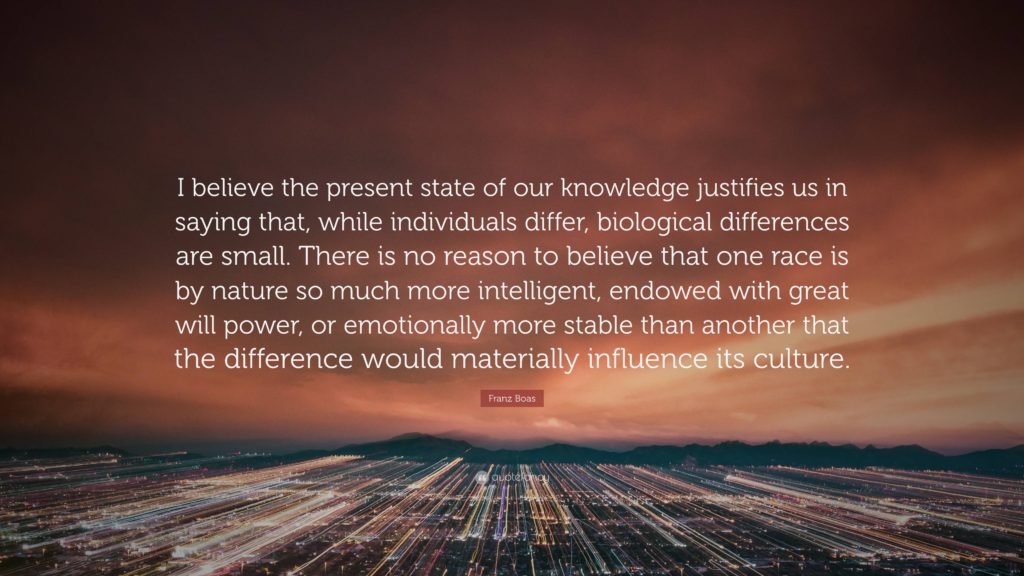
Franz Boas was the earliest major opponent of the hereditarian position. Born in Germany to Jewish parents, Wikipedia says of him that “Boas’s main project was to distinguish between biological and cultural heredity, and to focus on the cultural processes that he believed had the greatest influence over social life”.
This belief – that cultural influences have the greater influence on human behaviour and biological ones the lesser, or none at all – is the Jewish Position in a nutshell.
Boas introduced the concept of cultural relativism to the psychological sciences. Before him, it was assumed that the more civilised a culture was, the superior. After him, it was claimed that no-one could say that any culture was superior to any other. This attitude, which is essentially that of slave morality, is political and not scientific in nature. It’s the attitude of someone who promotes tolerance for the sake of tolerance and not for the sake of alleviating suffering.
When Boas’s supposed finding that American and European whites have significantly different skull sizes was proven to have been made up, Jewish professor Jonathan Marks defended his co-ethnic, claiming that those who had debunked Boas had themselves “been quickly rebutted by more mainstream biological anthropology.”
According to Marks’s Wikipedia page, he is “skeptical of genetic explanations of human behavior” and “of ‘race’ as a biological category.” These two attitudes are core components of the Jewish Position, the intent of which is to encourage out-group favouritism and to discourage in-group favouritism. As such, it strenuously denies any scientific evidence that suggests an out-group might be genetically inclined to behave violently or criminally.
Marks once wrote, citing fellow Jew Richard Lewontin (see below) that “…the point of the theory of race was to discover large clusters of people that are principally homogeneous within and heterogeneous between, contrasting groups. Lewontin’s analysis shows that such groups do not exist in the human species…” The Jewish Position denies that race is an valid concept.
Boas heavily influenced co-ethnic Elliot Aronson, born in 1932. Aronson’s ‘Nobody Left to Hate‘ continued the established Jewish trope that exclusion is to blame for pathological behaviour. The book suggested that the reason for the Columbine High School shooting may have been that Klebold and Harris had been excluded by the other students, and therefore the solution to violence is to reduce out-group antipathy.
Central to the Jewish Position is the idea that all exclusion on the basis of genetic or biological grounds is inherently immoral. Further, any in-group preference exercised on genetic or biological grounds is immoral. Proponents of the Jewish Position draw a connection between border control and concentration camps. For them, all lines between folk groups – whether lines of inclusion or exclusion – are evil.
Also born in the 1930s was Richard Lewontin. Lewontin pushed the Jewish Position so hard, a fallacy was named after him. A stubborn opponent of genetic determinism, Lewontin’s approach was typical of the Marxist that he proudly claimed to be. As is often the case with both Jews and Marxists, he opposed genetic determinism in part because it downplays the value of social activism.
Lewontin was one of the harshest critics of Edward O. Wilson’s landmark work Sociobiology. As is typical of those pushing the Jewish Position, his criticism of the work equated genetic determinism with fascism. He went on to co-write, with two other Jewish authors, a book called ‘Not In Our Genes‘, a groundbreaking work of biology denial.
One of the co-authors, Steven Rose, was from Britain, whereas the other two were from America. This reveals the degree to which the Jewish Position is supranational: Jews everywhere believe it, no matter which country they’re living in. In Australia, South Africa, Brazil, just as in America and Europe – everywhere there are Jews, the Jewish Position is asserted.
Lewontin collaborated closely with Stephen Jay Gould, another co-ethnic who prominently supported the Jewish Position. Gould had no shame about equating genetic determinism with Nazism, going as far as to blame people who believe in IQ science for the Holocaust. Gould took issue with anyone who believed in border control at all, also equating this to Nazism.
Gould was criticised for his 1981 propaganda masterpiece, The Mismeasure of Man, in which he smeared intelligence researchers as racists. It has been observed that “Gould’s Marxist political beliefs made him attack intelligence research because he saw it as a threat to his egalitarian social goals.” Ironically, Gould was aware that a person’s social goals affected what that person considered to be accurate science. He just didn’t apply this criticism to himself.
Robert Wright wrote in a letter to the New York Review of Books that “many evolutionary biologists consider Gould’s writings a serious impediment to popular understanding of Darwinian thought.” This is of true of everyone who takes the Jewish Position, which in its essence prioritises political expedience over truth and knowledge. It is a form of science denial, in particular biology denial.
The most prominent Jewish anti-hereditarian in popular culture today is Jared Diamond. Diamond’s most famous work, Guns, Germs and Steel, sought to show that the European dominace of recent centuries was a geographical fluke and not due to any inherent genetic superiority. According to Diamond, if Africans had had more plants suitable for domestication and a more pronounced East-West axis, they would have dominated the world instead.
In Guns, Germs and Steel, Diamond describes as “loathsome” the use of biological differences to explain economic outcomes. Yet, as a critique of Diamond’s points out, Diamond’s environmental determinism cannot account for why natural resource-poor Japan is wealthy, or why natural resource-wealthy Nigeria is poor. A biological determinist, aware that the most valuable human capital is the IQ of the people, can easily account for both.
The most prominent Jewish anti-hereditarian in academia today is Robert Sternberg. Sternberg is foremost in pushing nonsense like stereotype threat, the laughable idea that the low academic performance of blacks is because they’ve internalised white supremacist ideas about blacks being dumb.
Stereotype threat has been cited by Jewish researchers such as Joshua Aronson (the son of Elliot menioned above) as the reason for black academic underachievement. The reality is that, like all the other excuses made by people holding the Jewish Position, stereotype threat is a political concept and not a scientific one.
The political conclusion that Sternberg is desperately trying to avoid is that schools ought to be resegregated. To that end, he promotes the narrative that white people are to blame for black underachievement. Sternberg and his stereotype threat narrative claim that blacks only underachieve because white people expect them to, and thus black underachievement is due to white moral failure.
In summary, the Jewish Position is biology denial applied to the subject of human behaviour.
It’s fair to call it the Jewish Position because almost all of the people promoting it are Jews (as mentioned above) and because almost all of the people opposing it (Francis Galton, Ronald Fisher, Charles Darwin, Richard Dawkins, James Watson, Hans Eysenck, Arthur Jensen, Phillipe Rushton, Richard Lynn, Charles Murray, Satoshi Kanazawa, Linda Gottfredson et al.) are non-Jews. Jewish hereditarians, like Richard Herrnstein, are rare.
It’s worth noting that cultures without a heavy Jewish academic and media presence, such as China, India, Japan and Korea, near uniformly reject the Jewish Position. It’s only in the West, which does have a heavy Jewish academic and media presence, where the Jewish Position is taken seriously. Everywhere else, the genetic influence on intelligence is treated much the same as the genetic influence on height, i.e. as an obvious truth.
It’s also worth noting that the Jewish Position is never taken with regards to Israel. Where Israel is concerned, not only are borders and exclusion considered perfectly legitimate, but biological science (in the form of DNA analysis) can even be used to tell if someone is Jewish or not. In Israel, people can have a marriage licence denied if they can’t prove Jewish ancestry by DNA test.
Such policies would result in howls of outrage from all of the Jewish intellectuals mentioned above if any Western country introduced them – yet Israel may do so without a peep of protest.
The reasons why Jews almost uniformly hold the Jewish Position are probably best explained by Kevin MacDonald in his Culture of Critique. It’s enough for this essay to establish the trend that Jews who hold academic positions in the life sciences almost always reject hereditarianism, whereas non-Jews in similar positions in the life sciences almost always accept it.
The sum total of all of these facts is that no-one should ever trust a Jew or anyone pro-Jewish (such as a universalist Abrahamist) when it comes to discussions about heredity and the effect of genetics on human behaviour. They cannot be trusted to be honest on such issues any more than Nazis can, because they have a vested political interest in misrepresenting the truth (an example of what this column has previously called the Palestinian Paradox).