
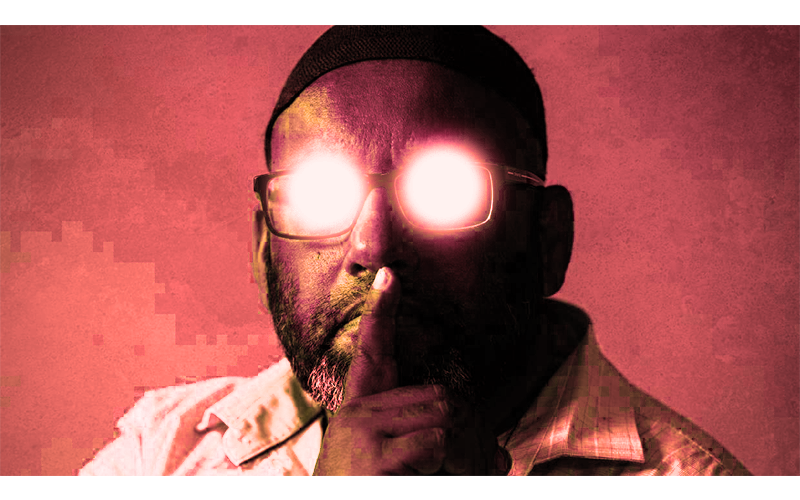
The Spear of Destiny

Many people with a passing familiarity with occultism will have heard of something called the Spear of Destiny. This is an extremely powerful concept with deep importance for the future of our planet. This essay discusses the occult meaning of the Spear of Destiny, and its implications.

Like many occult concepts, there is an exoteric and an esoteric form of the Spear of Destiny.

The exoteric form is the one that people are the most familiar with. The usual story is that the Spear of Destiny was the one held by the Roman centurion Longinus, which he used to pierce the abdomen of Jesus Christ while on the cross at Calvary. This spear apparently became a valuable relic, otherwise known as the Holy Lance.

The spear came into possession of the Holy Roman Emperors around 1,000 years ago, and has remained in Central Europe ever since. It was said that Adolf Hitler was obsessed with the Spear, and set a detachment of crack Waffen-SS troops to capture it when the Nazis annexed Austria. Today, it lies in the “Worldly Treasure-chamber” of Hofberg Palace in Austria.

However, that’s not what the Spear of Destiny really is. There’s an esoteric explanation that makes a lot more sense.

The real Spear of Destiny is a metaphysical object, and it is held by the most influential person on Earth, whoever that is. There is always one person on Earth whose initiative controls the destiny of the human race, one person who is more powerful than all others. This person has the ability to rewrite reality according to their will, as long as they continue to wield the Spear.

The first to hold the Spear of Destiny may have been Gilgamesh, the first king of Sumeria and arguably the progenitor of civilisation. As the first king in the world, Gilgamesh was the first man to truly put the environment around him to order. Therefore, he was the greatest and most powerful man on Earth, at least for a time.

The Spear of Destiny then moved to the West and to the North, as it would continue to do for at least four thousand years. The next inheritor of it may have been a leader of the Akkadian Empire that arose after Sumeria, probably Sargon of Akkad. The Spear would remain in Mesopotamia for many centuries, as it was the only place that civilisation and order existed to a meaningful degree.

Babylonian kings no doubt held the Spear for some time. Hammurabi would have held it when he composed his famous set of laws. Ashurbanipal may have held it at the time of the neo-Assyrian Empire, and the neo-Babylonians held it after him. Nebuchadnezzar may have held it at about the time the dream from the Book of Daniel occurred.

At some time around 500 B.C., the Spear of Destiny left the Ancient Near East, and came to Greece in time for their Golden Age. The Spear of Destiny was certainly held by Alexander as his Macedonian armies conquered almost the entire world known to them. Alexander was probably the single most influential man who ever existed, and he made the Spear his own.

After Alexander’s Empire collapsed and the Golden Age of Greek culture began to fall away, the Spear continued its Westward motion, ending up in Italy in time for the ascent of the Roman Empire. Without doubt, it was held by Julius Caesar, who used it to become one of history’s most influential statesmen. Trajan would have held it as the Roman Empire reached its greatest influence.

Before Trajan, however, there was Jesus Christ, whose dramatic and total reformation of Abrahamism created a religious movement that would grow to become the world’s largest. Longinus may well have held the metaphysical Spear of Destiny on the date of Christ’s crucifixion, because Jesus Christ was the most influential individual of his time, and Longinus took that mantle by killing him.

The Spear of Destiny remained with the Roman Emperors for a few hundred years after Trajan. Who held it during the Dark Ages is unclear, but it can be perceived again in the possession of Charlemagne, as the Frankish king put order to much of Western Europe. The Spear spent some time in the Holy Roman Empire, which was founded by Charlemagne in 800.

William the Conqueror may have held it in 1066 during the invasion of England, and Marco Polo may have held it during his travels in the 13th century. In any case, the Mediterranean rulers of Venice, Genoa and the later Iberians appeared to be in control of the world’s destiny at this time.

As the Age of Exploration began, the Spear may have been held by Christopher Columbus, but was more likely held by his patrons, King Ferdinand of Aragon and Queen Isabella of Castile. As Iberian dominance wound down, to be replaced by Northern European control, the Spear moved to Holland.

The Spear of Destiny was held by William of Orange at the peak of the Dutch Empire, and dramatically leapt over the English Channel after the Glorious Revolution of 1688. Shortly after this event, England would combine with Scotland into “One Kingdom by the Name of Great Britain.” This soon became the British Empire, the largest and most powerful the world had ever seen.

The Spear of Destiny would remain in Britain for at least two centuries, being held at one point by Queen Victoria as the British Empire expanded into a force capable of conquering the globe. After the carnage of World War One, the Spear of Destiny became attracted across the Atlantic, probably to New York, and probably into the hands of Theodore Roosevelt.

Adolf Hitler’s supposed obsession with the Spear can be better understood in this context. The exoteric story is that “Hitler believed the power of the weapon would give him the power to conquer the world“, and that Hitler said, of seeing the Holy Lance, “I myself had once claimed it as my talisman of power and held the destiny of the world in my hands.”

The esoteric story is much different. Hitler knew of the metaphysical Spear of Destiny and wished to take it back from the Anglo-Americans. Had he succeeded in conquering Europe and bringing Britain and America to the peace table, Hitler may well have taken possession of it, and he may well then have held the destiny of the world in his hands.

History, of course, had other ideas. From the East Coast of America, the Spear seems to have travelled further West, and probably now resides in California. It’s possible that Donald Trump holds it, but it’s also possible that it’s in the possession of a Los Angeles movie or music magnate, considering the reach of American soft power.

The future, of course, is unknown. But we can predict, given the relentless Westward motion of the Spear of Destiny over the past 4,000 years, that it will at some point cross the Pacific. Most people already believe that China is destined to supplant America as the world’s foremost power, and this means that the Spear might move there in coming centuries.

This is no guarantee, of course. The Spear might pass to Japan first, or even Korea or Indonesia. Another possibility, considered by very few, is that it may pass to Australia, as the Southern Kingdom has the land area to build a monumental empire over the next few hundred years. After that it may move to India.

All that can be said for sure is that the Spear of Destiny is the single most sought after object in this section of the Great Fractal, and therefore it can be predicted that people will fight for control of it as long as human civilisation exists.

*

If you enjoyed reading this essay, you can get a compilation of the Best VJMP Essays and Articles of 2018 from Amazon for Kindle or Amazon for CreateSpace (for international readers), or TradeMe (for Kiwis). A compilation of the Best VJMP Essays and Articles of 2017 is also available.

Could Labour Win An Absolute Majority in 2020?

A new Reid Research poll has put the Labour Party on 49.6% support, with the National Party languishing well back on 41.3%. Although this no doubt reflects a polling boost from the Christchurch mosque attacks, it raises an interesting question: could Labour govern alone after 2020? Dan McGlashan, author of Understanding New Zealand, examines.

No party has won an absolute majority since the introduction of MMP in 1996. The closest any one party has come was the 59 seats won by John Key’s National in 2011. But yesterday’s Reid Research poll suggests that there’s a very good chance that Labour could win one after the 2020 General Election.

We can see a clear pattern over the last two electoral cycles. The Fifth Labour Government came into power in 1999 on a promise to repeal the cruel welfare reforms of Jim Bolger’s Fourth National Government, winning 38% of the vote. This they increased to 41% by the 2002 General Election, as people still remembered what it was like having Ruth Richardson and Jenny Shipley in charge. From there, it fell away until National defeated them in 2008.

The Fifth National Government, likewise, came into power in 2008 on a promise to repeal the excessive pandering and taxation of the Clark Government. They won 45% of the vote in 2008, which increased to 47% in 2011, as people still remembered the suffocating nanny state culture of Helengrad. From there, it fell away until Labour defeated them in 2017.

So there’s every reason to think that the Sixth Labour Government will get a boost of some kind in 2020, as people still remember the grinning indifference of their National Party predecessors. The swing of the electoral pendulum suggests that Labour should hit its peak support next year or shortly thereafter, before the public inevitably gets sick of them and National wins again in either 2023 or 2026.

All this might mean that they can stay up in the high 40s (in terms of support), but there are other indicators that suggest they could govern alone after the 2020 General Election with as little as 45% of the vote.

Labour’s support parties, New Zealand First and the Greens, have fallen well below the 5% threshold, and there are good reasons to think that both will crash out of Parliament in 2020. The Greens are only polling at 3.9%, and New Zealand First are doing even worse, at 2.3%.

The New Zealand First Party might as well have pissed in the faces of their supporters, such is the contempt they have shown them since taking power after 2017. Every New Zealand First MP voted against Chloe Swarbrick’s medicinal cannabis bill, despite the passionate support for it among their heavily Maori voting base. Then they signed the country up to the TPPA, despite campaigning against it when in opposition.

The Green Party are not doing much better. Far from presenting an educated, intelligent, left-wing alternative, the face of their party is now anti-white racists like Marama Davidson and Golriz Ghahraman. The Greens lost ground in 2017 among people of European descent, and the sharp increase in authoritarian and anti-white rhetoric appears to have driven the centrist Greens back to Labour.

The Greens also have the double problem of defending their educated urban elite votes against The Opportunities Party, which looks set to run again, and Vernon Tava’s potential blue-green movement. Both of these latter vehicles will try to appeal to the same educated, urban 20-39 year old demographic as the Greens, meaning that competition will be extreme.

If both the New Zealand First and Green parties fail to get over 5% of the vote, then the composition of the next Parliament might be simply Labour, National and David Seymour. If this is the case, then 49% of the total electorate vote would likely entitle Labour to 65 seats or so, out of a 120-member Parliament.

Of course, the curious thing here is that if the Greens and New Zealand First do fall under the 5% threshold, and no other new party manages to get over it, one of either Labour or National is all but guaranteed to end up with an absolute majority. The only way it could not happen would be for David Seymour’s ACT, currently languishing at below one percent in the polls, to act as the tiebreaker.

This will be good news to some, and terrible news to others. As we have been reminded in recent years, we Kiwis have no absolute human rights, and Parliament is sovereign. Therefore, a party with an absolute Parliamentary majority can do absolutely whatever it wants to the New Zealand people, with no oversight. The only recourse the New Zealand people will have is the chance to vote them out again in 2023.

Considering that the Labour Government has already been very weak on protecting our rights to own firearms and our rights to free speech, there is good reason to be afraid of an absolute Labour majority. Andrew Little has already used the Christchurch mosque shootings to “fast-track” every piece of legislation he can think of, so who knows how far a Labour Party with an absolute majority in Parliament could go to reshape the world in their image?

*

Understanding New Zealand, by Dan McGlashan and published by VJM Publishing, is the comprehensive guide to the demographics and voting patterns of the New Zealand people. It is available on TradeMe (for Kiwis) and on Amazon (for international readers).

Selectionism: The Prejudice That The World May Not Be Ready For

People are always chimping out over all society’s prejudices: sexism, racism, homophobia etc. are all variously blamed for the world being an unpleasant place to live in. While all of these prejudices have certainly contributed to the miseries of the past and present, there’s one prejudice that few are aware of, and even fewer have spoken of. This prejudice is selectionism.

Sexually reproducing species fall along a continuum that has two poles referring to the two extreme reproductive strategies described by Robert MacArthur and Edward O. Wilson. These are known as the K strategy and the r strategy. The existence of this dichotomy has given rise to the existence of a prejudice that the world is yet to formally understand.

Among K-selected groups, the population is determined by the carrying capacity of the environment. Breeding rates are relatively low, which allows for high rates of parental investment. Consequently, the young take longer to mature. They also have longer lifespans on average and are larger. Examples are large mammals, especially humans and primates, as well as birds.

Among r-selected groups, the population is determined by the biotic potential of the individuals involved. In other words, the reproductive potential. Breeding rates are relatively high, and parental investment is low. The idea is to breed them and get them into adulthood as soon as possible. Examples are amphibians, insects and small mammals such as rodents.

It has long been noted that certain human groups are more K-selected than others. It’s apparent just by travelling around the world that some people have larger families than others, that some people mature more quickly than others and so that some people reach adulthood with greater levels of parental investment than others.

Those who get to adulthood with greater levels of parental investment tend to be healthier, both mentally and physically, and they also tend to be better educated, and thus wealthier. So K-strategists tend to produce higher standards of living than r-strategists, whether one observes at the family or the national level.

Almost without exception, the person noting such things considers themselves to be more K-selected than average. After all, in order to be educated well enough in order to understand ethology, a person generally needs to be the recipient of a large amount of parental investment, and if a person receives that then it’s likely that they are descended from K-strategists.

Selectionism, then, is a prejudice against those groups who use, or are perceived to use, an r-selected reproductive strategy. It’s essentially a bias in favour of K-strategists. A selectionist, therefore, would have a very strong in-group preference towards others they perceived to be K-selected. They would consider other K-selected groups to be superior.

Of course, there is a very real sense in which the K-selected are morally superior: their greater level of parental investment tends to lead to a healthier and better educated offspring, which tends to lead to a wealthy and prosperous society. Almost everyone agrees that a father that stays around to raise his children is morally superior to one who abandons them, and this near-universal agreement is why selectionism has so much power.

The interesting thing about it is that it cuts across and through the ordinary conceptions of races and classes. A selectionist couldn’t care less about interracial marriages between different K-selected groups. Neither could they care about marriages between different classes, as long as the family stays together and the children are raised into functioning adults.

So selectionism is entirely different to racism. Whereas the racist German and the racist Korean don’t want their children marrying each other for fear of diluting their particular racial gene pool, the selectionist sees no inherent problem. As long as their children don’t marry r-selected people, who are liable to abandon or neglect the grandchildren, the selectionist is happy.

Selectionism already exists as a prejudice, although not many people are aware of K and r selection – it’s just hidden by way of being conflated with other things.

For example, when a person chooses to look down on another race, class, family or other group of people, it’s commonly the case that they perceive that other group to be more r-selected than their own. They consider that other group to breed faster and more recklessly, and to invest less time in raising their offspring, thereby lowering the average human capital of society. In other words, they consider that other group to be more like a pest animal.

This is the basis of all group prejudice. What this essay suggests is that the group prejudice against r-strategists may come to replace all current prejudices against other races, classes or traditions. Instead of seeing blacks as pests, or the working class as pests, or Muslims as pests, this essay suggests that, in the future, people’s prejudices will fall along selectionist lines instead.

Concepts such as racism will eventually stop making sense on account of widespread race mixing. There are two separate forms of racism: excessive in-group preference and excessive out-group aversion. There is no difference between the two in a selectionist context, because K and r-selection make up a binary and mutually exclusive spectrum. Consequently, stronger in-group preference must also be weaker out-group preference in the context of selectionism.

The frightening thing about selectionism is that people who follow it might have a point: if the r-selected breed at greater rates within the same environment as the K-selected, and begin breeding earlier on account of earlier maturity, then they will inevitably overwhelm the K-selected unless they are prevented or somehow discouraged from doing so.

Selectionism, therefore, reflects a fundamental political dilemma. If the K-selected are taxed to support the greater breeding rates of the r-selected, then society itself will become more r-selected, and so all the good things brought about by heavy parental investment in offspring will disappear. Many of the people who appear to be racist, classist or otherwise prejudiced are aware of this equation.

It can be seen, then, that the idea of selectionism already has a powerful appeal, and it’s an appeal that may grow in pace with the numbers of the r-selected. Selectionism may be the prejudice that the world is not yet ready for.

*

If you enjoyed reading this essay, you can get a compilation of the Best VJMP Essays and Articles of 2018 from Amazon for Kindle or Amazon for CreateSpace (for international readers), or TradeMe (for Kiwis). A compilation of the Best VJMP Essays and Articles of 2017 is also available.

The Four Alchemical Realms of Law

When people talk about whether or not something is illegal, they’re talking about whether or not something is against the law. The problem with this logic is that there are several different kinds of laws, and some of them override others. As this article will examine, there is a realm of law corresponding to each of the four masculine elements of clay, iron, silver and gold.

The realm of clay corresponds to natural laws. These laws are fundamental, and therefore they underpin all the laws of iron, silver and gold. Like the clay, these laws are so fundamental that they don’t need to be written down, and they don’t need to be understood. They are simply Nature doing its thing, and they have applied long before any human laws existed, and still apply to the vast, vast majority of the Earth’s creatures.

In a state of Nature, most people are barely aware that these laws exist, until they feel the pleasure or pain that comes with acceding to, or violating, those laws. But the laws of Nature exist no matter whether a person is aware of them or not. Fall off a cliff, you die. Eat poison, you die. Get too close to the big animal with the sharp teeth, you die.

Although the basic laws of Nature are physical laws, and then chemical laws, some of them are also biological laws. Laws of clay that start to approach the realm of the laws of iron are those like “Don’t try to have sex with female X or male A will thump you over the head.” These are essentially the same laws that non-human creatures use to defend their territory or resources. “Might is right” is an example of the laws of clay.

The realm of iron corresponds to the the laws that are enforced by organised human violence. When civilisation began, all offences against the sensibilities of property owners were written down into a code of laws, and penalties for transgressing them proscribed. An entire class of judges and jailers came into being to enforce these laws, paid for by the surplus wealth generated by the order that came with civilisation.

These are laws of iron because the Police will beat you up or put you in a cage if you disobey them. You may even get your head chopped off with an iron axe. Unlike natural laws, legal laws are written down, and therefore can be enunciated very clearly (although some will always quibble). The point of this was to distinguish them from the laws of clay, which were never any more than simple animal instincts.

Like iron, the laws of iron are unyielding. The Justice System doesn’t care if you knew it was illegal or not, or if you really meant to do it or not. Justice is blind, which is another way of saying that it is merciless. Laws degrade into laws of clay once money starts getting involved in the justice system and better lawyers get lighter sentences. But when they don’t degrade, the edges of them become gilt with silver.

The realm of silver corresponds to the laws that are enforced by society. These are the laws that relate to social status, i.e. whether or not a person is considered high value by their community. Violating laws of silver doesn’t carry a risk of arrest like violating laws of iron does, but they can lead to people being less friendly towards you, and giving you fewer employment, social or romantic opportunities. Obeying laws of silver tends to lead to the opposite.

As silver is softer and brighter than iron, so are the laws that fall under the realm of silver more malleable than those that fall under the realm of iron. A person who has transgressed a law of silver, and who has earned some enmity from his fellows, can escape punishment by making a sufficient compensatory effort. Therefore, the laws of silver are more subtle than the laws of iron, and can also change on a whim.

However, like iron, they are cold and sharp enough, in their own way. Many a man has been found innocent at trial but nevertheless destroyed by whispering and gossiping. Social exclusion might be more subtle than an axe, and the consequences less permanent, but it is still enough to cause suffering, and therefore enough to modify social behaviour.

The realm of gold corresponds to the laws that are enforced by God. In this sense, the laws pertaining to the realm of gold are similar to those pertaining to clay, in that they are not written down, and neither are they social. Although other people might be able to help a person understand the laws of clay and gold, they can’t force that person to abide by them, unlike the laws of iron and silver. They can only instruct and leave it up to that person’s true will.

It isn’t easy to speak about what the laws of gold are, but it can be said that they are even more subtle than those of silver and iron. Here we are speaking of laws like the law of karma and the law of attraction. It has to be understood at this point that the realm of gold is the realm of consciousness, and its laws relate to how to alter the frequency of one’s consciousness.

Much of alchemy is the art of playing higher laws off against lower ones, so that one causes change in accordance with one’s will despite being bound by laws the entire time. This is a subject of its own and deserves its own essay, but there are some things that can be said about it here.

One can alter one’s consciousness by obeying laws in higher realms at the expense of laws in lower realms. The most powerful example of such a thing was the example of Socrates. By obeying the laws of gold, and completely ignoring all of the laws of silver, iron and clay to the point of causing his own death, Socrates made himself immortal in this world. Likewise, gathering with friends to break unjust laws of iron (such as drug laws) can create magically powerful bonds of solidarity.

This is another possible interpretation of Aleister Crowley’s saying that “The key to joy is disobedience”. By disobeying the cruder laws, such as the law of biological entropy, unjust statutory laws and by prising the truth above social fashion, it’s possible to raise the level of one’s consciousness. A skilled alchemist can therefore reduce the level of their suffering, and the level of the suffering around them, even as they disobey laws, and even though disobeying those lower laws consistently brings suffering.

*

If you enjoyed reading this essay, you can get a compilation of the Best VJMP Essays and Articles of 2018 from Amazon for Kindle or Amazon for CreateSpace (for international readers), or TradeMe (for Kiwis). A compilation of the Best VJMP Essays and Articles of 2017 is also available.