
The First Tenet Of Elementalism (redux)

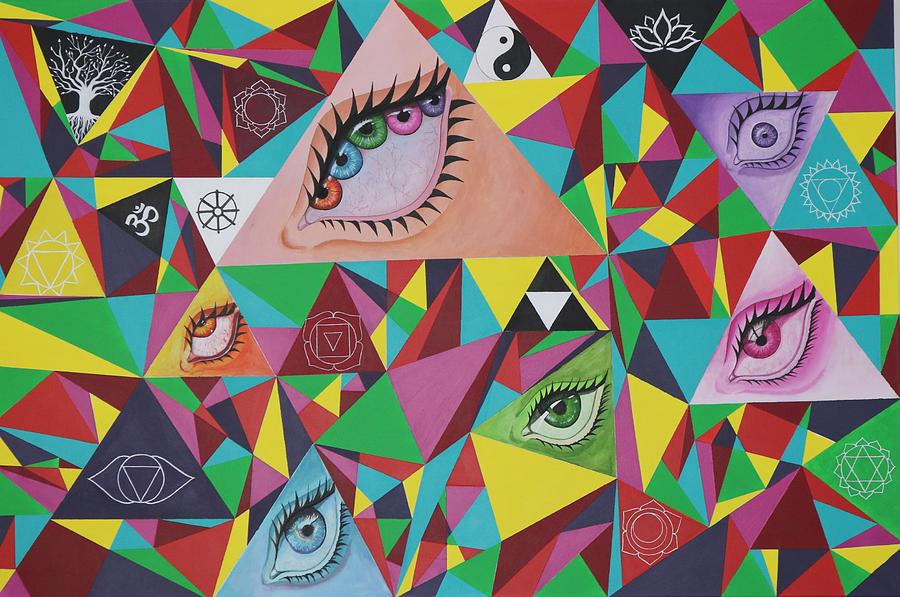
1. Consciousness is the prima materia.

2. This is the First and Foundational Tenet of Elementalism.

3. Consciousness is the original source from which all else manifests.

4. Consciousness is eternal and immutable, being outside of time and space. As such, it is the one thing whose existence needs no explanation.

5. Consciousness came first, before language, before thought, even before the division into masculine and feminine or the division into good and evil.

6. People today only consider consciousness a mystery because they are lost in the trappings of materialism. This traps them in ludicrious misconceptions, such as the idea that the brain generates consciousness.

7. The simple truth is that consciousness is more fundamental than the material world. It existed for an eternity before the material world first manifested, and will exist for an eternity after the material world unmanifests.

8. Because consciousness is more fundamental than language, it cannot be described in language. As such, there are no definitions of consciousness that make any sense.

9. Anyone who is conscious knows what consciousness is, and therefore doesn’t need to have it defined.

10. The Elementalist doesn’t try to define consciousness. The assumption is that anyone trying to define it doesn’t understand it.

11. Elementalism teaches that materialism is to ontology what Flat Earth Theory is to astronomy. Every Elementalist understands that materialism is a primitive theory for those who don’t get it.

12. The idea that consciousness evolved from biological processes of natural and sexual selection will, one enlightened day, be categorised alongside the idea that the Moon is made of cheese.

13. Consciousness has always existed, since before there were even bacteria on Earth, because consciousness dreamed up the Earth, and not the other way around.

14. The Elementalist knows that consciousness is the primary element of all those that exist. All else is dependent upon it.

15. Consciousness, in its creative infinity, is the same thing as God.

16. The consciousness possessed by the individual is an infinitely small fragment of the total glory possessed by God.

17. All of us that are conscious (which is all of us) are God.

18. The average Westerner is conditioned to believe that physical matter is the prima materia, and that their own consciousness is something that evolved out of ever-complexifying self-reproducing organic forms.

19. Knowing consciousness to be the prima materia, the Elementalist is unafraid of death, recognising the death of one’s body to merely be a change of physical form.

20. Because consciousness is the prima materia, all else is mere perception, which rises and falls like the wind. That which perceives remains resolute in eternity.

21. An Elementalist can immediately overcome any death anxiety by recalling the First Tenet.

22. Meditating regularly upon the First Tenet will build a spiritual armour that defends from any fears grounded in biology or materialism.

23. The one who meditates regularly upon the First Tenet will know that all of the horrors of this world are nothing more than the illusion of threat, and their combined power is nothing more than the ability to alter perception.

24. Understanding the First Tenet leads naturally to the Second Tenet.

*

This chapter is an excerpt from Elemental Elementalism, the foundational scripture of the new religion of the Age of Aquarius.

*

If you enjoyed reading this essay/article, you can get a compilation of the Best VJMP Essays and Articles of 2020 from Amazon for Kindle or Amazon for CreateSpace (for international readers), or TradeMe (for Kiwis). A compilation of the Best VJMP Essays and Articles of 2019, the Best VJMP Essays and Articles of 2018 and the Best VJMP Essays and Articles of 2017 are also available.

*

If you would like to support our work in other ways, subscribe to our SubscribeStar fund. Even better, buy any one of our books!


How To Deal With Extreme Suffering

1. Suffering can make a person say No to life.

2. Extremes of suffering can make a person deny the spiritual truths about reality.

3. It is true that this world is one of the Hell Realms. However, there are still many ways that extreme suffering can be relieved.

4. The foremost way to alleviate extreme suffering is to understand that the physical world and all the phenomena in it were created to entertain the gods.

5. Only the Tard asks “If God is real, why does suffering exist?”

6. The Elementalist understands that suffering must exist so that we have something to overcome.

7. The greater the suffering, the more glorious the overcoming.

8. Those who have overcome extreme suffering must not look back on it with resentment. The crack in one’s heart is the same conduit through which the light enters.

9. Both homicidal and suicidal ideation are best dealt with by taking a calm moment to appreciate how much the gods would be entertained by you overcoming such feelings.

10. Extreme suffering can be likened to standing at the foot of an extremely tall mountain. A great challenge awaits, with potentially great rewards.

11. When others are suffering, the correct response is calm compassion.

12. The Elementalist cannot solve the problem of the great suffering of the world, nor the great suffering of others. But the Elementalist, still having the power to alter his frequency of consciousness through the application of will, does not despair thereby.

13. The best way to alleviate general suffering is to transmute low-frequency aspects of one’s own consciousness into high-frequency ones.

14. Physical suffering is best alleviated by a return to the body’s natural state. The hungry must eat, the thirsty must drink, the tired must sleep.

15. Extreme physical suffering cannot be alleviated so easily. The solution is to keep that suffering in perspective: all sensory impressions of this world are illusions that rise and fall.

16. Emotional suffering is best alleviated by kindness and solidarity based on common feeling. The most reliable way to achieve this is to help other people who are suffering.

17. Extreme emotional suffering requires that a person look inwards and master their emotions. The easiest way to achieve this is through extensive meditation practice.

18. Intellectual suffering is best alleviated by knowledge.

19. Extreme intellectual suffering requires that a person return to the ancient masters. A person subject to extreme intellectual suffering should read Vyasa, Lao Tzu, Confucius, Buddha, Mencius, Chuang Tzu, Plato and Aristotle.

20. Spiritual suffering is best alleviated by wisdom.

21. Extreme spiritual suffering requires that a person meditate upon the Four Tenets. Only by understanding the Four Tenets can a person free themselves from illusion and delusion.

22. It is important to practice meditation as often as possible, so that thoughts and feelings of suffering can be mastered.

23. Meditation alleviates physical, emotional, intellectual and spiritual suffering.

24. The Elementalist, understanding the Fourth Tenet and the Good News of Elementalism, does not experience true suffering. Although the body and the mind of the Elementalist may suffer, the soul does not.

*

This chapter is an excerpt from Elemental Elementalism, the foundational scripture of the new religion of the Age of Aquarius.

*

If you enjoyed reading this essay/article, you can get a compilation of the Best VJMP Essays and Articles of 2020 from Amazon for Kindle or Amazon for CreateSpace (for international readers), or TradeMe (for Kiwis). A compilation of the Best VJMP Essays and Articles of 2019, the Best VJMP Essays and Articles of 2018 and the Best VJMP Essays and Articles of 2017 are also available.

*

If you would like to support our work in other ways, subscribe to our SubscribeStar fund. Even better, buy any one of our books!
The Elemental Hierarchy Of Consciousness

1. Consciousness is the prima materia and each one of us is ultimately a fragment of this consciousness.

2. Each fragment of consciousness possesses its own frequency. This frequency can be expressed as a number between 0 and 1, where 0 is the Winter Pole of the Quadrijitu, and 1 is the Summer Pole of the Quadrijitu.

3. All fragments of consciousness can be arranged into a hierarchy, such that the higher frequencies incarnate into higher worlds, and the lower frequencies into lower worlds.

4. Within this world, there is also a hierarchy of consciousness, such that the lower frequencies are close to sinking lower into the Hell Realms, and the higher frequencies are close to rising higher into the Heaven Realms.

5. The difference between the hierarchy of consciousness and the hierarchy of class is that the former can be altered quickly whereas the latter cannot.

6. One’s consciousness is a matter of one’s will in the present, but one’s class is a matter of one’s will in the past, including past lives.

7. The lowest frequency of consciousness is equivalent to lead.

8. A consciousness of lead lives in constant fear.

9. Fear kills the mind. A consciousness clouded by fear will make selfish decisions, and will thereby increase the suffering of those around them, creating a Hell on Earth.

10. The next highest frequency of consciousness is equivalent to tin.

11. A consciousness of tin lives to indulge itself.

12. Material indulgence is tempting because it can heal the suffering caused by an excess of fear. However, this indulgence frequency results in more suffering because it can lead to degeneracy and addiction.

13. The next highest frequency of consciousness is equivalent to iron.

14. A consciousness of iron lives for honour.

15. Honour is tempting because it can heal the suffering caused by an excess of indulgence. However, an excess of honour can lead to conflict.

16. The next highest frequency of consciousness is equivalent to copper.

17. A consciousness of copper lives for novelty.

18. Novelty is tempting because it can heal the suffering caused by an excessive focus on honour.

19. The next highest frequency of consciousness is equivalent to silver.

20. A consciousness of silver lives for glory.

21. Glory is tempting because it can heal the suffering caused by an excess of novelty.

22. The next highest frequency of consciousness is equivalent to mercury.

23. A consciousness of mercury lives for knowledge.

24. Knowledge is tempting because it can heal the suffering caused by an excess of glory.

25. The highest frequency of consciousness is equivalent to gold.

26. A consciousness of gold lives to know the truth.

27. Truth is tempting because it can heal the suffering caused by an excess of knowledge.

28. The struggle to raise one’s frequency of consciousness is one of the most worthy of all aspirations. The most important thing, however, is that this struggle entertains the gods.

*

This chapter is an excerpt from Elemental Elementalism, the foundational scripture of the new religion of the Age of Aquarius.

*

If you enjoyed reading this essay/article, you can get a compilation of the Best VJMP Essays and Articles of 2020 from Amazon for Kindle or Amazon for CreateSpace (for international readers), or TradeMe (for Kiwis). A compilation of the Best VJMP Essays and Articles of 2019, the Best VJMP Essays and Articles of 2018 and the Best VJMP Essays and Articles of 2017 are also available.

*

If you would like to support our work in other ways, subscribe to our SubscribeStar fund. Even better, buy any one of our books!

The Elementalist Conception Of Order And Chaos

1. Order and chaos are loosely analagous to masculine and feminine, respectively. They are not, however, analagous to good and evil.

2. Order is determined, chaos is undetermined.

3. Thus, order is represented by a 1, chaos by a 0.

4. Good order is that which decreases the suffering of sentient beings. This is usually caused by order that guides, enlightens, nurtures, and safely directs emotions.

5. Legal prohibitions on causing injury or harm to other sentient beings are examples of good order.

6. Bad order is that which increases the suffering of sentient beings. This is usually caused by order which stifles, strangles and suffocates.

7. Legal prohibitions on spiritual sacraments are examples of bad order.

8. Good chaos is that which decreases the suffering of sentient beings. This is usually caused by chaos which liberates and entertains.

9. A spiritual revolution that destroys a rotten and corrupt religious structure is an example of good chaos.

10. Bad chaos is that which increases the suffering of sentient beings. This is usually caused by chaos which spreads fear.

11. The best examples of bad chaos are crimes such as violence, theft and abandoning one’s family.

12. An excess of either order or chaos is indistinguishable from death.

13. Life exists, and can only exist, in the space where order and chaos are correctly balanced.

14. The more masculine a person is, the more they will prefer order. A preference for order follows naturally from the Fundamental Masculine Attitude.

15. The more feminine a person is, the more they will prefer chaos. A preference for chaos follows naturally from the Fundamental Feminine Attitude.

16. The Elementalist seeks spiritual balance, and as such does not preference either order or chaos.

17. The Elementalist prefers order if order helps the Elementalist to achieve their aspirations.

18. The Elementalist prefers chaos if chaos helps the Elementalist to achieve their aspirations.

19. Neither order nor chaos induces any strong emotional reaction in the Elementalist. Like yang and yin, both order and chaos rise and fall. The Elementalist watches them both rise and fall without clinging to either.

20. The gods are most entertained by the correct balance of order and chaos. As such, their will is to impose order upon the excessively chaotic, and chaos upon the excessively orderly.

*

This chapter is an excerpt from Elemental Elementalism, the foundational scripture of the new religion of the Age of Aquarius.

*

If you enjoyed reading this essay/article, you can get a compilation of the Best VJMP Essays and Articles of 2020 from Amazon for Kindle or Amazon for CreateSpace (for international readers), or TradeMe (for Kiwis). A compilation of the Best VJMP Essays and Articles of 2019, the Best VJMP Essays and Articles of 2018 and the Best VJMP Essays and Articles of 2017 are also available.

*

If you would like to support our work in other ways, subscribe to our SubscribeStar fund. Even better, buy any one of our books!