
Demography Is Destiny

The West is in a dismal state today. Despite unprecedented material wealth, our collective social capital has never been lower. Sometimes it feels like the West is in a state of civil war, with chaos and destruction reigning in many major cities. Most of this was predicted at least half a century ago, by those who studied the demographic trends.

The American fertility rate was over three children per woman from 1950 to 1964. This period of high fertility became known as the “Baby Boom”. The rate fell sharply after 1964, and by 1978 it had fallen to 1.8 children per woman. This demographic pattern had serious economic consequences.

As the Boomers entered the workforce en masse, an incredible economic phenomenon began. Because there were a great number of workers, and very few elderly or young dependents, the economy was unusually profitable. This is measured by something called the dependency ratio, which is the ratio of people in the workforce to people not in the workforce.

The dependency ratio was high during the Baby Boom, on account of all the children, but it began to plummet from around 1980, after those children entered the workforce. This led to a time of great profitability, which lasted as long as the Boomers were in employable age groups.

By today this process has begun to reverse. The first of the Baby Boomers hit the pension age of 65 in 2010. Ever since then, the dependency ratio has risen. In 2000, there were five workers per pensioner in America; by 2050, there are expected to be 2.9 workers per pensioner. We are about to go through a time of great unprofitability.

The saying “demography is destiny” refers to the fact that the macrotrends of Western economies since World War II have followed demographic trends.

When the Boomers die off en masse, a process which is beginning now, the dependency ratio will improve. This will also lead to a sharp decrease in housing demand. The combined effect of these two major changes will create an economic boom lasting several decades. Unfortunately for most of the people reading this article, the post-Baby Boomer boom won’t fully start happening until after 2050.

The situation might seem bad for the West, but it’s even worse in the industrialised countries of the Far East. Their fertility rate collapse is a more extreme version of the Western one.

China had a similar economic boom to the West from 1985 to 2010, with a large demographic bulge of working-age people keeping the dependency ratio low. But China today, despite being infamous for its population, only has a fertility rate of 1.7.

In 2010, the old-age dependency ratio in China was 11%, meaning nine workers for every pensioner. By 2060, it is expected to be over 50%, meaning two workers for every pensioner. Considering that they are only a middle-income nation today, and that future economic growth is uncertain, a dependency ratio of 50% threatens to cause extreme poverty.

It’s worse still elsewhere in Far East Asia.

In 2020, the South Korean fertility rate is less than 1.1 children per woman. At a fertility rate this low, the South Korean population will halve every generation. The fertility rates of people in Singapore, Taiwan, Hong Kong and Japan are only slightly higher, around 1.4. Their populations should decrease by a third every generation. China’s should decrease by a quarter.

Some might argue that Europe and Far East Asia are overpopulated anyway, and the environment would benefit from a sharp population decrease. The trouble is that the rulers of both places are accustomed to a certain standard of living, and, if given the choice, will act to maintain that standard of living even if succeeding generations have to suffer for it.

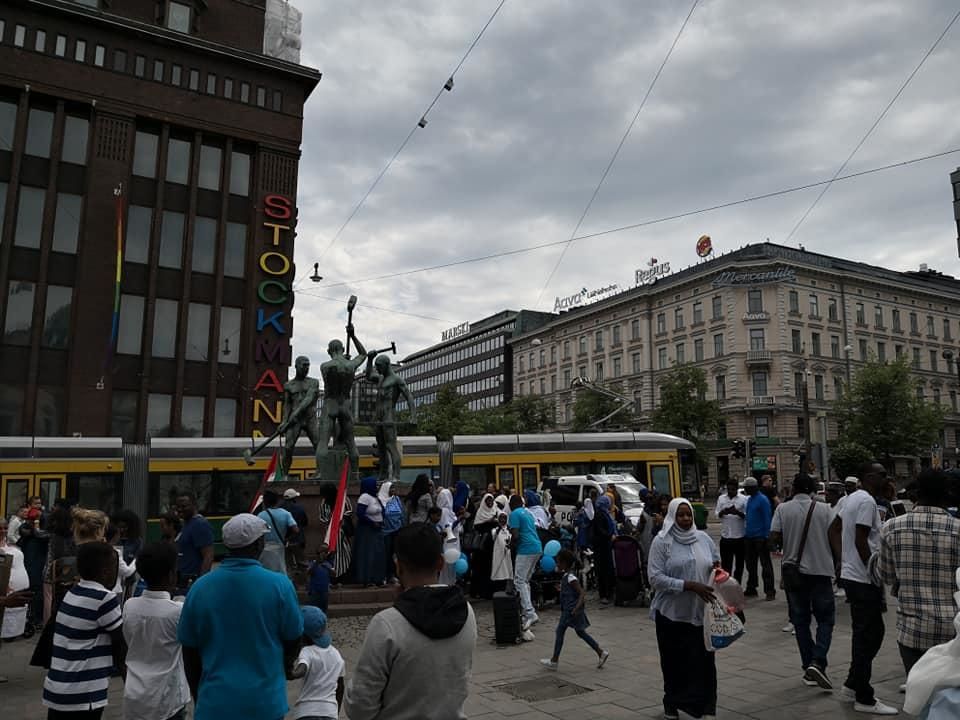
In Western countries, falling populations have been preempted by mass immigration. This has prevented Western economies from shrinking, keeping stock prices and house prices high, and the ruling class happy. However, the result of this process has been the collapse of social cohesion, reflected everywhere in less trust.

A nation that opens itself to mass immigration also opens itself to division and, eventually, chaos. The historical record is clear on this subject, as is the science. Changes in kinship intensity have direct and far-reaching political consequences. If demographics lead to a decrease in a nation’s kinship intensity, then that nation’s destiny is discord and war. The civil unrest in today’s America is merely a foretaste.

That demographic trends are capable of tearing nations apart from the inside can be understood mathematically. Taking the example of France, it can be seen that the destiny of any population with a low fertility rate, once it comes to host a foreign population with a high fertility rate, is to be conquered.

If the white population of France is 50,000,000, and their women reproduce at the rate of 1.5 children per woman, the white French population will fall to 28,125,000 after two generations. If the Muslim population is 5,000,000, and their women reproduce at the rate of three children per woman, the Muslim French population will rise to 11,500,000 after two generations.

After three generations, the French population will be some 21 million, and the Muslim population some 17 million. By that time, the majority of fighting-age males will belong to the Muslim population, and France will be a de facto conquered land. Muslims will have achieved with their wombs what they could not achieve with their swords 1,300 years earlier, at the Battle of Tours.

Much the same logic was followed by French financier Charles Gave, who outlined it in a paper he wrote for the Institute of Liberty. He was immediately attacked for promulgating the great replacement conspiracy theory, only it is no conspiracy. It’s a simple extrapolation from currently known values, and its logic is inescapable.

The fertility rate in France has been famously low for over a century now. The fertility rate in neighbouring Algeria, by contrast, was over seven children per woman as recently as 1980. The consequence is that, by today, there are two to three times as many Algerians in France as there were French people in Algeria in 1940, when Algeria was a French colony. France is now itself a colony in all but name.

France’s destiny is to become an Islamic state. This follows inexorably from their current demographics, and is no harder to predict than was the German victory over France in World War II. This victory had been forecast over half a century beforehand, by people who knew that Germany had a much higher fertility rate than France, and who had calculated that this would eventually lead to an overwhelming German numerical advantage.

The single most important demographic trend of this century is the one that predicts that the population of Africa will quadruple by the end of the century. Currently around one billion, it is expected to be four billion by 2100, which will mean that almost half of the world’s population will be African.

Countries like Niger and Somalia are still reproducing at the rate of over six children per woman. The total African fertility rate is 4.4 children per woman. The sad reality of this population explosion is that, by the end of this century, the majority of Africa’s megafauna will be extinct in the wild. Most megafauna are already threatened thanks to human population pressure, and they will not survive an African population of four billion.

The societies of Europe are unlikely to survive it either. Europe today is barely capable of defending their borders against migrant inflows from the South. In the medium-term future, with an even smaller European population and a surging African one, they won’t be capable of defending them at all. The destiny of Europe appears to be getting overwhelmed by the surplus African population.

The next century looks like it will bring a drastic decrease in the high IQ populations of the world, and an equally drastic increase in the low IQ populations of the world. The inevitable result will be low IQ people surging into high IQ territories, and a profound increase in the average amount of human suffering. Demography really is destiny, and it suggests that the world’s destiny is a grim one.

*

If you enjoyed reading this essay, you can get a compilation of the Best VJMP Essays and Articles of 2019 from Amazon for Kindle or Amazon for CreateSpace (for international readers), or TradeMe (for Kiwis). A compilation of the Best VJMP Essays and Articles of 2018 and the Best VJMP Essays and Articles of 2017 are also available.

*

If you would like to support our work in other ways, please consider subscribing to our SubscribeStar fund. Even better, buy any one of our books!

Why Inequality Destroys Nations

One often hears the argument that inequality destroys societies, but it isn’t easy to understand why. The mainstream media tells us that a rising tide lifts all boats, and so people ought to enjoy the bounty of the modern day without worrying about how other people have more. But the economic psychology of inequality is complicated. This essay explains.

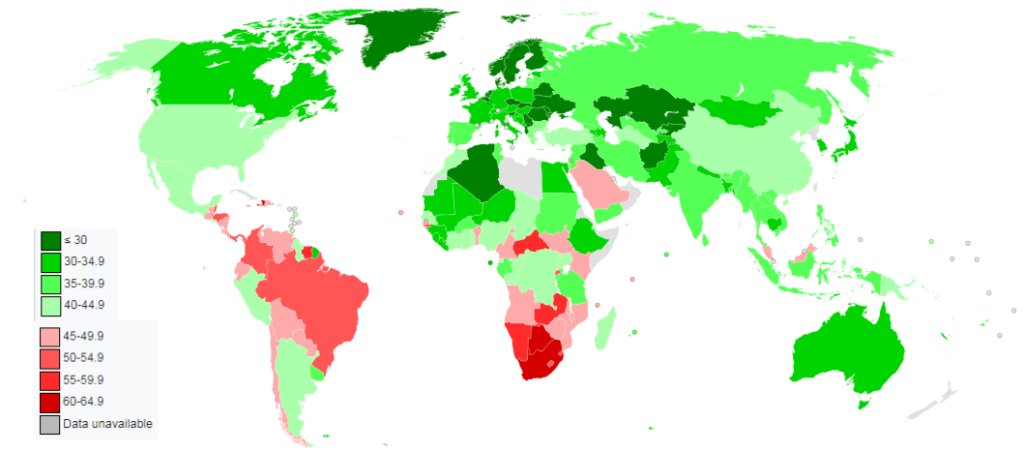
Casting an eye over a list of countries ordered by their degree of income inequality, one trend leaps out: unequal countries tend to be shitholes, and egalitarian countries tend to be decent.

Among the most unequal countries are places like Brazil, Mexico and the majority of African countries. Among the most equal countries are the European ones, Canada, Australia, Japan and South Korea. The pattern is obvious: a strong correlation exists between economic equality and overall quality of life.

The reasons for this can be understood if we compare the motivations of individuals in equal societies to individuals in unequal ones. The simple rule is that once inequality gets to the point where you no longer have a stake in society, then you no longer have a stake in society. This has behavioural consequences.

In an equal society, the members closer to the bottom of it still have enough of a stake to feel engaged. They are not so far from the decision-making level that their desires are ignored. Having a meaningful chunk of power, they are incentivised to work towards society’s betterment (or at least its upkeep).

In equal societies, all members feel a sense of ownership. A sense of pride at the quality of life offered by the society follows naturally. With ownership and pride, a person will take action to uphold that society. This is why people in countries like Sweden, Canada and Australia tend to perform prosocial behaviours like putting their shopping trolleys away and disposing of their litter in bins.

In an unequal society, the members closer to the bottom are without influence. Decisions are made so far above their heads that they aren’t consulted. As such, the people at the bottom are not incentivised towards prosocial behaviour. They perform antisocial behaviours, like aggressive panhandling, theft, robbery, sex crimes and murder.

In a society like this, not everyone feels a sense of ownership. Those who don’t tend to not contribute to society’s upkeep. In exactly the same way that rented cars and houses are treated much worse than personally owned cars and houses, a society in which people can only rent a stake (at best) will be treated much worse than a society in which people can own one.

The inevitable result of increasing inequality is a decline in prosocial behaviour and an increase in antisocial behaviour. You might as well throw that Coke can in the gutter, because it isn’t you that will have to pay to clean it up. In fact, the more damage you can do to society the better, because it will take the bastards who locked you out down a peg or two.

New Zealand might be in the middle of the inequality pack, but it’s still practically impossible to own a home here without inheritance. The average wage today has less than 40% of the housebuying power that it had 26 years ago. Our society is now so unequal that what used to be the elementary sign of having a stake in it – owning a home – is practically a dream unless you’re born rich.

This inequality has all but destroyed our society. It’s easy to see why if one imagines how it has affected people’s motivations.

As a non-landowner who will never own land while the average wage cannot buy the average house, I don’t care what happens to society. I have no stake in it and will never have one as long as the prevailing economic circumstances continue. New Zealand is someone else’s property, and as such I don’t feel motivated to defend it or to do any work to maintain it.

It’s said that if too many people drop out of society, then our economy would collapse, leading to New Zealand becoming ungovernable, perhaps even to civil war. I say: “Good!” If civil war means that I can afford a house in five years, then bring on civil war!

Many people will be appalled to hear such reasoning. But such reasoning is inescapable once a person has no stake in society. If the order of society as being maintained at my expense, then bring on the chaos! It’s irrational to reason otherwise unless one is content to be the slave of the rich, effectively a serf whose labour will never allow them to own land.

Given this psychological calculus, it’s apparent that increasing inequality will inevitably lead to society collapsing as fewer and fewer people feel like they have an interest in keeping it going. Prosocial behaviour will decline, and antisocial behaviour will rise, to the point where the fabric of society no longer exists, and we are back in Hobbes’s state of all against all.

Eventually, inequality will get so bad that intelligent people born poor will realise from early childhood that they never had a chance. These people will be hardened revoutionaries by the time they become adults, and will know nothing other than hate. They will be exceptionally dangerous and capable of ushering in a new order of the world.

*

If you enjoyed reading this essay, you can get a compilation of the Best VJMP Essays and Articles of 2019 from Amazon for Kindle or Amazon for CreateSpace (for international readers), or TradeMe (for Kiwis). A compilation of the Best VJMP Essays and Articles of 2018 and the Best VJMP Essays and Articles of 2017 are also available.

*

If you would like to support our work in other ways, please consider subscribing to our SubscribeStar fund. Even better, buy any one of our books!
Clown World Chronicles: What Is ‘Bioleninism’?

‘Bioleninism’ describes a familiar phenomenon in Clown World – social rejects coming together to force their will on society at large. A feature of Clown World is that people who normally keep themselves hidden away out of shame are out and proud. Even worse, they are organised and controlling the narrative. Bioleninism is the thread that binds them all.

The original Leninism was a kind of slave morality that attracted many of society’s misfits. Much like Christianity in the Roman Empire, which first became popular among slaves, Leninism first became popular among those at the bottom of society. In the case of Russia, it wasn’t slaves but drunkards, prostitutes, petty criminals and those shunned for cruelty.

Characteristic of all popular slave moralities is that they bring together the resentful. Christianity did this, the original Communism did this, and now the bottom-feeders of Clown World are coming together to do it again – this is Bioleninism.

Bioleninism is the name given to the phenomenon of all of society’s genetic rejects coming together with a view to force their will on the population at large. Its coining is usually attributed to a mysterious Internet commentator known as ‘Spandrell‘.

For better or worse, much of human life is a mating contest that primarily revolves around genetic quality. Society favours the good-looking, the tall, the strong, the intelligent and the vigourous. All of these qualities can be affected by nutrition, but the reality is that their expression is fundamentally a matter of genetics.

Evolution selects for genetic quality first and foremost, and in the modern human animal it does so mostly through sexual selection. In practice, this means that women decide which males pass their genes on and which don’t. Like the other workings of Nature, this is a brutal process that involves a great deal of suffering for all, especially those who are found wanting.

If a person loses the genetic lottery, and cannot find anyone to mate with, it’s common for them to become resentful. At worst, this resentment manifests as a bitter form of anger that desires the destruction of everything good in the world. The logic is that if I can’t have it, no-one else can have it either. This spite probably evolved alongside jealousy, envy and all the other emotions as a way of ensuring breeding opportunities.

Some people ask themselves how it’s possible that people still propound Communism, given that it has a track record of a hundred million deaths and has failed every time it’s been tried.

The reason is that the people who support Communism are primarily motivated by resentment and hate. They don’t care whether or not Communism lifts up or empowers anyone – they just want to see the people they envy brought down a level or two. As long as someone above average is smashed down to the same level as everyone else, then all is good.

Bioleninism draws together the same kind of slaves that would ordinarily be Christians. Only now, instead of burning infidels at the stake, the wrongthinkers they persecute are political enemies. Those healthy enough to assert the value of their families or nations are hounded into silence. Instead of being labelled infidels or bourgeoisie, they are labelled Nazis.

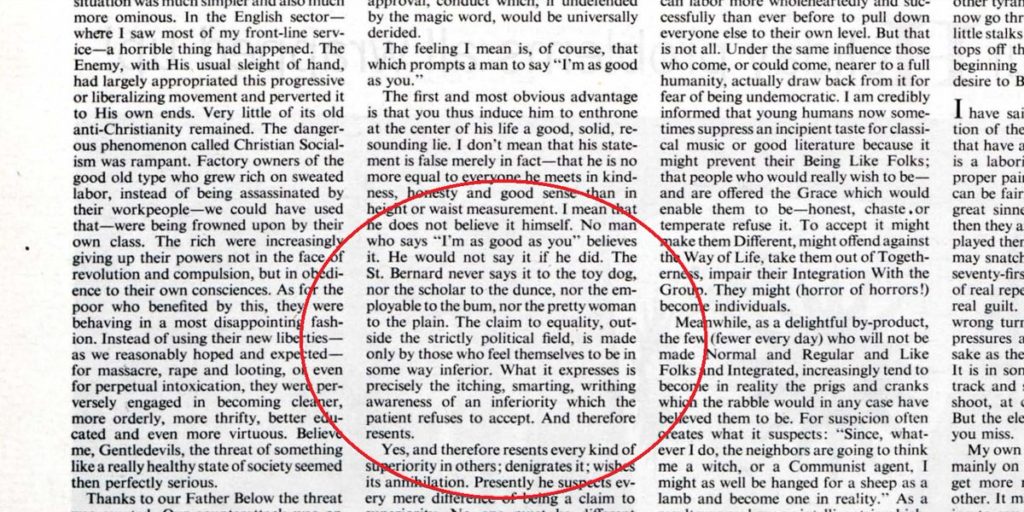
Characteristic of the Bioleninist is an obsession with equality, which is held up as a virtue for its own sake. The logic is that the genetic reject feels a deep sense of humiliation in the presence of the genetically healthy. Only by rubbing the latter’s face in the shit can the reject avoid this humiliation.

One of the reasons why Clown World is so terrible is because its rulers understand the phenomenon of Bioleninism, and use it against the people. As such, they take measures to destroy the genetic infrastructure of any place they lord over, making resistance to their will less likely. This is achieved in two major ways.

The first is to destroy any natural leader that arises before they can become influential. The rulers of Clown World know that human populations naturally produce great leaders, and that these great people will lead their nations towards ending their suffering. So these natural leaders have to be dealt to before they liberate their nation from control.

In practice, this doesn’t require that the leaders be destroyed so much as that the people are induced to follow natural slaves instead. This is achieved through mass media programming, which platforms entertainers and celebrities instead of intellectuals and philosophers. By raising up these clowns, the rulers of Clown World ensure that the natural leaders are not followed.

The second major way to destroy the genetic infrastructure of a nation is through mass immigration. The rulers of Clown World know that only high-IQ people are capable of maintaining an uncorrupt society. Therefore, since they want corruption, they want the kind of population that enables corruption. So they hold the border open to the dumbest, most impulsive people they can find.

The plan is to have one global seething mass of borderline-retarded consumer whores who can be played off against each other without ever seeing the man behind the curtain. The end goal of original Leninism was to have a society where everyone is reduced to the lowest common social denominator. The end goal of Bioleninism is to have a world where everyone is reduced to the lowest common genetic denominator.

*

This article is an excerpt from Clown World Chronicles, a book about the insanity of life in the post-Industrial West. This is being compiled by Vince McLeod for an expected release in the middle of 2020.

*

If you enjoyed reading this essay, you can get a compilation of the Best VJMP Essays and Articles of 2019 from Amazon for Kindle or Amazon for CreateSpace (for international readers), or TradeMe (for Kiwis). A compilation of the Best VJMP Essays and Articles of 2018 and the Best VJMP Essays and Articles of 2017 are also available.

*

If you would like to support our work in other ways, please consider subscribing to our SubscribeStar fund. Even better, buy any one of our books!

Clown World Chronicles: What Is A ‘Soyboy’?

Of all the weaklings of Clown World, none are more widely despised than the soyboy. Their low-testosterone faces can be seen everywhere, their raised eyebrows and gaping mouths desperately signalling an absence of threat. Right now, a great many men are soyboys and their number seems to be increasing. This essay explains the phenomenon.

The name ‘soyboy’ is bipartite.

The ‘soy’ refers to the commonly-held belief that ingesting too much soy will feminise a man. Many believe that a high-soy diet increases one’s estrogen production to the point where it breaks down muscle and adds fat. Research has linked soy consumption to low sperm count, which some believe to be the result of this feminising effect.

The ‘boy’ comes from the fact that a soyboy is too feeble to be considered a man. They are incapable of asserting themselves as a man because they are far too afraid of their own physical safety. The soyboy would get his arse kicked in a fight against any real man and against half of all women. Not that they’d ever get into one, because their instincts are to cower away when threatened.

The definition of a soyboy, then, is a male who failed to progress past juvenility. Despite being old enough to be a man, the soyboy is still a child in every meaningful sense. They are an example of arrested development, not a proper adult. Not ever having developed the masculinity of a proper man, they are as precious and as feminine as most children.

This femininity is the reason for the characteristic soyboy gape. Posing for a photo with one’s mouth open in a smile is usually associated with female anime characters. The soyboy has adopted this facial expression in an effort to look unthreatening. He is terrified that if he appears threatening, someone will attack him. So he cowers.

This fear of confrontation is why the soyboy is the way he is.

To avoid confrontation, the soyboy makes himself look physically weak and unassuming. The body language of even the largest of them displays passivity. This extreme meekness distinguishes the soyboy from the regular adult male in Clown World. It isn’t a gentlemanly, civilised meekness but a craven, slave-minded one.

Another characteristic sign of a soyboy is a preoccupation with childrens’ toys and games. An adult male who collects Star Wars figurines is typical. The ultimate expression of the soyboy is a 35-year old staring sheep-eyed at a camera with an open-mouthed smile, proudly holding up the boxed Lego spaceship they got for a birthday present.

Soyboys arise when the strong men-good times-weak men-hard times cycle hits the “weak men” phase. The reason why they are so numerous now is because the industrialised world has been so wealthy for so long. When things are going well, everyone suffers less, and eventually become accustomed to not suffering. As such, they become soft.

Also when things are going well, the tendency is to let weakness slide rather then to crack down on it. In hard times, weakness is beaten out of everyone because it’s understood that it endangers everyone else. In good times, people tend to ignore it or even laugh about it. When Clown World nears its peak, then weakness is held up as a virtue. The soyboy exemplifies this phenomenon.

Ted Kaczynski argued that men like soyboys were examples of oversocialisation. The more mollycoddled a boy is, and the less time he spends exploring the world on his own initiative, the more likely he is to grow into a soyboy. In this sense, the soyboy is much like a pampered housecat.

Fundamentally, the soyboy is the way he is because he cannot control his own fear, and as such it controls him. His life is a series of actions taken to forestall anxiety and tension. He fears conflict of any kind, and makes himself as unassuming as possible in the hope that aggression will avoid him.

The difference between a soyboy and a simp is that the soyboy is weak in an allround sense, whereas the simp’s only major weakness is specifically that he is an appeaser of women. The soyboy appeases women, but he appeases everyone else as well. The simp, on the other hand, is fully capable of aggression, even unprovoked.

The difference between a soyboy and a baizuo is that the latter is specifically an activist on the political left. Soyboys tend to lack the aggression to assert themselves politically. They would rather be at home playing video games than protesting. Baizuos have the same slave mindset as soyboys, only the baizuo is capable of aggression against their perceived enemies. The soyboy has no enemies because he has never stood up for anything.

Many soyboys are incels, but the overlap is small. Most incels are that way because they are too masculine and aggressive – i.e. they are the kind of man who demands total submission from their marriage partners and (for obvious reasons) they can’t find someone to volunteer. Soyboys are extremely feminine, not masculine, and are not necessarily incels (in fact, they are often the “kept man” of a gainfully employed woman).

Eventually, soyboys will become so numerous that opportunistic criminals will appear to take advantage of the collective weakness. The soyboys won’t resist. This is when we enter the “hard times” part of Clown World. The tyrants stand up and everyone is too submissive to oppose them. Then the real suffering begins.

The cure to the soyboy phenomenon, as the popular meme might suggest, is beatings.

*

This article is an excerpt from Clown World Chronicles, a book about the insanity of life in the post-Industrial West. This is being compiled by Vince McLeod for an expected release in the middle of 2020.

*

If you enjoyed reading this essay, you can get a compilation of the Best VJMP Essays and Articles of 2019 from Amazon for Kindle or Amazon for CreateSpace (for international readers), or TradeMe (for Kiwis). A compilation of the Best VJMP Essays and Articles of 2018 and the Best VJMP Essays and Articles of 2017 are also available.

*

If you would like to support our work in other ways, please consider subscribing to our SubscribeStar fund. Even better, buy any one of our books!