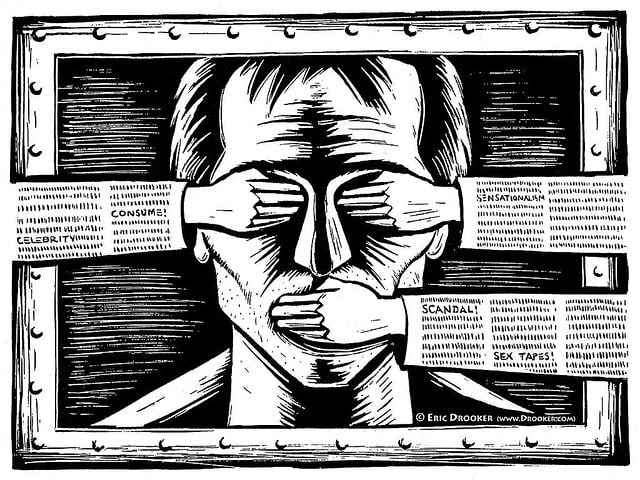
Censorship was straight forward in the 20th Century. If you wrote anything the rulers didn’t like, they confiscated all copies of it or put you in prison. There was no Internet back then, and no social media, and therefore no realistic possibility of building up a following outside of mainstream media and publishing. Things are different in the 21st Century.
Today, it’s more subtle. Instead of the physical gulag, there is the financial gulag. The Establishment uses the financial gulag to achieve the same deterrent effect on others as the physical gulag, but with the political advantage of evading accusations of totalitarianism.
Deplatforming is a central tactic of this decentralised censorship. The modus operandi is for some influencer to persuade dozens or hundreds of their minions to bombard a private company with demands to deplatform some wrongthinker. Any wrongthinker so deplatformed will have a harder time making money to support themselves – this is the financial gulag.
The logic is that the platforming of wrongthink normalises it, and therefore it’s a moral imperative to prevent its platforming whenever possible. Allowing wrongthink to get platformed jeopardises the entire authoritarian plan of shaping the human race into something perfect. As Josef Goebbels wrote, any attempt to establish a mainstream narrative is threatened by the existence of contrary narratives. Therefore they must be banned.
New Zealand saw this logic in action in 2019 when Stefan Molyneux and Lauren Southern had booked the Bruce Mason Centre, and then the Powerstation, to give talks covering a number of topics, including the deleterious effect of mass Muslim immigration. Globalists created a shitstorm of negative media attention, and the booked venues reneged on their deal to provide space for the Canadian duo.
The most recent example of this tactic in New Zealand was last month, when Napoleon Busch’s listing for a first edition CounterSpin mug was taken down. Hordes of virtue-signalling baizuos flooded TradeMe with messages accusing CounterSpin Media of being “disinformation spreaders” (“disinformation spreaders” being Newspeak for ‘wrongthinkers’).
TradeMe initially caved to mob pressure, removing the listing, but have since rescinded this decision. But in any case, the back-and-forth is emblematic of the arbitrary nature of 21st Century censorship.
VJM Publishing also suffered from this assault on free speech. Our best-selling book, Clown World Chronicles, was cancelled from TradeMe after a campaign launched by a self-admitted far-left extremist. Not even a change.org petition with 300+ signatures was enough to persuade TradeMe to relent.
The truth is that the political Establishment and the commercial Establishment are the same people. So the political Establishment can simply ask their friends in the commercial Establishment to ban anyone they don’t like, and their friends in the commercial Establishment are happy to oblige. The persecution of wrongthinkers is just another favour to be traded.
Having your right to speak taken off you is not even the worst aspect of 21st Century censorship.
The Canadian Trucker’s Convoy protests and the response by the Canadian Government gave us a new word in the fight against freedom: ‘debanking’. Debanking is when the Establishment withdraws financial services from people in order to starve them into submission. In the 21st Century, it’s not enough to remove from wrongthinkers the right to speak – they also have to lose the right to eat and pay bills.
Incredibly, the trucker’s convoy protesters were not debanked after a thorough investigation leading to a judge signing a warrant. The Royal Canadian Mounted Police simply gave the banks a list of names, and the banks cancelled the accounts of anyone on the list. If it sounds tyrannical, that’s because it is. And it’s not even the most egregious example.
Lauren Southern’s family came in for similar treatment when they tried to book an AirBNB, only for it to be cancelled on account of their family ties to Southern. Because Southern’s family was “closely associated” with her, and because she was already deplatformed, her family had to get deplatformed as well.
By contrast, no such corporate censorship was levied against Jeffrey Epstein, even after he was convicted of the sex trafficking of children. In fact, Epstein’s bank, JP Morgan, supported his actions even after Epstein was found guilty of soliciting a minor in 2008.
So if you oppose the ruling class, you and your family can be cancelled from any service for any reason, but if you support the ruling class, you can traffic and rape children with no cancellation. It sounds like North Korea, but it’s the modern West.
The political Establishment claims that there’s nothing immoral about this new censorship, because it’s being carried out by commercial and financial entities and not by government departments. As such, it claims, these cancellings are merely the free market in operation, and nothing that we ought to be concerned about.
In reality, this is the political Establishment working together with the commercial and financial Establishment to silence their common enemies. They’ve simply found a loophole in the law that allows them to claim plausible deniability. So instead of using the Police and Army to commit human rights abuses, they now use venue companies, banks, TradeMe, AirBNB and other corporate entities.
Make no mistake: censorship in the 21st Century isn’t the “little people” fighting back against their oppressors by using the weight of numbers. It’s the oppressors destroying their enemies by using the mob. 21st Century censorship might be less brutal than it was in the 20th Century, but its no less immoral.
Most people consider the mental health system to be part of the wider health system. This isn’t true at all. In reality, the mental health system is part of the criminal justice system. In the same way the political Establishment uses the Police, it also uses psychiatrists to destroy their enemies. Psychiatry in the West today is a weapon used to stifle dissent.
In the Soviet Union, dissidents were destroyed for being mentally ill. Dissidence itself was a crime; anyone who did not slavishly obey the authorities risked being diagnosed with “sluggish schizophrenia“. Anyone who pointed out that the Holodomor was a genocide risked getting locked up in a psychiatric institute, never to be seen again.
Like most crimes committed by authoritarians last century, the same thing is happening in Anglo countries today. As with all other crimes committed by Anglo governments, the mainstream media strenuously denies that it’s happening.
A New Zealand woman named Pamela Taylor is now copping the same treatment from the New Zealand mental health system that freethinkers copped in the Soviet Union. Taylor, like those destroyed by Soviet psychiatry, is a dissenter. She attended the Parliament Lawn protests last year, and is well aware of the criminal nature of our current ruling class.
Earlier this week the Police dragged Taylor away to a psychiatric facility in Dunedin where a Dr Nigel Fanshaw “deemed her to have mental dysfunction”. Apparently the psychiatric assessment was ordered by a Family Court Judge in connection with an ongoing dispute with the father of her children, and was prompted by Taylor’s view on the Coronavirus vaccine and the fact that she attended the Wellington protests last year.
Taylor is no longer being held in psychatric “care”, but the damage has been done. As honest legal scholars have pointed out for decades now, the process is the punishment. Simply being forced through the mental health system will serve as a lesson not to question the Government again.
Normies don’t realise it, but the mental health system is tougher than the criminal justice system.
If you chop someone’s head off and rape the corpse, and then get arrested, you will have a lawyer with you at every step of the process to make sure your rights aren’t violated. If you can’t afford a lawyer you’re given one for free by the state. This lawyer will ensure that, if your rights are violated, you will get away with whatever you did (or at least get massive compensation).
No such respect is granted to you if you’re under suspicion of having a mental illness.
If you’re under suspicion of having a mental illness, you can be hauled in front of a psychiatrist for a mental health assessment, without any right to protest. You can be put under the Mental Health Act and have your freedom taken off you, without any recourse to a lawyer, without any recourse to appeal, without any rights at all.
The decision whether to put you under the Mental Health Act will usually be made by one psychiatrist only. You will not have a lawyer present to ensure your rights are not violated. If a bad decision is made, you will not be informed of your rights to overturn that decision (you have no such rights anyway). You can then be hauled off and force medicated.
Psychiatric medication is capable of producing many and varied changes in human behaviour, but one of the most predictable is sedation. These “chemical lobotomies” are ideal ways to smash dissenters. In principle, it doesn’t matter if those so lobotomised are really dissenters or not, as being unable to work is also considered a form of dissent.
All of this horror is justified by the delusion that, because psychiatrists have done nine years of tertiary study, they must be smarter and morally superior to everyone else. In reality, psychiatrists are some of the most depraved and despicable members of our society. Almost all of them are hard-core materialists who believe that spirituality is a mental illness. Having no spiritual sense, they follow the societal herd on all moral questions.
And so, if a psychiatrist puts a patient under the Mental Health Act, that psychiatrist is not obliged to explain their reasoning. It’s assumed that any attempt to explain would be futile owing to the inherent subhumanity of the patient. No such assumptions of subhumanity are made about rapists and murderers, who are given full rights to appeal.
People under suspicion of mental illness are lower than rapists and murderers in New Zealand: that’s weaponised psychiatry.
The grim, brutal truth is that the mental health system is twins with the criminal justice system. Its purpose is primarily to destroy the enemies of the Establishment. The mental health system isn’t there to help, it’s there to punish. Dissenters like Pamela Taylor and VJM Publishing are the prime targets of it.
Weaponised psychiatry is used all over the world today to keep the herds of human livestock under control. This is not only true of the Soviet Union and its descendants but also of America and New Zealand, where psychiatrists routinely violate the Human Rights Act with no consequences. All it takes is a person or group arrogant enough to believe that they can decide what other people’s best interests are.
Surprisingly for many, TOP went backwards between 2017 and 2020, from 2.4% of the vote (63,261 votes) to 1.5% of the vote (43,449 votes). This was despite the fact that, this time, they had a charming and personable leader in Geoff Simmons.
The major problem facing TOP is that they appear to be a Green Party B team made up of those too weird or too unprofessional to represent a Parliamentary party. As such, they have no real niche.
Variable
Voting TOP 2020
Voting Labour 2020
0.33
Voting National 2020
0.11
Voting Greens 2020
0.84
Voting ACT 2020
0.18
Voting New Zealand First 2020
-0.17
Voting New Conservative 2020
-0.05
Voting Maori Party 2020
-0.34
Voting Advance NZ 2020
-0.36
Voting Sustainable NZ 2020
0.32
Voting ALCP 2020
-0.34
Voting TEA Party 2020
-0.18
Voting Heartland NZ 2020
-0.11
Voting Social Credit 2020
0.07
Voting NZ Outdoors Party 2020
-0.08
Voting ONE Party 2020
-0.07
Voting Vision NZ Party 2020
-0.38
The TOP voting bloc is extremely similar to the Green Party voting bloc. Voting Greens in 2020 and voting TOP in 2020 had a correlation of 0.84. This was much stronger than the correlation between voting for any other party in 2020 and voting TOP in 2020.
As long as this correlation remains so strong, it’s hard to see TOP having much success if they stay on the same path.
Significant positive correlations also existed between voting TOP in 2020 and voting Labour in 2020 (0.33) and voting Sustainable NZ in 2020 (0.32). All these results place TOP firmly among the left.
The strongest negative correlations were between voting TOP in 2020 and voting for one of the parties with many poorly-educated brown supporters. The correlation between voting TOP in 2020 and voting for Vision NZ Party in 2020 was -0.38; with voting for Advance NZ in 2020 it was -0.36; with voting for the Aotearoa Legalise Cannabis Party or Maori Party in 2020 it was -0.34.
Variable
Voting TOP 2020
Voting Greens 2020
Having no NZQA qualifications
-0.64
-0.64
Having Level 1 certificate
-0.48
-0.58
Having Level 2 certificate
-0.44
-0.53
Having Level 3 certficate
0.14
0.31
Having Level 4 certificate
-0.49
-0.60
Having Level 5 diploma
-0.61
-0.71
Having Level 6 diploma
0.30
0.05
Having a bachelor’s degree
0.55
0.59
Having an honours degree
0.75
0.77
Having a master’s degree
0.66
0.74
Having a doctorate
0.77
0.77
Two patterns are immediately obvious when looking at the correlations between education levels and voting tendencies.
The first is that the better educated a person is, the more likely they are to vote TOP. All of the correlations between voting TOP in 2020 and having a university degree were stronger than 0.50. At the other end of the spectrum, voting TOP in 2020 was significantly negatively correlated with having no NZQA qualifications, or only a level 1 or 2 certificate.
The second is that TOP shares the above pattern with the Greens, and for similar reasons. In fact, the correlations between having a university degree and voting either TOP or Greens in 2020 are almost identical – and they are identical in the case of having a doctorate and voting either TOP or Greens in 2020 (0.77). The correlations between having no academic qualifications and voting either TOP or Greens in 2020 were also identical (-0.64).
The largest differences here between TOP and Greens are with those at level 3 and those at level 6. TOP is significantly weaker than the Greens among voters at level 3, and significantly stronger than the Greens among voters at level 6. Voters at level 3 are usually at university, having completed high school and moved on. Voters at level 6 have usually completed a tertiary qualification at polytech level.
This suggests that TOP is more polytech in comparison to the Greens’ university, more working-class to the Greens’ middle-class. This revelation might serve to guide future TOP policy.
Variable
Voting TOP 2020
Voting Greens 2020
Being European
0.41
0.19
Being Maori
-0.42
-0.27
Being Pacific Islander
-0.37
-0.19
Being Asian
0.06
0.12
TOP is a much whiter party than the Greens. The correlation between being of European descent and voting Greens in 2020 was not significant, but the correlation between being of European descent and voting TOP in 2020 was 0.41.
Maoris and Pacific Islanders, for their part, were both much less likely to vote TOP in 2020 than to vote Greens in 2020. There was a significant negative correlation between being either Maori or Pacific Islander and voting TOP in 2020. This may be because both groups feel like they are already well-represented by the Labour Party. Asians were almost perfectly indifferent to TOP.
Variable
Voting TOP 2020
Voting Greens 2020
Median age
-0.15
-0.24
Mean age
-0.05
-0.14
Variable
Voting TOP 2020
Voting Greens 2020
Aged 20-24 years
0.39
0.56
Aged 25-29 years
0.28
0.45
Aged 30-34 years
0.25
0.34
Aged 35-39 years
0.24
0.24
Aged 40-44 years
0.30
0.21
Aged 45-49 years
0.20
0.08
Aged 50-54 years
0.09
-0.02
Aged 55-59 years
0.01
-0.13
Aged 60-64 years
-0.01
-0.17
Aged 65-69 years
-0.01
-0.16
Aged 70-74 years
0.02
-0.16
Aged 75-79 years
0.04
-0.17
Aged 80-84 years
0.09
-0.15
Aged 85+ years
0.22
-0.04
TOP voters are older than Greens voters in general, especially in the upper age brackets. Although the correlation between voting TOP in 2020 and median age is negative (-0.15), it isn’t significantly negative, as it is between voting Greens in 2020 and median age (-0.24). The correlation between voting TOP in 2020 and mean age (-0.05) is also weaker than the correlation between voting Greens in 2020 and mean age (-0.14).
The main difference is that TOP voters are more equally represented across all age brackets. There are significant positive correlations between voting TOP in 2020 and being in any age bracket under 35, but the correlations between voting Greens in 2020 and being in any of those age brackets are all stronger.
By contrast, the correlations between voting TOP in 2020 and belonging to any age bracket above 69 were all positive (if not significant). These correlations were all negative for voting Greens in 2020. The overall difference in support for TOP and Greens between the various age brackets is probably because TOP has a heavier online presence, especially a FaceBook presence (which appeals to old people), while the Greens have a heavier presence at universities.
Variable
Voting TOP 2020
Voting Greens 2020
Percent of electorate female
0.24
0.16
Both TOP and the Greens are movements that appeal to the socially conscious, and women tend to be a lot more socially conscious than men. Both TOP and Greens also get a lot of votes from universities, where there are more women than men. These factors explain why both TOP and the Greens get more female voters than male ones.
Curiously, the correlation between voting TOP in 2020 and being female (0.24) was stronger than the correlation between voting Greens and being female (0.16). This is probably because a majority of elderly people in New Zealand are female, and a higher proportion of elderly voters vote TOP compared to the Greens.
Variable
Voting TOP 2020
Voting Greens 2020
Having no children
0.57
0.75
Having one child
-0.19
-0.15
Having two children
-0.04
-0.30
Having three children
-0.31
-0.53
Having four children
-0.55
-0.61
Having five children
-0.65
-0.56
Having six or more children
-0.63
-0.48
The correlation between having no children and voting Greens in 2020 (0.75) was much stronger than the correlation between having no children and voting TOP in 2020 (0.57), which speaks to the extent which TOP voters are closer to the demographic average than Greens voters.
When it comes to having children, TOP voters are more normal than Greens voters, in the sense that the correlation between voting TOP in 2020 and having two children (-0.04) was much closer to neutral than the correlation between voting Greens in 2020 and having two children (-0.30). This was also notably true when it comes to voting TOP in 2020 and having three children (-0.31) when compared to voting Greens in 2020 and having three children (-0.53).
These differences are probably mostly caused by the fact that TOP voters tend to be older than Greens voters, and so have had more time to have children (both TOP and Greens are very strong among university students, who are mostly too young to have had children).
Variable
Voting TOP 2020
Voting Greens 2020
Working as a manager
0.05
-0.04
Working as a professional
0.73
0.75
Working as a technician or trades worker
-0.34
-0.50
Working as a community or personal services worker
-0.10
-0.03
Working as a clerical or administrative worker
0.07
0.03
Working as a sales worker
-0.09
-0.09
Working as a machinery operator or driver
-0.67
-0.58
Working as a labourer
-0.52
-0.48
All of this suggests that TOP voters are generally less exceptional and more representative of the mainstream than Greens voters. This is despite that the correlation between working as a professional and voting TOP in 2020 (0.73) is barely different to the correlation between working as a professional and voting Green in 2020 (0.75).
So the truth is that TOP voters aren’t any less intelligent or competent than Greens voters, but they are more representative of ordinary people. Unsurprisingly, then, there is no significant correlation between being foreign-born and voting for TOP in 2020 (0.19) when there is a significant correlation between being foreign-born and voting Greens in 2020 (0.24).
Also like the Greens, TOP finds itself in the difficult position of claiming to be a left-wing party in favour of social change, but at the same time getting little support from working-class occupations. The correlations between voting TOP in 2020 and working as a machinery operator or driver (-0.67) or working as a labourer (-0.52) were both strongly negative.
This is the core problem TOP faces: its message is fundamentally a left-wing one, based on a supposed will to redistibute resources to the working class, but its representatives are not themselves from that class. As a consequence, actual working-class people don’t see themselves represented by TOP candidates.
Variable
Voting TOP 2020
Voting Greens 2020
Own house in family trust
0.23
0.05
Own or part own house
0.05
-0.19
Don’t own house
-0.12
0.14
The most surprising correlation is between owning or part-owning a house and voting TOP in 2020 – this was 0.05, much more positive than the -0.19 between owning or part-owning a house and voting Greens in 2020. This is mostly a function of the fact that TOP voters are significantly older than Greens voters, because homeownership rates increase sharply as age increases.
It’s also a function of another correlation that will surprise many – the negative correlation of -0.15 between living on the North Island and voting TOP in 2020. It’s easier to own a home on the South Island because houses are cheaper, but, despite that the housing crisis is not as desperate there, South Islanders are more willing to vote TOP. This suggests that many TOP voters cast their vote out of concern for the national housing situation, and not out of mere self-interest.
Variable
Voting TOP 2020
Voting Greens 2020
Living in an urban electorate
0.28
0.30
Some might think that the differences in homeownership rates could be explained by a rural bias on the part of TOP voters. After all, the Greens are known to be a highly urban party and urban dwellers are much less likely to own their own homes.
However, TOP voters and Green voters are almost identical when it comes to the proportion of them who live in an urban electorate. Therefore, it’s more likely that the differences in homeownership rates are a function of the greater age of TOP voters.
Variable
Voting TOP 2020
Voting Greens 2020
Income less than $5,000
-0.22
-0.01
Income between $5,000 and $10,000
0.12
0.34
Income between $10,000 and $20,000
-0.42
-0.37
Income between $20,000 and $30,000
-0.26
-0.37
Income between $30,000 and $50,000
-0.43
-0.52
Income between $50,000 and $70,000
0.12
-0.04
Income greater than $70,000
0.56
0.52
If the biggest problem faced by the Greens is that they are full of middle-class people claiming to represent the working class, TOP has that same problem, only bigger.
Both TOP and the Greens do very poorly among working-class Kiwis. All of the correlations between voting TOP in 2020 and being in an income band between $10,000 and $50,000 were significantly negative. The most strongly negative correlation between voting TOP in 2020 and being in any income band was -0.43, with the $30,000-$50,000 band, where minimum wage workers working 35-40 hour weeks will be.
On the other hand, there was a correlation of 0.56 between voting TOP in 2020 and having an income of $70,000 or more. This was even higher than the 0.52 between voting Greens in 2020 and having such an income. This means that TOP voters are disproportionately highly-educated professionals.
Variable
Voting TOP 2020
Voting Greens 2020
Receiving NZ Super or Veteran’s Pension
0.01
-0.20
Receiving Jobseeker Support
-0.45
-0.27
Receiving Sole Parent Support
-0.47
-0.31
Receiving Supported Living Payment
-0.11
-0.06
Receiving Student Allowance
0.43
0.54
TOP gets many of its votes from university students: the correlation between voting TOP in 2020 and receiving a Student Allowance was 0.43, much stronger than for any other benefit type. The correlation between voting Greens in 2020 and receiving a Student Allowance was notably stronger, at 0.54.
A higher proportion of TOP voters were pensioners, though, in comparison to the Greens. The correlation between receiving NZ Super or a Veteran’s Pension and voting TOP in 2020 was 0.01, in comparison to -0.20 with voting Greens in 2020. This reflects the fact that the correlations between being in any age bracket above 70 years old and voting TOP in 2020 were all positive, but the same correlations with voting Greens in 2020 were all negative.
Variable
Voting TOP 2020
Voting Greens 2020
Not religious
0.38
0.31
Is a Buddhist
0.14
0.22
Is a Christian
-0.31
-0.39
Is a Hindu
-0.05
0.09
Is a Jew
0.46
0.54
Is a Muslim
-0.04
0.10
Is a follower of the Maori religions
-0.45
-0.30
Is a Spiritualist or New Ager
0.31
0.34
TOP voters are so similar to Greens voters that similarities remain even when you divide them both into religions.
The greatest difference between voting TOP in 2020 and voting Greens in 2020 was with followers of the Maori religions (-0.45 and -0.30, respectively). This is a small difference and can be easily explained by the fact that TOP and Greens voters tend to be from enfranchised classes and followers of Maori religions tend to be from disenfranchised classes.
The differences between voting TOP in 2020 and voting Greens in 2020 was even less when it came to followers of other religions.
The strongest positive correlations between voting TOP in 2020 and religious category were with Jews (0.46), people with no religion (0.38) and Spiritualists and New Agers (0.31). The first two can be easily explained by the strong correlations between being in those categories and working as a professional. Spiritualists and New Agers might choose TOP because they consider them the closest thing to a revolutionary party that might usher in a new age.
In summary, TOP voters are similar to Greens voters, only older, whiter, wealthier, more female and generally more mainstream.
*
This article is an excerpt from the upcoming 3rd Edition of Understanding New Zealand, by Dan McGlashan and published by VJM Publishing. Understanding New Zealand is the comprehensive guide to the demographics and voting patterns of the New Zealand people.
The New Zealand First Party were polling poorly in the lead-up to the 2020 General Election, and they did not recover on the night. Their 75,020 votes comprised 2.6% of the party vote, not enough to win representation in Parliament. With that, Winston Peters disappeared, perhaps for the last time.
Variable
Voting New Zealand First in 2020
European
0.27
Maori
0.32
Pacific Islander
-0.18
Asian
-0.55
The most important thing to note about New Zealand First is that it is (or, at least, pretends to be) a nationalist party. As such, it appeals to demographic groups in proportion to how Kiwi those groups are. So the more loyalty a person has to overseas interests, the less likely they are to vote New Zealand First.
Almost all Maori voters were born in New Zealand, which is why the correlation between voting New Zealand First in 2020 and belonging to a particular race was the most strongly positive in the case of Maoris (0.32). The next most positive correlation was with Europeans (0.27), and the strongest negative correlation was with Asians (-0.55).
This closely mirrors the depth of the roots that each of those groups has in New Zealand. It’s fair to say that, the deeper one’s roots, the deeper the nationalist sentiments, and so the more likely one is to vote New Zealand First.
Variable
% of electors NZ-born
Voting New Zealand First in 2020
0.55
Voting ALCP in 2020
0.69
Voting Advance NZ in 2020
0.72
Voting Labour in 2020
-0.05
Voting National in 2020
-0.24
Voting Greens in 2020
-0.24
Voting ACT in 2020
-0.01
Voting TEA Party in 2020
-0.75
Underlying New Zealand First’s nationalist credentials are a high proportion of NZ-born voters. No party got both more votes than New Zealand First and a higher proportion of New Zealand-born voters in 2020.
The only parties to get a higher proportion of New Zealand-born voters were the ALCP and the Advance NZ parties, who, like New Zealand First, are heavily supported by disenfranchised people. The globalist parties, like National, Greens and the TEA Party, were the opposite to New Zealand First by this measure.
Some might be surprised that the correlation between voting New Zealand First in 2020 and being born in New Zealand was not higher. After all, very few foreigners vote for nationalist parties anywhere. The explanation is that New Zealand First voters tend to be disadvantaged, which means they are often forced to live alongside cheap labour imports and refugees, who almost never vote for nationalists.
Variable
Voting New Zealand First in 2020
No qualifications
0.51
Level 1 certificate
0.59
Level 2 certificate
0.49
Level 3 certificate
-0.13
Level 4 certificate
0.62
Level 5 diploma
0.37
Level 6 diploma
-0.00
Bachelor’s degree
-0.55
Honours degree
-0.46
Master’s degree
-0.50
Doctorate
-0.34
New Zealand First voters in 2020 tended to be poorly educated. There was a significant negative correlation between voting New Zealand First in 2020 and having any of the university degrees. These correlations were much weaker than in 2017, when all four correlations (between voting New Zealand First and having a degree) were around -0.70.
The strongest support for New Zealand First came from older people with School Certificate (Level 1 certificate) and younger people who have completed a polytechnic course (Level 4 certificate). This tells us that nationalist sentiments were more common among working class voters.
This set of correlations can best be explained by the fact that a large proportion of New Zealand First voters are rural and Maori, two groups that tend to be less educated than others.
Variable
Voting New Zealand First in 2020
Working as a manager
0.10
Working as a professional
-0.41
Working as a technician or trades worker
0.28
Working as a community or personal services worker
0.31
Working as a clerical or administrative worker
-0.27
Working as a sales worker
-0.32
Working as a machinery operator or driver
0.17
Working as a labourer
0.36
Variable
Voting New Zealand First 2020
Working in agriculture, forestry or fishing
0.44
Working in mining
0.18
Working in manufacturing
0.09
Working in electricity, gas, water and waste services
0.33
Working in construction
0.29
Working in wholesale trade
-0.39
Working in retail trade
0.07
Working in accommodation and food services
-0.16
Working in transport, postal and warehousing
-0.03
Working in information media and telecommunications
-0.45
Working in financial and insurance services
-0.50
Working in rental, hiring and real estate services
-0.15
Working in professional, scientific and technical services
-0.50
Working in administrative and support services
-0.25
Working in public administration and safety
0.00
Working in education and training
0.02
Working in healthcare and social assistance
0.34
Working in arts and recreation services
-0.15
Working in other services
0.31
There was a significant positive correlation between voting New Zealand First in 2020 and working as a technician or trades worker (0.28), as a labourer (0.36), or working in agriculture, forestry or fishing (0.44), electricity, gas, water and waste services (0.33) or construction (0.29). In other words, there was significant New Zealand First support among typical working-class people.
This can be easily explained with reference to the fact that working-class Kiwis are the big losers from mass immigration, which drives down their wages and drives up their rent. As such, working-class Kiwis are much more likely to support nationalist – and thereby anti-immigration – sentiments than middle-class ones.
There were significant negative correlations between voting New Zealand First in 2020 and working as a professional (-0.41) or working in professional, scientific and technical services (-0.50). This reflects the fact that nationalism often doesn’t appeal to the highly educated, who see it as potentially restricting their freedom to travel and to ply their trade in new places.
It’s necessary to note, however, that a high proportion of people working in professional industries are foreign-born. It might be that middle-class Kiwis are just as likely as working-class ones to be nationalists, but because the overwhelming majority of immigrants are middle-class and not nationalists (at least not Kiwi nationalists), middle-class people, taken as a whole, are not nationalists.
Contrary to the perception that New Zealand First voters are all selfish bigots, there were significant positive correlations between voting for them in 2020 and working as a community or personal services worker (0.31) or working in healthcare and social assistance (0.34). Selfish people don’t tend to choose occupations or industries where helping other people is the focus.
Variable
Voting New Zealand First in 2020
No children
-0.52
One child
-0.34
Two children
0.14
Three children
0.55
Four children
0.60
Five children
0.45
Six or more children
0.32
Being nationalists, it follows that New Zealand First supporters like to breed. The correlation between voting New Zealand First in 2020 and family size was strongest with those who have four children (0.60). There were also significant positive correlations between voting New Zealand First in 2020 and having three children (0.55), five children (0.45) or six or more children (0.32).
On the other hand, there was a significant negative correlation between voting New Zealand First in 2020 and having no children (-0.52) or only one child (-0.34).
These correlations can best be explained by reference to the fact that New Zealand First voters tend to be rural, Maori and poorly-educated, which are three factors suggesting a higher-than-usual birthrate. Moreover, the sort of person who moves to a big city and does not have children is almost invariably attracted by globalist ideals.
Variable
Voting New Zealand First in 2020
Is married
0.02
Is divorced/separated/widowed
0.64
Has never married
-0.23
One of the harder-to-explain correlations between voting New Zealand First in 2020 and another demographic variable is that with being divorced/separated/widowed, which was 0.64. It’s not immediately apparent why nationalists who have large families would so often be divorced or separated.
The most plausible reason is that New Zealand First has been highly demonised in the mainstream media and in popular consciousness, and therefore attracts an unusually high proportion of disagreeable people, the agreeable ones having fallen in behind the mainstream parties. As there is a correlation between being disagreeable and getting divorced, disagreeableness could explain the high divorce rates of New Zealand First voters in 2020.
Variable
Voting New Zealand First in 2020
Lives in an urban electorate
-0.43
Lives on North Island
0.10
Is male
-0.00
New Zealand First had strong rural support in 2020. A correlation of -0.43 between living in an urban electorate and voting New Zealand First in 2020 was as strong as the correlation between living in an urban electorate and voting NZ Outdoors Party in 2020, and was exceeded only by voting Advance NZ in 2020 (-0.56).
The slight North Island bias of New Zealand First voters was not significant, and probably reflected Winston Peters’ personal support in his home electorate, rather than an actual North Island bias. It is probably not the influence of a higher proportion of Maori voters on the North Island, because there is a higher proportion of Pacific Island and Asian voters on the North Island as well.
New Zealand First voters tend to be sterotyped as angry men, but the correlation between voting New Zealand First in 2020 and being male was -0.00, i.e. non-existent. Popular consciousness refuses to accept the extent to which nationalism and anti-globalism are supported by women. The voters of actual far-right parties, such as ACT and New Conservative, had a pro-male bias in 2020, whereas New Zealand First voters did not.
Variable
Voting New Zealand First in 2020
Receiving NZ Super or Veteran’s pension
0.47
Receiving Jobseeker Support
0.34
Receiving Sole Parent Support
0.24
Receiving Supported Living Payment
0.25
Receiving Student Allowance
-0.31
New Zealand First voters are often characterised as angry pensioners who can’t handle change. This perception fits nicely with the stereotype of nationalists as elderly bigots. There might be some truth in this, but it’s misleading.
For one thing, the correlation between voting New Zealand First in 2020 and being on a pension was 0.47, which is significant but not particularly strong. The correlations between voting New Zealand First in 2020 and being on other benefits were also significant: with being on Jobseeker Support it was 0.34, and with being on Sole Parent Support it was 0.24. Very few people on Sole Parent Support are elderly.
For another, the correlation between being on a pension and voting ACT in 2020 was 0.72, with voting New Conservative it was 0.65 and with voting National in 2020 it was 0.64. So the elderly bigot segment of the population would apparently much rather vote for right-wing parties led by whites than for a centrist party led by a Maori.
Variable
Voting New Zealand First in 2020
Aged 20-24
-0.44
Aged 25-29
-0.47
Aged 30-34
-0.50
Aged 35-39
-0.57
Aged 40-44
-0.40
Aged 45-49
-0.09
Aged 50-54
0.18
Aged 55-59
0.44
Aged 60-64
0.44
Aged 65-69
0.45
Aged 70-74
0.43
Aged 75-79
0.39
Aged 80-84
0.31
Aged 85+
0.19
New Zealand First voters are, true to stereotype, significantly older than average. There was a significant negative correlation between voting New Zealand First in 2020 and belonging to any age group under 45 years of age, and there was a significant positive correlation between voting New Zealand First in 2020 and belonging to any age group between 55 and 84.
These correlations are, however, not as strong as those between voting for other parties.
The strongest positive correlation between voting New Zealand First in 2020 and belonging to any age group was with those aged 65-69. The correlation in this instance was 0.45. But the correlation between being in this age group and voting ACT in 2020 was much stronger, at 0.77. The correlations between being in this age group and voting National in 2020 (0.67) or voting New Conservative in 2020 (0.61) were also stronger.
In fact, the correlations between being in any age group above 45 years of age and voting National in 2020 were stronger than any of the correlations between being in those age groups and voting New Zealand First in 2020. So New Zealand First’s reputation as a pensioner’s party is mostly unfounded. The reality is that pensioners tend to be wealthy, on account of having much longer than average to accumulate wealth, and wealthy people prefer National to New Zealand First.
Variable
Voting New Zealand First 2020
No religion
0.18
Being a Buddhist
-0.55
Being a Christian
-0.09
Being a Hindu
-0.41
Being a Muslim
-0.43
Being a Jew
-0.37
Following Maori religions
0.36
Following Spiritualism or New Age religions
0.35
Further proof that New Zealand First voters are not from the political establishment comes from the correlations between voting for them in 2020 and religion.
Highly telling is the negative (if not significant) correlation between voting New Zealand First in 2020 and being a Christian. This was -0.09. Given how many Christians are in positions of power in New Zealand, the fact that few of them vote New Zealand First reveals the extent to which New Zealand First is an anti-Establishment party.
The most strongly negative correlations between being religious and voting New Zealand First in 2020 were with being a Buddhist (-0.55), being a Muslim (-0.43), being a Hindu (-0.41) and being a Jew (-0.37). This can be easily explained by reference to the fact that people in these four groups tend to be immigrants, and therefore do not possess nationalist sentiments.
The most strongly positive correlations between being religious and voting New Zealand First in 2020 were with the Maori religions (0.36) and with Spiritualism and New Age beliefs (0.35). The former can be easily explained by the heavy Maori support for New Zealand First. The latter can be explained by the fact that many New Zealand First voters feel like outcasts in a globalist system, and people who follow Spiritualism and New Age beliefs are also usually outside the mainstream.
In summary, New Zealand First voters are a cross-section of salt-of-the-Earth working-class Kiwis. They like to have children, don’t like to live in big cities and don’t care much about higher education. Most of them belong to similar demographics as Labour voters, but are put off by Labour’s pandering to globalist interests.
The stereotypes about them carry a grain of truth, in that New Zealand First voters tend to be older than average, but are grossly misleading in the main. For one thing, Maoris vote New Zealand First more than white people do; for another, New Zealand First voters are much more likely to be family people than crotchety old bigots.
The best hope for New Zealand First in the 2023 General Election is possibly that disaffection with Labour’s Maori Caucus sees many Maori voters switch to New Zealand First. Labour gets far more Maori votes (by absolute measure) than either The Maori Party or New Zealand First, and if New Zealand First can pick up most of those Maori voters who have abandoned Labour since 2020 they could get over 5% in the 2023 General Election.
*
This article is an excerpt from the upcoming 3rd Edition of Understanding New Zealand, by Dan McGlashan and published by VJM Publishing. Understanding New Zealand is the comprehensive guide to the demographics and voting patterns of the New Zealand people.