

New Zealand First Supporters Preferred National in 2017, But Not in 2014

A study reported in the mainstream media this week suggested that New Zealand First voters would have preferred that Winston Peters had gone with the National Party after the 2017 General Election. There has been much wailing and regret since the 2017 election, and the composition of the Sixth Labour Government is responsible for a great proportion of it. Numbers man Dan McGlashan, author of Understanding New Zealand, has the stats.

At the top level, the statistics do suggest that a slim majority of New Zealand First voters preferred National after the last General Election. The correlation between voting National in 2017 and voting New Zealand First in 2017 was 0.04, whereas the correlation between voting Labour in 2017 and voting New Zealand First in 2017 was -0.15.

These are very weak correlations – neither of them are considered statistically significant. The National one is positive and the Labour one negative, which does indeed tell us that the overlap between New Zealand First voters and National voters was larger in 2017 than the overlap between New Zealand First voters and Labour voters.

This does make Peters’s decision to go with Labour instead of National somewhat surprising. One explanation for it may be that Peters was judging his voters based on what they were in 2014.

In the 2014 election, the demographics of the New Zealand First voters were different. The correlation between voting New Zealand First in 2014 and voting National in 2014 was -0.34, and between voting New Zealand First in 2014 and voting Labour in 2014 it was 0.11. This correlation with National voters is statistically significant, which means the two groups are significantly different to each other.

So although it might be true that a majority of New Zealand First voters in 2017 would have preferred that Peters went with National, a majority of New Zealand First voters in 2014 would have preferred that Peters went with Labour, had he come to hold the balance of power then.

The reason for the change is the considerable number of Maori voters who switched from New Zealand First to Labour between 2014 and 2017. In 2014, the correlation between voting New Zealand First and being Maori was strong, at 0.66. New Zealand First lost the confidence of many of these voters during the next three years, and by 2017 the correlation between voting New Zealand First and being Maori had fallen to 0.38.

Because the correlation with being Maori and voting Labour is also strong (0.42 in 2014 and 0.58 in 2017), it can be seen that the shared Maori connection may have been enough to tilt New Zealand First’s loyalties towards the Labour Party.

A second point is that New Zealand First are nationalists, and concomitantly have a high proportion of people born in New Zealand among their voters. The correlation between being born in New Zealand and voting New Zealand First in 2014 was 0.69, and in 2017 0.54.

This high proportion of New Zealand-born voters makes New Zealand First very different to National. The low-tax, low-solidarity model of the National Party appeals strongly to those born overseas, and this is reflected in their voters.

The correlation between being born in New Zealand and voting National in 2017 was -0.41, which reveals the depth of globalist sentiments among National voters. The correlation between being born in New Zealand and voting Labour was 0.22 in 2017, on the border of statistical significance, but much closer to New Zealand First than to National.

New Zealand First, therefore, shares two very strong qualities with Labour that they do not share with National – a high proportion of Maori support and a high proportion of New Zealand-born support. These qualities may have been instrumental in making Peters’s decision.

So although it may be true that New Zealand First voters in 2017 would have preferred Bill English as Prime Minister, there are solid strategic reasons for Peters to have made the choice he did (whether he came to regret it afterwards must be the subject of a different analysis).

*

Understanding New Zealand, by Dan McGlashan and published by VJM Publishing, is the comprehensive guide to the demographics and voting patterns of the New Zealand people. It is available on TradeMe (for Kiwis) and on Amazon (for international readers).
The Sixth Labour Government Kicks The Kiwi Working Class In The Guts – Again

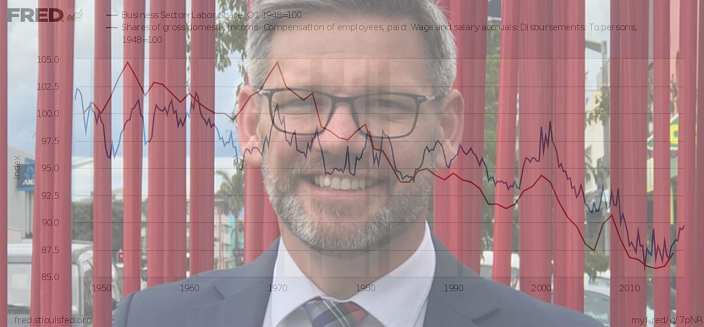
Any last hope that the Sixth Labour Government was still operating on behalf of the New Zealand working class was dashed earlier this week by the announcement of new working visa rules. “Up to 30,000 businesses across the country will benefit” from Labour’s latest kick to the guts of the marginal workforce. This essay explains.

Immigration Minister Iain Lees-Galloway claims that the new work visa rules will “assist between 25,000-30,000 businesses to fill shortages.” Unsurprisingly, the mainstream media is spinning this as a victory for New Zealand businesses, which it undoubtedly is. What they don’t mention, however, is how it’s a commensurate loss for the New Zealand working class.

As this page has previously pointed out, the wage of working-class people is a function of the supply of cheap labour. Increase the supply of cheap labour, as the “Labour” Party have done here, and you weaken the bargaining position of the working class. The more cheap labour there is, the greater the choice for the employers – and they will choose the cheapest labour they can, this being one of their greatest expenses.

The way the economy is supposed to work is that labour shortages force businesses to increase the wages they pay, which leads to marginal workers becoming attracted to those offers. The way the economy works in Clown World is that labour shortages cause employers to go crying to the Minister of Immigration, who fast-tracks visas for cheap labour to move here and undercut the native working class.

The sad truth is that the Labour Party is just as neoliberal and just as beholden to corporate interests as the National Party is – and neoliberals love mass immigration. The only difference is that the Sixth Labour Government is willing to throw the working class a bone in the form of a Winter Heating Allowance, a referendum about cannabis law reform or a bit of money to our mental health system (or what passes for it).

When it comes to actually running the country, however, they’re still very much in bed with the large New Zealand employers, and they still run the country more or less on instruction from those employers. The sad irony is that there was once a time when the Labour Party did stand for the New Zealand worker, and would have heavily criticised a move like this had it been National who brought it in.

Today’s Labour Party is unrepentantly the heir of Rogernomics. Protecting the negotiating position of the New Zealand worker is of no interest to them. Neoliberalism is still very much the way forwards, and the ever-rising suicide rate just something to be shrugged off, despite that adverse economic conditions contribute greatly to it.

The New Zealand media plays an essential role in manufacturing consent among the public for moves like these. Being entirely owned by foreign finance companies and banking interests, the media is beholden to people who profit handsomely from mass immigration driving up housing prices, increasing demands for mortgages and lowering wages.

This is why the media constantly runs stories with titles like “Growers say fruit will rot unless govt speeds up migrant worker decision,” “Labour shortage as Auckland construction ‘goes off’,” and “Why horticulture industry is facing a labour shortage.” These stories are effectively propaganda pieces, run on behalf of corporate interests, to massage the New Zealand population into accepting the mass importation of cheap labour.

Notably, no trade unionist was asked for their opinion on the Government’s move.

One of the stories linked above quotes ACT Party leader David Seymour as saying there simply aren’t “enough New Zealand workers willing to pick [the fruit].” This is a complete lie, because it leaves out half of the equation. Seymour’s sentence makes no mention of the wages being offered. The full sentence should read “enough New Zealand workers willing to pick at the wages being offered.”

Seymour, the consummate neoliberal, loves nothing more than importing cheap labour for the benefit of capital interests and at the expense of the native working class. As Dan McGlashan showed in Understanding New Zealand, no other party has a higher proportion of foreign-born voters than ACT, with a correlation of -0.74 between being born in New Zealand and voting for ACT in 2014.

Short-term opportunism can be expected of Seymour, who knows no loyalty other than to the dollar. It’s a real shame when this mentality guides the actions of the supposed social democrats. If the Labour Party won’t take measures to strengthen the negotiating position of the New Zealand working class, then who will?

The alliance of politicians, corporations and media make it all but impossible for the New Zealand worker to get a fair deal today. Given that the cost of housing is rising much faster than wages, which are already nowhere near high enough to buy houses on, a fair deal seems like it’s getting even further away. An entirely new socioeconomic arrangement is becoming necessary, perhaps one based around a universal basic income.

*

If you enjoyed reading this essay, you can get a compilation of the Best VJMP Essays and Articles of 2018 from Amazon for Kindle or Amazon for CreateSpace (for international readers), or TradeMe (for Kiwis). A compilation of the Best VJMP Essays and Articles of 2017 is also available.

If you would like to support our work in other ways, please consider subscribing to our SubscribeStar fund.

The Gender Wage Gap Is Bullshit

Periodic outrage arises at something called the “Gender Wage Gap.” We are constantly being told that men are paid a certain percentage more than women because of anti-female discrimination and prejudice within the workplace. The problem is that the idea of a gender wage gap is absolute bullshit. Demographer Dan McGlashan, author of Understanding New Zealand, explains.

There is, indeed, a correlation of 0.23 between net median income and being male (and commensurately a correlation of -0.23 between net median income and being female). This is not a very strong correlation, and in this study is only on the borderline of statistical significance.

This does mean that men control slightly more of the nation’s money supply than women do. Some people, particularly on the left, make the assumption that all human population groups are precisely the same, and therefore any difference must be the consequence of oppression. The existence of a positive correlation between personal income and being male is taken as proof that women are systematically underpaid.

However, a closer look at the data reveals the lie in this lazy assumption.

The correlation between being male and having a personal income above $150,000 was 0.03 – essentially nonexistent. The correlation between being male and having a person income between $100,000 and $150,000 was even less than this, at 0.01. This shows that the distribution of the highest-earning jobs is almost perfectly even between men and women.

Indeed, we can see from Understanding New Zealand that there is essentially no difference between men and women when it comes to higher education. The correlation between being male and having a Bachelor’s degree is not significant, at -0.04, and for the postgraduate degrees the correlation is weaker still. So the equal share of educational achievement leads naturally onto an equal share of the top professional jobs.

The best-paid jobs in New Zealand are appointed on the basis of education and not gender. Further proof for this comes from the fact that the correlations between working as a professional and having any degree are extremely strong – around 0.80 to 0.90. The correlation between being a professional and being a male, by contrast, is not significant, at -0.10.

Nearer the centre of the earnings scale we can see that the correlation with being male rises, to 0.22, for an income between $50,000 and $60,000. This correlation is borderline significant, but it is in the wage brackets between $40,000 and $70,000 where the bulk of the nation’s income is earned. All of these wage brackets have a positive correlation of at least 0.18 with being male.

Lower down the earnings scale, we can see that the correlation with being male is negative for all income brackets below $30,000. It is a borderline significant -0.19 for the prime beneficiary’s income bracket of $10,000 to $15,000. Indeed, we can see that the correlation between being male and being on the unemployment benefit is -0.39, so women are significantly more likely to be bringing in less than average.

So if women and men are paid the same at the top levels, why do men earn more in the middle levels?

As mentioned above, the reason that men make more money than women overall is because of the fact that there are more of them in the $40,000 to $70,000 range and fewer in the $30,000 and below range. But the reason for this is not prejudice.

Most of this difference can be explained by the correlation of 0.48 between being male and being in full-time work. There is also a correlation of -0.48 between being male and being unemployed. Simply put, this means that men work a lot more than women do. Further proof comes from the negative correlations between being male and being on the unemployment benefit (-0.39), being on the invalid’s benefit (-0.26) or being on the student allowance (-0.21).

What this means is that the plum jobs are shared out equally between men and women, but the lower one goes down the socio-economic scale, the more likely it is that women will become unemployed instead. This makes perfect sense, because the less one earns the more marginal working becomes in comparison to spending that time on one’s family, and women are much more likely to make such a calculation than men.

The gap in earnings between men and women can be best explained, therefore, not by sexism or any other form of prejudice, but by life history patterns. Men tend to work hard as young adults and then work hard as older adults. Women, by contrast, tend to work hard as young adults and then transition to part-time work as they get older, shifting the primary focus of their concern from their career to their family.

What the statistics show is a very reasonable pattern of women starting out as professionals if they can, otherwise starting at the bottom and transitioning into family care as they age. Men also start out as professionals if they can and also otherwise start at the bottom, but the difference is that they tend to transition into managerial positions as they age. This is evidenced by the correlation of 0.49 between being male and working as a manager.

The “gender wage gap”, therefore, is best explained as the result of different choices made by the average man compared to the average woman. It has nothing to do with prejudice or sexism, and anyone claiming that it does is either misguided or lying.

*

Understanding New Zealand, by Dan McGlashan and published by VJM Publishing, is the comprehensive guide to the demographics and voting patterns of the New Zealand people. It is available on TradeMe (for Kiwis) and on Amazon (for international readers).

A Universal Basic Income Would Pay For Itself In The Bitching It Would Prevent

The Internet is full of bitching about who is entitled to what and who is ripping who off. Endless back-and-forths that have been running for decades already, and sometimes for centuries before the Internet was invented. This bickering does a tremendous amount of social damage, fostering distrust, suspicion and cynicism at all levels. As this essay will examine, a universal basic income would pay for itself by settling much of this bitching.

One of the eternal debates relates to the pension age.

Our society is currently structured so that 64-year olds are made to work under threat of starvation, but 65-year olds are gifted $370 a week from the state until they die, no questions asked. A person’s life is radically different from the week before they turn 65 compared to the week after. Turning 65 grants you access to so much free money that it’s like winning the lottery.

The problem, from the state’s point of view, is that the pension already costs New Zealand some $16 billion dollars per year – a figure that is rising by about a billion a year. This means that there is a great incentive to cut down on costs by raising the pension age. On top of that, many argue that the current pension arrangement in unsustainable, on account of that people are in good health for longer.

Naturally, proposals to raise the pension age are bitterly resented by those close to it. Howls of outrage are inevitable every time the media raises the subject. Also naturally, those younger still, who have no hope of the luxury pension lifestyle that today’s elderly enjoy, don’t give a shit, and are happy to just laugh. Therefore there is bitter resentment on all sides.

We already have a universal basic income for those over 65. If we would lower the size of the payment to something more reasonable, and then extend the age limit all the way down to 18, would could get rid of the need to argue over the pension age entirely.

Another eternal debate revolves around making a distinction between the mentally ill and the lazy. The logic is that it’s fair to pay mentally ill people welfare because they can’t be expected to hold down a job, but it’s not fair to pay lazy people on welfare because it will just encourage them to not work.

The difficulty is, of course, that it’s almost impossible to tell the difference between the two. It’s not at all routine to find agreement between two psychiatrists as to whether a given patient is mentally ill or a malingerer. It couldn’t possibly be, given how complicated the average mind is and how long it takes to get to understand it.

In practice, there’s essentially no way to tell whether a person’s unwillingness to work stems from mental illness (thereby demanding a feminine solution) or a failure of the will (thereby demanding a masculine solution). There is no scientific test, so the psychiatrist just asks a bunch of questions and then offers a degree of help commensurate with how much they like the patient.

This means that a large part of the welfare apparatus – that devoted to distinguishing the “deserving” from the “undeserving” – is superfluous and could be scrapped at no loss. A universal basic income would remove the need for absurdities such as the requirement to get a doctor’s certificate every year or so to “prove” that one was too mentally infirm to hold down a job.

A mentally healthy person will not choose to avoid work, for the simple reason that employment is the only realistic way to meet one’s social needs today. Some people might need to take a break away from intense social pressure on occasion, and a UBI would help them do this. Then they could return on their own terms when able. This would prevent people from being ground down into destruction through the stress of trying to maintain employment with a mental illness.

Seldom does a person stop and think about how much social damage is caused by arguments about who is worthy to receive a basic level of financial dignity and who isn’t.

A universal basic income would settle all of these disputes in one stroke. It would say: there is no such thing as public welfare anymore, only dividends. Every citizen gets a basic dividend of the nation’s wealth, enough to stave off abject misery, no questions asked. No more squabbling about who’s paid in enough and who has been promised what.

There is a lot of talk about a looming financial crisis, and how we can’t lower interest rates to fight it, and will therefore have to print money. The last time we printed money we gave to the banks, and that didn’t help alleviate the human suffering. This time we should print money and give it to everyone to meet their basic survival needs.

If 3,500,000 people received a dividend of $250 for 52 weeks, the total cost would be $45,500,000,000. According to the New Zealand Treasury, crown income was $81,800,000,000 for the 2016/2017 financial year. That same link also shows us that the current cost of social security and welfare is $30,600,000,000, currently paid for by taxation and not money printing.

This means that we could scrap the entire social security and welfare bureaucracy, shift all of the funding for it to a UBI, and we’d only be $15,000,000,000 short. This shortfall could be made up for by money printing, or from increased economic efficiencies brought about by the structural change of every person having government-backed poverty insurance.

One likely side-effect of a UBI is that is will make many things much cheaper.

For instance, without the life-or-death pressure of needing to get a job before one starves, Kiwis would be much more willing to live in places with fewer job opportunities. This would create a drift to rural areas and release some of the demand pressure on urban land. Introduction of a UBI would, of course, mean the termination of the Accomodation Supplement, as there is simply no justification to live somewhere you can’t afford if this isn’t necessary for work purposes.

The fact is that New Zealand needs entrepreneurial activity if it is to succeed this century, and much of this will necessarily be Internet-based owing to New Zealand’s extreme geographical isolation. A UBI would make it possible for small start-ups to get off the ground in the smaller centres, because these start-ups would have much lower initial costs.

The rest of the value might be made up from the social benefits of putting a definitive and official end to all questions about who was worthy of Government assistance and who was a bludger, malinger, thief etc. Everyone gets $250, and when the rate goes up it goes up for all. Because everyone gets it, and the same amount, there would be no question over who is entitled and who isn’t.

*

If you enjoyed reading this essay, you can get a compilation of the Best VJMP Essays and Articles of 2018 from Amazon for Kindle or Amazon for CreateSpace (for international readers), or TradeMe (for Kiwis). A compilation of the Best VJMP Essays and Articles of 2017 is also available.