
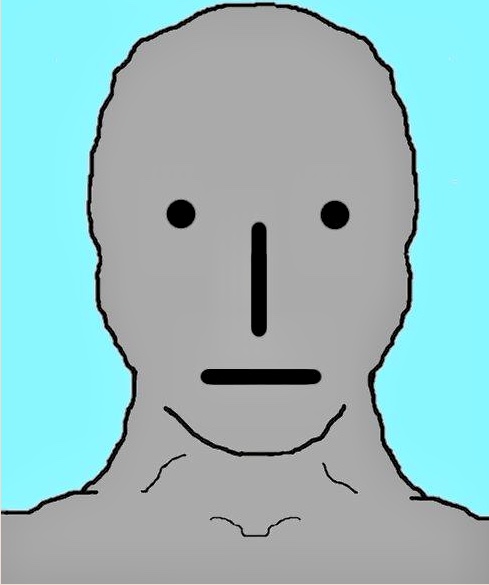
Why You Can Never Know if Another Person is an NPC, And What This Means

Much recent interest has been devoted to the idea that a significant proportion of other human beings might be “NPCs” (non-player characters). What is meant by this is that “the lights are on but nobody’s home” – that the person is not conscious, despite appearing to be. As this essay will discuss, this philosophical problem has a number of chilling interpretations.

When people decry others as NPCs, what they are really saying is that these people are not conscious. There might be bodies moving around and saying and doing things, but there is no conscious observer that pays attention to the lived experience of such bodies. Individual NPCs might just as well be androids of some kind, machines that replicate the functions and actions of conscious beings without actually being such.

The reason why recent interest has attached to this idea is that some people seem to be utterly incapable of thinking for themselves.

Certain political issues have made it apparent that a large proportion of voters do not think about reality at all. They are happy enough to adopt wholesale a Weltanschauung from the television and from their peers. This is especially true if a person adheres to one or the other side of the mainstream political spectrum, but a political allegiance isn’t necessary. Many people’s heads seem to be more or less empty: they simply repeat whatever has been pumped into them from the outside.

This has led others to wonder if there’s anyone really in those heads at all. These apparently unthinking people might be NPCs: essentially meat-puppets that look and sound like humans but which have no conscious will, and who therefore are incapable of creative direction. They can only follow orders like drones, whether those orders come from other humans (PCs or NPCs), the Government or the television. They are therefore categorically different to those of us who are conscious.

But this line of reasoning opens up some extremely thorny philosophical questions.

Primary among these is that you can’t measure or detect consciousness empirically. Consciousness is a state of being aware, and this is impossible to measure because awareness cannot be detected by any instrument. A materialist will object that it is possible to measure responsiveness, and this can be done with (for e.g.) EEG machines that can tell whether a person is awake – but these measures are always of purported correlates of consciousness, not consciousness itself.

We seem to intuitively believe that being “awake” is somehow linked to being conscious, but the simple fact is that we are also conscious of experiencing dreams, and are therefore also conscious even when asleep. Therefore, our intuitive perceptions about who is conscious are not necessarily accurate. It may be that the common perception that all humans are conscious is erroneous.

One can be aware of one’s consciousness, of course. This is logically trivial: if one is conscious of anything at all, then one is conscious. Therefore, if you’re even aware of yourself asking the question of whether or not you’re conscious, you must be. Although, because one’s own consciousness cannot be measured any more than that of other beings can, its presence cannot be proven to anyone other than oneself.

It really seems that the only way consciousness can be sensed in others is by means of some intuition. It certainly seems as if consciousness can be detected in others; at least, this seems intuitively true to most people. This is the basis of the NPC phenomenon: by whatever means this intuitive decision is made, a person decides that another person is either conscious or not.

The difficulty then arises: is it true that all other humans are conscious, or only some? Because not everyone necessarily agrees. Some argue that only their race is conscious, and that others are some kind of ‘bugmen’. Others argue that only members of their religion are conscious, because only these have been “infused with the light of God” or similar. Yet others argue that only members of their class are conscious, and that the poorer someone is, the more like an animal.

The obvious problem with this way of thinking is that it leads to asking questions like: if other races/religions/classes are not conscious, why not just wipe them out for the sake of securing a better position for our own? It’s clear to anyone who has studied World War II that the dehumanisation of other people, by way of declaring them less conscious, can easily lead to bloodshed and genocide. This is why the vast majority of people have adopted the unspoken assumption that all other humans are conscious.

Even if all humans are declared conscious, one must then ask if all other beings are conscious, or only some?

Another thorny philosophical question is moral: if another individual is an NPC, and therefore not conscious, is it immoral or not to exploit that individual? One the one level, it seems like nothing should be different, but on another, it could be argued that if nothing is aware of any injury caused to the physical body then it isn’t really suffering. Therefore, harm done to beings that are not conscious is not immoral (unless those beings are the property of someone else).

Because you can never really know if another person is an NPC, the default response seems to be to assume that no-one is, i.e. that all other people are conscious and that their suffering is meaningful. This is certainly the approach that a courtroom will take if you beat up someone because you think they are an NPC. But you can’t ever really be sure.

*

If you enjoyed reading this essay, you can get a compilation of the Best VJMP Essays and Articles of 2017 from Amazon for Kindle or Amazon for CreateSpace (for international readers), or TradeMe (for Kiwis).

Folksjälvmord

On my first visit to Sweden, from 2001 to 2003, I found occasion to coin a word in the Swedish language. They already had a word for genocide (‘folkmord’) and they already had a word for suicide (‘självmord’), but they didn’t have a word for the sociological phenomenon, widespread at the time, that combined both. This essay discusses ‘folksjälvmord’ and the reasons for it.

If you have 1,000 crowns in one bank account at 6% interest, and 100,000 crowns in another bank account at 2% interest, inevitably the first account will become larger than the second (assuming no withdrawals or changes to the rate). This is a matter of mathematical certainty, and can be proven true in every case where a smaller balance has a higher interest rate than a larger balance. No-one disputes this.

By similar reasoning, we can see that if the population of a minority group is increasing faster than their host population, then the minorities will eventually outnumber their hosts. Assuming no withdrawals (i.e. deportations or genocides), then a population that has a fertility rate of 3.0 plus 50,000 immigrants per year will eventually grow to overwhelm a population that starts out a hundreds times larger, but which only has a fertility rate of 2.0 or less (and no immigrants).

This process is known straightforwardly as “conquest” in any other context, but when the host population has an overwhelming military advantage compared to their invaders it isn’t so simple. If the hosts are willingly paying tax money to import these minorities, and then paying again to have those minorities breed while on welfare, then they’re effectively paying for their own ethnic cleansing.

This process can only be likened to a collective suicide, or suicide at the level of the population – folksjälvmord. After all, politics is little more than the expression of power, and the expression of power is mostly a numbers game, particularly in a democracy. If the host population stops being the majority then they give up power, and giving up power within your own country to a foreign entity that you imported can only be analogised as stabbing oneself in the leg or stomach, perhaps harakiri style.

Swedes didn’t think much of my witty neologism. The thought that it might happen to them seemed to be so unpleasant that it simply couldn’t be countenanced. It didn’t seem to matter to them that the same process of inevitable mathematical conquest was precisely what happened in the New World, where I came from. Better to simply blindly believe that all would be well than to ask how the Africans and Muslims would behave when they comprised 20%, 30%, 40%, 50%+ of the population.

This wilful, oblivious ignorance about the state of their situation might be likened to a delusion-based psychiatric illness, in the same way that someone who is obviously dying but who refuses to admit it.

A man addicted to heroin doesn’t want to hear that the drug will soon kill him; a nation addicted to virtue-signalling and self-righteousness doesn’t want to hear that the mass importation of foreigners with incompatible values will soon destroy them. In either case, a well-meaning observer might be well aware that the behaviour in question was effectively suicidal.

Sixteen years after this first visit of mine, it’s possible to observe the results of the practice of folksjälvmord. Although the decay of the country is yet to reach the elites – and therefore, yet to be officially acknowledged – the Swedish people are certainly aware of it. They responded by giving 18% of their votes to the far-right extremist Sweden Democrats in a General Election last month.

In Germany, which has also recently imported a large number of low-IQ immigrants, a similar phenomenon can be observed. Opinion polls for the next German Federal Election show that the far-right extremist Alternativ fuer Deutschland is now polling higher than the Establishment social democrats. This phenomenon is likely to spread to other nations that let in large numbers of “refugees” against the better judgment of the more sober of their citizens.

Folksjälvmord, then, doesn’t simply refer to a declining population, because populations (historically speaking) tend to resist conquest with as much violence as they can muster. It can also refer to the coming to power, within a nation, of groups of people who are patently unfit to rule, and who wreck the place. Folksjälvmord could, in that context, be considered a symptom of a dark age, or Kali Yuga. The destruction is as much internal, and spiritual, as external and physical.

The state of the world has notably changed since first coining the term ‘folksjälvmord’. The national suicides of the European nations are continuing apace – but now the Far East Asian ones have joined them. Indeed, the fertility rate in Far East Asia is now lower than Northern Europe (China 1.6, Japan 1.4, South Korea 1.2, c.f. Sweden 1.9, Netherlands, Denmark and Norway 1.7), and is continuing to fall there.

Perhaps the most frightening realisation is that folksjälvmord is far from a uniquely Swedish, European or even Western problem. It seems to be a natural part of the ebb and flow of empires and the golden ages of various peoples: as before, so after.

*

If you enjoyed reading this essay, you can get a compilation of the Best VJMP Essays and Articles of 2017 from Amazon for Kindle or Amazon for CreateSpace (for international readers), or TradeMe (for Kiwis).

Why Science, Correctly Performed, Will Lead To A Belief In God

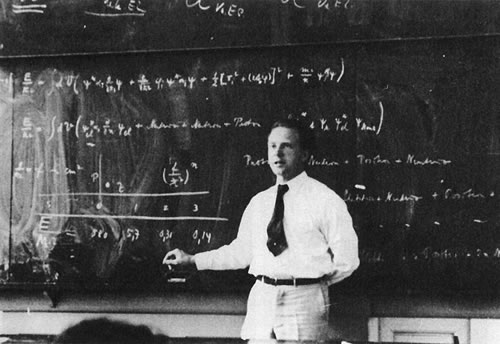
Nobel Physics Prize laureate Werner Heisenberg once said “The first gulp from the glass of natural sciences will turn you into an atheist, but at the bottom of the glass God is waiting for you.” Something that Heisenberg understood, but which most lesser scientists do not, is that a belief in God will arise from doing science correctly. As this essay will examine, atheism is not necessarily the correct attitude to take into the natural sciences.

The scientific method begins with determining what we know for sure, and from there reaching out to what else can be stated with some degree of certainty. For instance, if a particular chemical reaction has transpired in a particular way a hundred times, we can predict with a high level of certainty that it will transpire that way one more time. From there, we can make alterations to our methodology in order to learn more.

What do we know for sure?

As it turns out, there is only one thing that a person can know 100% for sure: that they are conscious. Everything else is necessarily a matter of faith. Every belief, apart from the belief that one is conscious, is a matter of faith, because it is a statement about the material world.

All phenomena within the material world are known to be transitory, and therefore they contain an element of chaos that precludes total understanding of them. One might declare with certitude that “The Sun will rise tomorrow,” but even this is an article of faith – the Earth could be struck overnight by a gigantic comet that reduced the planet to cosmic rubble, thereby proving one wrong.

Although one might be 99.9999% sure about such predictions, one can never truly be certain, in the way that one can be certain that one is conscious. No prediction that depended on the permanence of some aspect of the material world could ever be made with 100% certainty – Heisenberg himself expressed this understanding with his Uncertainty Principle. It is certainly possible to predict that things will change (i.e. that you will die), but it is seldom possible to predict precisely when.

If one doesn’t know for sure that the material world exists, but one knows for sure that consciousness exists, then it doesn’t make logical sense to assume that the material world is the basis of reality. Consciousness can easily create the impression of a material world – it does so every night in our dreams. But there is no scientific explanation, no plausible explanation, that can demonstrate how the material world might develop consciousness. All talk of “emergent properties” is merely materialist dogma, special pleading.

Ockham’s Razor tells us that it’s more likely that consciousness dreamed up the material world and Planet Earth, in much the same way that it dreams worlds at night (an explanation that requires one step), than that the material world spawned from nowhere and evolved to be conscious (an explanation that requires hundreds, if not thousands of steps).

Therefore, there is no reason to assume that the death of the physical body ought to affect consciousness. If the material world is simply a set of phenomena that are dreamed up by consciousness, then there is no reason to assume that the death of one’s physical body ought to affect that consciousness. Therefore, there is no reason to assume that consciousness “disappears” or “dies” or even so much as changes form when the physical body dies.

The real question, then, is: of what does one become conscious upon the cessation of the temporal patterns that corresponded to one’s physical body? It isn’t easy to speculate about such things, because it depends on how laws from this world translate to the next. One thing can be said for certain though: of the next world, one will be conscious.

Ockham’s Razor can also be applied to the realm of biology to support the contention that consciousness is the prime materia.

Evolutionary science tells us very clearly that organisms do not evolve unnecessary appendages. None of limbs, organs, or parts of the brain will come into existence unless there is an evolutionary pressure that favours them. This will only be the case if those limbs, organs or parts of the brain (or early forms of them, at least) confer some kind of selective advantage. Without this advantage, there will be no selective pressure in favour of that appendage, and without that pressure it will not come to exist.

Consciousness confers no survival advantage. The human animal does not need to be aware in order to carry out any of its survival functions. All of the thoughts and calculations that the human brain performs over the course of a human life could just as well be made without consciousness. After all, a computer or android could be programmed to scan its physical environment for the sign of predators or food sources. It wouldn’t need to be conscious to do so.

If consciousness confers no survival advantage, then it cannot have been selected for by natural selection (i.e. by biological or material means). If it was not selected for by natural selection then it cannot be biological and attached to, or arising from, any part of the brain. To the contrary – the material world, including the brain, arises from consciousness.

If consciousness can dream up this world, and if it can dream up the fantastic nightscapes of our dreams, then it can dream up an infinitude of other world, realms and dimensions. And indeed it has – the entire rest of the Great Fractal is currently being explored by consciousness, in an infinitude of realms that you cannot even hope to perceive (yet).

Anything within the Great Fractal (i.e. everything that it is possible to perceive) can be dreamed up and explored by consciousness. Consciousness is infinitely creative. Consciousness can find a way to perceive anything that is perceivable. If it’s perceivable, then there’s a path to it through the Great Fractal from where consciousness currently is.

This effectively means that consciousness is omnipotent: after all, it is capable of conjuring anything from all the permutations of what’s possible.

It is often said that belief in God is a question of faith. Indeed it is. There is no possible way to prove that any being apart from oneself is conscious. All other beings could be conscious like you, or they could be programmable meatbags – and you have no way to prove otherwise. If they are conscious, that consciousness cannot be observed or measured. There is no instrument that will detect its presence or absence.

If consciousness is eternal, has the power to create anything possible, and whose presence in others is necessarily a question of faith, then consciousness is therefore God. It fulfills all of the criteria commonly attributed to God by Epicurus and others. This understanding can be arrived at scientifically, by logic, without need for faith.

*

If you enjoyed reading this essay, you can get a compilation of the Best VJMP Essays and Articles of 2017 from Amazon for Kindle or Amazon for CreateSpace (for international readers), or TradeMe (for Kiwis).

The West is Undergoing A Cultural Revolution

The goal of destroying a population’s links with their past is – as it was in Maoist China – to make them more amenable to the imposition of a new ideology

The stated goal of the Chinese Cultural Revolution was to purge all trace of capitalist and traditional elements from Chinese society, clearing the slate for the imposition of Maoism. This was soon regarded as a catastrophic mistake, for predictable reasons. This essay argues that the West is, right now, undergoing a similar cultural revolution.

The Communists of the West have now completed their Long March through the institutions. Their control of the education system is now so total that Western schools could hardly be more effective brainwashing institutions if they had been designed with that objective in mind. The social pressure to conform to a politically correct worldview is so great that the vast majority succumb, simply becoming repeaters of indoctrination.

These repeaters go on to repeat the politically correct worldview they are programmed with, and they do this with all the fervour of a person raised in a fundamentalist religion. And so, it is now assumed that, in every conflict, the side with the least amount of power is automatically the morally correct side, which is Marxist morality in a nutshell.

This moral value has now driven out most of the others. It is now widely believed that it’s immoral to have a decent life, and that the more decrepit one is the more moral one must be. All winners are now losers, and vice-versa. The Western Cultural Revolution is under way.

Our ancestors, who built this decent life for us to enjoy, are no longer to be seen as heroes who crossed mighty oceans to carve nations out of forests and mountains with sweat and toil. No longer are they to be venerated for passing down a niche for us to survive in. Instead they are to be despised for the damage they did to those forests and mountains, and to the primitives that may have lived there before them.

We are destroying all of our contacts with the old, and signs of this painfully fashionable iconoclasm can be seen everywhere.

In the New World, it’s evident from the tearing down of statues and the reinterpretation of history to cast white settlers and pioneers as oppressors and other ethnicities as victims. The noble savage mythology has seen a resurgence; it has become politically incorrect to point out the horrific rates of homicide and easily preventable deaths in native societies before European contact. The tribal warfare and mass slaughters that occurred before the land was pacified by Europeans are taboo to mention.

In Europe, it’s evident from the shattering of national identities that has transpired in the wake of mass Muslim and African immigration. Propaganda inviting Germans to consider ethnic non-Germans to be “typisch Deutsch” has the effect of shattering the bonds that Germans have with their ethnic ancestors, who have of course been German for thousands of years.

The purpose of this Western Cultural Revolution is the same as it was in China: before Communism can be imposed on a population, all of their traditions must be destroyed, so that they have no solid ground from which to resist. Totalitarianism is total. The citizens must learn nothing from their parents or grandparents – all knowledge, all wisdom comes from the State and only from the State.

Part of this cultural revolution is the rejection of historical narratives that were inherited from the elders. For instance, the narrative that European people and Maoris co-operated for centuries to collectively raising these islands from the Neolithic Age to the highest standard of living in the world, is gone. It has been replaced by a narrative of exploitation and grievance, revenge and resentment.

This new narrative is intended to drive a wedge between white people and Maoris, disorientating, weakening and confusing them both – and making them both optimally conducive to instruction from authorities such as Government and corporate media (who are now working hand in glove to milk the cattle class of everything). Destroying the people’s historical narrative of what it means to belong to their nation makes those people more malleable.

This Cultural Revolution is also Communism – not on the scale of China, but on the scale of the West. The traditional narratives of all Western nations are to be destroyed so that the populations will be maximally amenable to the mass immigration that the corporate class demands for the sake of pushing down wages. As this newspaper has investigated elsewhere, it’s already impossible for the majority of young people to ever own a house on the wages that are being paid nowadays. But the corporate class will go further.

As ecological pressures lead to a shrinking economic pie, the ruling classes of the West need to find some way to convince the masses to accept a lower standard of living, and ideally without having to accept a lower standard of living themselves. They will do this by way of imposing a new ideology on us – likely some kind of globalist envirototalitarianism. To make us accepting of this new doctrine, they will destroy all contact we had with our national past and with our ancestors.

This is the Western Cultural Revolution, and it will be no less destructive and ruthless than the Chinese one.

*

If you enjoyed reading this essay, you can get a compilation of the Best VJMP Essays and Articles of 2017 from Amazon for Kindle or Amazon for CreateSpace (for international readers), or TradeMe (for Kiwis).