
An Introduction To Great Fractal Theory

Works such as The Verity Key (published 2012) make reference to something called the Great Fractal, a concept expounded upon in an essay published here in 2017. Great Fractal Theory is a subset of a wider philosophy known as Elementalism. This essay provides a basic introduction.

Great Fractal Theory starts with a simple premise: that consciousness is the prima materia. Consciousness was the first thing to exist, and everything else comes after and is dependent upon it. Consciousness is more fundamental than both time and space, and therefore does not need to have a beginning, an end, a cause, or a final destiny. It simply is.

Everything else that exists falls into the category of ‘the contents of consciousness’. Here we find the metaphysical world (that which Plato referred to as the ‘World of Forms’), and the physical or material world (that which we’re used to calling ‘Earth’).

The material world is not truly real, despite the fact that it appears very real. In fact, it has been dreamed up by consciousness, in the Great Act of Creation. Consciousness is therefore the creator of the material world, in the same way that it creates the worlds we navigate in our dreams. It is the stage upon which the play on life takes place.

The material world is most accurately understood as not being a place, then, but rather a matrix-like series of self-similar sets of perceptions that manifest in conscious awareness. Consciousness perceives a field of impressions that collectively create the illusion that we are bodies living in a material world, as opposed to consciousness dreaming it up. As such, we appear to be ‘living’ rather than simply experiencing.

The essence of Great Fractal Theory is that all of the possible fields of impressions that consciousness could ever perceive are related to each other by way of a fractal matrix. This matrix, known as the Great Fractal, contains every emotion, every thought, every desire and every sensory impression that could ever possibly manifest in conscious awareness.

Our lives do not involve being bipedal fleshsuits moving around on a rock in space, but rather being fragments of consciousness navigating through an eternal and ever-changing Great Fractal of self-similar fields of sensory impressions.

The easiest way to conceptualise the Great Fractal is to think of one’s own life.

Consciousness is, right now, experiencing not only your current life but also all the possible gaps in between your birth and your death. Your own personal fragment of consciousness may be living right now, in 2020 A.D., but other fragments of consciousness are living out every possible moment of your life, simultaneously.

By “every possible moment”, imagine that your life was divided into a billion or so chunks, each corresponding to a second or two of awareness. Think that all billion of these fragments of consciousness are living their own lives, unaware of the presence of the others. Then think that each of these billion fragments could themselves be divided into a billion fragments.

Now imagine these quintillion or so lives, each separated by one or two nanoseconds, rolling from birth to death like freight carriages on a railway. One ends and one begins every few nanoseconds, and follows the exact path of the life that you are experiencing right now, past and future. This is what Nietzsche meant by eternal recurrence: your life is lived again, by another fragment of consciousness, forever.

Now imagine a parallel streak made up of lives of people who are of the other gender to you. Their lives are otherwise exactly the same, only they came into the world female instead of male (or vice-versa). These lives would have followed an entirely different path on account of that they would have had different instincts and would have been treated differently, but a life they would have had.

This parallel streak of lives can also be divided into a quintillion separate existences. Now takes this dual streak of lives, and change another facet from masculine to feminine or vice-versa. If you are rich, imagine another dual streak of lives that is poor. If you are short, imagine another streak of lives that is tall. If you are white, imagine black etc.

Every possible way that a human life can differ from another is another dimension of the Great Fractal. This number of dimensions is close to infinite – there are as many different dimensions of this Great Fractal as there are ways to distinguish one human life from another. So not only does every moment of every human life exist in the Great Fractal, but so does every moment of every possible human life.

If we say, for simplicity’s sake, that there are a hundred different dimensions along which human lives could differ, that would mean that the Great Fractal contained at least one quintillion to the power of a hundred different human lives in it – a number that defies comprehension.

All of these lives are being lived right now.

On top of this has to be added not only the lives that are possible according to the specific world that has manifested to us (i.e. Earth), but all the possible lives in all possible worlds. These possible worlds might also differ from each other over a hundred different dimensions.

This would mean that the number of human lives being lived right now is (at least) one quintillion to the power of a hundred to the power of a hundred. This number would cover all the fragments of consciousness that are right now experiencing a human-like life in an Earth-like world, somewhere in the Great Fractal.

Trying to understand this is enough to understand that the Great Fractal is humming with consciousness.

On top of this, we could add all of the non-human lives being experienced by consciousness right now. There’s no reason, other than anthropomorphic conceit, to believe that only human beings are conscious. Once it’s realised that consciousness is the prima materia and not a phenomenon of the brain, it becomes entirely possible that all other animals, indeed even insects and trees, are conscious like we are.

If we assume, for simplicity’s sake, that the number of dimensions along which life can vary is a hundred, then the number of different lives being experienced by consciousness right now is at least 1,000,000,000,000,000,000 ^ 100 ^ 100 ^ 100. This is a nonsense number as there’s no way that a human mind can comprehend it. However, our failure to comprehend it is the glory of God.

In sum, anything that can possibly be perceived by consciousness lies somewhere in the Great Fractal. All moments of all lives of all possible creatures in all possible worlds are contained within the Great Fractal, to be experienced by consciousness eternally. Your life is simply an infinitely small fragment of this incomprehensibly vast whole.

Getting what you want out of life is not, as most think, a matter of manipulating and dominating the material world until it accords with your will. Making your dreams come true is simply a matter of navigating your consciousness to the part of the Great Fractal in which those dreams are experienced. This is, however, a topic for another essay.

*

If you enjoyed reading this essay, you can get a compilation of the Best VJMP Essays and Articles of 2019 from Amazon for Kindle or Amazon for CreateSpace (for international readers), or TradeMe (for Kiwis). A compilation of the Best VJMP Essays and Articles of 2018 and the Best VJMP Essays and Articles of 2017 are also available.

*

If you would like to support our work in other ways, please consider subscribing to our SubscribeStar fund. Even better, buy any one of our books!
Why Is Rent-Seeking Legal?

Our legal system has many quirks and contradictions that defy easy explanation. It seems strange that doctors are allowed to mutilate the genitals of infant boys, yet they are not allowed to prescribe medicinal cannabis products that would save lives. This article will discuss another activity of questionable morality: rent-seeking.

Rent-seeking is an attempt to increase one’s personal wealth without creating or producing any. It is the use of resources, such as land, to extract economic benefits (known as rents) from others without making any contribution to the overall economic good.

The most common form of rent-seeking today is found in residential property. There are some 625,000 rented houses in New Zealand today, and the average weekly rent is $390 a week for small houses and $525 for larger ones. Assuming an average rent of $480 per week, rents on residential property bring in some $15,600,000,000 every year in New Zealand alone.

Rent-seeking is correctly understood to be a form of parasitism. As with other forms of parasitism, rent-seeking is a net negative for the overall health of the system. Not only does it suck money away from the productive and gift it to the unproductive, it also incentivises anti-social behaviour. Economically, it disrupts market efficiencies, limits competition and creates artificially high barriers to entry for market participants.

Despite being a form of parasitism, rent-seeking is a long and honoured tradition in New Zealand. Many a fortune has been built in this country by taking advantage of people’s need for shelter from the elements. As a previous essay here has discussed, there’s nothing as profitable as human suffering, and being exposed to the elements is one of the worst kinds of suffering.

The beauty of rent-seeking is that it carries little risk. All you need to do is to own property and the Police will keep people away from it unless those people pay you money. As long as there are men willing to enforce other people’s claims to property in exchange for a wage (and there always will be), then owning some of that property is effectively a licence to print money.

In reality, there’s little difference between a landlord charging someone rent on the threat of throwing that person out into the street, and an armed robber charging someone their wallet on the threat of stabbing them in the guts. In both cases, the power to charge a fee or levy comes from the power to cause extreme physical suffering. Both are a form of extortion.

Given the apparent net harm of trying to extract wealth from the system instead of creating it, the question has to be asked: why is rent-seeking legal?

The main reason why rent-seeking is legal is simply because the rent-seekers make the laws. It was they who, way back in the day, invented Government by paying some weak-minded arse-lickers to defend their property against outsiders (this is all that Government is). Those arse-lickers bifurcated into the Police and security services (whose prime directive is to protect and serve property owners) and the Government (whose prime directive is to organise the protection of property owners).

At the end of the day, the Government is there to manage the affairs of the rich, and they don’t care if the poor are impacted adversely. People too poor to own property don’t have a seat at the table. This is the same reason why businesses were compensated directly in the form of wage subsidies, rather than workers being given a universal basic income – the wealthy take the lion’s share, the poor get the scraps.

This arrangement has created a great deal of resentment, however. Those forced to pay rent on threat of being thrown into the street don’t feel much less resentful about it than those forced to give up their wallet on threat of being stabbed. The fact that rent-seeking is socially accepted in our culture barely softens the blow. It still feels like a robbery.

As is usually the case for such abuses of power, this resentment has built to the point where it threatens to spill over.

The Sixth Labour Government has made it illegal to evict tenants from residential property for the next three months at least. Some groups of tenants have realised that, if they collectively refused to pay rent until the end of the coronavirus crisis, they could pretty much get away with it. There’s no way to enforce an eviction during the lockdown, so anyone who refuses to pay rent from now on can get at least three months of living rent-free.

Other people and places overseas have already declared rent strikes on account of that the coronavirus has made earning their usual income, and therefore paying their usual expenses, impossible. Housing Minister Megan Woods has said “there was also an obligation on tenants not to abuse the situation,” but it’s hard to see why, other than the possible threat of being blacklisted in the future.

The only reason why property owners can get tenants to pay them rent in the first place is because they have the power to force them to on threat of eviction. If that power is taken away, there’s little reason for those who had been coerced into paying rent to continue playing ball.

Perhaps the fairest outcome would be to continue to allow the extraction of rents, but to levy a 90% tax on incomes derived from it. An outcome similar to this was discussed in a previous article here that proposed the introduction of Georgist-style taxes on rent-seeking activity.

In short, rent-seeking is legal because it always has been, and because we’ve never questioned it. We’ve never been able to, because not only did the rent-seekers control the law enforcement forces but they also controlled the apparatus of propaganda, and these combined to normalise the practice. The legitimacy of rent-seeking doesn’t survive scrutiny, and there is a very real chance that it will be as illegal as armed robbery later this century.

*

If you enjoyed reading this essay, you can get a compilation of the Best VJMP Essays and Articles of 2019 from Amazon for Kindle or Amazon for CreateSpace (for international readers), or TradeMe (for Kiwis). A compilation of the Best VJMP Essays and Articles of 2018 and the Best VJMP Essays and Articles of 2017 are also available.

*

If you would like to support our work in other ways, please consider subscribing to our SubscribeStar fund. Even better, buy any one of our books!
Things The Coronavirus Has Already Proven

The Great Coronavirus Pandemic of 2020 is only just beginning. Although it is already dominating the headlines, most of the suffering is still to come. Exactly how much suffering there will be – and who will suffer it – is still unknown, as are most outcomes of this rapidly-unfolding drama. However, there are some things that this pandemic, and the response to it, have already proven. This essay explains.

Many people, mostly for egotistical reasons, believe that human beings are categorically superior to other animals. The usual belief is that our high brain volume to body volume ratio has granted us an unmatched degree of intelligence, if not spiritual insight. Therefore, we’re above “animal behaviour”.

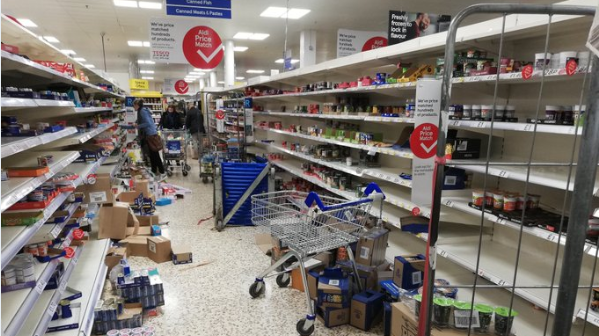
The ongoing panic buying that has seen supermarkets in the West stripped bare is stark evidence against this. Human beings are another kind of primate, only narrowly less impulsive and aggressive than the others. The “monkey see, monkey do” logic that causes juvenile primates to imitate their peers is on vivid display in the now numerous videos of people fighting over water and toilet paper.

In reality, humans are just as prone to panic-fuelled acts of selfish aggression as any “lower” animal. All we need is enough fear to cause a limbic hijack and we’re operating on raw animal instinct again. The ongoing coronavirus pandemic has proven that we’re as susceptible to that panicky fear as any flock of sheep.

A second thing that the COVID-19 pandemic has proven is that borders are good. Because the West has been so wealthy for so long, we have developed a kind of tameness. We forgot that the world is dangerous, and that much of that danger comes in human form. We started to believe the fatal delusion that all human groups are the same.

The pandemic caused us to remember that borders are there for a reason – the same reason why you have a fence around your property and skin around your body. It’s to keep bad things out. Esoterically speaking, a border is just a hard masculine line that protects a softer, feminine core, like a skull, a ribcage, a door or a fence.

We have now remembered that borders are good because they keep bad things out. Whether people infected with viruses or people infected with hate-filled ideologies, borders serve to keep us safe from danger. The COVID-19 pandemic has proven that having open borders makes as much sense as leaving your front door open at night.

A corollary to this is that the pandemic has proven that the Government can stop mass immigration if they want to.

For the past few decades, neoliberals have screamed that everything would collapse if we stopped the mass importation of cheap labour – our fruit and vegetables would go unpicked, our garbage would go uncollected and our elderly would go without care. Western Governments have closed the borders anyway, reasoning that, absent cheap labour imports, wages will rise to the point where these jobs can be filled by natives.

More worryingly, the COVID-19 pandemic has proven that our dependence on offshore supply chains for some basic goods and medicines has made us not only economically vulnerable, but also strategically vulnerable.

Many industries are running into procurement difficulties, because China shut down so many of its factories and docks that the flow of exports has been throttled. Many Western manufacturers are just learning that, because so much has been outsourced there, when China shuts down the world shuts down. It has become common to hear a person exclaim their recent realisation that X% of a vital industrial widget is produced in China and so, without Chinese production, no-one can get hold of it.

Our exposure to medical shortages threatens to be much worse than our exposure to industrial shortages.

Two weeks ago, India, the world’s leading producer of generic drugs, instituted export restrictions on 26 of them. Because the coronavirus pandemic has impacted pharmaceutical factories in China, many Indian drug manufacturers can no longer acquire precursor ingredients. The panic buying has already shown how close we are to chimpout – once people start being told that the pharmacies can’t supply their psychiatric medicines there could be riots.

Perhaps more fundamental than any of these things is that COVID-19 has proven that the Government doesn’t know what the fuck it’s doing. This was already widely understood by most intelligent people, but by now most poeple have had the nauseating realisation that the Government is made up of people who are good at winning elections and not people who are good at governing. All around the world, they are panicking.

One of the main things that Western authorities now have to concern themselves with is civil unrest. It’s slowly dawning on people that this pandemic has the potential to disrupt life as we know it for a significant length of time. As this realisation spreads, all kinds of negative sentiments will grow. Anger, fear, vengeance and short-term thinking will all increase – and they won’t be rational.

The COVID-19 pandemic has proven that our society is on much shakier foundations than it used to be, and shakier foundations than many had realised. The bonds of solidarity that comprise every community are much fewer and much weaker. The potential for chimpouts at any time have never been greater.

*

If you enjoyed reading this essay, you can get a compilation of the Best VJMP Essays and Articles of 2019 from Amazon for Kindle or Amazon for CreateSpace (for international readers), or TradeMe (for Kiwis). A compilation of the Best VJMP Essays and Articles of 2018 and the Best VJMP Essays and Articles of 2017 are also available.

*

If you would like to support our work in other ways, please consider subscribing to our SubscribeStar fund. Even better, buy any one of our books!

Diversity Is A Strength In Times Of Plenty, And A Weakness In Times Of Shortage

The Establishment and the mainstream media like to say that diversity is a strength. This opinion is aggressively rejected by most of the working class, who consider it a great weakness. The reality, as this essay will discuss, is that both sides are right – but only in the appropriate context.

Since the end of World War II, the West has enjoyed great prosperity. Our stockmarkets, factories, airports and seaports have all boomed from the ever-increasing demand. Most people felt like they were getting a good deal, or that, if they weren’t, they soon would. During this great age of plenty, diversity has generally caused more pleasure than pain.

In times of plenty, diversity is a strength. When the economy is growing, and no-one has to worry about competing with each other, then diversity means an enrichment of the everyday experience of life. It means new foods, new cultural displays, new ideas. It means an exciting, vibrant increase in novelty.

In times of shortage, however, diversity means something else.

Every community is divided along fracture lines – lines of race, gender, religion, age, education and cultural affinity. In good times, these fracture lines are papered over by wealth – people don’t need to fight if everyone has enough to meet their own needs. In bad times, these fracture lines are exposed and aggravated.

When times are tough, the community needs to pull together. A given community’s ability to pull together depends mostly on its level of solidarity, and that in turn depends mostly on the number and degree of commonalities that members of the community have with each other. After all, ‘commonality’ and ‘community’ have a similar etymology.

The presence of commonality means co-operation. Where commonalities exist, people are happy to help each other, because they know that this help will benefit a person like them. This knowledge assures them that the help will be reciprocated, and not just taken. They can count on getting helped in the future, and so feel like part of a society, a wider kinship group.

A lack of commonality means exploitation. The rule is that people are willing to exploit others to the degree that those others are different from them. The greater the number of fracture lines in a community or society, the greater the degree of exploitation that exists. As mentioned above, this is no big deal when the economy is expanding, because this means new niches open up for people to move into.

In times of shortage, however, diversity means that helping other people is helping people who aren’t your kin. The natural inclination, then, is to keep for yourself, to not share. The problem here is that people get desperate in times of shortage. When people are desperate, a refusal to share with them often leads to violence.

Diversity makes it much harder to settle the tensions that arise from shortages. Two people of the same culture can use their shared moral values to come to a mutual agreement. If they have a common language, they can talk their way to a mutual understanding. Absent these things, misunderstandings lead to flaring tempers.

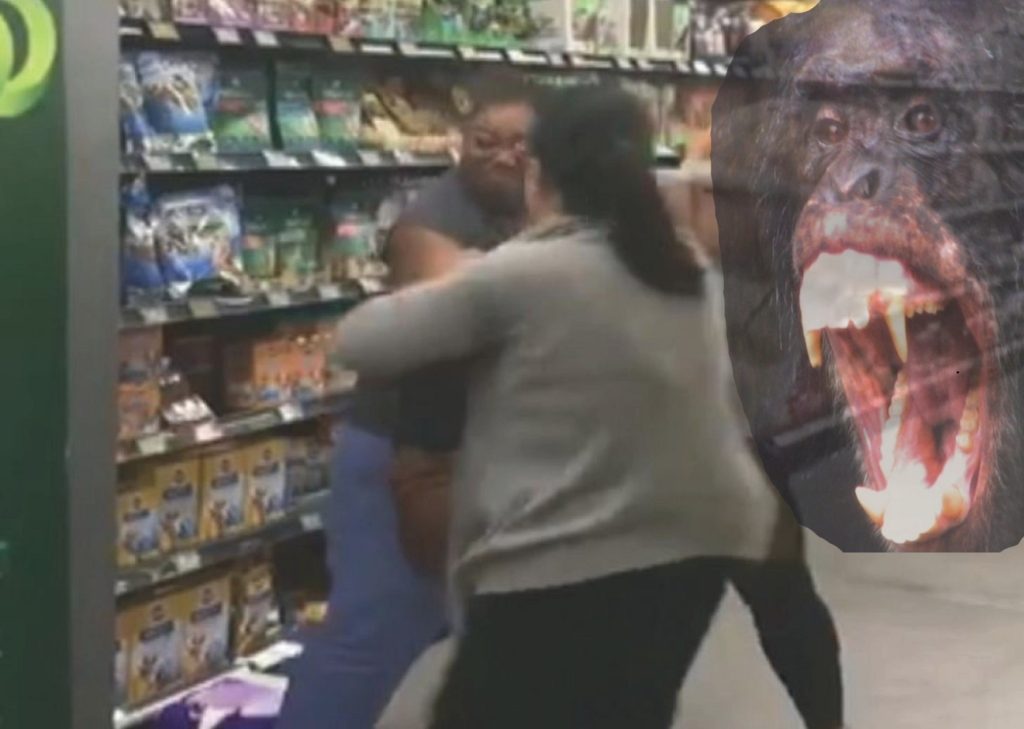
Arriving at a mutual agreement in times of scarcity is much easier between two natives than between a native and an immigrant. Between two immigrants, as we see in the Woolworths toilet paper fight video linked above, there is a minimum of commonality, and this regularly ends in actions that are not made from a place of empathy.

If the COVID-19 pandemic does have a severe enough economic impact to cause widespread shortages, some people are going to be forced into making some terrible decisions – and much more terrible than what brand of toilet paper to buy because their preferred one is sold out.

Faced with two patients who can’t breathe, and only one ventilator, the medical staff dealing with the pandemic are going to be forced to make decisions as to who lives and who dies. There are already reports that Italian doctors have been forced to leave old people to die on account of that there aren’t enough beds in intensive care units. Increasing diversity means that some Italian doctors will have to decide whether an elderly native Italian or a younger immigrant gets the ICU bed.

More relevant to the average person are the hundreds of small decisions that they will have to make about questions that test their loyalties. Some people have been stockpiling hand sanitiser on account of that the sudden shortage of it has spiked the price. These price gouging actions have been heavily criticised, on the grounds that not only are they shamelessly opportunistic but they also prevent needy people from getting supplies.

But in a highly diverse society, the balance of rewards is different to what it would be in a more homogenous one. The more diverse society is, the less likely such actions are to harm a person who has something in common with you. All the profit from such actions, however, you keep for yourself. So why not use a pandemic as an opportunity to price gouge? If no-one from your kin group loses out, you might as well take advantage.

Proof for these suppositions come from the fact that neither supermarket fighting nor price-gouging is happening in nations with low levels of diversity. There are no videos of people fighting over toilet paper in places like South Korea, Taiwan or Japan – and there may never be. The absence of diversity in these places means they have enough in common for people to work together instead of chimping out.

All of these problems are just part of the regular course of empires. Empires burgeon, rise, stagnate, decay and fall. The increase in diversity usually comes after the stagnation phase, as the ruling class tries to squeeze out the maximum possible expansion by opening the borders. The current iteration of the West is somewhere between the decay and the fall stages. The nations to successfully respond to the COVID-19 pandemic, like South Korea and Japan, will be the leading nations of this century.

*

If you enjoyed reading this essay, you can get a compilation of the Best VJMP Essays and Articles of 2019 from Amazon for Kindle or Amazon for CreateSpace (for international readers), or TradeMe (for Kiwis). A compilation of the Best VJMP Essays and Articles of 2018 and the Best VJMP Essays and Articles of 2017 are also available.

*

If you would like to support our work in other ways, please consider subscribing to our SubscribeStar fund. Even better, buy any one of our books!