

The Case For Cannabis: Legalisation Would Not Increase Drugged Driving Deaths

The resistance that many people have towards cannabis law reform is fear based. Like a panicky chicken, the prospect of any change at all is met with terror. One of the fears that people have at the thought of cannabis legalisation is that it will lead to carnage on our roads. As this article will examine, these fears are misguided.

As with many of the misgivings that people have about cannabis law reform, the fear of an increase in drugged driving deaths is based on a misconception about how dangerous cannabis is. This is partially based on ignorance, and partially based on the idea that being high on cannabis is like being drunk on alcohol.

The idea seems to be that perfectly otherwise normal people will smoke some cannabis and, because cannabis makes you go crazy, they will get in a car and drive like a crazy person. This perception has been stoked by sensationalist media reporting involving headlines such as “Stoned driver faces jail” when the driver in question had also been smoking methamphetamine.

The idea that cannabis legalisation will lead to more road deaths is not accurate for three major reasons.

The first is that it ignores the substitution effect (for the sake of argument, let’s agree here with the lazy assumption that legal cannabis will lead to more use). An individual driving under the influence of cannabis might not be as safe as a sober person. But evidence from elsewhere shows that, if cannabis was legalised, a proportion of incidents of drunk driving will be replaced with incidents of stoned driving, which are safer.

Research has shown that rates of alcohol use fall in places where recreational cannabis is made legal. This is because cannabis and alcohol serve as substitutes to a large extent. Because rates of alcohol use fall after cannabis legalisation, rates of drunk driving also fall, and this means that traffic fatalities also fall – significantly.

It’s better for a driver to be sober, but if they aren’t going to be sober, it’s better for them to be stoned than to be drunk. It’s a grim calculus, but if legalising cannabis would lead to twenty extra drugged driving deaths but would prevent fifty drunk driving deaths, it would be a worthwhile move.

The second is that the actual science is inconclusive as to whether being stoned impairs driving safety. Various studies have provided contradictory results. The lazy assumption is that being under the influence of any psychoactive drug, including cannabis, will make a person worse at driving. The reality is that stoned drivers take a variety of measures to reduce their risk of crashing.

Part of the problem is that unregulated cannabis contains a great variety of various cannabinoids, and these cannabinoids can be present at a great variety of frequencies. Studies appear to be clear that high doses of THC impair driver safety, which follows logically from the fact that THC is known to have a psychotogenic effect, but there is no such evidence suggesting the same about high doses of CBD.

It also appears to be true that, unlike alcohol, cannabis tolerance has an effect on whether it impairs driving performance. For many cannabis users, cannabis is merely a background substance that quietens distracting thoughts. All these reasons mean that, although no responsible person would advocate driving after using cannabis, a person who has just smoked it is not necessarily unsafe to drive.

The third is that it is irrelevant. Like with many arguments against cannabis law reform, focus on the specifics misses the bigger picture.

Not everyone trusts the Government when it says that cannabis is a substance that isn’t safe to drive on. As the linked articles above demonstrate, there are indeed instances when a person who has consumed cannabis is not safe to drive. But why would a person trust a Government public safety notice on the subject, when they have previously lied about cannabis full stop?

Over recent decades, governments all over the world have denied that cannabis was medicinal. But because people all over the world knew that it was medicinal, the end result has been decreased trust of governmental pronouncements, particularly when they relate to cannabis. So if the a government would give the perfectly reasonable advice to avoid driving within two hours of smoking, it might well be ignored.

If cannabis was legal, and if the Government spoke to the public honestly about it instead of lying, users might trust them when giving intelligent and prudent advice about smoking cannabis and driving. This would save many more lives in the long run than could possibly be saved by putting cannabis growers and users in prison.

The idea that cannabis legalisation will lead to a spate of fatal traffic accidents is fearmongering. It’s the same kind of fearmongering that claimed that legalising homosexuality would lead to everyone dying of AIDS. The experience of overseas territories that have legalised cannabis shows that these fears are little more than hysteria.

*

This article is an excerpt from The Case For Cannabis Law Reform, compiled by Vince McLeod and due for release by VJM Publishing in the summer of 2018/19.
Is New Zealand Now A Tyranny?

In the Greco-Roman world, tyranny was defined as a form of government in which the rulers were unrestrained by laws. If the rulers are unrestrained by laws, then they are capable of inflicting any amount of cruelty upon the people, without there being any obvious way to stop them. This is widely agreed to be a terrible and evil form of government. This essay asks: is New Zealand now a tyranny?

One of the clearest examples of a tyranny is the presence of arbitrary and seemingly random punishments. New Zealand man Philip Arps is facing 14 years imprisonment for sharing a video of the Christchurch mosque shootings last month, on the grounds that the video was “objectionable content”. This is an incredible potential punishment if one consider the seven years imprisonment that Myron Robert Alf Felise got earlier this year for punching teenager Eli Holtz to death.

If New Zealand would bring in a 14-year maximum sentence for common assault or petty theft, it would be an obvious case of tyrannical overreach. So how can it be possible for them to introduce equally as severe a punishment for an action that did not harm anyone? It seems especially bizarre if one considers that New Zealanders are sharing and viewing videos of murderous terror attacks every day, but none of these are likewise criminalised.

A second example of tyrannical behaviour is the numerous laws and actions carried out by the New Zealand Government without the consent of the people, or even in cases when the people had explicitly withdrawn their consent. A current and ongoing example of these is the campaign of harassment currently being conducted by the New Zealand Police against anyone thought to be right-wing.

There are several anecdotal reports on social media about people having Police officers come to their house, often without warrants, in order to intimidate them and to gather intelligence (and one hilarious recording of such by New Zealand alt-media legend Vinny Eastwood). According to these reports, Police officers are demanding information about other right-wing people, and demanding to know if people are racists or if they supported Branton Tarrant.

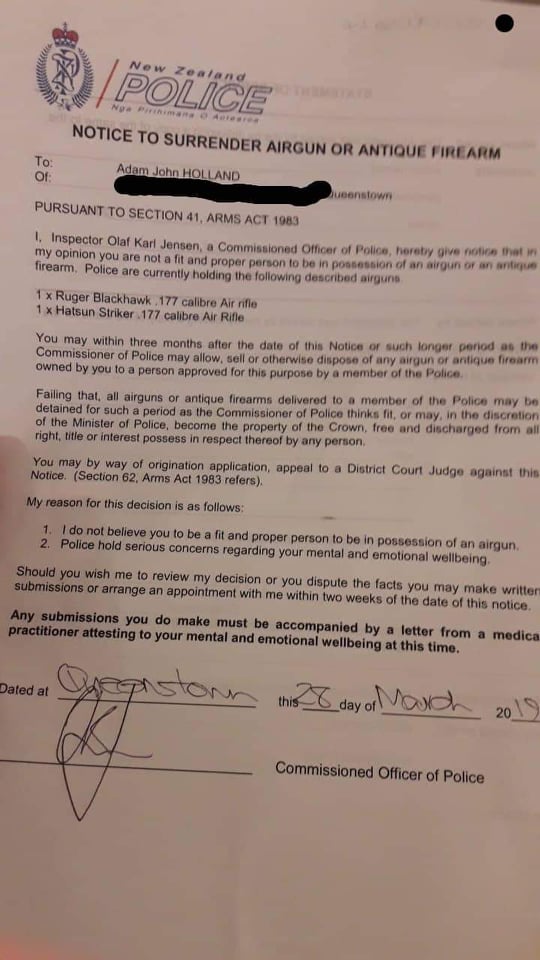
One of the worst examples was what happened to Adam Holland in Queenstown (see image at top of article). Holland had two airguns and a crossbow removed from his possession on the grounds that Inspector Olaf Jensen had personally decreed Holland was “not a fit and proper person to be in possession” of such, and that “Police hold serious concerns regarding [Holland’s] mental and emotional wellbeing”.

Police officers have zero psychological education to justify any serious concern about anyone else’s wellbeing, and their whimsy is nowhere near a sufficient basis to remove possessions from a private citizen who has not used them in commission of a crime. What sort of country strips citizens of possessions on the basis of one Police officer’s judgment? How long until they take machetes and kitchen knives away?

Holland’s experience is just a further example of a process that started before the Sixth Labour Government. The Fifth National Government was happy to sell national assets, despite a referendum that explicitly declared the public unwillingness to do so, and all recent Governments have refused to acknowledge the clear public desire for cannabis law reform.

If a clear and direct expression of the public does not constrain our rulers, then what does?

A third example is the ongoing free speech violations. Justice Minister Andrew Little currently has a giant warboner over the possibility of introducing so-called “hate speech” laws, in which criticism of certain power structures becomes a criminal offence. As has been seen in Austria, where a woman was given a criminal conviction for saying that Muhammad was a pedophile, hate speech laws soon lead to the criminalisation of dissent.

The Government hasn’t started stripping our rights to speak away quite yet, because they are currently in the process of sounding out how much they think they can get away with, but the process of using propaganda to soften public resistance to such tyrannical laws is in full swing. The mainstream media is busy acclimatising the public to no longer being allowed to speak freely.

The really frightening thing is that such laws directly violate Section 14 of the New Zealand Bill of Rights Act, which guarantee New Zealanders the right to impart opinions of any kind in any form. If the Government is not bound by the New Zealand Bill of Rights Act when taking our rights to speak away, what are they bound by? And if they are bound by nothing, as appears to be the case, then how are they any different to the literal definition of tyranny?

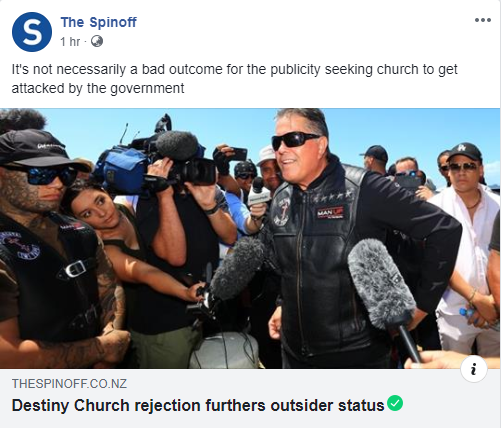
A fourth example is given in the image above. The Spinoff regularly runs articles attacking the enemies of the Government and making apologies for unpopular Government actions (although rarely are they so blatant as in the example above). The worrying thing is, as they admit on their company page, The Spinoff “works with NZ on Air and Creative New Zealand to fund our work” – in other words, they take Government cash to produce propaganda.

When the Government works hand-in-hand with the free press to create propaganda pieces, you don’t have a free press. In fact, the need for an authoritarian government to totally control the narrative was even mentioned by Josef Goebbels in his Principles of Propaganda. So the Government funding a media enterprise that pretends to be independent, but which in reality attacks enemies of the Government and propagandises for Government policies, is something fully in line with tyrannical Nazi principles.

The only way New Zealand can get out of this is to come together as individuals, ignoring the government, and to decide on a set of our rights that are inviolable and which must be respected by anyone who wishes to rule us. A starting point could be the essay published here expounding a seven-fold conception of inherent human rights. If all Kiwis agreed that every other Kiwi possessed such rights, we would be free of tyrannical measures.

If this doesn’t work then we’re left with anarcho-homicidalism.

*

If you enjoyed reading this essay, you can get a compilation of the Best VJMP Essays and Articles of 2018 from Amazon for Kindle or Amazon for CreateSpace (for international readers), or TradeMe (for Kiwis). A compilation of the Best VJMP Essays and Articles of 2017 is also available.

The Case For Cannabis: It’s Easier To Stop Using Cannabis If It’s Legal

Many people take an overly simplistic approach to cannabis law reform and assume that cannabis prohibition leads to less use and less desire to use. In truth, much like the fact that people don’t use more cannabis in places where it is legal, cannabis prohibition doesn’t even help addicts. As this article will show, it would be easier for people to stop using cannabis if it was legal.

The logic appears to be that making cannabis illegal will make people decide to stop using it. If it’s not possible to openly grow and sell cannabis, some people reason, then it won’t be as easy for a person to maintain a cannabis habit, and therefore people will be incentivised to quit.

Many people who support this theory seem to assume that cannabis users, many of who are using the substance for medicinal reasons, will just sit and mope for a while and then go and do something more productive. Not only does this ignore the obvious fact that it’s easy to get hold of cannabis pretty much anywhere in New Zealand, it also ignores human psychology.

The reality is, thanks to the wonders of something called variable interval reinforcement, prohibiting cannabis actually makes addicted cannabis users more addicted. Under prohibition, because a person can never be sure if they can maintain a supply, they come to cherish cannabis a lot more when they do get it. So when they do use it, the reinforcing effect is much more powerful.

There are two major reasons why legal cannabis would make it easier for those who are cannabis addicts to quit.

It might not be easy for the average educated, middle-class person to appreciate, but not everyone trusts their doctor or mental health worker. Just because the average Normie considers their doctor to be an intimate confidante doesn’t mean that the average cannabis user feels the same way.

Attitudes have changed sharply compared to some decades ago, but there’s still a lot of distrust on the part of many cannabis users towards health professionals. So if they are honestly advised to quit cannabis for good reasons, they are less likely to pay heed, because they can’t be sure if the advice is coming from a place of honesty or is a formality due to the law.

It’s not easy for a doctor to say that cannabis would be beneficial if it is not legal. For one thing, they don’t want to get a reputation for being the local cannabis doctor. For another thing, there are potential professional consequences. None of them want to explain to a professional board why they recommended an illegal drug to a patient.

If cannabis were legal, it would be possible to trust your doctor if they would say that you wouldn’t benefit from using medicinal cannabis. As it is, if your doctor does not recommend medicinal cannabis, it’s impossible to know if they say this because they believe cannabis would be harmful, or if they believe cannabis would be beneficial but are afraid of potential professional or legal consequences for saying so.

The second major reason is that legal cannabis would make it easier for a user, who accepted that they were addicted, to taper down their use with the intent of stopping.

This relates to the reinforcement schedules referenced above. In the same way that it’s better to use variable interval reinforcement to strengthen a response, it’s better to use fixed interval reinforcement to weaken one. This is because it leads to a gradual weakening of the craving, rather than taking it full force and risking a relapse.

Anyone who has tried to suddenly stop using tobacco or alcohol knows how difficult it is to just make a clean break with it. In most cases, if there is not an immediate threat of death, a person will be advised by their doctor not to quit cold turkey but rather to taper down over a few weeks or a month. As mentioned above, this is partly to avoid relapse, but it’s partly because this is less painful.

People who were interested in stopping their cannabis use could, if we had a sane system, get a prescription for a fixed amount of cannabis with a view to tapering off. They could be given a number of joints and told to smoke x for the first week, x-1 for the second week, x-2 for the third week – or whatever worked.

This would prevent the disaster scenario familiar to people who have tried to stop smoking tobacco or drinking alcohol, in which one sits there while the craving for the drug rises and rises, until one finally caves, at which point using it feels like a divine gift. As mentioned above, this variable interval reinforcement only makes it much harder to quit.

Legal cannabis would be much better for those addicted than prohibition is. It would encourage addicts to trust their doctors when they suggested that cannabis had no medicinal value for them, and it would enable those doctors (or psychologists) to provide a schedule of decreasing fixed reinforcement that would allow for a relatively painless transition to sobriety.

*

This article is an excerpt from The Case For Cannabis Law Reform, compiled by Vince McLeod and due for release by VJM Publishing in the summer of 2018/19.
Clown World Chronicles: What is a ‘Baizuo’?

The English language has stolen another word, this time from the Chinese. ‘Baizuo’, pronounced ‘bye-tswaw’, translates directly as ‘white left’, and refers to a particular kind of ignorant and arrogant liberal leftist who seems too ridiculous to be possible, but who actually thrives in today’s world. This article explains.

Strong men create good times. Good times create weak men. Weak men create bad times, and bad times create strong men. This is the course of history.

We are currently at the end of the good times creating weak men phase of history. The West has been so prosperous for so long that most of us can no longer see reality accurately. This is because we are no longer punished for seeing reality inaccurately, because our wealth is such that we still have full bellies, shelter and entertainment – even if we make mistakes, and usually even if we make an endless string of mistakes.

This means that the natural corrective mechanisms that Nature uses to prevent people from becoming too dumb no longer function. Stupidity is allowed to flourish, because it no longer makes us suffer, go hungry or die. The stupid have therefore come to thrive under these new conditions – and stupidity has become the new normal.

Many Chinese Internet dwellers have noticed this in their online encounters with Westerners, and have become fascinated by the phenomenon, labelling those Westerners as ‘baizuo’. Baizuo mentality appears similar to the mindset of the Romans at the time of Nero. It’s a consequence of the decadence brought about by the presence of great wealth over several generations.

There are a large number of people in the West whose entire lives have been lived among plenty. They have no conception of how it is to grow up poor, and so they don’t understand the problems that come with being poor, which are little more than the problems caused by our metabolic needs in a state of Nature.

The major problem with growing up poor is that a poor life is unforgiving. If you damage or lose an item of clothing, getting a replacement is not a simple matter. Paying an unexpected bill doesn’t mean dipping into the savings fund, it means going without somewhere. And God help you if you damage anything valuable, for the punishment for that, usually from parents, can be swift and merciless.

But there is also a major benefit with growing up poor. This is, in the same way some amount of yang always exists even at peak yin, one is forced to see reality accurately. One can thereby develop a perceptual edge over one’s otherwise more privileged fellows.

The baizuos no longer see reality accurately, because they no longer understand Nature. As such, they no longer believe in Nature. They do not believe that men and women are different, and they don’t understand that the various groups of people around the world are different. The joke is that they think food comes from supermarkets.

The baizuo phenomenon is essentially the mass psychosis of a generation raised in such wealth that they could get away with losing touch with reality. Unlike generations raised in poverty – such as the Chinese – the vast majority of Westerners under the age of 40 have been raised in such a total absence of poverty that they have forgotten entirely that life on Earth is fundamentally an eternal struggle.

There are several facets of this phenomenon that the Chinese find especially fascinating, as does any rational Westerner trying to make sense of his fellows.

One is the obsession with political correctness, to the point of the baizuo’s own detriment. Whereas the Chinese loves to make jokes that defy the ruling authorities, and whereas most Chinese have a VPN to evade Government censorship, the humourless baizuo appears to desire more authoritarianism and more free speech restrictions and crack downs.

Another is the astonishing, almost child-like naivety when it comes to the dangers of the world. The majority of baizuos are asleep and dreaming when it comes to the issue of mass Muslim and African immigration. They absolutely refuse to listen to the experiences of people who have seen the deleterious effect of mass Muslim and African immigration on other nations, especially those in Europe.

Baizuos believe that all of the poor people of the world truly yearn for peace and tolerance and understanding for all, if only we would give them the opportunity to move to the West. That this has never been the rule in history doesn’t bother them, for they don’t believe in history any more than they believe in biology. They genuinely believe that all other groups of people are just like them, and think just like them.

A third is the arrogance with which the baizuo is stupid. In a state of Nature, stupidity is punished with pain, so that people who demonstrate stupidity soon become humble. The stupidity of the baizuo does not get punished, and, as a result, baizuos come to think they are right about everything all the time. Their arrogance is unchecked.

Whereas a well-travelled person could talk to a typical Chinese about the problems caused by Islam and be understood, the baizuo response would be to shout ‘racist’ and imply that the traveller must have been biased against Muslims all along, their observations merely confirmation bias. Most baizuos have never travelled outside of their own language zone, but are still conceited enough to think they know everything about the world.

The baizuo mentality, then, can be thought of as a form of slave morality. The baizuos are the weak men who lead to bad times, but their influence is already peaking. This means that the bad times are coming, and with their arrival the baizuos will disappear.

*

If you enjoyed reading this essay, you can get a compilation of the Best VJMP Essays and Articles of 2018 from Amazon for Kindle or Amazon for CreateSpace (for international readers), or TradeMe (for Kiwis). A compilation of the Best VJMP Essays and Articles of 2017 is also available.