VJMP Reads: Edward Bernays’s Propaganda VIII

This reading carries on from here.

The eighth chapter of Edward Bernays’s Propaganda is called ‘Propaganda for Education’.

Bernays opens this chapter with the contention that the public is yet to fully appreciate the value of education. Here he laments that the role of educator has not kept pace with social change, and is operating according to obsolete logic. This is a common theme throughout this book, which is striking for having been written in 1928.

Teachers ought to understand that they have a job as propagandist as well. This is not only in regard to what they teach, but they have to propagandise for the same reason as any other concern, such as a business: public understanding of the teacher’s role, and their acceptance and goodwill, is necessary.

This is not only of advantage to the teachers, who will get a higher salary if their work is more appreciated, but is of advantage to society as a whole, because the profession will be able to attract a higher grade of person. It is necessary to do this because the higher education system gets funding from central governments, and the actions of these governments are subject to public goodwill.

It’s important that institutions of higher learning don’t become dependent on endowments, because this risks that they lose political independence. If the funding is dependent on industry men, those industry men are liable to coerce the university into becoming closer to a polytechnic. As such, the cultural benefits of the institution are lost.

To this end, many of these institutions have employed public relations men. This is one of several points in the book at which Bernays appears to act as a public relations man for the public relations industry itself.

Propaganda can do more for the education industry than to simply raise its profile. Through using a public relations man to stay onside with the newspapers, and thereby establishing friendly relations with the public, the colleges and universities can make sure to attract the best quality of person.

All of the general principles outlined earlier in this book also apply to education. The fact that the public now takes an active interest in the affairs of the companies and businesses that share space with it is noteworthy. This has created a new demand for propagandists, whose job is to keep the public onside.

Bernays concludes this chapter with a warning. Propaganda can be abused. It can be used to create a false image of an institution in cases where such a false image is of benefit to that institution. In this sense, education is little different to business or politics. “There can be no absolute guarantee against its misuse.”

*

If you enjoyed reading this essay, you can get a compilation of the Best VJMP Essays and Articles of 2018 from Amazon for Kindle or Amazon for CreateSpace (for international readers), or TradeMe (for Kiwis). A compilation of the Best VJMP Essays and Articles of 2017 is also available.

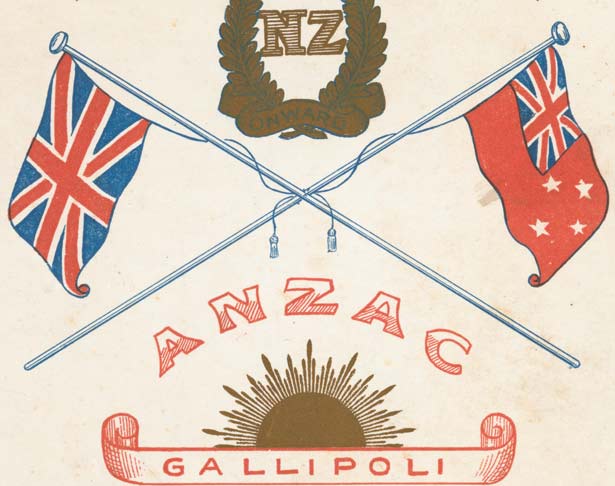
An ANZAC Lesson: The Real Enemy Is Always Behind You

My grandfather Fred was born in West Auckland, on the land that is now McLeod Park, named after his father Harry. Fred saw action in North Africa and Italy with the 2nd New Zealand Division and the British Eighth Army. He survived the war, returned to New Zealand, and raised a family. This essay is about one of the lessons he taught me.

He had, like tens of thousands of other Kiwi men, volunteered to fight in World War Two. Having volunteered, and then having experienced war and decided that it was a complete waste of time and something best avoided, he wanted to teach his offspring some lessons to help them avoid ending up fighting overseas.

He only ever spoke of combat, or of the general deprivations of war, to his wife, but he did tell us grandchildren a lot of stories about the lessons he had learned from his war experience. These generally involved insights about psychology, whether general or specific to the various nationalities he had encountered, or relating to military life and the nature of organisations.

One of his favourite stories related an experience that occurred shortly after the German surrender in May 1945. He was on the back of a troop transport truck with the other members of his company, when they encountered a column of German prisoners of war being marched along the road in the other direction. Upon seeing this, the officer in command of the New Zealand troops ordered the company to not acknowledge the presence of the German troops – after all, the war was not technically over yet.

But when the two forces met, the Kiwi troops spontaneously broke into a cheer, and waved to the Germans, who waved back with similar sentiments. It didn’t matter that they had been ordered not to do this, for the war was over, and that meant that the inhumanities of war no longer needed to be inflicted upon each other. Open fraternisation was, of course, not possible, but it was clear that no genuine illwill existed at the level of the average soldier.

It took a while to fully appreciate the import of this story. The first lesson was the magnitude of the relief that the soldiers must have felt upon understanding that the war was over. The realisation that all the killing and dying had ended would have been a joy that is barely comprehensible to someone who has never experienced combat. This joy would have been powerful enough to override any remaining sense of obligation to follow orders.

I spoke with him about this story once, after it had occurred to me that this feeling of goodwill towards the German soldiers was stronger than any goodwill he felt towards his own leaders, who were, after all, on his side. At this point he gave me a lesson, with an admonition to never forget: the real enemy is always behind you.

The apparent truth is that your enemy is the guy on the other side of the battlefield shooting at you. The real truth is that your enemy is the guy behind you, the one who coerced you into fighting in the first place. Never mind the fact that the guy behind you speaks your language – you still have more in common with the working-class man on the other side of the battlefield than you do with your own commanders.

This truth was illustrated by another, darker story, that took place in Italy. Fred’s company had taken a number of German soldiers prisoner during the battle of Monte Cassino. In the heat of the moment, one of the younger German soldiers broke down in tears, apparently under the conviction that he was about to be shot dead.

Fred offered the young German a cigarette, and instead spoke to him. Why would we shoot you in cold blood? he asked. Do you think we are monsters? The German replied that he had been told that the British were, indeed, monsters, whose insatiable greed had led them to try and take over the entire world and to subjugate it and all its peoples. It was in trying to stop this greed that the Germans had been drawn into the war.

Fred realised, of course, that he had been told exactly the same stories about the Germans. Moreover, the men who had been the ones to tell those stories had not themselves been subjected to the horrors of combat. The New Zealand politicians who had organised the war effort were safely back at home, fat and happy, as were the newspaper men. The sense of betrayal he felt upon realising this inspired the lessons he had to teach me.

Never, ever trust the politician or the newspaper who tells you how evil and terrible some men overseas are. It’s all but guaranteed that the politician and the newspaper are lying to trick you into sacrificing yourself for the commercial interests of their sponsors. World War Two was a banker’s war, Fred taught me, and the soldiers who fought in it were coerced into doing other men’s dirty work for them. There was nothing glorious or honourable about it anywhere.

There are two ways to get a man to do your dirty work for you. The first is to force him, the second is to trick him.

New Zealand’s involvement in World War One had at first been a voluntary affair, but it became a matter of force on the 1st of August 1916 with the passing of the Military Service Act. In total, almost 20,000 Kiwi men were conscripted for military service, roughly 20% of the total who served. Some 3-4,000 of these men were killed in battle.

By the time World War Two rolled around, the propaganda of the Establishment had become a lot more sophisticated. This was thanks, in large part, to men such as Edward Bernays, who had studied the use of propaganda and how to make it more effective, and who had written about it in books such as Propaganda. So they knew how to use the apparatus of mass media to convince men to join the Army.

This meant that the Establishment media could simply pump out enough stories about how the Germans bayonetted babies, and how they were trying to take over the world, and how Hitler was a unique evil that demanded a unique response, and enough people would believe it so that they didn’t need to conscript anyone any more. Men would simply volunteer to fight.

Fred raised me so as to never fall for the propaganda. Never to believe the politician, never to believe the media. Because, at the end of the day, the real enemy is always behind you. Your real enemy is not the opposition soldier but the one who raised the company, battalion or Army that you are now a member of. He’s the real enemy because the opposition soldier is, in the final analysis, only protecting himself from you.

Once, after I had been studying some military history, I remarked to him about conscription. Sure, I knew that the reasons behind the Vietnam War and the Gulf War were equally as false as for all the other wars. I could be smart enough to know that the television was lying to me about the need for me to participate in the next war, but if enough people my age were also aware of this, what would stop them going back to conscription?

What would I do if a conscription officer came to my house?

His reply was simple, and borne of the bravery that comes from having to face combat: “Shoot the bastard.”

*

If you enjoyed reading this essay, you can get a compilation of the Best VJMP Essays and Articles of 2018 from Amazon for Kindle or Amazon for CreateSpace (for international readers), or TradeMe (for Kiwis). A compilation of the Best VJMP Essays and Articles of 2017 is also available.
Clown World Chronicles: Understanding the Honk Meme

There’s a new meme making waves in cyberspace. Based on the original Pepe the green frog meme, this new form adds a multicoloured clown wig, a red clown nose, a novelty bow tie and a eerie, distant smile. The meme is normally presented with the word ‘Honk’ or similar. This essay explains the honk meme.

The original Pepe meme is how an entire subculture has found a manner of expression. This bland-looking rubber-lipped frog has come to stand for an entire generation of everymen, his various expressions of rage, fear, anger and bliss the way that generation signals emotions in Internet groups. Many threads on Internet message boards start with a picture of Pepe, and these images portray an incredibly broad range of sentiments.

Pepe represents the travails of a generation that finds itself doing much worse than its parents did. The Millennials are discovering that their standard of living is lower than the generation before it, and much lower than that of the Boomers. Studies show that wage workers in Western countries have lost most of their house-buying power over the last few decades, and it looks set to get worse.

So Pepe’s new appearance, in the form of the Honkster, signals a dark turn in the collective mindset of the young.

Essentially, the idea is that we now live in Clown World, where nothing makes any sense any more. Our society is no longer a real society, where people care for each other on account of belonging to a wider kin group, but a parody of one, in which the old have all the wealth and power and aspire to suck as much life out of the younger generations as possible. We’ve strayed so far from our founding principles that we’ve lost our moral compass.

The sheer ridiculousness of so much of everyday life, it is reasoned, can only be explained with the idea that the normal timeline of Planet Earth deviated from its previous course at some unknown point in the recent past, and entered this place called Clown World. According to this theory, the Planet Earth is now in a different dimension of reality to the one it was in up until a few years ago. Therefore, the ordinary laws of psychology, sociology and political science no longer apply.

In Clown World, the clowns are in charge. This is nowhere more easily understood than by observing the total absence of qualifications among our ruling classes. Donald Trump in America, Theresa May in Britain, Justin Trudeau in Canada and Jacinda Ardern in New Zealand all appear uniquely hopeless. They blunder clumsily from one slapstick mishap to the next, and they appear intent on making the world into as big a circus as possible.

In Clown World, there is no longer cause to feel any hope. The world has failed. Not only has it failed, but it’s failed so badly that it seems like it was really just a joke the whole time. Nothing this absurd could possibly have been taken seriously by so many people, and therefore the only rational thing to do is to throw one’s head back in laughter as the clowns make honking noises.

The slack smile of the Honkster is not the smile of joy. It’s not even the sardonic smile of a generation that knows their parents traded away their inheritance for a pittance. It is the drugged smile of oxycontin, anti-depressants and anti-psychotics, pharmaceuticals being the only way to cope the fact that our world is a brave new one, in which people’s suffering has been medicated away to reduce their propensity to rebellion.

In this context, it has been said by an anonymous wit that “The world ends not with a bang, and not with a whimper, but with a honk.”

The honk is the look on the face of the Green Party supporter when she is gang raped by the same refugees she voted to open the borders for.

The honk is the sound the key makes in the lock when it turns to jail a man for criticising Police inaction in the face of reports of Islamic rape gangs operating in their area.

The honk is the cry of helplessness of a hundred million young people all over the West, drawn out so long that it has taken on a different character entirely, morphing from despair into a demented humour.

Realistically, this honk ought to be a terrifying sound. The discordant honking is the fanfare of a generation that has not only lost hope, but which has also lost meaning. In Clown World, it makes no sense to hope for anything, because there is no relationship between hoping for things and getting them. One cannot set one’s will to a goal and achieve it here, because nothing makes sense. The whole world is against one.

As the economic situation worsens, the face of the Honkster might be replaced with something less humourous. The bitterness inherent in the Clown World meme, and the nihilism it reveals, suggests an unstable and unpredictable environment. The Honk meme might be a sign that the social fabric is starting to tear.

*

If you enjoyed reading this essay, you can get a compilation of the Best VJMP Essays and Articles of 2018 from Amazon for Kindle or Amazon for CreateSpace (for international readers), or TradeMe (for Kiwis). A compilation of the Best VJMP Essays and Articles of 2017 is also available.

Banning The Great Replacement Manifesto Violates The NZ Bill of Rights Act

In the wake of the Christchurch mosque shootings, the country has been forced to endure the Great New Zealand Chimpout. This has involved everyone losing their minds, and over-reacting in ways that they may later come to regret. One of these over-reactions was to ban Branton Tarrant’s Great Replacement Manifesto, an action which was – as this article will show – a violation of the basic rights of New Zealanders.

The idea of the New Zealand Bill of Rights Act is ostensibly to “affirm, protect and promote human rights and fundamental freedoms in New Zealand”. Supposedly based on the American model of inherent human rights, the NZ Bill of Rights Act is said to guarantee the rights of Kiwis and delineate areas in which the Government cannot take freedoms away.

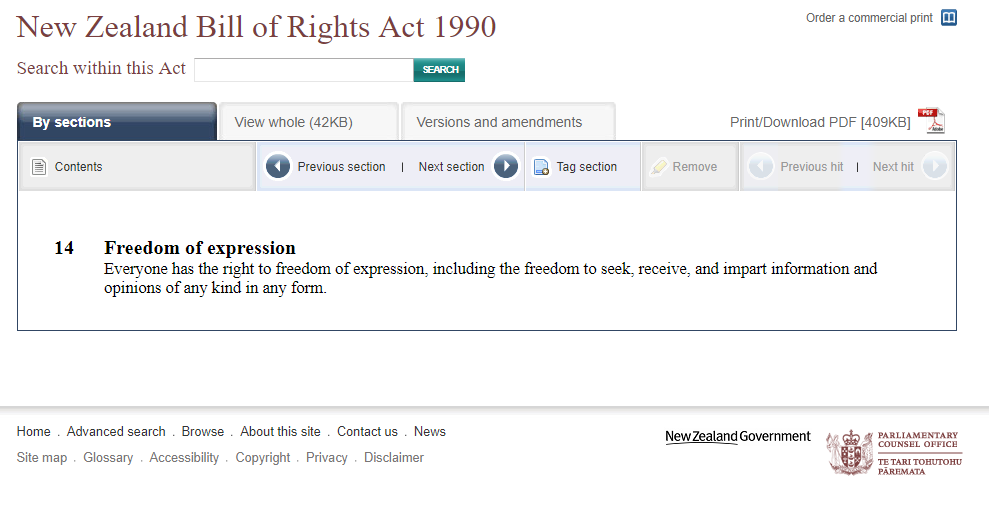
However, the New Zealand Government has just violated this. In deciding to ban the possession of a copy of Tarrant’s manifesto, the Government violated Section 14 of the NZ Bill of Rights Act, which states:

14 Freedom of expression

Everyone has the right to freedom of expression, including the freedom to seek, receive, and impart information and opinions of any kind in any form.

This states, perfectly clearly, that New Zealanders have the right to seek the Great Replacement Manifesto, to receive the Great Replacement Manifesto, and to impart (share) the Great Replacement Manifesto. Consequently, the actions of the New Zealand Government to ban this document are illegal, and are a violation of the human rights of New Zealanders.

So why did they do this?

The Government doesn’t want anyone becoming aware of its failures. Like the psychopathic narcissists they are, politicians are incapable of admitting that they are ever wrong. Therefore, they are incapable of admitting what every working-class Kiwi already knows: that mass immigration has greatly enriched the already wealthy, at the expense of the already poor.

What they really, really don’t want is other working-class people realising that the demographic trajectory of New Zealand appears to be taking them on a path towards Brazil, and then South Africa, and then Haiti. Because, if they do realise this, then the Government either has to take action to prevent it (which will put them offside with their masters in banking and industry), or risk more mass shootings as the position of the working class continues to decline.

Much better to kick the can down the road, and just try not to talk about it, like we did with drug law reform, euthanasia law reform, climate change etc. Otherwise, someone has to point out that the emperor has no clothes. The fear that the charade might soon be over has led to a state of panic among New Zealand’s ruling class.

This atmosphere of panic, coupled with the unusually large number of weaklings in the highest reaches of Government, is why there has been an over-reaction like this. Most New Zealanders are still running around like headless chickens, and in their submission have accepted that the Government can take away any rights it sees fit.

Moreover, there’s a set precedent that the Government can violate the Bill of Rights Act and no-one cares. As a previous article here has pointed out, psychiatrists already violate the Bill of Rights Act by forcing medical treatment on people who have explicitly withdrawn their consent. This has even gone as far as electroshock treatment, but only alt-media sources like VJM Publishing are interested in taking up the issue.

What needs to happen is twofold. The Government first needs to quietly make Tarrant’s manifesto legal for people to read. Second, it needs to address the concerns raised in the manifesto in a more honest and respectful manner than just screaming about “white supremacism”. After all, the bulk of the concerns about the effects of mass Third World immigration are held just as strongly by Maoris as by white people.

If the indigenous people of New Zealand don’t want to be replaced by overseas sources of cheap labour, then this has to be acknowledged and addressed. If they believe that maintaining some level of ethnic homogeneity is better than full globohomo, then this has to be acknowledged and addressed. If they believe that the past conduct of certain ethnic and religious groups is so poor that we would be better off keeping those groups out of the country, this too needs to be acknowledged and addressed.

An honest conversation with the New Zealand working class has been needed since the imposition of neoliberalism. True courage, and true leadership, would see it happen soon. The New Zealand Government has to speak honestly to the people about their vision for the nation. It cannot end suffering by banning information and sending the Police to harass any Kiwi who speaks freely.

*

If you enjoyed reading this essay, you can get a compilation of the Best VJMP Essays and Articles of 2018 from Amazon for Kindle or Amazon for CreateSpace (for international readers), or TradeMe (for Kiwis). A compilation of the Best VJMP Essays and Articles of 2017 is also available.