
The Metaphysical Microscope

One of the most common arguments the materialist makes is that nothing divine can be proven. If anything divine existed, so the materialist has it, the believer in the spiritual worlds would be able to present it for scrutiny. If the believer cannot summon the divine to stand before us on command, then it can logically be concluded that nothing divine exists.

The materialist usually demands that the believer produce a magic rabbi with a beard and sandals, this being the conception of the divine in the mind of the herd. Failing that, showing Buddha, Zeus, Krishna or Odin would do. Because no divine being can be so produced, the materialist smugly concludes that nothing divine exists.

Realising evidence of the divine is not a matter of someone bringing it forth as if it were evidence in a court trial. It’s a matter of seeing it. The evidence, in reality, is everywhere. The determining factor is the clarity of one’s vision.

If a sceptic should claim that microbes don’t exist on account of that the sceptic had never seen one, a scientist could give him a microscope. “Simply use this tool called a microscope”, the scientist could say, “and the microbial world will reveal itself to you.” A scene like this happens in high school science classes all over the world every day.

This all sounds logical to a modern person. But what if the sceptic was religious, and didn’t want to look down the microscope for fear of demon possession? Or, what if the sceptic suspected, rightly, that looking down the microscope would so vastly expand his narrow conception of reality that his smug, empty confidence would be shattered?

This might sound absurd, but this is directly analogous to the current situation with psychedelics.

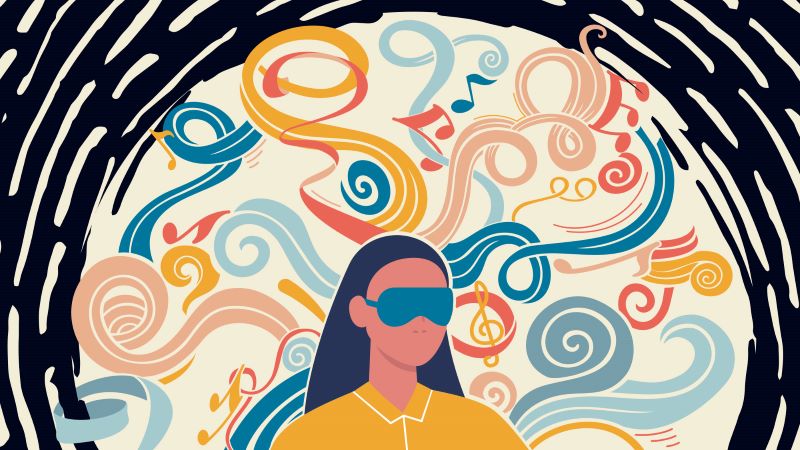
It was known, from the first modern psychedelic wave of Humphrey Osmond and Aldous Huxley in the 1950s, that these sacraments revealed the divine. That’s even where the name comes from: ‘psyche’ means soul, and ‘delic’ comes from ‘deloun’, which means to reveal. In other words, psychedelics reveal the presence of the soul – and thereby the spiritual worlds – to those who could not previously see them.

Anyone who denies this point is obliged to either: take a massive dose of a psychedelic sacrament and take a look for themselves, or keep quiet, and let those who have taken a look do the talking. To refuse to take a psychedelic on any grounds – fear of mental illness or otherwise – and then deny what other people have seen, is childish absurdity.

People may choose not to look through the metaphysical microscope, but they don’t get to deny what others have seen.

The use of psychedelic sacraments is a metaphysical microscope that reveals the spiritual worlds to the observer. If a person denies the spiritual worlds, they are hereby invited to take a large dose of a psychedelic sacrament. Enough is now known about psychedelics for any intelligent person to research a safe dose and to source it from a reputable supplier. Even in the most desperate case, it’s possible to identify and consume a pile of magic mushrooms in the wild.

An unwillingness to do this is not proof that no spiritual worlds exist. It’s merely proof that someone is a coward.

It’s possible to take a heavy dose of a psychedelic and still not see any worlds beyond. This is analogous to how a blind person won’t see any microbes even with a microscope. But neither is this proof that no spiritual worlds exist.

Psychedelics, after all, are not even necessary – it’s possible to see spiritual worlds simply through refining one’s consciousness to a high enough frequency. Since most people don’t have enough time for that, most people take psychedelics. But no-one is blinder than he who will not see.

A microscope is a tool for looking deeper inside the physical world; a psychedelic is a tool for looking deeper inside the metaphysical world.

Those who have seen beyond are as convinced of the existence of spiritual worlds as they are of the existence of Planet Earth. If materialists refuse to use a metaphysical microscope to catch up to those of us who have seen beyond, we will just have to move on without them. They can gather and ponder the contradictions of their worldview while the rest of us can exult in knowing the truth.

Those who do not see are normies, but those who will not see are tards.

*

If you enjoyed reading this essay/article, you can get a compilation of the Best VJMP Essays and Articles of 2020 from Amazon for Kindle or Amazon for CreateSpace (for international readers), or TradeMe (for Kiwis). A compilation of the Best VJMP Essays and Articles of 2019, the Best VJMP Essays and Articles of 2018 and the Best VJMP Essays and Articles of 2017 are also available.

*

If you would like to support our work in other ways, please consider subscribing to our SubscribeStar fund. Even better, buy any one of our books!

VJMP Trip Report: Dimethyltryptamine

The first attempt, using a complicated setup involving a metal crucible, a glass chamber with a seal and a powerful blowtorch, failed in a flash, bang and puff of smoke. There was enough for a second hit, which I tried using the “Terence McKenna Method” of a bong half-filled with cannabis, then a layer of DMT, then some more cannabis. It was hard to light but, thanks to the assistance of a nearby shaman, I managed to blast it back and hold it in.

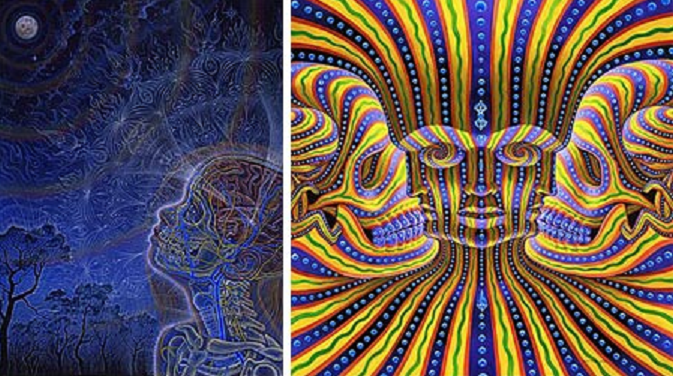
My first impression was that it felt a lot like salvia, except pleasant. It brought with it a salvia-like experience of the edges of perception vibrating harder and harder until normal perception broke down. As with salvia, I had the sense of seeing entire universes within the smallest fragment of the material world. One such fragment was the ceiling boards above the couch where I lay.

The background music playing, a pleasant downbeat ambient, collapsed into a single tone, a high-pitched frequency that I realised was the same as the Hindu Om, i.e. the frequency of the Universe. I heard this tone in the centre of my head as I felt the particles of my body vibrate and melt into the couch. Also like the salvia, the DMT seemed to enable my soul to look past the restrictions of the body, i.e. vision was no longer restricted to the senses of the eyes.

The only major difference to the salvia was that the DMT felt really good.

These ceiling boards I stared at seemed to dissipate, as if the particles maintaining the illusion of them had become too high-energy, and they left behind a gloriously multicoloured fractal that vibrated intensely. The longer I looked into this fractal, the more it started to take three-dimensional form, with a number of corridors stretching away from me and away from the immediate surface.

On the walls closest to me, i.e. those not stretching away to form the corridors, faces appeared. At first these were Olmec-style colossal heads. The central one, and the undulations of its colours, transfixed me. Soon it formed into the face of a tuatara, which watched me out of both eyes. I realised that I was being observed by God, who was behind the face of the tuatara, as I was myself God observing the tuatara from behind my own face.

Ensorcelled by these strange hallucinations, the visions before me seemed more true than the material world that I had just come out of. I realised that this was how it felt to die, for one’s consciousness to shed the coat of skin that it’s adorned with in this life – and that to die was the most natural thing in the world.

In the same way that, after you breathe in, the most natural thing is to breathe out, so after you live, the most natural thing is to die. It’s nothing to fear in the slightest.

Life in this space is an experience that our individual fragments of consciousness chose to have. In choosing to do so, they stepped down out of the true reality and into this space, which we call “The World”, but which is more like a single room off a narrow street that itself connects to a larger street which itself connects to a larger street and so on. The great trunk line of reality is somewhere else.

We choose to incarnate into this realm, and after this life we incarnate out of it again. Life is much like a protracted bungee jump: the beginning is terrifying, with a rush of barely comprehensible sensations, then you get used to the fear to some degree, and soon enough you’re back on the platform watching others do it. It’s all very entertaining, and accords with the understanding of Elementalism that the meaning of life is to entertain the gods.

I had a vision of having been buried inside a coffin and reaching out above my head, rising through my own crown chakra and through the ground, into the light above. In that space in the light above was the real world, and there were all the consciousnesses that had ever shared time or space with me here in the material world. They are only ever separated from the rest of us by the flimsiest of veils, one that can be broken through in a moment.

I was not in this space for long – either the dose was not the absolute strongest or some medication prevented the DMT from reaching its full effect. But it was long enough for me to remember the reason why I incarnated into this planet to have this particular life. To do so would afford the opportunity to rebalance the frequency of my consciousness, which had become imbalanced owing to decisions (and patterns of decisions) taken in previous lives.

In this life on Earth, I was born into poverty because I had not sufficiently appreciated wealth in previous lives, and that had left an impact on the frequency of my consciousness. I was born into violence, and was forced to encounter violence, because I had been violent in previous lives, and that had also left an impact on the frequency of my consciousness. I was born into spiritual ignorance for similar reasons.

Incarnating into an environment that is impoverished in these ways trains the frequency of one’s consciousness to appreciate them more. To that end, I said Yes to everything that I would experience during this life, and therefore have no cause for any resentment.

No matter how grim life on Earth may get, the experience serves to rebalance the frequency of one’s consciousness so that one may attain higher dimensions after the death of one’s physical body. As such, there’s no reason to say No to any of it. Even in dying and death, the experience can be embraced. If this is done, one’s consciousness will return to the real world above in a well-balanced state.

These realisations brought with them a powerful sense of the fundamental allrightness of the Universe. I understood that there was a way of perceiving reality so that none of the miseries in this world caused real suffering, and therefore that Plato was correct, when he wrote at the end of Timaeus, that this really is the best of all possible worlds.

There’s no reason to feel any real resentment, not even at the genuine shitness of some of the aspects of life in this world, because enduring them trains the frequency of one’s consciousness to appreciate their absence. The hunger, violence, lies, depression, misery and pain in this world train us to appreciate worlds in which they don’t exist (or are less pressing).

This was a great revelation for me, as I have always struggled with not really wanting to be in this place. These sentiments were especially strong after my grandparents died in 2016. DMT helped me realise that they (like everyone else that has ever incarnated into this world) wait for me in the real world above, and that the best thing is that our inevitable reunion follows a glorious life here, and not an inglorious one. We truly are heroes living under the eyes of the gods.

*

If you enjoyed reading this essay/article, you can get a compilation of the Best VJMP Essays and Articles of 2020 from Amazon for Kindle or Amazon for CreateSpace (for international readers), or TradeMe (for Kiwis). A compilation of the Best VJMP Essays and Articles of 2019, the Best VJMP Essays and Articles of 2018 and the Best VJMP Essays and Articles of 2017 are also available.

*

If you would like to support our work in other ways, please consider subscribing to our SubscribeStar fund. Even better, buy any one of our books!

Why You Should Join A Gang Instead Of Working

New Zealand now has over 7,000 gang members, an increase of some 13% from a year previous. Many theories have been put forward to explain this sudden rise, but none of them are adequately grounded in economic psychology. This essay makes a seemingly preposterous argument: that it makes more sense to join a gang nowadays than to work.

According to the Real Estate Institute of New Zealand, the average New Zealand house price is now $810,000, up 19% from a year earlier. According to interest.co.nz, the ratio of this average house price to the median household income is now 8.43.

This ratio was 5.87 as recently as July 2016. Even back then, it meant that a working couple able to save 25% of their total wage could expect to take over 23 years to pay for the average house. That was considered “severely unaffordable” by all honest commentators. But it’s now almost 50% worse than even that.

These are terrifying statistics for anyone at, or near, the bottom of the educational ladder. The average household income, according to the stats mentioned above, is $96,114. That means over 33 years for the average couple, saving 25% of their total wage, to pay for the average house. Any household with a minimum wage earner will likely have it much harder than this.

This means it’s now realistically impossible for a significant, and growing, proportion of New Zealand workers to ever own a home on their wage. It’s even more difficult for those who aren’t part of a steady couple.

Historically speaking, those at the bottom of society have always had one universal method of radically improving their position: crime. And the bigger the crime, the better. Many people say that crime doesn’t pay, but this is only true for the lower classes. Pull off a big enough heist and you can go up an entire league.

As Chuang Tzu once observed: “The petty thief is imprisoned but the big thief becomes a feudal lord.” Petty thievery won’t get you into a house that you can raise a family in, but full-time drug running is another story.

A young New Zealander without an education might have no chance of ever owning a house by working for one, but there’s a ready alternative: to join a gang, and get $810,000 through crime.

It’s common for dedicated meth users to go through $1,000 of meth in a week. Someone supplying it need only have a dozen customers with this level of demand and they could sell $600,000 worth of meth in a single year. Assuming $400,000 of expenses in precursor/bulk wholesale costs, rip-offs and fees to one’s own gang so as to keep covering for your operations, this means an income of $200,000 per year – tax free.

The only major downside is a small risk of getting killed or imprisoned.

Gangbanging is relatively dangerous, but the vast majority of gang members manage to conduct their affairs without getting killed. In recent years, New Zealand has averaged about 61 homicides a year. Even assuming that the majority of those were gang-related, it means that a person in a gang has little more than a 0.5% chance of being killed in any given year.

Even if this risk is 50 times higher than the risk of being murdered if one isn’t in a gang, it’s still a fairly low risk. It means that, after four years of selling meth and saving $4,000 a week, one would have earned enough to buy the average house, with a mere 2% chance of getting killed (approximately).

The risk of being imprisoned is also relatively minor. Furthermore, as shit as prison might be, it’s not a whole lot worse than busting a gut for 40 hours a week and being left with nothing after taxes, bills and rents are paid. At least rent is free in prison, and while there you can easily make the contacts that will help you sell meth more discreetly once you get out.

In the cold light of day, a young New Zealand man, one with ambitions to own a home so that he can raise a family in it, is better off joining a gang and getting taxed at 0% than getting educated, earning a professional wage and getting taxed at 39%. He can actually own a house the first way, whereas the second demands decades of work for partial equity in one. Even if he does manage to own a house the second way, he likely won’t have enough spare energy to raise a family in it.

What many middle-class people – especially those who inherit wealth – don’t realise is that few people join gangs purely out of malice and spite. Some of them join gangs because, on balance, they can have a better life in one. The prospect of working for 50 years to merely own some equity in a cold, damp house is a miserable one. It’s not surprising that the more daring of the country’s young men are tempted to gamble for a better life.

The solution to New Zealand’s rising gang problem will inevitably be a multifaceted one, but the basis of it must be enabling even poorly-educated workers to own their own home and raise a family. As long as workers aren’t getting paid enough for this to be possible, they’re better off joining gangs.

*

If you enjoyed reading this essay/article, you can get a compilation of the Best VJMP Essays and Articles of 2020 from Amazon for Kindle or Amazon for CreateSpace (for international readers), or TradeMe (for Kiwis). A compilation of the Best VJMP Essays and Articles of 2019, the Best VJMP Essays and Articles of 2018 and the Best VJMP Essays and Articles of 2017 are also available.

*

If you would like to support our work in other ways, please consider subscribing to our SubscribeStar fund. Even better, buy any one of our books!

Could New Zealand Legalise Cannabis On Maori Land?

The outcome of last year’s cannabis referendum was bitter for many Maori people. Despite that some 80% of Maoris voted in favour of changing the law, heavy anti-cannabis sentiment among Pacific Islander and Asian voters saw the referendum ultimately fail. Fortunately for all, an elegant solution exists overseas, and we could copy it.

The 2020 cannabis referendum was close. 50.7% of eligible voters wanted to continue with cannabis prohibition, and 48.4% did not. There was a significant positive correlation between being New Zealand-born and voting Yes in the referendum, so within that 50.7% were a large number of recent immigrants, particularly Chinese ones. Some 80% of Chinese voters voted in favour of locking Kiwi cannabis users in cages.

There are roughly 250,000 ethnic Chinese in New Zealand. Assuming that 80% of them were eligible to vote in the referendum, and assuming that 80% of those did, that gives us 160,000 ethnic Chinese voters. We know from above that 80% of those voted in favour of cannabis prohibition, which gives us 128,000 Chinese No voters opposed to 32,000 Chinese Yes voters. This represents a majority of around 96,000 for the No side among Chinese voters.

In the cannabis referendum overall, 1,474,635 people voted in favour of the continued persecution of cannabis users, and 1,406,973 voted to end it (for more detail on who these people were, see Understanding New Zealand 3). This means that the No side won the cannabis referendum by 67,662 votes.

So a little bit of primary school-level maths shows us that non-Chinese voters wanted to change the cannabis laws. But the native Kiwi majority that wanted reform was forced to endure further prohibition because of the wishes of recent immigrants, often from totalitarian political systems, and with little understanding of our culture.

For someone born in New Zealand, with centuries-deep roots in New Zealand, it seems outrageous to me that voters who came to New Zealand in the last decade took away our right to use cannabis. The voters who have flooded into the country since John Key threw the borders open have no real loyalty to, or respect for, the New Zealand people. They shouldn’t be deciding what rights the rest of us have.

That mostly rural-dwelling Maoris wanted legal cannabis, but got trumped by city-dwelling Pacific Islanders and Asians, has worsened existing social tensions in New Zealand. Maoris already had reason to resent the cannabis laws, which were forced on them by outsiders in the first place. The Sixth Labour Government’s response to their 80% support for legal cannabis has been, so far, to tell them to go fuck themselves.

One obvious, and obviously superior, solution presents itself.

In 2014, the United States Federal Government stated that it would not interfere with any Indian reservation or territory that wanted to legalise cannabis on its land. This declaration was a formality that followed from their already declared policy of non-interference with legal cannabis in Colorado.

One tribe, that of Squaxin Island in Washington, opened a legal cannabis store called ‘Elevation’ in 2015. First nations peoples in Canada have also allowed for legal cannabis sales on their lands. Native tribes in the Americas are generally pro-cannabis for the same reasons that Maoris are: they know it’s much better for them than alcohol is and that cannabis prohibition was pushed on them by outsiders.

This article proposes that the New Zealand Government allow individual Maori tribes to legalise and sell cannabis on their land.

There are two major benefits to this proposal.

The first, and most major, is that it shows some respect to the 48.4% of Kiwis and roughly 80% of Maoris who want a legal respite from cannabis prohibition. Currently, these two groups of people are told that they just have to eat shit, because neither a Labour nor a National Government will do anything about the cannabis laws.

Legal cannabis sales on Maori land would allow for the pro-cannabis half of the population to freely access and to use cannabis there, away from the judgment of those who think they’re scum. This would allow for the custodians of that land to build cannabis dispensaries, cafes and accommodation for the cannabis tourists. If the anti-cannabis half of the population doesn’t like it, they can stay in the cities and drink booze.

The second major benefit, or group of benefits, relate to the tourism potential of this proposal.

If you’re a young Western tourist, and you can choose between travelling to the American West Coast and using cannabis and alcohol, or travelling to New Zealand and using alcohol only, it’s an easy decision. About as easy as choosing between travelling to a Western country and using alcohol or travelling to a Middle Eastern theocracy and using nothing.

Legalising cannabis on Maori land would create a massive tourism boost in rural and impoverished areas like Northland and the East Coast of the North Island. These areas would benefit from both domestic and international tourists, and it would also create a spillover tourism effect for non-Maori businesses who catered to the international tourists who would otherwise have gone to a country with legal cannabis.

The idea of legalising cannabis on Maori land is a sure win for the first party to propose it. It’s the kind of solution that New Zealand needs. Unfortunately, our current parties are either bereft of imagination or more interested in grandstanding than making positive, practical solutions.

*

If you enjoyed reading this essay/article, you can get a compilation of the Best VJMP Essays and Articles of 2020 from Amazon for Kindle or Amazon for CreateSpace (for international readers), or TradeMe (for Kiwis). A compilation of the Best VJMP Essays and Articles of 2019, the Best VJMP Essays and Articles of 2018 and the Best VJMP Essays and Articles of 2017 are also available.

*

If you would like to support our work in other ways, please consider subscribing to our SubscribeStar fund. Even better, buy any one of our books!