Where In The World Does New Zealand Rank On Cannabis Law Reform?

New Zealand was once looked to for moral leadership. We were the first country to give women the vote and the first to institute a universal old-age pension, but these were 19th Century issues. On 21st Century issues, such as cannabis law reform, we are no longer close to the frontrunners. This article attempts to determine how far we have fallen.

Perhaps the first major crack in the cannabis prohibition dam came with the legalisation of medicinal cannabis in California in 1996. In the near quarter-century since then, a tidal wave of cannabis law reform has rolled around the world. New Zealand has made a determined attempt to resist this wave, and has stayed loyal to the idea that cannabis users are scum who should be persecuted.

Cannabis is now recreationally legal in California, as it is in Alaska, Colorado, Illinois, Maine, Massachusetts, Michigan, Nevada, Oregon, Vermont, Washington and the District of Colombia. That makes for 12 places in just one country that are more enlightened than New Zealand on the cannabis issue – over 100 million people.

Even if a person would say, uncharitably, that all these places are just one country, there are now several other countries that have legalised recreational cannabis. Uruguay did so in 2013 and never looked back. Canada did so in 2018. Georgia and South Africa have also legalised recreational cannabis for possession and consumption (although not yet for sale).

So that makes five countries that have legalised recreational cannabis to some extent – but they’re not the only ones ahead of New Zealand on cannabis law reform.

Many other countries have legal arrangements where cannabis is tolerated without being fully legal. The most famous example is the Netherlands, where cannabis is openly sold from licensed cafes, on the proviso that the cafe is willing to operate under a strict set of conditions. This is not de jure legal, but there is an understanding on the part of the Police that such activity is to be tolerated (provided it stays within certain limits).

Spain has a similar arrangement, where cannabis is legal if kept to private areas such as the personal home or in cannabis social clubs. In this sense, many countries have decriminalised cannabis to a greater extent than what New Zealand has done.

Antigua and Barbuda, Argentina, Austria, Barbados, Belgium, Belize, Bermuda, Bolivia, Chile, Colombia, Costa Rica, Croatia, the Czech Republic, Ecuador, Estonia, India, Israel, Italy, Jamaica, Luxembourg, Malta, Mexico, Moldova, Nepal, Paraguay, Peru, Portugal, Saint Kitts and Nevis, Saint Vincent and the Grenadines, Slovenia, Switzerland and Trinidad and Tobago have all decriminalised cannabis to some degree.

It might come as a blow to the Kiwi ego that several Third World countries are now more advanced than us when it comes to a major moral issue such as cannabis law reform. But it gets worse – even Australia is ahead of New Zealand in this regard now. Cannabis will be legal in the ACT as of next week, and it has already been decriminalised in the Northern Territory and in South Australia.

So that makes 40 countries that have either legalised or decriminalised cannabis to some degree – but the true picture is even worse than this, because New Zealand doesn’t even have medicinal cannabis yet.

Since becoming legal in California 24 years ago, medicinal cannabis has now become legal in a further 32 American states and four territories. Even if we apply the rule from above (according to which all these states and territories only count as one country) there are still many other countries with more tolerant medicinal cannabis laws than New Zealand.

Even Zimbabwe has more enlightened medicinal cannabis laws than New Zealand does – they legalised it in 2018. It might sound incredible to some Kiwi ears that a place with the reputation for corruption and backwardsness of Zimbabwe could be ahead of New Zealand in a major area of medical knowledge. Alas, it’s the truth.

In reality, every single country already mentioned is ahead of New Zealand when it comes to cannabis law reform. We have neither legalisation nor decriminalisation of recreational cannabis, and medicinal cannabis is de facto illegal on account of that virtually no-one can afford what’s on offer.

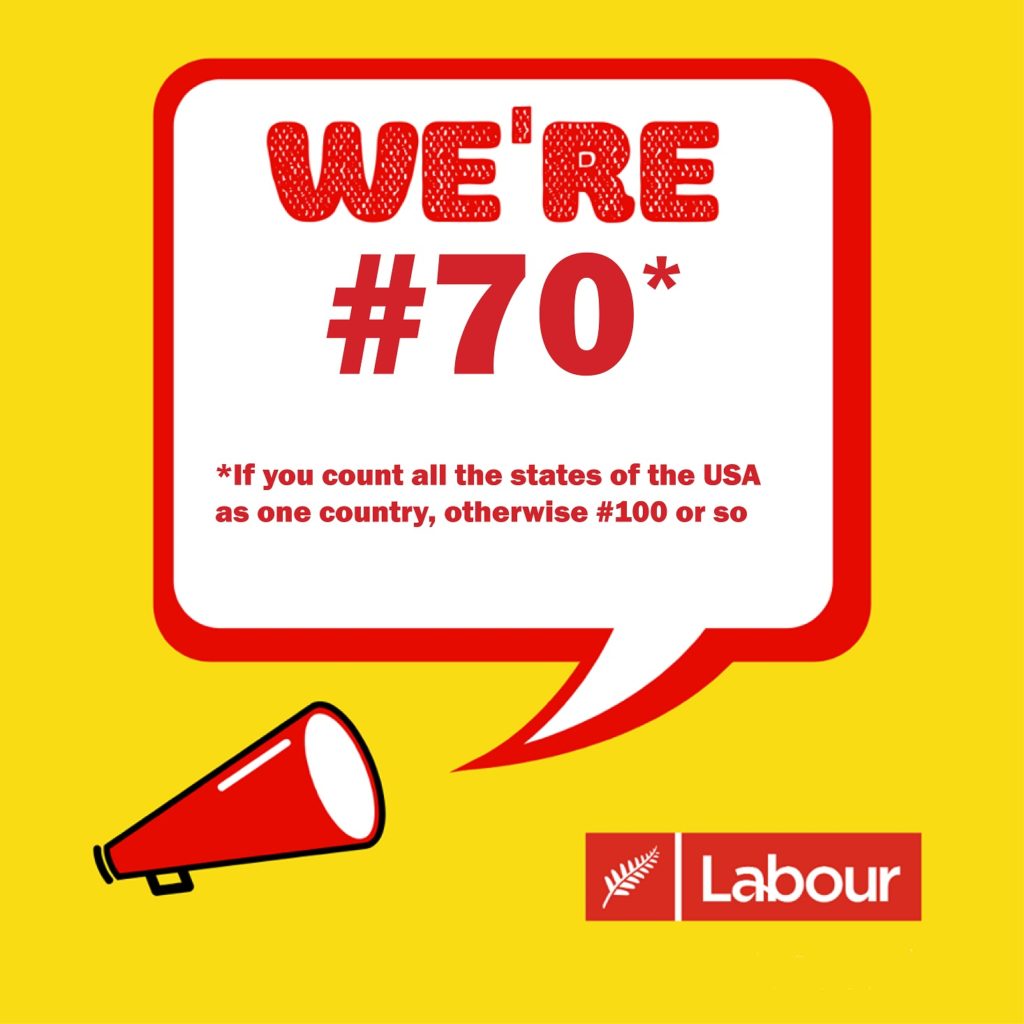
We were first in the world to repeal the prohibition on women voting. When we eventually get around to repealing elements of cannabis prohibition, we will be no earlier than 70th in the world to have begun to do so. If you count the American states separately, New Zealand will be no earlier than 100th or so.

It might not be easy for the Kiwi ego to accept, but not only are we years behind backwards American states like Louisiana and Alabama, but we are also years behind Third World nations such as Uruguay, South Africa and Zimbabwe. If we ever had any special ability to read the winds of change, or to provide moral leadership to a world desperately in need of it, that is now gone.

By 2020 New Zealand is, morally speaking, right back in the pack. Far from being leaders, we now respond with sheep-like herd instinct to patterns that we’re not intelligent enough to understand. The only way to lift this state of disgrace is to legalise cannabis immediately and across the board.

*

If you enjoyed reading this essay, you can get a compilation of the Best VJMP Essays and Articles of 2019 from Amazon for Kindle or Amazon for CreateSpace (for international readers), or TradeMe (for Kiwis). A compilation of the Best VJMP Essays and Articles of 2018 and the Best VJMP Essays and Articles of 2017 are also available.

*

If you would like to support our work in other ways, please consider subscribing to our SubscribeStar fund.

The Gentlemen Shows That The Normalisation Of Cannabis Is All But Complete


Guy Ritchie’s latest crime caper film, The Gentlemen, is the rollicking, romping gorefest that one has come to expect from the director of Snatch. Behind the larger-than-life characters and the brilliant dialogue, however, are a few hints about where society is going, and a few things made to look normal that aren’t usually normalised. This article explains.

Cannabis users who stopped to think about it may have noticed a few things in The Gentlemen that are different to the usual messages contained within big-budget films. Normally alcohol, tobacco, adrenaline and oxytocin are all portrayed as acceptable forms of enjoyment, but cannabis is not. Cannabis tends to get lumped with opium and heroin as a drug of despair.

The hero of the story, Mickey Pearson, is a British cannabis tycoon. The character, played by Matthew McConaughey, is in charge of an empire that produces 50 tons of skunk every year. Yes, he has done some bad things on the way up through the underworld, but he’s very much a moral player, someone with far more class than the average criminal.

This weed-dealing protagonist is presented as the good guy, who the audience is invited to sympathise with. Not a good guy – because he’s certainly capable of violent crime still – but the good guy. This makes a change from the usual popular culture treatment of cannabis users. Aside from this central fact, several scenes in the film serve to normalise the idea of cannabis in the eyes of the audience.

In one scene, Mickey speaks to a Chinese gangster and heroin dealer named Lord George. Mickey makes the point that the drug he himself deals doesn’t kill anyone, unlike the heroin that George deals. It’s uncommon for a popular culture film to draw a distinction between cannabis dealers and “other” drug dealers. Usually the two are lumped in together, but here Lord George is presented as distinctly less moral than Mickey.

In another scene, Mickey’s henchman Ray (played by Charlie Hunnam) smokes a joint while expressing his disgust for heroin users. While rolling it up he expounds upon his weed preferences, including his belief that the right mixture of cannabis and tobacco is 50:50. In this scene, we are invited to sympathise with the cannabis-smoking Ray, whose classy demeanour presents him in sharp contrast to the heroin users around him.

In yet another scene, the major antagonist is trying to bargain Mickey down on the selling price of Mickey’s business. The antagonist makes the point that cannabis will become legal soon and therefore his enterprise would have to compete with the legal market, which inspires Mickey to demonstrate that his business has been future-proofed already.

The point that cannabis will become legal soon, and therefore that the relative values of positions in the cannabis market will change soon, is made with certainty. Guy Ritchie has his finger on the pulse well enough to know which way things are going, and it’s obvious from the international trends that moves towards cannabis liberalisation will soon occur everywhere. People have thought through most possibilities already.

This means that the plot of The Gentlemen is realistic enough to suspend disbelief and enjoy the story. It’s a great film – and for cannabis users eager to see an end to the prejudice against them, it’s great to see cannabis use normalised in popular culture.

*

If you enjoyed reading this essay, you can get a compilation of the Best VJMP Essays and Articles of 2019 from Amazon for Kindle or Amazon for CreateSpace (for international readers), or TradeMe (for Kiwis). A compilation of the Best VJMP Essays and Articles of 2018 and the Best VJMP Essays and Articles of 2017 are also available.

*

If you would like to support our work in other ways, please consider subscribing to our SubscribeStar fund.

VJMP Predicts The 2020s

Earlier this week, VJM Publishing paid homage to science fiction author J R Mooneyham and his outstanding website. Because Mooneyham’s website relates to science fiction and to predictions of the future, we at VJM Publishing decided to pay more homage by imitating it. Here are our predictions for the 2020s.

We predict that the current movement across the West towards right-wing populism will increase. This was foretold as early as 2012, when Vince McLeod wrote about a Great Right Shift in his cyberpunk novel The Verity Key. We are seeing the Great Right Shift come into play now, and it will continue for several decades.

Western capitalist economies are built on the belief that all human beings are the same, and therefore that it’s possible to boost economic growth indefinitely through immigration. The reality is that human groups are almost as different to each other as dog breeds are, and so our system is doomed to collapse. This is the fate of all systems built on falsehoods.

It’s possible to predict, then, that social cohesion will continue to decrease across the West. Diversity will continue to increase, and this will eat into solidarity like an acid. This decrease in solidarity will be the immediate cause of most of the phenomena listed below.

It’s hard to tell if Trump will win next year, on account of the vagaries of the Electoral College system. If he loses, America will continue to fracture culturally. Even if he wins, the demographic trends will force a sharp increase in white identity. By the end of the decade, it won’t be unusual for people to openly identify as white nationalists.

The Sweden Democrats are currently polling at around 25% – we predict that they will be close to 50% by the end of the decade. Other nationalist movements in Europe will also gain ground. Marine Le Pen will win in 2022, leading to change across Europe.

There is ample space for a similar nationalist movement in New Zealand, and the lure of power will pull someone into that space. Already it has become apparent that National and Labour are two wings of the Establishment Party, and ten years from now someone will have taken advantage of the sentiments this evokes. By 2030 they will be polling at 25% and the Establishment parties will refuse to work with them.

In the realm of religion, the 2020s will be marked by the further collapse of the Abrahamic cults. Islamic apostasy in particular will be extremely strong, driven by Internet exposure to other cultures and by a reaction to the horrific scriptures. By 2030, organised ex-Muslims will be powerful forces in many countries, including Western ones. This process will lead many Westerners to Satanism.

Nearing the end of the 2020s we will start to see the rise of an esoteric form of Luciferianism. In the same way that Buddha acted to reform Hinduism and Jesus acted to reform Judaism, so too will the common Western religion of Satanism get reformed into an advanced form of Luciferianism. This movement may or may not have a great leader, but an original literature will be composed.

Related to this is an end to the suppression of psychedelic spiritual sacraments. Both cannabis and the major psychedelics will be fully legal everywhere by the end of the 2020s. The War on Drugs will be widely seen as an embarrassment akin to the criminalisation of homosexuality. The suppression of psychedelic science has done 1,600 years worth of damage, but much of this will be repaired by 2030.

Popular intellectual culture will continue to decline in the West as the public discourse drifts ever-closer to its lowest common denominator. This will be exacerbated by Western leftists moving even further away from common sense. By the end of the 2020s, Western leftists will be openly agitating in favour of pedophila, and people who claim that pedophilia harms children will be branded as bigots.

Despite this, small pockets of extremely high intellectual culture will come into existence, guided by the Internet. Because the Internet makes it possible to overcome the tyranny of geography, it can bring together people who are interested in a particular topic from all over the world.

This will lead to extremely immersive online communities relating to all kinds of topics rising up. On the topic of politics, communities like /pol/ on the various chans will grow ever stronger as authoritarian crackdowns on free speech intensify. The Establishment will be aware that it is losing control of the narrative and will therefore crack down hard on alternative sources of propaganda.

The 2020s will see a pronounced rise in the number of hikikomoris and incels. Already the trend towards dropping out of society is worrisome, partially thanks to economic conditions that make it all but impossible to own a home while earning the average wage. In the 2020s it will become extreme. By 2030, many people will have come to see sex as a crude instinct best suppressed.

Interest rates will remain low, bordering on subterranean, until they don’t. The point at which they don’t will mark the point when the shit hits the fan for real. Once they start to rise, many enterprises will fall into bankruptcy. This will lead to panic, and the measures that Governments take to prop up the banking system will be ruthlessly authoritarian.

It’s uncertain what the climate will do over the next 10 years. What we can predict, however, is that climate hysteria will continue to increase. It’s never admitted, but one of the reasons why climate hysteria is pushed so hard is that it induces people to think globally, and to ignore local issues. Hence, climate hysteria is an integral part of manufacturing consent for United Nations dictates, and this will intensify.

The impact of technology on the organisation of human life will become ever stronger. Ted Kaczynski will continue to be vindicated. Some countries will ban personal ownership of motor vehicles as the entire fleet moves to self-driving cars and trucks. Others will force Internet users to declare their identity every time they use the Internet. Mass surveillance will become normalised, and anyone who objects to it will be dismissed as paranoid.

Another phenomenon that will reach fever pitch is spree killings and random murders, whether carried out by firearm or by blade. Mass shootings are already becoming common on account of the general social malaise, and mass stabbings/machete attacks aren’t far behind. In some places, stretches of the 2020s will be like the film Battle Royale. This will cause some very strange alliances and feuds.

By the end of the 2020s, the majority of the population will be on some kind of psychiatric medicine. The idea that people need it because we evolved to live in a different world will become normalised. Social pressures will become so intense that it will be hard to function without sedatives. Related to this, cannabis will replace alcohol as the first choice recreational drug among Western youth.

Culturally speaking, we agree with Rick Giles that the 2020s ought to see a return of physical Honour Culture. The increasing paranoia and worsening economic conditions will cause many to realise that a social collapse is eminently possible. Many have already taken measures to prepare for this by hoarding firearms and precious metals, but there will be a surge in those who prepare by getting fit.

In summary, the 2020s will be worse in most ways, and better in a small number of other ways. It will get worse in terms of society, which will become ever shittier and more soulless and authoritarian. It will get better in the sense that it become possible to reject the system and to carve one’s own niche in cyberspace or in the counterculture that will dominate this decade.

*

If you enjoyed reading this essay, you can get a compilation of the Best VJMP Essays and Articles of 2018 from Amazon for Kindle or Amazon for CreateSpace (for international readers), or TradeMe (for Kiwis). A compilation of the Best VJMP Essays and Articles of 2017 is also available.

*

If you would like to support our work in other ways, please consider subscribing to our SubscribeStar fund.

Who Are The Forces Of Evil In The Cannabis Referendum Debate?

Now that the cannabis referendum question has been announced, the real battlelines have finally been drawn. Every decent person understands that the forces of evil are lined up against the Cannabis Legalisation And Control Bill, but the question remains: who are they? Dan McGlashan, author of Understanding New Zealand, describes the opponents to cannabis law reform in New Zealand.

The easy way to tell who is for and who is against cannabis is by looking at the correlations between various demographics and their support for the Aotearoa Legalise Cannabis Party in the 2017 General Election.

This can be done by importing the demographic data from the Electoral Profiles on the Parliamentary website into a statistics program such as Statistica, and then calculating a correlation matrix. Such an approach was the basis of my analysis in Understanding New Zealand, in which I calculated the correlations between all demographics and voting preferences and every other.

The strongest correlation between voting ALCP in 2017 and being in any demographic is the one between voting ALCP in 2017 and being Maori. This was a gigantic 0.91, which suggests that the vast bulk of Maori people are in favour of cannabis law reform. The strength of this relationship can be seen from looking at the ALCP vote in the Maori electorates, which is around twice as high as the ALCP vote in general electorates.

Maoris are strong supporters of cannabis law reform for several reasons. The primary reason is because cannabis suits them better than alcohol, to which they have little genetic resistance. The fact that white people have thousands of years of genetic resistance to alcohol, and Maoris don’t, mean that the normalisation of alcohol culture is grossly unfair.

The other super-powerful correlation with voting ALCP in 2017 was with regular tobacco smokers. This was 0.89, suggesting that if a person is a regular tobacco smoker they are all but certain to be a supporter of cannabis law reform.

The reason for this correlation is that it’s mostly only people with mental problems who smoke tobacco, and these same people smoke cannabis for its medicinal effects. If a person has PTSD or anxiety, it’s often the case that tobacco and cannabis both have a similar medicinal effect.

One less strong, but still powerful, correlation was between supporting the Aotearoa Legalise Cannabis Party and being New Zealand born – this was 0.73. It will come as a surprise to many, but cannabis use is an implicit part of the New Zealand identity. It’s as much a part of who we are as rugby, beaches, barbeques and ethnic confusion. Therefore, people who are born and raised in New Zealand are much more likely to support cannabis law reform than those born elsewhere.

These correlations suggest that the average cannabis user is the salt-of-the-earth working-class Kiwi. This is proven by the correlation between voting ALCP in 2017 and being employed in working-class professions, such as community or personal service worker (0.77), labourer (0.71), machinery operators and drivers (0.70) or technicians and trades workers (0.43).

The pro-cannabis forces, then, are basically the people who are at the coal face of the tough jobs in New Zealand. People who work repetitive jobs or jobs with heavy social contact are the ones who tend to have the strongest need to destress at the end of the day, and it’s for them that cannabis law reform would be the most beneficial.

This gives us a good idea of who the forces of evil are.

Many of the opponents to cannabis law reform are old people. The correlation between voting ALCP in 2017 and median age was -0.57. It’s necessary to note, however, that the correlation between voting ALCP and being on the pension was only -0.18, i.e. not statistically significant. This means that the relation to age and support for cannabis law reform is not linear – it rebounds among pensioners.

This replicates a pattern seen overseas. People tend to be anti-cannabis the older they are, up until the point where they are so old that their life starts to revolve around medicines and doctors. At this point it’s common for people to get exposed to cannabis and to come to appreciate its medicinal effects. So the brainwashing only lasts until there’s an element of personal interest in it, at which point it’s discarded.

Christians make up another strong anti-cannabis bloc. The correlation between voting ALCP in 2017 and being Christian was -0.37. Christians have always hated cannabis users, in particular because cannabis is the natural spiritual sacrament of the Eurasian people. This is why Bob McCoskrie, funded by Church money, is taking the leading role in the anti-cannabis campaign.

Jews, Muslims, Hindus and Buddhists are all significantly opposed to cannabis law reform as well. The correlation between voting ALCP in 2017 and belonging to any of these religious groups was at least -0.30. As mentioned above, this is because cannabis is a spiritual sacrament, and therefore its use is directly against the interests of organised religion.

Predictably, then, there is a strong negative correlation between voting National and voting ALCP. Interestingly, the correlation between voting ALCP in 2017 and voting National in 2017 (-0.70) is more strongly negative than the correlation between voting ALCP in 2017 and voting Conservative in 2017 (-0.40). This underlines the degree to which National voters are not motivated by conservatism so much as actual malice.

The forces of evil, then, in the cannabis law reform debate are the same old, religious bigots who have opposed every other attempt at making society better. They’re essentially the same people who opposed homosexual, smacking and prostitution law reform, and they’ll oppose everything in the future too, because any change makes them piss their pants.

*

If you enjoyed reading this essay, you can get a compilation of the Best VJMP Essays and Articles of 2018 from Amazon for Kindle or Amazon for CreateSpace (for international readers), or TradeMe (for Kiwis). A compilation of the Best VJMP Essays and Articles of 2017 is also available.

*

If you would like to support our work in other ways, please consider subscribing to our SubscribeStar fund.