

Paula Bennett’s Cannabis Stance Emblematic Of National’s Failure

Yesterday’s Reid Research poll suggested complete and utter failure for the National Party in this September’s election. Most media commentators rushed to congratulate Jacinda Ardern’s Labour Party, and suggested that their steady hand during the ongoing coronavirus pandemic was the reason for the good polling. The alternative explanation, as this essay will explore, is that National are shit.

The poll suggested that Labour is currently favoured to win 56% of the vote at the next general election. This would only be a fraction lower than what the African National Congress won in last year’s general election in South Africa, a country often criticised for being a one-party state. It’s a triumphant poll for Labour supporters; their opposition lies scattered and disorganised.

Predictably, most National supporters reacted by bleating about how Reid Research was in Ardern’s back pocket and how everything will be different once the economic effects of the lockdowns are more widely understood. But it won’t be. The fact is that the country has fundamentally lost confidence in the current National leadership.

This magazine reminded everyone last year, in response to increased complaining about the human rights abuses committed by the Sixth Labour Government, that Labour were only in power because National were shit. The Fifth National Government had unmistakably demonstrated its indifference to the suffering of New Zealand’s working class and younger generations, and, subsequently, Winston Peters went with Labour after the 2017 General Election.

Nothing has changed on National’s part.

Deputy Leader Paula Bennett has announced that she’ll be voting to keep putting cannabis users in cages this September. She isn’t bothered that cannabis prohibition costs the taxpayer $400,000,000 a year to enforce, or that it causes great suffering to many of her fellow citizens for no justifiable reason. She wants to charge on with cannabis prohibition as if we’ve learned nothing at all from the past 45 years of failure.

This position is a microcosm of National’s failings.

We tried the politics of cruelty for nine years – the term of the Fifth National Government. We saw John Key and then Bill English sit on their arses as medicinal cannabis was legalised across the world, leaving desperate Kiwis to suffer needlessly. They wasted some $3,600,000,000 on enforcing cannabis prohibition during their term, with nothing to show for it at the end.

During those nine years, we saw the suicide rate climb as the mental health system was pared down to the bare bones. Banking and finance interests grew fat and wealthy, while working New Zealanders were driven first into debt and then to the wall. The National Party rejected all pleas for relief with the same contemptuous indifference that the previous National Government had shown.

By 2017, New Zealanders decided that they’d had enough cruelty. National lost so much support that they lost their grip on power, and Winston Peters dealt the killing blow. It seems that National didn’t learn much from this, however. They have continued to campaign for a kick in the guts to all the usual victims.

Bennett’s position on cannabis shows that National still don’t give a fuck at all. They don’t give a fuck about science, or evidence, or what’s happening with cannabis law reform overseas. They’re just drifting along, in their own little bubble, as if it were still the 1990s.

Things were different in the 1990s. The Fourth National Government passed a Budget in 1991 that left the children of poor families to go hungry, and were rewarded. Kiwis didn’t care about hungry kids then, so we voted National back into power – twice. In the 1990s, we didn’t give a fuck either. But we do now (at least generally speaking).

New Zealand, and the world, have moved on from beggar thy neighbour politics, but the current National leadership has been slow to see it.

Today’s National Party are so out of touch with the average New Zealander that they might as well have a Deputy Leader who wants to put homosexuals in cages. Bennett’s position on cannabis is ludicrous in the light of existing evidence. The electorate inevitably punishes someone holding antiquated positions, and cannabis prohibition is an antiquated method of dealing with cannabis misuse.

To be in favour of cannabis prohibition today is to deny reality. A person is insane if they think that, by using the criminal justice system to put cannabis users in cages, the Government decreases the sum total of human suffering. Kiwi voters can sense this, and so they have overwhelmingly chosen to support the opposition.

The National Party needs to move away from the politics of hate that have characterised it in recent decades, and accept that policies like cannabis prohibition belong in history’s garbage can. This might necessitate a clearout of their current leadership. Nikki Kaye has previously demonstrated a 21st Century approach to cannabis law reform, and the electorate might reward this good sense over what Bridges and Bennett are offering.

*

Vince McLeod is the author of The Case For Cannabis Law Reform, the comprehensive collection of arguments for ending cannabis prohibition.

*

If you enjoyed reading this essay, you can get a compilation of the Best VJMP Essays and Articles of 2019 from Amazon for Kindle or Amazon for CreateSpace (for international readers), or TradeMe (for Kiwis). A compilation of the Best VJMP Essays and Articles of 2018 and the Best VJMP Essays and Articles of 2017 are also available.

*

If you would like to support our work in other ways, please consider subscribing to our SubscribeStar fund. Even better, buy any one of our books!

Opposing Islam Is Left-Wing, Not Right-Wing

With the rapid changes that have occurred in the West over recent decades, many people have been forced to make quick strategic decisions. In some cases, grievous errors have been made. In other cases, great amounts of complete and utter bullshit have been spoken. This article looks at one egregious example.

On 11 January this year, Radio New Zealand ran a smear attack against Right Minds columnist Dieuwe de Boer, calling him a “far-right activist”. This was part of a report detailing how de Boer had been raided by Police in connection with a recently-prohibited firearm part (none was found). This hit piece led to a couple of complaints to the New Zealand Media Council.

Beholden to the same globalist corporate interests as the rest of the New Zealand media, the New Zealand Media Council ruled in favour of Radio New Zealand. In a decision that the Marxists at the Human Rights Commission must have applauded, they declared that it was not unreasonable to use the term ‘far-right’ to describe de Boer on account of that he was “openly critical of Islam”.

As usual when it comes to Governmental proclamations, the truth is closer to the opposite of what they say it is. In this instance, the truth is that open criticism of Islam is left-wing, not right-wing.

Islam is practically no different, in either ideology or action, to the far-right-wing Christian conservatives that the left has always opposed. Just like Christian conservatives, the vast majority of Muslims oppose homosexuality, oppose women’s liberation, hate non-believers and oppose the use of spiritual sacraments.

There are 12 countries in the world that currently punish homosexuality with death: Afghanistan, Brunei, Iran, Mauritania, Nigeria, Pakistan, Qatar, Saudi Arabia, Somalia, Sudan, the United Arab Emirates and Yemen. All of them are Muslim-majority countries.

The vast majority of Muslims support punitive measures against homosexuals. Koranic passages such as 26:165 and 29:28 describe homosexuals as evil, and declare that they should be destroyed. Hadiths such as Sunan Abu Dawud 38:4447 are no less horrifying. This one cites Muhammad himself as saying: “If you find anyone doing as Lot’s people did, kill the one who does it, and the one to whom it is done.”

These attitudes and beliefs are firmly right-wing conservative. The religious sentiments that inspire Muslims to persecute homosexuals are almost identical to the religious sentiments that inspired Christians to persecute homosexuals in decades gone by.

Hatred for homosexuals is not the only thing shared by Muslims and conservative Christians. Both have taken measures to oppress and enslave women. Both have taken measures to persecute non-believers. Both have extremely relaxed attitudes to child abuse. Both have imprisoned users of spiritual sacraments.

In all of these instances, Muslims and Christians have been opposed by the left. It was primarily the left that fought to change the laws that were persecuting homosexuals. It was primarily the left that fought to criminalise child abuse. It’s primarily the left fighting now to end the persecution of cannabis and psilocybin users.

Therefore, opposing the attitudes and beliefs held by Muslims is left-wing.

It’s left-wing to oppose Islam because Islam itself is far-right. In fact, Islam is so compatible with the far-right that there was even a Muslim division of the Waffen-SS. The 13th “Handschar” Division was made up of German officers and volunteer troops, mostly Muslim, mostly recruited in Bosnia with assistance from the Grand Mufti of Jerusalem.

Nazism and Islam are highly compatible on account of that they are both hate-fueled supremacist ideologies that share a common enemy in the Jew. If Nazis are the kind of far-right extremists who we should all be scared of, and if Muslims fight side-by-side with Nazis out of shared ideological sentiments, then Islam itself is far-right. This is basic logic.

De Boer opposes Islam, not because Islam is left-wing, but because the Christian vs. Islam conflict is part of the interminable internecine warfare that Abrahamism has inflicted upon the world. Everywhere there is Abrahamism, there is war, whether war against non-believers or war against heretics. Christianity and Islam have been at war for almost 1,400 years, and de Boer is merely playing his part in that.

One point needs to be emphasised, however: just because there is an internal conflict within Abrahamism, one that sees Christians and Muslims fighting with each other, doesn’t mean that anyone criticising one particular faction of Abrahamism becomes “right-wing”. Christianity is itself divided into Catholic and Protestant factions, but no serious person would claim that a Protestant who opposes Catholicism on account of Catholicism’s barbaric attitudes towards spiritual sacraments is ‘far-right’.

The left would like to claim Muslim voters for their own on account of that Muslims tend to be non-white and outside the Establishment power structure. But neither of those things is close to sufficient. Homosexuals, women and users of spiritual sacraments are already outside the power structure – therefore anyone who hates these people is in service of the right wing.

It is left wing to stand against doctrines that call for the subjugation and oppression of homosexuals, women, outsiders and users of spiritual sacraments. This is especially true when the subjugators claim to be acting in the name of the God, and it goes double when they specifically claim that it is their destiny to rule over the rest of the planet.

Therefore it is left wing to stand against Islam.

*

If you enjoyed reading this essay, you can get a compilation of the Best VJMP Essays and Articles of 2019 from Amazon for Kindle or Amazon for CreateSpace (for international readers), or TradeMe (for Kiwis). A compilation of the Best VJMP Essays and Articles of 2018 and the Best VJMP Essays and Articles of 2017 are also available.

*

If you would like to support our work in other ways, please consider subscribing to our SubscribeStar fund. Even better, buy any one of our books!
Clown World Chronicles: What Are ‘Diversity Blocks’?

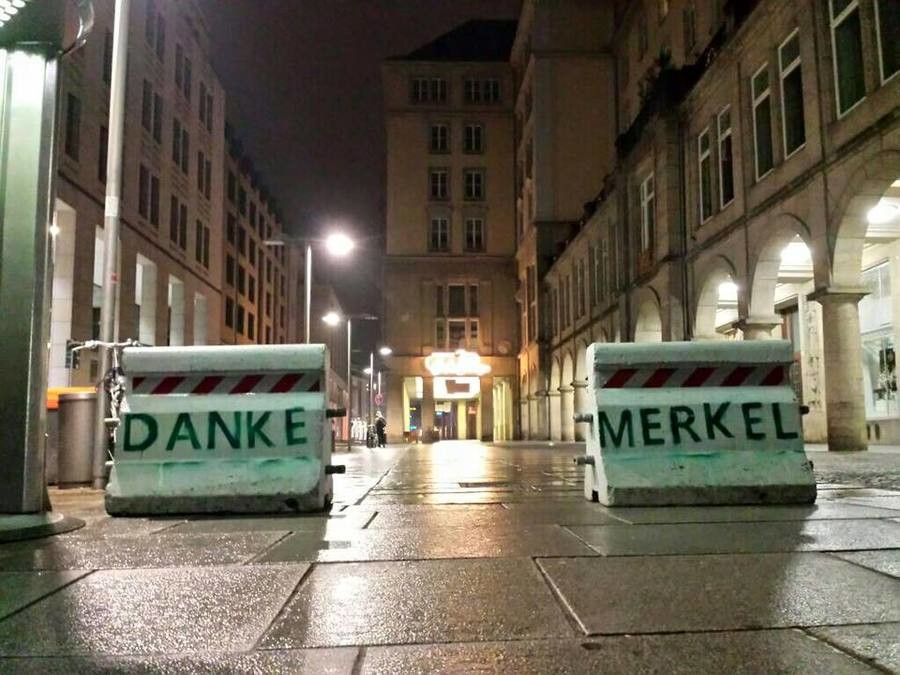
Residents of Western Europe have noticed a new phenomenon in recent years: the appearance of large, solid concrete blocks near major walkways and throughfares. Known as ‘diversity blocks’, these brutal grey cubes are very noticable in otherwise highly refined and meticulously sculpted urban landscapes. This essay explains.

In the first two decades of this century, Muslim terrorists killed several hundred people in Europe in dozens of incidents. Initially, the preferred mode of attack was to use bombs, whether dumb bombs or human suicide bombers. This was how the 2004 Madrid train attackers killed over 200 people, and it’s how the terrorists who blew up the London buses the next year operated.

After these incidents, local security services tightened the net around the networks that provided the chemicals and the knowledge necessary to build explosive devices. They also introduced measures such as the need to fill out a form declaring one’s intent in order to buy potential explosive precursors. This meant that it became much harder to organise a bomb attack.

For a while, knife and machete attacks (and even the occasional sword attack) filled the gap, but these left a frustratingly low number of victims. It was soon realised that a terrorist in control of a truck (or at least a van) could inflict a great number of casualties simply by running down a crowd of people – especially easy in Europe thanks to their tradition of pedestrian streets.

The first act of terror to make use of this new insight was the 2016 Nice truck attack, where Mohamed Lahouaiej-Bouhlel drove a cargo truck into a crowd of people celebrating Bastille Day, killing 86 and wounding over 400. This inspired the Berlin truck attack some months later, where another Muslim terrorist killed 12 people, and the 2017 Stockholm truck attack, where yet another Muslim terrorist killed five.

These attacks became so common that people started to refer to them as “truck of peace” attacks. At this point, even the sclerotic European authorities realised that they needed to do something about it.

The problem with truck attacks is that many major roads run right next to major pedestrian lanes. This is all but inevitable given the logistics of traffic planning. So all any prospective truck attacker needs to do is drive along in regular traffic, and then suddenly veer off into the pedestrians. With enough momentum it’s possible to kill dozens of infidels in this manner simply by running them down.

The solution was as crude and brutal as the truck attacks themselves: gigantic blocks of solid concrete placed between the pedestrian malls and the roads. The logic was that the truck would hit these blocks and lose all momentum before ploughing into anyone. These blocks were placed everywhere, but especially in front of pedestrian malls and open markets.

It wasn’t long before some European citizens started taking the piss. Inspired by the sentiment that German Chancellor Angela Merkel had unnecessarily endangered her nation by opening the borders to over a million “refugees” from Syria in 2015, some started calling them ‘Merkel blocks’. The name that stuck, though, was ‘diversity blocks’.

They are called ‘diversity blocks’ for two reasons.

The first is that they are only necessary because diversity exists. In the days before mass Muslim immigration, European citizens generally didn’t have to worry about terrorism. Although there was localised terrorism at certain times, like the IRA, the Baader-Meinhof Gang, and the Basque separatists in Spain, there was nothing close to the pervasive, continent-wide fear that exists now.

When “diversity” started to become popular as an end in itself, many different groups of people became invited into Europe. Some of these people had very different ideas about the value of life to the natives. Many among these newcomers were inspired by violent ideologies foreign to Europe. Thanks to the diversity that these people brought, Europeans now have to put massive concrete blocks everywhere to prevent being murdered.

The second is that the blocks are also evidence of diversity. They don’t have them in Eastern Europe, because they don’t have Islamic terrorism there. Neither do they have them in Japan or South Korea. Diversity blocks only exist where Islamic terrorism exists at a sufficient level, and Islamic terrorism only exists where Muslims are sufficiently numerous.

In Clown World, the fact that we have to put gigantic concrete blocks everywhere to prevent the newer members of our society from slaughtering us is not considered cause for alarm. The mainstream media plays down the significance of these blocks, suggesting that they’re only temporary measures while returning ISIS soldiers can be deradicalised. Most of us know that they’ll be there as long as Clown World is.

A sane society would get rid of the people opening the borders to these killers. In Clown World, we vote those people back into power. Diversity blocks, then, stand as totems to the decay of the West, as gravestones for the free and easy way of life that we once knew.

*

If you enjoyed reading this essay, you can get a compilation of the Best VJMP Essays and Articles of 2019 from Amazon for Kindle or Amazon for CreateSpace (for international readers), or TradeMe (for Kiwis). A compilation of the Best VJMP Essays and Articles of 2018 and the Best VJMP Essays and Articles of 2017 are also available.

*

If you would like to support our work in other ways, please consider subscribing to our SubscribeStar fund. Even better, buy any one of our books!
Why Is Rent-Seeking Legal?

Our legal system has many quirks and contradictions that defy easy explanation. It seems strange that doctors are allowed to mutilate the genitals of infant boys, yet they are not allowed to prescribe medicinal cannabis products that would save lives. This article will discuss another activity of questionable morality: rent-seeking.

Rent-seeking is an attempt to increase one’s personal wealth without creating or producing any. It is the use of resources, such as land, to extract economic benefits (known as rents) from others without making any contribution to the overall economic good.

The most common form of rent-seeking today is found in residential property. There are some 625,000 rented houses in New Zealand today, and the average weekly rent is $390 a week for small houses and $525 for larger ones. Assuming an average rent of $480 per week, rents on residential property bring in some $15,600,000,000 every year in New Zealand alone.

Rent-seeking is correctly understood to be a form of parasitism. As with other forms of parasitism, rent-seeking is a net negative for the overall health of the system. Not only does it suck money away from the productive and gift it to the unproductive, it also incentivises anti-social behaviour. Economically, it disrupts market efficiencies, limits competition and creates artificially high barriers to entry for market participants.

Despite being a form of parasitism, rent-seeking is a long and honoured tradition in New Zealand. Many a fortune has been built in this country by taking advantage of people’s need for shelter from the elements. As a previous essay here has discussed, there’s nothing as profitable as human suffering, and being exposed to the elements is one of the worst kinds of suffering.

The beauty of rent-seeking is that it carries little risk. All you need to do is to own property and the Police will keep people away from it unless those people pay you money. As long as there are men willing to enforce other people’s claims to property in exchange for a wage (and there always will be), then owning some of that property is effectively a licence to print money.

In reality, there’s little difference between a landlord charging someone rent on the threat of throwing that person out into the street, and an armed robber charging someone their wallet on the threat of stabbing them in the guts. In both cases, the power to charge a fee or levy comes from the power to cause extreme physical suffering. Both are a form of extortion.

Given the apparent net harm of trying to extract wealth from the system instead of creating it, the question has to be asked: why is rent-seeking legal?

The main reason why rent-seeking is legal is simply because the rent-seekers make the laws. It was they who, way back in the day, invented Government by paying some weak-minded arse-lickers to defend their property against outsiders (this is all that Government is). Those arse-lickers bifurcated into the Police and security services (whose prime directive is to protect and serve property owners) and the Government (whose prime directive is to organise the protection of property owners).

At the end of the day, the Government is there to manage the affairs of the rich, and they don’t care if the poor are impacted adversely. People too poor to own property don’t have a seat at the table. This is the same reason why businesses were compensated directly in the form of wage subsidies, rather than workers being given a universal basic income – the wealthy take the lion’s share, the poor get the scraps.

This arrangement has created a great deal of resentment, however. Those forced to pay rent on threat of being thrown into the street don’t feel much less resentful about it than those forced to give up their wallet on threat of being stabbed. The fact that rent-seeking is socially accepted in our culture barely softens the blow. It still feels like a robbery.

As is usually the case for such abuses of power, this resentment has built to the point where it threatens to spill over.

The Sixth Labour Government has made it illegal to evict tenants from residential property for the next three months at least. Some groups of tenants have realised that, if they collectively refused to pay rent until the end of the coronavirus crisis, they could pretty much get away with it. There’s no way to enforce an eviction during the lockdown, so anyone who refuses to pay rent from now on can get at least three months of living rent-free.

Other people and places overseas have already declared rent strikes on account of that the coronavirus has made earning their usual income, and therefore paying their usual expenses, impossible. Housing Minister Megan Woods has said “there was also an obligation on tenants not to abuse the situation,” but it’s hard to see why, other than the possible threat of being blacklisted in the future.

The only reason why property owners can get tenants to pay them rent in the first place is because they have the power to force them to on threat of eviction. If that power is taken away, there’s little reason for those who had been coerced into paying rent to continue playing ball.

Perhaps the fairest outcome would be to continue to allow the extraction of rents, but to levy a 90% tax on incomes derived from it. An outcome similar to this was discussed in a previous article here that proposed the introduction of Georgist-style taxes on rent-seeking activity.

In short, rent-seeking is legal because it always has been, and because we’ve never questioned it. We’ve never been able to, because not only did the rent-seekers control the law enforcement forces but they also controlled the apparatus of propaganda, and these combined to normalise the practice. The legitimacy of rent-seeking doesn’t survive scrutiny, and there is a very real chance that it will be as illegal as armed robbery later this century.

*

If you enjoyed reading this essay, you can get a compilation of the Best VJMP Essays and Articles of 2019 from Amazon for Kindle or Amazon for CreateSpace (for international readers), or TradeMe (for Kiwis). A compilation of the Best VJMP Essays and Articles of 2018 and the Best VJMP Essays and Articles of 2017 are also available.

*

If you would like to support our work in other ways, please consider subscribing to our SubscribeStar fund. Even better, buy any one of our books!