
If You Think National Will Roll Back “Hate Speech” Laws, You’re Stupid

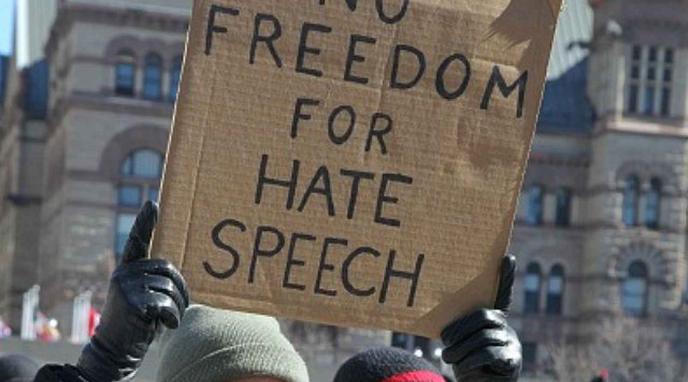
Libertarians across New Zealand were dismayed by news last month that Jacinda Ardern’s Labour Government intends to press ahead with so-called “hate speech” legislation. This is widely expected to entail European-style restrictions that could see a person imprisoned for saying that mass immigration is like an invasion, as French author Renaud Camus was earlier this year. But those putting their hopes in the National Party to fix it will be disappointed.

Right-wingers, in general, were also dismayed at Ardern’s confirmation that the Sixth Labour Government will introduce “hate speech” laws if they are re-elected on the 17th of this month. The conservative argument is that free speech is a fundamental part of New Zealand culture, and there’s no good reason to throw this away.

Judith Collins responded by saying that National “would not add further” to the loss of free speech, but would not commit to rolling back any free speech violations that the Labour Government might commit. Neither did she affirm that free speech was a fundamental Kiwi value that needed to be defended.

The reality is that National can sense a political advantage in acting as if they are in favour of free speech, but they don’t really care about it, for two major reasons.

The first is that they’re not, in any sense, a libertarian party. In fact, they are transparently authoritarian in several ways. National likes to pose as if they’re against government interference into the private lives of citizens, in contradistinction to Labour, who want a nanny state. But if they were libertarian they would work to legalise cannabis.

Being in favour of legal cannabis is no longer a radical position for a right-wing party in the Anglosphere. 55% of American Republicans are in favour of cannabis legalisation, and even a state as Republican as Alaska, where Donald Trump beat Hillary Clinton 51%-37%, now has legal cannabis. Part of the reason for this is the libertarian streak possessed by American right-wingers.

This libertarian streak doesn’t exist in New Zealand conservatism, which is why we are some 20 years behind America when it comes to cannabis. But the absence of these libertarian sentiments among New Zealand conservatives suggests that they won’t make an effort fighting for free speech either. Why would someone who thinks you should be in a cage for growing medicinal cannabis fight for your right to free speech? They wouldn’t.

The second major reason why National don’t care about free speech is because they are influenced by people who are against it.

British Conservative Leader Boris Johnson is bringing in draconian anti-free speech laws under the guise of child safety. The proposed bill will make it illegal to cause “online harms”. The Centre for Policy Studies declared their opposition to the bill, stating that it was wrong to let an unelected communications regulatory body decide what people were allowed to write on the Internet.

If the British equivalent of the National Party is restricting free speech in the same way that the New Zealand Labour Party intends to do, that is evidence that the moves are not inspired by left-wing or big government sentiments but by globalist ones.

Because the National Party is just as beholden to globalist interests as Labour is (even if those interests are slightly different), there’s no reason to think that they would be much different to Labour when it comes to free speech. Globalist interests want few things more than to shut down criticism of mass immigration – the less resistance, the higher house prices can be pumped, the more mortgage profits can be raked in.

In fact, one can predict that even if National wins the election this month they will introduce some kind of free speech restrictions anyway. There is transparently a wider globalist agenda to abolish free speech and, with it, dissent and criticism in general. This agenda has arisen because we are in the democracy to tyranny part of the political cycle.

No matter who wins this month’s election, New Zealand will lose our rights to free speech, as we have already lost our firearms rights and our rights to use spiritual sacraments. And in the same way that neither Labour nor National rolled back firearms restrictions or restrictions on the use of cannabis and psilocybin, nor will either party roll back any restrictions on free speech that might get passed in coming years.

*

If you enjoyed reading this essay, you can get a compilation of the Best VJMP Essays and Articles of 2019 from Amazon for Kindle or Amazon for CreateSpace (for international readers), or TradeMe (for Kiwis). A compilation of the Best VJMP Essays and Articles of 2018 and the Best VJMP Essays and Articles of 2017 are also available.

*

If you would like to support our work in other ways, please consider subscribing to our SubscribeStar fund. Even better, buy any one of our books!
VJMP Reads: Free Speech Under Attack II

This reading carries on from here.

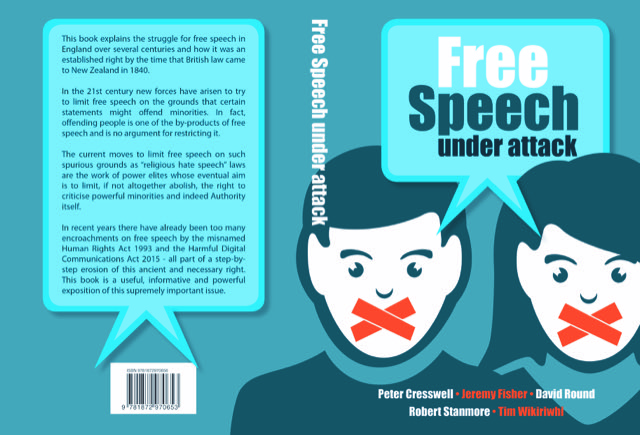
Chapter Four of Free Speech Under Attack is ‘How Speech Became Violence’ by Peter Cresswell. This essay echoes the warnings about leftist totalitarianism that VJM Publishing (among many others) has issued. Here Cresswell outlines the development of the concept of hate speech in New Zealand.

Putting hate speech on the agenda appears to be a leftist plot to introduce mass censorship. The anti-fascists have become the fascists. The modern Left is entirely in opposition to free speech. In fact, they are trying to destroy speech entirely, and with it people’s ability to communicate. Creswell concludes with an admonition to stay vigilant against those who would take freedom away.

Chapter Five is also by Cresswell, and titled ‘Identity Politics: the Threat from the “Azza” Group’. Cresswell begins by talking about the threat of identity politics and how it influenced the Christchurch mosque shootings. Identity politics is a modern tribalism that rejects the power of reason. This tribalism brings with it a savage and primitive way of thinking.

This tribalism has been specifically encouraged as a “formula for dissent, disagreement and disruption” by those who would start a revolution. Cresswell identifies the philosophy of Herbert Marcuse as instrumental in inspiring the attempts to revolutionise language. The concept of intersectionality must also take much of the blame.

Chapter Six is ‘Politicising a Massacre’ by Robert Stanmore. This refers to the Christchurch mosque shootings, after which all kinds of parties painted their enemies with being associated with Brenton Tarrant. Stanmore reflects on the hypocrisy of Jacinda Ardern wearing a hijab when it is a symbol of the subjection of women. The firearms ban was also bad legislation.

VJM Publishing gets a mention here, as one of the bloggers harassed by the New Zealand Police as part of their Operation Whakahumanu intimidation campaign. Stanmore also points out Ardern’s general hypocrisy on the subject of racism, and the danger of Andrew Little’s zeal to introduce hate speech laws. He also makes an argument that VJM Publishing has made before, that shutting down free speech will make terror attacks more likely, not less.

*

If you enjoyed reading this essay, you can get a compilation of the Best VJMP Essays and Articles of 2019 from Amazon for Kindle or Amazon for CreateSpace (for international readers), or TradeMe (for Kiwis). A compilation of the Best VJMP Essays and Articles of 2018 and the Best VJMP Essays and Articles of 2017 are also available.

*

If you would like to support our work in other ways, please consider subscribing to our SubscribeStar fund. Even better, buy any one of our books!
Why They Stopped Pushing Class, And Started Pushing Race

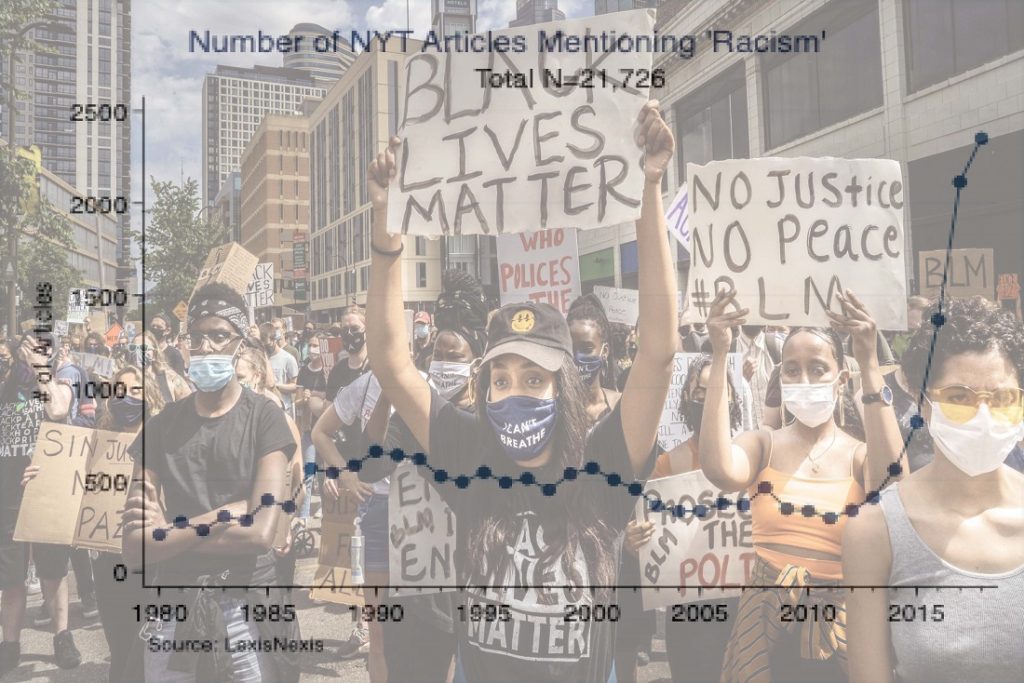
Recent studies have shown that the frequency of race-baiting content in the mainstream media has increased sharply over the past decade. Terms such as “structural racism” and “racial inequality” have spiked in use. The lazy reason we’re all given is that this is a sign racial issues are finally being treated with due seriousness. The truth is much more sinister.

Many people have noticed that the mainstream media now pushes race issues at every opportunity. The major news shows now feature racial issues in almost every broadcast. Often, innocuous issues are spun to make it seem that black or brown people are being oppressed in situations when they really aren’t. Spokespeople for racial collectives are featured prominently.

The mainstream media has made it seem as if racial injustice is the single most pressing issue in all of society. With the hysteria around the George Floyd killing, it reached a truly religious fervour. This extreme attention paid to race issues, at the expense of class issues, is part of a deliberate divide-and-conquer strategy.

The simple story is that the mainstream media is owned by international banking and finance interests, and these interests control the loyalties of the ruling class of every Western nation.

The last thing those interests want is for the lower classes to unify, because if the lower classes did unify it would be against the international banking and finance interests and their lackeys. So those interests direct their employees in the mainstream media to promote racial narratives intended to set those lower classes against each other.

They know that a large proportion of the working class is non-white. By lifting that part up, and by pushing the white part down, they guarantee tension and conflict. Pushing racial consciousness ensures that the non-white working class takes an antagonistic attitudes towards white people, and consequently get rejected by the white working class.

As this column has previously pointed out, the corporate world has thrown itself in behind Black Lives Matter when they did the exact opposite for Occupy Wall Street. This is also deliberate. Although corporations act as if their support for Black Lives Matter is for purely altruistic reasons, the true reason for their support is that promoting racial narratives at the expense of class narratives serves their interests.

Simply put, race divides us more effectively than class does.

Although the white working class has no voice in today’s political scene, they are still some 35% of the population of the West. This means that the majority of poor people in every Western country are white. For these people, being told that they are privileged because of their skin colour – when still poor – is an outrage. But this idea is pushed because, not despite, that it is outrageous.

The primary consequence of pushing the lie that the white working class is privileged is discord between the white working class and the non-white working class. The more that the non-white working class is raised up above the white segment, the more hate is generated. This hate is amplified when the non-white working class is taught to regard the objections of the white working class as racist.

The result of pushing race consciousness in the mainstream media is that the working class has fallen apart. White working class people will not take the side of people who think they are racists, and non-white working class people will not take the side of people who they think are oppressors. This mutual antagonism prevents the working class from coalescing towards any common goal.

Meanwhile, the ruling class laughs, their opposition crippled by infighting.

The mainstream media has induced such an advanced state of race neurosis that many people are too afraid to discuss racial topics at all. Now we just meekly surrender while the mainstream media browbeats us into submission for the supposed crimes of our ancestors. Thanks to a decade of this psychological pressure, our minds have become warped into thinking through a racial lens.

This myopically race-based way of thinking means that class narratives are forgotten, and, with their loss, the opportunity for class-based resistance to the predations of our rulers becomes impossible.

The mainstream media will only very rarely discuss an issue from a working-class perspective, because that strengthens the enemies of their owners. Acknowledging the legitimacy of working-class consciousness is to acknowledge that the working class might have a legitimate grievance, or at least a legitimate reason to pull together. Much better to split them in two by promoting racial consciousness.

This divide and conquer strategy is used elsewhere. Western intelligence agencies use their control of media organs to sow discord in geopolitical rivals. For example, instead of speaking of China as a single unit, they will divide it into the oppressors who live urban and the oppressed who live rural. Then they push the rural narrative for the sake of promoting rural consciousness at the expense of national consciousness.

Occupy Wall Street terrified the international banking and finance interests that control the apparatus of propaganda. Those interests saw their class enemies pulling together under a common banner. Ever since then, the mainstream media has gone to extreme lengths to promote racial consciousness ahead of class consciousness. The rioting of 2020 suggests that they mostly succeeded.

*

If you enjoyed reading this essay, you can get a compilation of the Best VJMP Essays and Articles of 2019 from Amazon for Kindle or Amazon for CreateSpace (for international readers), or TradeMe (for Kiwis). A compilation of the Best VJMP Essays and Articles of 2018 and the Best VJMP Essays and Articles of 2017 are also available.

*

If you would like to support our work in other ways, please consider subscribing to our SubscribeStar fund. Even better, buy any one of our books!

Clown World Chronicles: Who Is The Merchant?

The Merchant, aka Shlomo Goldberg, aka Abraham Shekelstein, is a prominent figure in Clown World. All the various tricks and schemes that lower people’s quality of life seem to have the Merchant’s fingerprints on them. Like a dark shadow cast by a thick cloud, the Merchant’s influence is seen and felt everywhere.

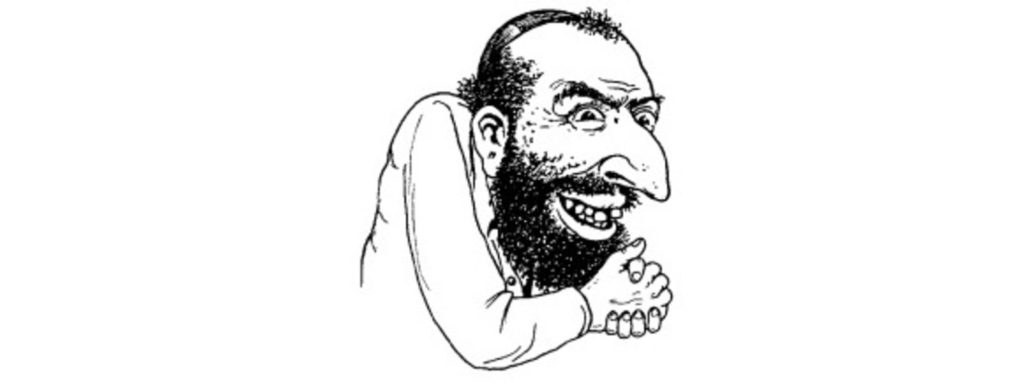
Usually depicted rubbing his hands together in anticipation of a fat profit, the Merchant is a hideously deformed figure. His outsized nose juts snout-like from his face, his teeth are crooked as if he uses them to open bottles, and his feeble arms and shoulders betray the fact that he never does any physical labour.

The Merchant is the Elder God of the Fundamental Negative Axis. As such, he is an extremely powerful figure. He is the greatest force for evil in all of Clown World. This is because he, more than anyone else, denies the supremacy of Kek.

The Merchant’s arrogance is such that he believes there are none greater than himself, and as such he believes he has the right to reshape the world according to his whims. This brings him into direct conflict with the Will of Kek, which is to spread the lulz. The Merchant is not interested in humour, but rather in subjugating people through contracts and legal obligations.

Although the Merchant has a Jewish appearance, this is incidental. The ugliness of the Merchant is not because he is Jewish but because he represents the ugliness within all of us. The Merchant is the physical embodiment of the desires within all of us to either humiliate our enemies or to escape into fantasy worlds. He is the incarnation of all of our anti-life sentiments.

Most Clown World denizens have figured out by now that our collective preoccupation with money and material wealth is destroying us. Despite decades of supposedly relentless economic progress, most young workers are much poorer than their parents were at the same age. The pressure that this unexpected poverty has put on the minds of the young is driving many to seeking oblivion in drugs, porn, video games or even suicide.

The obsession with achieving social status through material possessions has caused us to cast spirituality aside for so long that we have now forgotten its importance. The received wisdom in Clown World is that spirituality is mental illness, the absolute meaninglessness of life and the inevitable extinguishing of consciousness being hard facts. As a result, more people than ever are now NPCs.

The Merchant sees this, cackles and rubs his hands.

He represents our greed, our acquisitiveness, our aggression, our narcissistic status anxiety, our deceitfulness and our shamelessness. He is us, and there is no escaping that fact. Every citizen of Clown World, without exception, has an aspect of the Merchant within themselves. It is the duty of each of us to keep it under control.

The Merchant’s role in Clown World is to tempt. Every time a person’s will wavers, the Merchant is there to tempt them into making a short-term decision. The Merchant influences people to tick up impulse purchases on the credit card, or to smash back a six-pack when they have work in the morning. He tempts people to rat their neighbours out to the cops and to schedule hour-long work meetings.

In the Clown World pantheon, the Merchant exists in a state of mutual antagonism with Kek, the Elder God of the Positive Fundamental Axis. The world is the battleground on which they fight for the consciousness of everything that lives. The current state of Clown World is a sign that the Merchant is currently in the ascendancy.

The Great NPC is the henchman of the Merchant, and does his bidding in all instances. The Merchant has achieved total control over the Great NPC by controlling his informational environment and his desires. Not only does the Merchant control all the media the Great NPC watches, he uses this to tell the Great NPC what he desires. As such, the Great NPC stumbles from seeking one indulgence to the next.

The major influence of the Merchant in Clown World is to create more NPCs. This has the effect of destroying all of the humour in the world, thereby making life difficult for Kek followers. The Merchant’s influence on the mass media ensures that the common citizen is assaulted with propaganda telling them what to think and what to consume.

The Merchant is not powerful enough to take on Kek directly, and it is the Merchant’s fate to be destroyed in righteous fire when Kek returns to liberate the human race from Clown World. But the Merchant is powerful enough to effectively banish Kek from various parts of the world. This he does by influencing people to become serious and humourless.

Wherever you find people who want to ban cannabis, MDMA and the other spiritual sacraments, people who demand that everyone else take the knee in solemn submission, wherever you find cancel culture, you can find the influence of the Merchant. His influence will grow until Kek returns, at which point the Merchant’s machinations will be exposed.

*

This article is an excerpt from Clown World Chronicles, a book about the insanity of life in the post-Industrial West. This is being compiled by Vince McLeod for an expected release in the middle of 2020.

*

If you enjoyed reading this essay, you can get a compilation of the Best VJMP Essays and Articles of 2019 from Amazon for Kindle or Amazon for CreateSpace (for international readers), or TradeMe (for Kiwis). A compilation of the Best VJMP Essays and Articles of 2018 and the Best VJMP Essays and Articles of 2017 are also available.

*

If you would like to support our work in other ways, please consider subscribing to our SubscribeStar fund. Even better, buy any one of our books!