
The Case For Cannabis: Law Reform Is Not A “Slippery Slope”

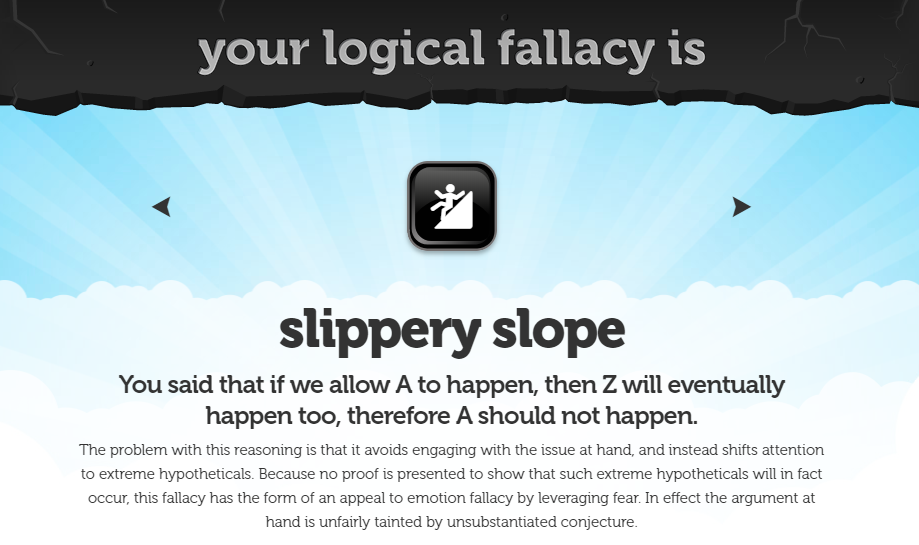
The case for cannabis prohibition is essentially based on fear, in particular fear of the unknown. Prohibitionists and other doommongers like to give the impression that cannabis law reform is a “slippery slope” to widespread social decay. As this article will show, cannabis law reform will not be a slippery slope to selling heroin to schoolchildren, or anything like it.

The slippery slope argument is used so often that it has become a formal logical fallacy. In short, this logical fallacy is when a person argues that a certain action must not be allowed, because if it is allowed, it will lead to worse actions also becoming allowed. To prevent those worse actions from coming to pass, we should keep the status quo, because to make even a small change is to step onto a slippery slope that will inevitably lead to disaster.

When we wanted to make it illegal to hit your children, we were told it was a slippery slope to those children beating up their parents. When we wanted to legalise prostitution, we were told it was a slippery slope to Weimar Republic-style child prostitution on the main streets. When we wanted to introduce a capital gains tax, we were told it was a slippery slope to the Government confiscating properties from those it deemed too wealthy.

None of these feared outcomes occurred, which is why the slippery slope fallacy is a recognised fallacy.

The slippery slope argument, then, is wheeled out almost every time someone tries to change any law. So it’s not a surprise that it also gets wheeled out in response to proposals for cannabis law reform. The problem is that we’ve had cannabis prohibition for so long now that almost no-one can remember life from before it was brought in, so we’ve forgotten that prohibition has done more damage than legal cannabis ever could.

The old form of this argument was that cannabis use is a slippery slope to heroin use, and therefore we have to keep cannabis illegal to protect people from getting sucked into heroin, because they’re all some form of “dope”. Nowadays, almost everyone knows that the sort of people who use cannabis have very little in common with those who use heroin, and don’t generally move in the same circles.

Cannabis prohibitionists warn us breathlessly that liberalising the cannabis laws will lead to “THC-laced confectionery” being sold to schoolchildren. The New Zealand media has shown images of gummy bears that are purported to contain 30% or more THC, and the implication is that a small child might gulp down a couple of dozen of them thinking they’re sweets. Ignoring the fact that eating two dozen cannabis-infused gummy bears would still be safer than eating two dozen paracetamol, the argument fails for at least two major reasons.

For one thing, most of the arguments about harm don’t apply to other drugs. It’s fair and reasonable to argue that cannabis causes less harm than alcohol; it’s neither fair nor reasonable to make the same argument of crystal methamphetamine. Neither has anyone ever argued that heroin or methamphetamine was a spiritual sacrament.

Where those arguments do apply, then it’s fair enough to consider them on their own merits. The War on Cannabis is, indeed, one front in the wider War on Drugs, and just because the case for drug law reform is the most obvious in the case of cannabis doesn’t mean it doesn’t exist in the case of other drugs. It happens to also be true that the law against psychedelics is as ridiculous as the cannabis one, if not more so.

The other major reason is that we are entirely free to recriminalise cannabis, should we reform the current laws and then decide the change isn’t working. The people who have looked at the evidence and the previous experience of places that have relaxed their cannabis laws almost all believe that this won’t happen, but it might. If we do decide that cannabis law reform doesn’t work, we will be free to change it back.

The argument that legalising cannabis would be a slippery slope to various kinds of social decay is not valid. Cannabis prohibition is, and never was, a wise move – prohibition is itself the experimental condition. In any case, relaxing the law is not a move into permissiveness but finally having the courage to correct an error that was made generations ago.

*

This article is an excerpt from The Case For Cannabis Law Reform, compiled by Vince McLeod and due for release by VJM Publishing in the summer of 2018/19.


Why Don’t Maori Leaders Represent Their People When It Comes to Cannabis?

(Photoshop credit: Kayla Chamberlain)

It’s not a secret to VJM Publishing readers that there is a great love of cannabis among the Maori population. The Maori people were never convinced that cannabis prohibition was a good idea, and they were always more heavily impacted by the enforcement of the law than non-Maoris. So why don’t Maori leaders represent their people when it comes to changing the cannabis laws? This essay explains.

Dan McGlashan showed in Understanding New Zealand that there was an extremely strong correlation between being Maori and voting for the Aotearoa Legalise Cannabis Party in 2017: 0.91. This is one of the strongest correlations between any two factors in New Zealand society, even stronger than the correlation between personal income and voting ACT, or being on the unemployment benefit and voting Labour.

So those of us in the know were not at all surprised by the Horizon Research poll announced yesterday, which stated that 75% of Maori voters intend to vote to legalise cannabis when the referendum comes around. Moreover, of the remainder, only 14% intended to vote no, with 11% being unsure. This means that up to 86% of Maoris would vote yes on the referendum if it were held tomorrow.

The question arises, however: if a vast majority of Maoris support legal cannabis, why are Maori leaders so pathetically gutless on this issue?

First of all, it should be pointed out that the bulk of non-Maori leaders are equally as cowardly, so it’s partly a disease of our own political class. Jacinda Ardern and Andrew Little have also been pathetic on this issue, as has every member of the National Party. Cowardice is a characteristic feature of New Zealand politicians, and when it comes to cannabis this seems to double.

However, the bulk of non-Maori leaders are not representing a population as heavily impacted by cannabis prohibition as Maori leaders are. The British settlers were long since used to alcohol, but for the Maoris its introduction was akin to the deployment of a bioweapon. This makes the need for cannabis law reform more pressing for Maoris, and thereby the current crop of Maori leaders more negligent than the others.

Secondly, it’s also a fact that young people are much more likely to favour cannabis law reform than the old ones who suffered most of the propaganda. Again as shown by McGlashan, the correlation between median age and voting for the Aotearoa Legalise Cannabis Party in 2014 was -0.55, which supports the Horizon Research poll suggesting that Maoris under 55 years of age are much more likely to support legalisation.

Most of the Members of Parliament who are Maori are old, so it can be seen that their attitudes are very likely the same prejudices against cannabis held by other old people. After all, they all went through the same reefer madness brainwashing as the other old people. At least part of the failure of Maori leaders on this issue can be attributed to the general failure of the Boomer generation to appreciate the perspectives of other generations. They’re simply out of touch.

Thirdly – and this is a very sad and depressing fact – there is a lot of lobbyist money from anti-cannabis sources flowing into the coffers of various politicians. A previous study here at VJM Publishing showed that at least 7% of National Party funding came directly from alcohol manufacturers and their associations, and those groups will have leaned heavily on the recipients to vote against any recreational alternative to alcohol.

We can’t say that any of these Maori leaders are taking money from alcohol, tobacco or pharmaceutical interests, because we don’t have any evidence for that. But there is a fuckton of anti-cannabis lobbyist money and these politicians are taking positions consistent with what the lobbyists want them to take. They’re certainly signalling a willingness to take money from such lobbyists. Ockham’s Razor would suggest that we at least be suspicious.

All of this helps to explain why Willie Jackson, Peeni Henare, Meka Whaitiri, and all the Maori members of the New Zealand First caucus voted against Chloe Swarbrick’s medicinal cannabis bill. Basically, they don’t give a shit about the reality of life on the ground for the average Maori, they just want their votes on the way to the Parliament trough.

The reality of life on the ground is that a great proportion of the Maori people have taken to cannabis because it’s a recreational alternative to alcohol. The arrival of alcohol had a similar effect on Maoris as it did on most New World people suddenly exposed to it: utter carnage, and they are smart enough to have learned that a session on cannabis tends up to end up much happier than a booze one.

We can’t realistically expect courage or leadership from a New Zealand politician, but we can at least expect them to understand and acknowledge when the winds of opinion have changed among the people they’re supposed to be representing, and to act accordingly. Maori leaders need to come out and publicly state that cannabis law reform is the way forward, not just for their constituents but for the entire nation.

*

If you enjoyed reading this essay, you can get a compilation of the Best VJMP Essays and Articles of 2018 from Amazon for Kindle or Amazon for CreateSpace (for international readers), or TradeMe (for Kiwis). A compilation of the Best VJMP Essays and Articles of 2017 is also available.

The Case For Cannabis: Prohibition Destroys Families

Cannabis prohibition is a destructive approach in many ways. Because of the need to use law enforcement officers to attack people who use cannabis, massive emotional trauma and psychological damage is the inevitable result of prohibition. As this article will examine, some of the worst damage is that inflicted upon families of cannabis users.

The most severe way that cannabis prohibition affects families is through law enforcement. To fully appreciate the destructive effect that prohibition has had on families, it helps to imagine the situation from the perspective of a child who has had a parent taken way on account of a cannabis offence.

The psychological literature is replete with information about the devastating effect that losing a parent, even temporarily, has on the child’s mental health. It’s common for children in such a situation to feel a powerful sense of neglect and loss. They don’t understand why their parent has been taken away and put in a cage – after all, most adults don’t understand cannabis prohibition either, so how can a child?

Cannabis prohibition means that children are deprived of bonding time with their parents, sometimes even for years, because of the need to put people in prison for violating the cannabis laws. This regularly has a devastating effect on the child’s mental health – for no real benefit to anyone.

Another way that prohibition destroys families is by driving a wedge between generations. As mentioned elsewhere in this book, the young are almost universally in favour of cannabis law reform. They know it’s much safer than alcohol, and they’ve seen the carnage alcohol has caused to their parents’ and grandparents’ generations.

So when their parents start lecturing them about how they should avoid cannabis because it causes psychosis, and how they should drink alcohol instead because it’s not a drug, the predictable response is that the children come to lose faith in their parents, and to trust them less.

The most extreme example of this is when one family member is using medicinal cannabis and living in the same house as another one. This often causes conflict when the owner of the house is afraid that the presence of cannabis will attract the Police. In cases like this, it’s possible for the tension to lead to a family being pulled apart, and this can all be attributed to the law against cannabis.

It should be pointed out here that the damage done to families is worse than it seems at first glance. The sort of people who grow cannabis are frequently in a precarious social situations. After all, one of the main reasons why people smoke it is to deal with the anxiety and depression that comes with being on society’s fringes.

For these people, the safety net of the family is sometimes the difference between life or death. Vulnerable people generally don’t have much else to rely on. Putting an adult in prison can have the effect of removing an important node from their family’s social net, meaning that families have to go without income and children have to go without parents. Even more distant relatives like cousins, nephews and nieces can be affected.

It’s common for the imprisonment of one parent to lead to the rest of the family having to move home or school. Breaking up these social networks, merely because a person grew a medicinal plant, is unconscionable. This suffering caused to family members of cannabis users is not justifiable.

Cannabis ought to be made legal so that Kiwi families are no longer made to suffer as collateral damage. A repeal of cannabis prohibition would mean that the integrity of the family could no longer be damaged by the actions of law enforcement. This would avoid causing severe emotional damage to the children and wider family members of anyone imprisoned, a much more humane and compassionate approach to the one currently used.

*

This article is an excerpt from The Case For Cannabis Law Reform, compiled by Vince McLeod and due for release by VJM Publishing in the summer of 2018/19.
The Case For Cannabis: Prohibition Corrupts the Youth

As this book underlines at length, cannabis prohibition itself does a great amount of damage to our society. Leaving aside the fact that cannabis itself is not harmful, prohibition and the act of enforcing it causes legitimate harm by way of trauma, and usually to people who have done nothing wrong. As this article will examine, prohibition also does damage by corrupting the nation’s youth.

The received wisdom is that cannabis corrupts the youth, by transforming good students into lazy, violent delinquents. The truth is much different. The truth is that cannabis prohibition creates the corruptive effect.

A young person who is taking note of the debate around cannabis law reform couldn’t help but to draw some unsavoury conclusions about how the world works. Watching Bob McCoskrie blatantly lie and scaremonger in the name of Jesus demonstrates clearly to any young people watching that our culture is rotten with crooks, our mainstream religion dead, our mainstream media complicit in it all. What sort of message is that?

The youth aren’t stupid. They know that cannabis prohibition is bullshit. This can be seen from the strong correlation between being young and voting for the Aotearoa Legalise Cannabis Party in 2017. The fact is that anti-cannabis propaganda has had a decreasing impact since the 1970s, by when enough people had experimented with it for there to be subcultures of individuals who knew that the reasons for prohibition were false.

This raises a question that few ask themselves, because of the rush to look tough on crime. What impression are we giving the youth by way of our actions around cannabis? Because the youth of New Zealand are watching their elders, and observing how some of those elders are blatantly lying about the side-effects of cannabis, and clearly trying to scaremonger the population, while ignoring the scientific evidence.

The youth also see the Police enforcing the law, despite the widespread awareness that enforcement of this law only serves to increase the suffering of the New Zealand people. This teaches them that the law is indifferent to the suffering of the people, merely something that is imposed upon them by Parliament, and the Police little better than dogs, merely following orders for the sake of a full belly.

Observing this blatant corruption in action has a hugely corrosive effect on the moral integrity of young people.

Above all this, cannabis prohibition corrupts the youth the worst in lower-class families. Because cannabis is on the black market, it’s possible for someone to make a few thousand dollars in hard cash from running a clandestine grow. When a child sees their parent or uncle making money from growing cannabis, and not from working, then the idea of crime instead of work starts to become normalised.

Imagine if the alternative for at-risk children was watching their family member work on the white market as a cannabis researcher, or even as a budtender. A child is much better off seeing their parents work almost any job on the white market than something on the black one. It’s much better to normalise the idea of making money from legal enterprise, but cannabis needs to be made a legal enterprise before that can happen.

Worst of all is the effect on those young people who see their older family members arrested and sometimes imprisoned for something which they can’t understand is a crime. There’s no way to get a young person, who is wise to the nature of propaganda and brainwashing, to believe that cannabis is evil enough to warrant such treatment. They know that the Government is committing an abuse against them.

The corruptive effect of this is immense. For such a young person, watching a member of your family go through that much suffering just over a plant normalises certain ideas about society. One of the most dangerous of these is that society is their enemy – an enemy that wants to destroy them.

Cannabis prohibition has corrupted our youth, by showing them that truth and justice have no place in the organisation of the world. The way to get ahead is to bribe politicians, scaremonger, lie and cheat. Political decisions about medicines are not made on the basis of evidence and science, and neither are they based on the imperative to end suffering.

It’s impossible to tell a young person that they ought to obey the laws of a society when those laws are transparently arbitrary and ridiculous. This means that cannabis prohibition has had the effect of eroding the otherwise law-abiding nature of people.

It would be much better for the supposed adults to demonstrate honesty and fairness to the young people. This we could do by repealing cannabis prohibition, and then making a commitment to tell the truth about it at all levels of government, education and medicine.

*

This article is an excerpt from The Case For Cannabis Law Reform, compiled by Vince McLeod and due for release by VJM Publishing in the summer of 2018/19.