

The Case For Cannabis: Legalisation Would Not Increase Drugged Driving Deaths

The resistance that many people have towards cannabis law reform is fear based. Like a panicky chicken, the prospect of any change at all is met with terror. One of the fears that people have at the thought of cannabis legalisation is that it will lead to carnage on our roads. As this article will examine, these fears are misguided.

As with many of the misgivings that people have about cannabis law reform, the fear of an increase in drugged driving deaths is based on a misconception about how dangerous cannabis is. This is partially based on ignorance, and partially based on the idea that being high on cannabis is like being drunk on alcohol.

The idea seems to be that perfectly otherwise normal people will smoke some cannabis and, because cannabis makes you go crazy, they will get in a car and drive like a crazy person. This perception has been stoked by sensationalist media reporting involving headlines such as “Stoned driver faces jail” when the driver in question had also been smoking methamphetamine.

The idea that cannabis legalisation will lead to more road deaths is not accurate for three major reasons.

The first is that it ignores the substitution effect (for the sake of argument, let’s agree here with the lazy assumption that legal cannabis will lead to more use). An individual driving under the influence of cannabis might not be as safe as a sober person. But evidence from elsewhere shows that, if cannabis was legalised, a proportion of incidents of drunk driving will be replaced with incidents of stoned driving, which are safer.

Research has shown that rates of alcohol use fall in places where recreational cannabis is made legal. This is because cannabis and alcohol serve as substitutes to a large extent. Because rates of alcohol use fall after cannabis legalisation, rates of drunk driving also fall, and this means that traffic fatalities also fall – significantly.

It’s better for a driver to be sober, but if they aren’t going to be sober, it’s better for them to be stoned than to be drunk. It’s a grim calculus, but if legalising cannabis would lead to twenty extra drugged driving deaths but would prevent fifty drunk driving deaths, it would be a worthwhile move.

The second is that the actual science is inconclusive as to whether being stoned impairs driving safety. Various studies have provided contradictory results. The lazy assumption is that being under the influence of any psychoactive drug, including cannabis, will make a person worse at driving. The reality is that stoned drivers take a variety of measures to reduce their risk of crashing.

Part of the problem is that unregulated cannabis contains a great variety of various cannabinoids, and these cannabinoids can be present at a great variety of frequencies. Studies appear to be clear that high doses of THC impair driver safety, which follows logically from the fact that THC is known to have a psychotogenic effect, but there is no such evidence suggesting the same about high doses of CBD.

It also appears to be true that, unlike alcohol, cannabis tolerance has an effect on whether it impairs driving performance. For many cannabis users, cannabis is merely a background substance that quietens distracting thoughts. All these reasons mean that, although no responsible person would advocate driving after using cannabis, a person who has just smoked it is not necessarily unsafe to drive.

The third is that it is irrelevant. Like with many arguments against cannabis law reform, focus on the specifics misses the bigger picture.

Not everyone trusts the Government when it says that cannabis is a substance that isn’t safe to drive on. As the linked articles above demonstrate, there are indeed instances when a person who has consumed cannabis is not safe to drive. But why would a person trust a Government public safety notice on the subject, when they have previously lied about cannabis full stop?

Over recent decades, governments all over the world have denied that cannabis was medicinal. But because people all over the world knew that it was medicinal, the end result has been decreased trust of governmental pronouncements, particularly when they relate to cannabis. So if the a government would give the perfectly reasonable advice to avoid driving within two hours of smoking, it might well be ignored.

If cannabis was legal, and if the Government spoke to the public honestly about it instead of lying, users might trust them when giving intelligent and prudent advice about smoking cannabis and driving. This would save many more lives in the long run than could possibly be saved by putting cannabis growers and users in prison.

The idea that cannabis legalisation will lead to a spate of fatal traffic accidents is fearmongering. It’s the same kind of fearmongering that claimed that legalising homosexuality would lead to everyone dying of AIDS. The experience of overseas territories that have legalised cannabis shows that these fears are little more than hysteria.

*

This article is an excerpt from The Case For Cannabis Law Reform, compiled by Vince McLeod and due for release by VJM Publishing in the summer of 2018/19.
The Case For Cannabis: Quality Control

Libertarians like to complain about government regulation, claiming that it leads to stifled innovation and more expensive products. Although this is true of mature markets, regulation for emerging markets of any good or service usually keeps cowboys out of the industry. An argument for cannabis law reform is that it would maintain a certain level of quality within cannabis products.

The black market means a lot of things. It means shady characters, violence, turf wars, unbelievable amounts of bullshit and prison sentences. It also means a variable quality of product – and this has a number of adverse consequences for people’s health.

Black market alcohol still regularly kills people in places like Norway, where legal alcohol is extremely expensive, because it doesn’t have the same quality controls as the commercial product. As a result, the person making it often has little idea of how strong their product really is. Sometimes it’s as strong as absinthe.

Despite the fact that legal alcohol still kills a lot of people, most people can understand the quality control argument against alcohol prohibition. Although legal cannabis would be much less likely than alcohol to kill people, there is still a quality control argument to be made for cannabis law reform. If one approaches the subject of cannabis law reform from a harm reduction point of view, then legalisation makes a lot more sense than prohibition.

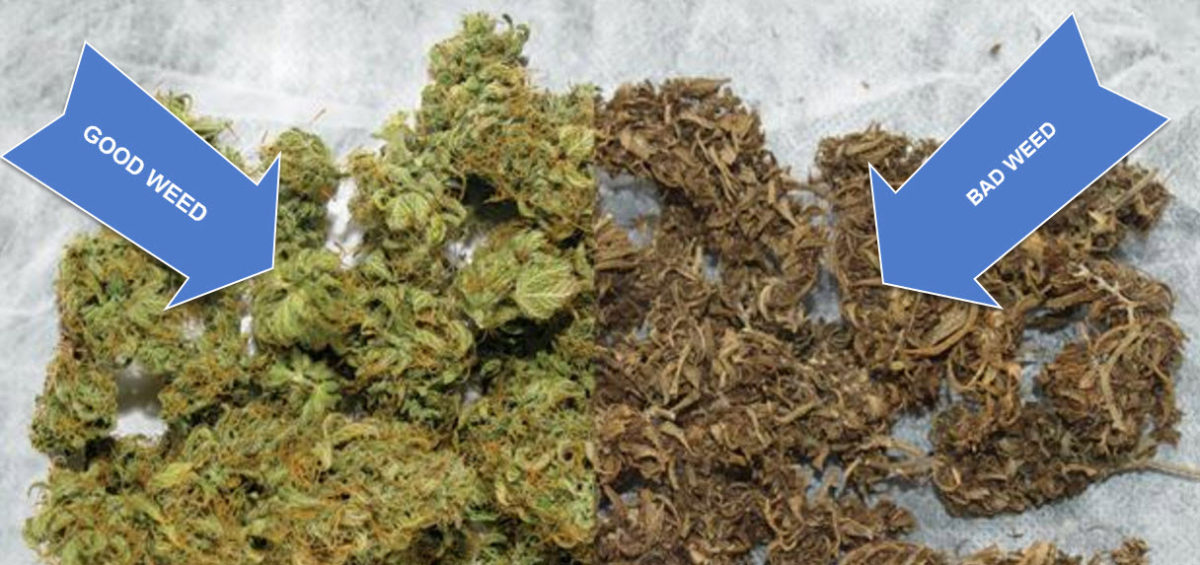
When growing cannabis, there’s not too much that can go wrong. It’s called weed for a reason. Nevertheless, it’s still possible to grow buds that have mold on them, especially because of the fact that they are often grown indoors in moist environments, or grown outdoors in places where the rainfall can’t be controlled. This mold can easily lead to lung conditions if the bud containing it is smoked.

Much worse is that sometimes black market cannabis is sprayed with various substances that make it appear more sticky or provide more of a “hit”. This can be anything from legal highs to fly spray. It might be hard for some people to believe that anyone selling cannabis could be so unscrupulous, but that’s what people are exposed to when cannabis is on the black market. It’s complete chaos.

None of these things would happen if cannabis was commercially grown, at least not any more often than you’d buy moldy bread from the supermarket. If it ever did happen, it would trigger a review of quality control procedures at the place of manufacture, and new procedures would be put in place to make sure it didn’t happen again.

Quality control is not simply a matter of physical safety. The more science advances, the more we are coming to appreciate how many active cannabinoids there are in the cannabis plant, and how different amounts of various ones can have entirely different effects to others.

We’re starting to learn that cannabinoids like delta-9 THC, while immensely enjoyable in the right context, are not necessarily helpful from a pain relief perspective. We’re also learning that cannabinoids like CBD have a wide range of medicinal uses, but that it’s difficult to gather useful scientific data about how to prescribe them, because it’s hard to get hold of accurately calculated doses.

A regulated cannabis industry would allow for manufacturers to create products that had precise and known amounts of each ingredient cannabinoid. This would make it possible for doctors to prescribe a regular supply of the right cannabinoid at the right dose. In this context, the right dose means a dose that is strong enough to achieve the desired therapeutic effects without being so strong that it causes other problems.

Neither is quality control simply a matter of health.

Perhaps the worst examples of a lack of quality control can be found in the various ripoffs that occur on the black market. There are many elderly people who are desperate to get hold of cannabis medicine for conditions that cause them to suffer, and for who legal medicines are unsuitable. These elderly patients are then forced into the black market, and often get tricked into giving money to someone who supplies a substandard product – or even no product at all.

That vulnerable people can get ripped off to the tune of thousands of dollars by clowns who don’t know how to manufacture quality cannabis products, or by criminals who are happy to supply rubbish that doesn’t work, is one of the cruelest outcomes of cannabis prohibition. Some of these people are trying to find solace to deal with the pain of the last days of their lives, and cannabis prohibition leaves them exposed to the most exploitative elements of the black market.

This has been a common occurrence on various FaceBook groups, where old people are given a small amount of CBD oil as a sample and then asked to pay thousands for a low-grade oil that confers no therapeutic advantage. Because cannabis is illegal, these old people have no chance of getting justice through Police action. Of course, the scammers are fully aware of this, because prohibition is a criminal’s best friend.

Cannabis should be made legal so as to make sure that the cannabis that people use, and which they are going to use regardless of the law, is of an adequate quality. This will not only avoid the occasional physical illness that comes from buying black market cannabis, but it will also decrease the suffering caused by criminal activity in the cannabis market.

*

This article is an excerpt from The Case For Cannabis Law Reform, compiled by Vince McLeod and due for release by VJM Publishing in the summer of 2018/19.

The Case For Cannabis: It’s Easier To Stop Using Cannabis If It’s Legal

Many people take an overly simplistic approach to cannabis law reform and assume that cannabis prohibition leads to less use and less desire to use. In truth, much like the fact that people don’t use more cannabis in places where it is legal, cannabis prohibition doesn’t even help addicts. As this article will show, it would be easier for people to stop using cannabis if it was legal.

The logic appears to be that making cannabis illegal will make people decide to stop using it. If it’s not possible to openly grow and sell cannabis, some people reason, then it won’t be as easy for a person to maintain a cannabis habit, and therefore people will be incentivised to quit.

Many people who support this theory seem to assume that cannabis users, many of who are using the substance for medicinal reasons, will just sit and mope for a while and then go and do something more productive. Not only does this ignore the obvious fact that it’s easy to get hold of cannabis pretty much anywhere in New Zealand, it also ignores human psychology.

The reality is, thanks to the wonders of something called variable interval reinforcement, prohibiting cannabis actually makes addicted cannabis users more addicted. Under prohibition, because a person can never be sure if they can maintain a supply, they come to cherish cannabis a lot more when they do get it. So when they do use it, the reinforcing effect is much more powerful.

There are two major reasons why legal cannabis would make it easier for those who are cannabis addicts to quit.

It might not be easy for the average educated, middle-class person to appreciate, but not everyone trusts their doctor or mental health worker. Just because the average Normie considers their doctor to be an intimate confidante doesn’t mean that the average cannabis user feels the same way.

Attitudes have changed sharply compared to some decades ago, but there’s still a lot of distrust on the part of many cannabis users towards health professionals. So if they are honestly advised to quit cannabis for good reasons, they are less likely to pay heed, because they can’t be sure if the advice is coming from a place of honesty or is a formality due to the law.

It’s not easy for a doctor to say that cannabis would be beneficial if it is not legal. For one thing, they don’t want to get a reputation for being the local cannabis doctor. For another thing, there are potential professional consequences. None of them want to explain to a professional board why they recommended an illegal drug to a patient.

If cannabis were legal, it would be possible to trust your doctor if they would say that you wouldn’t benefit from using medicinal cannabis. As it is, if your doctor does not recommend medicinal cannabis, it’s impossible to know if they say this because they believe cannabis would be harmful, or if they believe cannabis would be beneficial but are afraid of potential professional or legal consequences for saying so.

The second major reason is that legal cannabis would make it easier for a user, who accepted that they were addicted, to taper down their use with the intent of stopping.

This relates to the reinforcement schedules referenced above. In the same way that it’s better to use variable interval reinforcement to strengthen a response, it’s better to use fixed interval reinforcement to weaken one. This is because it leads to a gradual weakening of the craving, rather than taking it full force and risking a relapse.

Anyone who has tried to suddenly stop using tobacco or alcohol knows how difficult it is to just make a clean break with it. In most cases, if there is not an immediate threat of death, a person will be advised by their doctor not to quit cold turkey but rather to taper down over a few weeks or a month. As mentioned above, this is partly to avoid relapse, but it’s partly because this is less painful.

People who were interested in stopping their cannabis use could, if we had a sane system, get a prescription for a fixed amount of cannabis with a view to tapering off. They could be given a number of joints and told to smoke x for the first week, x-1 for the second week, x-2 for the third week – or whatever worked.

This would prevent the disaster scenario familiar to people who have tried to stop smoking tobacco or drinking alcohol, in which one sits there while the craving for the drug rises and rises, until one finally caves, at which point using it feels like a divine gift. As mentioned above, this variable interval reinforcement only makes it much harder to quit.

Legal cannabis would be much better for those addicted than prohibition is. It would encourage addicts to trust their doctors when they suggested that cannabis had no medicinal value for them, and it would enable those doctors (or psychologists) to provide a schedule of decreasing fixed reinforcement that would allow for a relatively painless transition to sobriety.

*

This article is an excerpt from The Case For Cannabis Law Reform, compiled by Vince McLeod and due for release by VJM Publishing in the summer of 2018/19.

The Case For Cannabis: It Doesn’t Matter That Awful People Support Cannabis Law Reform

Some people – whether they’re honest about it or not – don’t support cannabis law reform because of the sort of person who does support it. Because many unpleasant and dangerous people think that cannabis prohibition is a bad idea, some others have gone as far as to conclude that it must really be a good idea. As this article will show, it doesn’t matter that awful people support cannabis law reform.

Indeed, demographic analysis shows that the sort of person who supports cannabis law reform isn’t the same sort of person who is doing the best. According to Dan McGlashan’s Understanding New Zealand, the correlation between voting for the Aotearoa Legalise Cannabis Party in 2017 and net personal income was -0.48, meaning that ALCP supporters were among the poorest in the nation, about as poor as National voters are wealthy.

Voting ALCP in 2017 had a correlation of 0.66 with being a solo parent, 0.68 with having no formal academic qualifications, 0.79 with being on the invalid’s benefit, 0.82 with being on the unemployment benefit and a whopping 0.89 with being a regular tobacco smoker. This suggests that being a cannabis supporter is correlated with just about every measure of low social standing.

Clearly, cannabis isn’t a drug for people who are doing well in life. Fundamentally, cannabis is a medicine, and therefore it appeals primarily to people who are sick in some way. This is obvious from the strong correlation between voting ALCP and being on the invalid’s benefit, because many of those people have discovered cannabis in their desperation. It’s not surprising, then, that its supporters are generally people who aren’t doing well.

None of that matters when it comes to determining the fairness of cannabis law reform.

Many people don’t like to use objective, intellectual reasoning when they make decisions. As was understood by Edward Bernays, people often rely on the consensus opinion of the herd when they choose what car to buy, or what political party to vote for. More specifically, they rely on the consensus opinion of their peer group.

People who are in this category, and whose peer group are prejudiced against cannabis users, tend to be prejudiced against cannabis as well. Their reasoning follows the logic that, because the sort of person who supports cannabis has a low social standing, they can’t have devoted any real honest thought to the issue. However, this entire argument is based on a kind of snobbery. It’s little more than looking down one’s nose at another person.

In fact, it’s a classic example of an ad hominem fallacy. Just because an argument for cannabis law reform comes from a person who isn’t a highly upstanding member of the community doesn’t mean that the argument is false in any way. The logical validity of the argument for cannabis law reform has no relation to the social standing of the people promoting it.

Variations of the ad hominem fallacy have been used to oppose most other kinds of reform. Women’s suffrage was opposed by those who characterised its supporters as spinsters and shrews. Homosexual law reform was opposed by those who characterised its supporters as AIDS-riddled degenerates. In more recent times, capital gains tax reform has been opposed by those who characterise it as expropriation and its supporters as communists.

It’s also a circular argument to say that cannabis should be prohibited because criminals use cannabis. If cannabis is illegal, then of course only criminals are going to use it. So a person cannot then turn around and argue that, because only criminals use it, this is justification for keeping it illegal.

People who use this argument tend to portray cannabis users, and cannabis law reform proponents, as brutally immoral degenerates. Dealing cannabis is viewed not as bravely supplying a medicine in the face of a tyrannical political system, but as maliciously destroying other people’s brains for life. Cannabis dealers are equated to child molesters in terms of the suffering they bring.

Even if this absurd caricature was true, it wouldn’t matter. In much the same way that neo-Nazis have a fair point when they talk about the effect of mass immigration on social cohesion, and in the same way that ecofascists have a fair point when they talk about the effect of vehicle exhaust pollution on the world’s ecosystems, all those members of society’s underclass who support cannabis law reform have a fair argument to make.

Although it’s true that the strongest support for cannabis law reform comes from society’s underclass, individuals within that underclass aren’t necessarily there because they are evil or immoral. Most of the people who use cannabis are doing badly because they are ill, either physically or mentally – cannabis is ultimately a medicine, before it is anything else.

So just because a person is poor, or a criminal, doesn’t mean that their arguments in favour of cannabis law reform can be dismissed. To the contrary – it is often people like this who are at the front lines of the War on Drugs, and understand and accounting for their experiences is crucial if we are to set the world to peace and order.

*

This article is an excerpt from The Case For Cannabis Law Reform, compiled by Vince McLeod and due for release by VJM Publishing in the summer of 2018/19.