Slave Morality in 2019

Some people have made the assumption that, because Christian morals have faded from the zeitgeist in recent decades, Nietzschean concepts like slave/master morality are no longer relevant. As this essay will examine, this is not only wrong but the opposite of the truth. Slave morality, in 2019, is more influential than ever before.

The slave/master morality dichotomy comes from The Genealogy of Morals. In this book, Nietzsche outlined the distinction between the master morality that arises in a state of Nature, which divides the world into good and bad, and the slave morality that arises after civilisation and which divides the world into good and evil, with the evil being the same as the good of the master.

Understanding slave morality is to understand resentment: the man with slave mentality resents the man with master morality, and seeks to bring him down. This resentment is the emotion that arises when the ego cannot get consensual reality to conform to its will, as a slave cannot. Resentment is, therefore, the natural consequence of weakness, whether that weakness be physical, emotional, intellectual or spiritual.

One major problem with the modern world is that it is heavily overpopulated. We are coming up to 8,000,000,000 human inhabitants on this planet. This means that the vast bulk of us have effectively no influence over the course of the world, or even over our own lives. We can only move around in small boxes built by other people.

The result is that there are now previously unheard of levels of resentment in our society. This resentment has found a florid range of expression.

Social Justice Warrior culture is one of most apparent examples. The resentment of the weak can be clearly heard in the cries about privilege and oppression. The mantra of SJW culture is that whoever has power is automatically the bad guy in any conflict against someone with less power. The intention of SJWs is the same as that of the slave moralist: to rip down anyone strong and call them evil.

As Ted Kaczynski pointed out in Industrial Society and Its Future, these impulses on the part of the leftist can’t ever be satisfied. Their passion to change the world comes from the resentment of being stupid and ignorant, and this doesn’t go away no matter who they destroy. So every time they succeed in destroying someone, they simply move on to the next target.

Therefore, as long as resentment exists, there will be Social Justice Warrior culture. This culture will, like slave moralities everywhere, try and destroy anyone who is happy. SJW culture chooses to do this by calling them bigots, Nazis and racists, and declaring that all good in their lives is privilege that has been stolen from someone else.

Related to SJW culture is ethnomasochism. This is when a person derives a particular kind of thrill from running down their own people. In the same way that a regular masochist will tell his dominatrix that everything he does is wrong, so does the ethnomasochist declare that the history of his people is littered with acts of irredeemable evil.

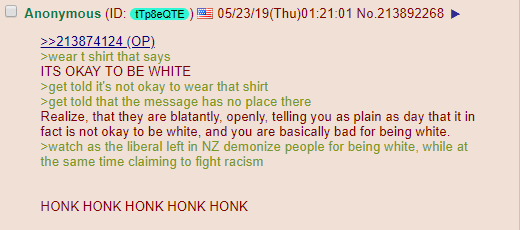
This ethnomasochism is related to the Holocaust religion, in the sense that it posits a white boogeyman whose excessive in-group favouritism has brought terrible suffering and evil to the world. In the quasi-religious context of ethnomasochism, ‘sin’ is replaced with ‘racism’, which has to be beaten out of society by ripping down anyone who suggests it’s okay to be white.

The resentment of the ethnomasochist leads them to destroy their own nation through support for things like open borders and the mass immigration of Muslims and Africans. The paradoxical fact that they derive a sense of control from this can be explained by comparing the mentality to someone who cuts their own arms: if one must suffer, then at least one can learn to suffer on demand.

Trans culture is a third example. Many men who have found that they don’t come up to the mark as men, i.e. men who women are not naturally attracted to, also find that they can get more attention if they pretend to be women. This is particularly common among men who are physical weaklings. This behaviour mimics a mental illness known as gender dysphoria.

The fundamental motivation for many of these people is to destroy the legitimate enjoyment that normal people get out of natural interactions between masculine and feminine. They want to destroy the natural concept of both “man” and “woman” so that healthy people who fit into these roles cannot enjoy them. A generation ago, homosexuality filled this social niche, but today it’s no longer shocking enough to do so.

Already trans culture has had enough of an impact to make it difficult for quality women to find a man worth being devoted to. By continuing to delegitimise and denormalise healthy expressions of masculinity and femininity, those who promote trans culture find expression for their resentment by destroying the natural and the beautiful.

The inability to understand the importance of free speech or the right to self-defence is yet another example. When a person with slave mentality gets into power, as has happened in New Zealand with the ascension of Jacinda Ardern to the Prime Minister’s position, they are liable to strip these rights away from the populace.

This is made possible by the resentment of the dumb and boring conformists who have nothing interesting to say. Slaves don’t care about the erosion of free speech because they have nothing to say worth listening to, and therefore are not impacted by the loss of an ability to speak, any more than the average person would be impacted by a ban on professional boxing.

People with slave morality don’t understand the desire of master moralists to have the ability to defend themselves either. After all, the defining feature of a slave is that he will not defend himself if he is beaten. The resentment that comes from being this weak manifests as a desire to remove other people’s ability to defend themselves.

A fifth way is the bizarre alliance with Islam. As a psychologist writing in New English Review has explained, Islam is the perfect religion for the resentful who like to see themselves as victims. It takes the same persecution mania as the other Abrahamic cults and raises it to another degree. Muslims resent the current order of the world, and so they are natural allies to the slave moralists.

Many secular Westerners with slave mentality have powerful sympathies for Islam, and can relate to a person throwing their life away in a suicide bombing. After all, the more one resents life, the less value one puts on it. As Nietzsche wrote, the slave moralist is the one who has said ‘No!’ to life, and there is no more vivid expression of this rejection of life than a suicide bombing.

The depth of the resentment can be seen by the size of the cognitive dissonance that arises when the Islamophile is asked about Islam’s attitude to women and homosexuals. Despite the brutally cruel oppression of these groups by Muslim culture, the resentment of the Islamophile is so great that all of these crimes will be swept under the carpet. In this sense, the Islamic apologist is to this generation what the Communist apologist was to the previous one.

These are merely a sample of all the various ways that slave morality expresses itself in 2019. The frightening thing is that, as the world gets more impersonal and more overpopulated, slave morality looks set to become even more influential. The only solution appears to be a massive cull, and an emptying out of the cities where this cancerous mentality has its strongholds.

*

If you enjoyed reading this essay, you can get a compilation of the Best VJMP Essays and Articles of 2018 from Amazon for Kindle or Amazon for CreateSpace (for international readers), or TradeMe (for Kiwis). A compilation of the Best VJMP Essays and Articles of 2017 is also available.

Civilization VI: Gathering Storm Explains How Humanity Is Doomed

God simulator fans have been busy for the past three months, thanks to the release of the second expansion to Sid Meier’s Civilization VI. Titled Gathering Storm, the expansion offers a number of new mechanics relating to climate. Unfortunately for us is the fact that, insofar as the Civilization games are history simulators, this one suggests that humanity is all but guaranteed to destroy the planet.

The fact that humanity is all but guaranteed to destroy the planet becomes clear if one considers the game theory logic of Gathering Storm.

A game of Civilization normally starts in 4000 B.C. At this point your empire will consist of one small village, a rudimentary knowledge of agriculture, and a gigantic, unknown map full of rivals to be explored. From here, you will be presented with a near-infinitude of different decisions. If you make the correct ones, your civilisation will survive against the military and economic threats posed by the others.

As the scientific knowledge of your civilisation progresses, it will advance through the Classical Era to the Medieval Era, and then to the Renaissance Era. Through each era, your empire’s military power increases, but nothing you do affects the global environment until you discover industrialisation. Once you get to the Industrial Era, your scientists are beginning to grapple with the uses of coal.

This means three major things. The first is that it makes naval vessels like ironclads and battleships possible. The second is that it makes coal power plants possible. The third is that the world atmosphere starts to become polluted as these units and buildings consume fossil fuels.

Let’s say you’re at war with someone (and, let’s face it, you probably are). The inexorable logic of war in the industrial age is that victory mostly comes down to getting the most and the biggest guns onto the field. This means that war is mostly a matter of production. Whoever has the most factories can produce the most guns, whoever has the most shipyards can produce the biggest navy, whoever has the best railway network can get the most nitre to the ammunition factories etc.

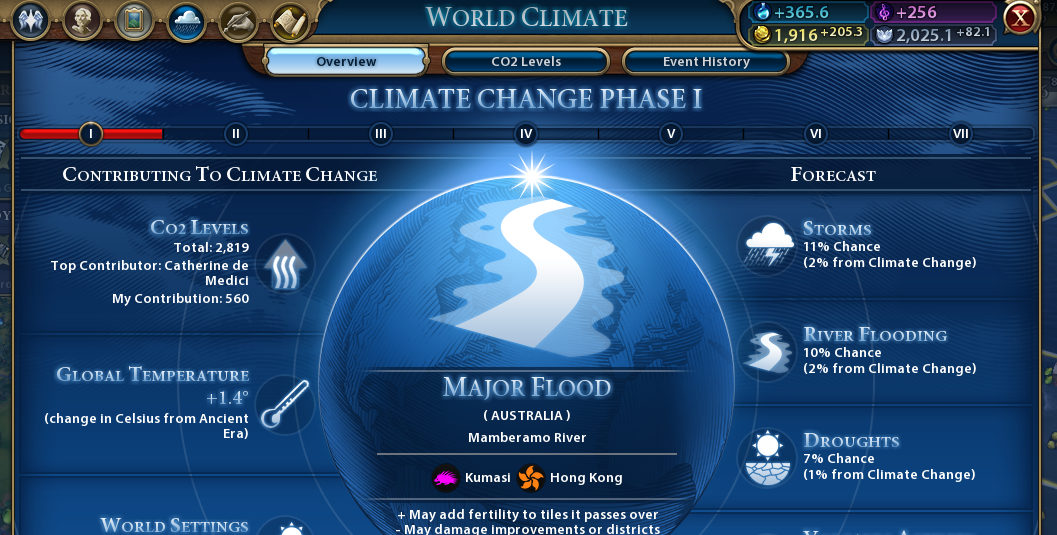
In Gathering Storm, it’s possible to harness the power of coal to not only create a more powerful range of naval vessels, but also to fuel power plants that greatly increase the productivity of the empire’s workshops, factories and arsenals. This also has the effect of spewing pollution into the atmosphere, measured in-game by CO2 levels.

In the Civilization series, technological advancement tends to proceed at roughly the same speed for everyone. This means that any technological and military advantages are usually slim and sometimes short-lived. So it’s very possible that, when the player discovers industrialisation, they are in a war that they are losing or which has stalemated. The increased power that comes from harnessing coal, then, is often enough to break the deadlock.

So the imperatives to burn coal and oil at the expense of the global environment are inescapable. If you don’t do it, your enemy will, and then they will destroy you. He who rapes the planet the fastest gets the edge on his enemies – and stays alive. As above so below: the kill-or-be-killed logic of the animal world applies at all levels of human organisation.

This is not just a matter of game-world logic either.

By 1903, British Admiral John Fisher had realised the strategic imperative to switch the British Navy from coal to oil. A navy that was fueled by oil was many times more efficient than one fueled by coal. Its ships, compared to coal-powered ships, had greater range, greater speed, lighter weight, required a smaller crew – and could carry more guns.

Fisher encountered some difficulty in persuading his higher-ups to agree to the change. Eventually, however, the iron logic prevailed, and the Royal Navy switched to oil just in time for World War One. The British strategic victory at the Battle of Jutland underlined the degree to which the switch to oil had created a distinct naval advantage. A failure to have done so would have meant defeat.

Of course, this profound naval advantage had to be maintained – which meant that military control over Middle Eastern oil fields had to be maintained, which meant that a massive navy had to be maintained. In other words, the Empire became irrevocably committed to the logic of maintaining a perpetual advantage on their enemy by controlling more energy.

At this point, the extreme difficulty of taking measures to preserve the Earth’s environment by way of not burning too many fossil fuels becomes apparent. If the Royal Navy had remained on coal, it’s possible that the Germans would have switched to oil and then won a military advantage. This could have led to the destruction of Britain itself, for that is the nature of military advantages.

Why would one side sit back and allow their enemies to obtain a strategic advantage over them? They wouldn’t. In the same way that no Civilization player will refuse to build battleships and power plants and allow the other players to destroy him, no real-life leader would refuse a military advantage that kept their people safe.

What emerges, from a game theory perspective, is a global tragedy of the commons-style scenario. The payoff to the people burning the fossil fuel is that they keep all the benefits of harnessing the energy. The drawback is the environmental damage done by burning the fossil fuels, which are mostly spread out across the entire world.

We do have one great factor in our favour. On our planet, technological advancement occurred in an extremely unequal manner, unlike in a game of Civilization. The Industrial Revolution began in Britain, and by the time the rest of the world had caught up, the British had built a global empire.

This made it possible for a minority of nations to develop so far economically that they were able to produce scientists who could foresee the danger of burning too many fossil fuels, and before we had burned so many that the planet was on an unavoidable path to disaster. And here we are today, but at a crossroads.

It’s not clear what the path away from this situation is. However, as this newspaper has mentioned before, the average person will eventually have to cut their consumption to a level roughly equal to that of a New Zealand beneficiary. This is not optional, as the planet simply cannot support more than this. The only thing certain is that a turn away from materialist consumption is necessary.

*

If you enjoyed reading this essay, you can get a compilation of the Best VJMP Essays and Articles of 2018 from Amazon for Kindle or Amazon for CreateSpace (for international readers), or TradeMe (for Kiwis). A compilation of the Best VJMP Essays and Articles of 2017 is also available.

Understanding the Globalist/Nationalist Dichotomy

In psychologist and political scientist Lee De-Wit’s recent book ‘What’s Your Bias?‘ he spoke of a new order of political alliances. The political order of today, he contends, is no longer a matter of change vs. stability, as it was during the French Revolution, or a matter of labour vs. capital as in the Industrial Revolution. Today it’s nationalist vs. globalist.

The natural basis of solidarity is biological. The strongest bond in the world is between the mother and offspring of animal species, in particular K-selected species such as humans and elephants. Mothers of any mammal species become dangerous if their offspring are threatened; many men have been killed by wandering between a mother bear and her cubs. This fierce willingness to protect is the basis for all solidarity.

It is in order to work in accordance with this natural bond that men choose to form monogamous families. The formation of a nuclear family allows for the maximum possible division of labour, so that the mother is able to fully utilise her natural love for her offspring, while the father is able to fully utilise his muscular advantage in gathering resources. Therefore, the father works with the natural solidarity of mother and child.

Families naturally bond together and form tribes, with a chieftain who settles disputes. These tribes naturally form together and form clans, and these clans naturally bond together and form nations. This process of natural bonds of solidarity leading to higher levels of social order was described by Aristotle in Politics. A nationalist, therefore, is someone who identifies with their wider kin group.

Globalism comes from the other direction. The first truly global system was the British Empire, because the British were the first to control the ocean navigation routes of the entire planet. This they achieved after their victory at the Battle of Trafalgar. Being in control of a global system, the British used it to meet their desires for increased material prosperity.

They did this in a manner similar to the previous empires, such as the Spanish and Portuguese – they imposed it on whoever had the materials. Because controlling the sea lanes made them militarily unstoppable, it was not necessary to obtain the consent of the people who lived on top of those resources. If the British respected the locals enough, they worked with them; if not, they butchered them.

Globalist logic, therefore, is not to see the nation as a family to which one belongs, but as a collection of resources that one exploits. The horrific thing about globalist logic is that it reduces human beings to dollar values and spreadsheet entries. This is why the idea of globalism imposing itself on the nation engenders so much anger among those who are loyal to a kin group.

Whether or not a person is a nationalist is primarily a matter of whether they are loyal to the people of the nation, or loyal to foreign ideologies and interests that might seek to exploit it. A person cannot be neither, unless they are also indifferent to all of the political issues influenced by this dichotomy, and those are many.

For instance, whether or not a person was born in New Zealand has a moderately strong correlation with their likelihood to vote for a nationalist party. Dan McGlashan showed in Understanding New Zealand that the correlation between being born in New Zealand and voting for the New Zealand First party was 0.54.

This is entirely logical, because there’s no point in having in-group loyalty towards a group that you don’t really belong to. If a person is born overseas, then it’s much easier for them to up sticks and move to yet another country. A person born in New Zealand, however, probably has cousins (and aunts and uncles etc.) also born here. Therefore, the New Zealand nation is their kin group.

Globalists are the children of the Empire. They don’t necessarily have loyalty to the people who they live around, because their immediate ancestors are often from somewhere else. Because the people around them are not part of their wider kin group, they feel no need to make decisions with that kin group in mind. They are comfortable exploiting them for the sake of their own personal gain, or for the gain of their kin group.

A nationalist, then, represents their people, whereas a globalist represents either another kin group somewhere else, themselves or an ideology. This ideology can be anything, but it’s usually the ideology of the Empire itself. A thousand years ago, the globalist ideology was Christianity. Today, the globalist ideology is neoliberalism, otherwise known as globohomo.

An important point is that this globalist-nationalist dichotomy cuts right across the left-right dichotomy, and could be argued to have replaced it.

The world’s globalists are split across the left and the right wings.

The left-wing globalists are ecocommunists who want a one world government that manages and allocates all of the world’s resources. These ecocommunists see ecological crises – and the perceived threat of such crises – as a great opportunity to get people to accept a global government. Mass immigration is great because it destroys national loyalties, making people more willing to accept being loyal to a global system.

The right-wing globalists are hypercapitalists who don’t want any government at any level. These free marketeers are in favour of globalism for purely economic reasons. They don’t care about the effect that importing cheap labour has on working class neighbourhoods, because they don’t live in them. All they want is the freedom to come, plunder, and then leave with the loot, and therefore laws protecting the nations are opposed.

Neither of these groups care much for natural bonds, such as to family or village. They are simply those with loyalties elsewhere, or to themselves only. ‘Globalist’ is, therefore, not at all a euphemism for Jew. An Englishman living in Auckland who has no loyalty to New Zealand is just as much the globalist as any New York Jew working in high finance.

The nationalists, likewise, are split across the left and the right wings.

Left-wing nationalists opposes mass immigration on account of the effect it has on the nation’s workers. They are concerned about the effect that a reserve pool of cheap labour will have on their people’s wages. They are also concerned that mass immigration will destroy the solidarity necessary for the nation to agree to welfare measures like a UBI.

Right-wing nationalists, by contrast, oppose mass immigration for the reason that they dislike people not of their nation, and believe they should stay away. Right-wing nationalists have problems with things like racemixing, which left-wing nationalists don’t really care about. Both sides also sharply disagree when it comes to measures such as work for the dole or drug law reform. Right-wing nationalists don’t care about working-class wages and don’t want a UBI anyway.

Because of their shared opposition to globalism, left-wing nationalists often get lumped in with right-wing nationalists by globalist propagandists. This has led to the absurd spectacle of politicians who are supposedly working-class representatives championing things like raising the refugee quota, despite that it instantly weakens the bargaining position of the native working class.

*

If you enjoyed reading this essay, you can get a compilation of the Best VJMP Essays and Articles of 2018 from Amazon for Kindle or Amazon for CreateSpace (for international readers), or TradeMe (for Kiwis). A compilation of the Best VJMP Essays and Articles of 2017 is also available.

The Case For Cannabis: It Doesn’t Matter That Substance Abusers Use Cannabis

Some people are hesitant to support cannabis law reform because they don’t want to make it easier for substance abusers to destroy themselves. Their fear is that legal cannabis will simply provide another substance for substance abusers to get wasted on. This article will explain why cannabis prohibition is not the best way to deal with those fears.

Like many of the arguments against cannabis law reform, this one is mostly based on a misconception of the psychology of cannabis users, and of substance abusers in general. It could be called the Trainspotting myth, because some people believe that the trajectory of cannabis use proceeds much like heroin use does in the film based on the eponymous Irvine Welsh book.

The fear is that legal cannabis will simply provide another way for degenerates to destroy themselves, and so why should the Government facilitate this? The fewer legal drugs available, the fewer easily-accessible avenues for self-destruction. Better to keep cannabis illegal to persuade people to go straight.

The sort of moraliser that makes arguments like this is generally not the same kind of person that hangs out with actual heavy substance users. As such, they don’t understand the psychology of them. Almost no-one goes from living a completely clean life to misusing any drug just because they “got addicted”.

The reason why people become substance addicts is usually because they have untreated mental illnesses, and this leads to a much stronger sense of enjoyment from the feeling of being drunk/stoned/wasted. The more unpleasant one’s thoughts, the more pleasant to escape from them. Therefore, it’s not so much the drug that leads to the abuse but the way the mind and brain are wired.

There are cases where people are substance abusers, and it may be that, for some of these people, legal cannabis means that they abuse more cannabis than they would have done if it was illegal. If this means that they avoid abusing worse drugs, then this is a good thing. All things being equal, it’s better for a person to use cannabis every day than to use several of the drugs listed in the image at the top of this page.

There’s no guarantee that any individual cannabis user is going to smoke cannabis until they die. Plenty of cannabis users, even heavy ones, get sick of smoking it and move on to other things. After all, although cannabis can be great fun, it can also get boring, much like alcohol and women and loud music and all the other things that people like to indulge in for a while.

So it’s better for them to get their fix on a drug that they are going to survive than on one that is going to kill them. Let them get their kicks on something that’s not going to do any long-term damage. It’s much, much better for people to use cannabis – and to perhaps need a few weeks to come back to normal – than to use something that will permanently change their brain chemistry.

An intelligent approach to cannabis law reform would put the emphasis on harm minimisation. If a person is honestly concerned about the total damage and suffering that a substance abuser might cause themselves, then a regime of regulated, legal cannabis would lead to less harm, for a variety of reasons.

Substance abusers are much more likely to get help from mental health professionals if their substance is legal. This fact has been clearly demonstrated by the willingness of patients to talk to their doctors about their alcohol or tobacco use compared to their willingness to talk about their methamphetamine use. If a substance is illegal there is a lot of fear associated with it.

Legal cannabis would make it easier for actual substance abusers – the sort who are destroying their lives – to trust their doctors or drug counsellors. This would make them more likely to take advice to either quit, or, if necessary, to go on a treatment program such as one that tapers off cannabis.

Legal cannabis would also make it possible for accurate and honest educational campaigns to exist. Right now, there’s no reason for any cannabis user to believe anything the Government says about the substance, because everyone knows they lie about it. So if the Government gave intelligent advice about protecting the lungs, it may not be heeded.

*

This article is an excerpt from The Case For Cannabis Law Reform, compiled by Vince McLeod and due for release by VJM Publishing in the summer of 2018/19.