

Clown World Chronicles: What Is A ‘Midwit’?

Films and history books warn us of the dangers of evil geniuses coming to power. Skillful orators like Hitler, we are told, are able to trick masses of people into following them, with dire consequences. But the lone evil genius is not as big a danger as a horde of mediocre people. Understanding the midwit phenomenon is crucial to understanding Clown World.

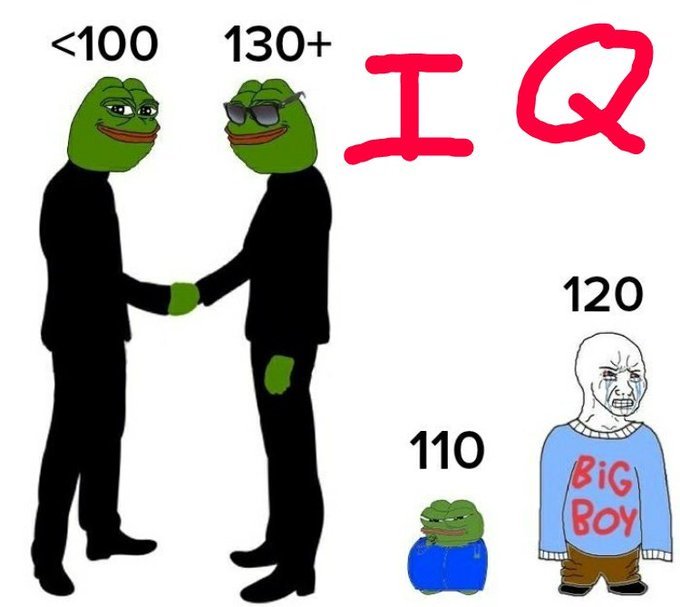
A ‘midwit’ is someone of middling intelligence. They are higher than lackwits, halfwits and fuckwits, but are lower than any genuine wit. They’re not dull, just not bright. Although this sounds very ordinary, the sheer mass of humanity at the very centre of the bell curve creates its own phenomena that we have to be wary of.

Psychologists have observed a curious phenomenon that is known as the Dunning-Kruger Effect. This is when a person with a low level of ability or knowledge heavily overrates themselves. It’s a specific example of an area of Psychology known as illusory superiority.

A person is most liable to fall victim to the Dunning-Kruger Effect when they know a little bit about a subject. This is because a person who doesn’t know the boundaries of a field of knowledge will not know the limitations of their own knowledge either. The tendency in such cases is to discount the volume of the knowledge not known.

When someone uses the term ‘midwit’ they are referring to this kind of person. They don’t mean a person of merely average intelligence, but rather a person who is utterly incapable of recognising their own intellectual shortcomings. The midwit secretly thinks he might be the smartest person who ever lived. This is because his understanding of his limitations is minimal.

Central to midwit psychology is their tendency to go along with the herd. Midwits can’t actually see ahead, much less beyond, but they like to give the impression they can. They only way they can continue to give this impression is by expending great energy determining what actually smart people think.

The problem here is that midwits can’t generally tell the difference between people smarter than them and crazy people. This leads to three characteristic midwit errors.

The first is dismissing people smarter than them as crazy.

Midwits don’t have the academic acumen to read scientific journals, much less conduct scientific literature reviews. As such, they are dependent on the word of experts in order to understand anything. Of course, if a person doesn’t have any expertise themselves then they have to rate those who do on trust, and that is a crapshoot at the best of times.

Any genuine scientific or cultural advance will, at first, only be understood or appreciated by the genuine experts and geniuses in the field. From them, it filters out to the merely brilliant, then to the bright and then finally to everyone else. So any really interesting scientific advance will only be appreciated by a minority – until it stops being interesting.

Because the midwit follows the herd, the midwit will always dismiss the genius as crazy on account of his low number of followers. When the genius becomes recognised by the masses, the midwit will follow along, up until the point where the genius becomes unfashionable. Then the midwit will drift into the next intellectual trend.

The second characteristic midwit error is following a crazy person out of the belief that that person is smart.

The archetypal example of this is the Manson Family. Charlie Manson was certainly capable of sounding smart, but his was more of a carnival storyteller’s glibness than the wisdom of a sage. He could take people for an enjoyable ride and show them some incredible places, but at the end of it they were left with regret.

Manson was certainly capable of expressing advanced spiritual insights. After all, if you hang around the psychedelic drug scene long enough you will come to hear some profound insights into the nature of reality from genuine shamanic adventurers. All he had to do was parrot them accurately enough and a couple of dozen Southern California midwits decided that he was a guru.

Because midwits are mediocre, they’re especially prone to mistake convoluted insanity for profundity. Consequently, there are all kinds of lunatics who have followings on account of that their babblings have become fashionable. Most of these lunatics are mainstream media figures – television celebrities are to the midwit what the gods were to the ancient Greeks and Romans.

These errors are magnified by the sheer number of midwits out there. Because there are so many of them, most midwits are used to the experience of encountering others who agree with them. This leads to the third, and most characteristic error of the midwit: groupthink.

Because the midwit knows that they are not distinguished in any fashion, being entirely mediocre, they come to prize the bare average above the exceptional. From this they develop a tendency to ignore anything vaguely controversial. If the herd thinks it, that’s good enough for the midwit. As the midwit is right on the centre of the bell curve, their opinions are the most common. Therefore, they conclude, they must be correct.

Related to this, midwits are especially fond of labelling any explanation they cannot understand a ‘conspiracy theory’. Perhaps unsurprisingly, they fall for all sorts of conspiracy theories themselves, especially ones that get popular in the midwit’s circle, or which may have been pushed in the mainstream media.

The traditional solution to the midwit problem was beating them into submission with a Bible. In recent years, control has shifted to a combination of psychological abuse (at school) and pacification (through the mainstream media). The contentment of the midwit is the dam protecting Clown World from the waters of change. If it goes, we fall into chaos.

*

This article is an excerpt from Clown World Chronicles, a book about the insanity of life in the post-Industrial West. This is being compiled by Vince McLeod for an expected release in the middle of 2020.

*

If you enjoyed reading this essay, you can get a compilation of the Best VJMP Essays and Articles of 2019 from Amazon for Kindle or Amazon for CreateSpace (for international readers), or TradeMe (for Kiwis). A compilation of the Best VJMP Essays and Articles of 2018 and the Best VJMP Essays and Articles of 2017 are also available.

*

If you would like to support our work in other ways, please consider subscribing to our SubscribeStar fund. Even better, buy any one of our books!

They Want To Cause Suffering To People They Hate

The latest cannabis referendum poll suggests that 54% of New Zealanders will vote ‘Yes’ in the referendum on September 19. According to the poll, there are significant differences in levels of support for the referendum between supporters of the various parties. Some people have found this hard to explain. For their benefit, this essay elucidates.

Paul Manning, Chief Executive of Helius Therapeutics, asked the question “What do they want?” in response to the news that many elderly and conservative voters plan to vote against the cannabis referendum. He points out that these people understand that cannabis is widely available and that cannabis prohibition is not working. So why do they support it?

The reason why most elderly and conservative voters intend to vote ‘No’ is because they hate the sort of person who uses cannabis and they want to cause them suffering. This might sound uncharitable, or even cynical, but it has to be understood that most elderly and conservative Kiwis are twisted creatures of hate.

For their entire lives, this generation of New Zealanders has been exposed to propaganda inducing them to hate cannabis users. Ever since the 1930s, when Reefer Madness came out, popular culture has normalised the idea that cannabis users are depraved, anti-social maniacs. This propaganda has had the intended effect on the elderly of the West, who mostly swallowed it hook, line and sinker.

This anti-cannabis propaganda stems from two main sources, both of which hate cannabis for its ability to induce free thinking.

The first is the Church, who have always hated freethinkers because freethinkers question religious dogma. For centuries, the Church has relied on the acquiescence of its subjects in order to brainwash them. Freethinkers were the enemy because they threatened this acquiescence, and thereby Church control – this is why the Church has always persecuted them, going back to the murder of Hypatia and beyond.

The second is the Government, which wants a compliant population of submissive worker drones. Their ideal citizen is one with an IQ of 90, who goes to work everyday and produces widgets or basic services without ever complaining. As far as the Government is concerned, they are running a tax farm, and their chief concern is to milk the livestock as profitably as possible. The last thing that want is someone rocking the boat with free thought.

The elderly have internalised almost a century of this propaganda. As such, they genuinely believe that cannabis users are dangerous radicals who threaten to destroy the foundations of society itself, and who therefore deserve all the abuse they get. This hatred, in their minds, justifies cannabis prohibition.

In America, it was admitted that the purpose of the War on Drugs was to smash people they hated. John Ehrlichman, aide to Richard Nixon during the latter’s presidency, admitted that the purpose of the War on Drugs was to target anti-war hippies and black people. In an interview with Harper Magazine, Ehrlichman is quoted as saying:

“We knew we couldn’t make it illegal to be either against the war or black, but by getting the public to associate the hippies with marijuana and blacks with heroin, and then criminalizing both heavily, we could disrupt those communities. We could arrest their leaders, raid their homes, break up their meetings, and vilify them night after night on the evening news. Did we know we were lying about the drugs? Of course we did.”

Although it hasn’t been admitted, the same calculus applies in New Zealand.

There are almost no blacks in New Zealand, but elderly and conservative New Zealanders hate Maoris just as much as their American counterparts hate blacks. Elderly and conservative New Zealanders also hate hippies, who they associate with Communism and with the free and honest sex lives they wish they had had.

It’s well known that Maoris are strong supporters of cannabis law reform – the correlation between being Maori and voting for the Aotearoa Legalise Cannabis Party in 2017 was a whopping 0.91. The reason for this immensely strong support is because Maoris are adversely affected by cannabis prohibition to a much greater degree than other New Zealanders.

However, this disproportionate harm is considered a good thing by many elderly and conservative New Zealanders. They see Maoris as the enemy anyway – a thieving, bludging, ungrateful, violent enemy – so if cannabis prohibition harms them, that’s a good thing.

These elderly and conservative New Zealanders also hate other cannabis using demographics, such as young people, artists, hippies and freethinkers. Elderly and conservative New Zealanders do plenty of drugs, but their drugs are sedatives, alcohol and opiates. Cannabis prohibition doesn’t target them.

This hate is why arguments appealing to the suffering caused by cannabis prohibition often have no effect. Most elderly or conservative voters think “Cannabis users are suffering? Good! Smash them, crush them, destroy them. Ruin their lives with a criminal conviction. Imprison them so their kids can’t see them. They are the enemy and should be obliterated!”

The psychiatric damage caused to cannabis users by arresting and imprisoning them is considered a bonus by these people. Appealing to the cruelty of it makes as much sense, to elderly and conservative voters, as appealing to the cruelty of shooting the enemy soldiers on the other side of the battlefield. Of course it’s cruel, that’s the point.

Unfortunately, there’s no easy solution to the presence of this malicious streak in New Zealand’s elderly and conservative voters. Hatred is a deep emotion – usually too deep to be influenced by reason. The sight of intelligent young people like Chloe Swarbrick speaking eloquently merely aggravates the elderly and conservative, and further entrenches their prejudice.

At the end of the day, young Kiwis and Maoris can take solace in the fact that the old bastards who hate them are dying off. No amount of hate can stop the aging process, and the old bigots will lose their ability to influence the law once Time puts them in the ground. Absent measures such as forcing the elderly to surrender their voting rights in exchange for a pension, that will have to do.

*

Vince McLeod is the author of The Case For Cannabis Law Reform, the comprehensive collection of arguments for ending cannabis prohibition.

*

If you enjoyed reading this essay, you can get a compilation of the Best VJMP Essays and Articles of 2019 from Amazon for Kindle or Amazon for CreateSpace (for international readers), or TradeMe (for Kiwis). A compilation of the Best VJMP Essays and Articles of 2018 and the Best VJMP Essays and Articles of 2017 are also available.

*

If you would like to support our work in other ways, please consider subscribing to our SubscribeStar fund. Even better, buy any one of our books!

Clown World Chronicles: What Is ‘Race Neurosis’?

People in Clown World exhibit all kinds of neuroses, most of them caused by our highly unnatural way of life. Adapting to modern industrial society has proven to be challenging for even the most resourceful of people. As this essay will examine, the forced diversity that we all live under has created a form of mental illness particular to itself.

A neurosis refers to a class of mental disorders that are characterised by anxiety, obsessional thoughts and avoidance behaviour. Karen Horney considered the defining characteristic of neurosis to be a worldview that is distorted by compulsive needs. Neurotics exhibit their unusual behaviours, according to Horney, to meet their exaggerated needs for power, prestige and affection.

It’s common for people to be neurotic about cleanliness – some are excessively anxious about getting infected by germs and will obsessively wash their hands or clean their teeth. These behaviours feed the neurosis by causing the neurotic to feel themselves superior to others on account of their greater hygiene, and that other people will be more affectionate towards them because they are so clean.

People with race neurosis are similar. Their need for power is met by silencing others for making ‘racist’ comments, and their need for prestige is met by looking down their noses at those moral inferiors and shaming them. As with other ingratiating behaviours motivated by neurosis, those with race neurosis believe that this virtue signalling will cause others to like them more.

‘Race neurosis’ refers to a very specific kind of neurosis that is most accurately considered a type of obsessive-compulsive disorder. The compulsive need in the case of race neurosis is the need to deny human biodiversity. This compels them to believe that all human subgroups are precisely the same and, when different, only different for environmental and not genetic reasons.

The person with race neurosis will instantly disregard any explanatory theory of human behaviour that assumes that human biodiversity exists. They do this out of a deeper compulsive need – the one to assert that all human subgroups have equal value. This assertion may be true in a metaphysical sense, but it isn’t at all true in a biological sense – and the racial neurotic has trouble making a distinction.

No two things in Nature are the same, whether measured as individuals or as groups. Of any two, one will be taller, one will be darker, one will be relatively more endomorphic – and one will be smarter. This means that, by any measure you care to name, one will be superior and the other inferior. A person with race neurosis has extreme difficulty accepting this.

This neurosis is an echo of the earlier Christian neurosis that was triggered by the realisation that humans were just another form of animal. In the same way that this realisation led to people denying the science of evolution and castigating Darwin as a heretic, race neurosis also leads to people denying the science of evolution and castigating its proponents as evil.

Race neurosis goes hand-in-hand with creationist narratives about the origins of the human species. Because no two things in Nature are the same, human biodiversity denial is most plausible when it can appeal to a creator God, who (for various reasons) is presumed to be unwilling to create superior and inferior groups of people. Therefore, certain qualities (like intelligence) can be assumed to be equal across all human groups.

People suffering from race neurosis also practice a variety of avoidance behaviours, on account of that they live in constant fear of empowering “far-right wing extremists”. They are extremely reluctant to acknowledge either white or Asian superiority in any intellectual or behavioural facet, out of the fear that, if either was widely acknowledged, certain races would find themselves in gas chambers again.

Race neurosis can even go so far that a person can think it immoral for someone else to say that it’s okay to be white.

A person can confidently be said to have race neurosis if they become angry or distressed when a belief in human biodiversity is asserted. If a person merely disagrees with hereditarianism, they will be able to discuss the relevant scientific evidence without becoming distressed. But if they suffer from a form of race neurosis, they will sense that one of their sacred beliefs is being challenged, and they will become defensive.

Race neurosis is deliberately aggravated by the mainstream media, who play up stories that have a racial angle and play down stories that don’t. Examples can be found right now in the numerous articles admonishing people to abstain from any anti-Chinese racism that might have been provoked by coronavirus fears. This constant hammering has created the false impression that racial prejudice causes a significant proportion of the world’s avoidable suffering, and that is one of the world’s foremost issues.

Also contributing to the problem is the common eschatological belief that all of the world’s races are destined to fight to the death for supremacy in some future race war, willingly or otherwise. People who hold this belief are often afraid that talking about human biodiversity will set this conflict off. Their logic is that recognition of group differences is a step on the slippery slope to warfare.

The cure for race neurosis is genuine hardship. Anyone genuinely worried about whether they have signalled their anti-racism hard enough is immensely privileged – to worry so much about something so meaningless is evidence of no genuine troubles. In Clown World, the disconnect that many people have from reality manifests in psychiatric conditions such as race neurosis.

*

This article is an excerpt from Clown World Chronicles, a book about the insanity of life in the post-Industrial West. This is being compiled by Vince McLeod for an expected release in the middle of 2020.

*

If you enjoyed reading this essay, you can get a compilation of the Best VJMP Essays and Articles of 2019 from Amazon for Kindle or Amazon for CreateSpace (for international readers), or TradeMe (for Kiwis). A compilation of the Best VJMP Essays and Articles of 2018 and the Best VJMP Essays and Articles of 2017 are also available.

*

If you would like to support our work in other ways, please consider subscribing to our SubscribeStar fund. Even better, buy any one of our books!

Things The Coronavirus Has Already Proven

The Great Coronavirus Pandemic of 2020 is only just beginning. Although it is already dominating the headlines, most of the suffering is still to come. Exactly how much suffering there will be – and who will suffer it – is still unknown, as are most outcomes of this rapidly-unfolding drama. However, there are some things that this pandemic, and the response to it, have already proven. This essay explains.

Many people, mostly for egotistical reasons, believe that human beings are categorically superior to other animals. The usual belief is that our high brain volume to body volume ratio has granted us an unmatched degree of intelligence, if not spiritual insight. Therefore, we’re above “animal behaviour”.

The ongoing panic buying that has seen supermarkets in the West stripped bare is stark evidence against this. Human beings are another kind of primate, only narrowly less impulsive and aggressive than the others. The “monkey see, monkey do” logic that causes juvenile primates to imitate their peers is on vivid display in the now numerous videos of people fighting over water and toilet paper.

In reality, humans are just as prone to panic-fuelled acts of selfish aggression as any “lower” animal. All we need is enough fear to cause a limbic hijack and we’re operating on raw animal instinct again. The ongoing coronavirus pandemic has proven that we’re as susceptible to that panicky fear as any flock of sheep.

A second thing that the COVID-19 pandemic has proven is that borders are good. Because the West has been so wealthy for so long, we have developed a kind of tameness. We forgot that the world is dangerous, and that much of that danger comes in human form. We started to believe the fatal delusion that all human groups are the same.

The pandemic caused us to remember that borders are there for a reason – the same reason why you have a fence around your property and skin around your body. It’s to keep bad things out. Esoterically speaking, a border is just a hard masculine line that protects a softer, feminine core, like a skull, a ribcage, a door or a fence.

We have now remembered that borders are good because they keep bad things out. Whether people infected with viruses or people infected with hate-filled ideologies, borders serve to keep us safe from danger. The COVID-19 pandemic has proven that having open borders makes as much sense as leaving your front door open at night.

A corollary to this is that the pandemic has proven that the Government can stop mass immigration if they want to.

For the past few decades, neoliberals have screamed that everything would collapse if we stopped the mass importation of cheap labour – our fruit and vegetables would go unpicked, our garbage would go uncollected and our elderly would go without care. Western Governments have closed the borders anyway, reasoning that, absent cheap labour imports, wages will rise to the point where these jobs can be filled by natives.

More worryingly, the COVID-19 pandemic has proven that our dependence on offshore supply chains for some basic goods and medicines has made us not only economically vulnerable, but also strategically vulnerable.

Many industries are running into procurement difficulties, because China shut down so many of its factories and docks that the flow of exports has been throttled. Many Western manufacturers are just learning that, because so much has been outsourced there, when China shuts down the world shuts down. It has become common to hear a person exclaim their recent realisation that X% of a vital industrial widget is produced in China and so, without Chinese production, no-one can get hold of it.

Our exposure to medical shortages threatens to be much worse than our exposure to industrial shortages.

Two weeks ago, India, the world’s leading producer of generic drugs, instituted export restrictions on 26 of them. Because the coronavirus pandemic has impacted pharmaceutical factories in China, many Indian drug manufacturers can no longer acquire precursor ingredients. The panic buying has already shown how close we are to chimpout – once people start being told that the pharmacies can’t supply their psychiatric medicines there could be riots.

Perhaps more fundamental than any of these things is that COVID-19 has proven that the Government doesn’t know what the fuck it’s doing. This was already widely understood by most intelligent people, but by now most poeple have had the nauseating realisation that the Government is made up of people who are good at winning elections and not people who are good at governing. All around the world, they are panicking.

One of the main things that Western authorities now have to concern themselves with is civil unrest. It’s slowly dawning on people that this pandemic has the potential to disrupt life as we know it for a significant length of time. As this realisation spreads, all kinds of negative sentiments will grow. Anger, fear, vengeance and short-term thinking will all increase – and they won’t be rational.

The COVID-19 pandemic has proven that our society is on much shakier foundations than it used to be, and shakier foundations than many had realised. The bonds of solidarity that comprise every community are much fewer and much weaker. The potential for chimpouts at any time have never been greater.

*

If you enjoyed reading this essay, you can get a compilation of the Best VJMP Essays and Articles of 2019 from Amazon for Kindle or Amazon for CreateSpace (for international readers), or TradeMe (for Kiwis). A compilation of the Best VJMP Essays and Articles of 2018 and the Best VJMP Essays and Articles of 2017 are also available.

*

If you would like to support our work in other ways, please consider subscribing to our SubscribeStar fund. Even better, buy any one of our books!