

Clown World Chronicles: Intellectual Culture In Clown World

The intellectual heritage of the West is our greatest achievement and most treasured possession. The insights that our great thinkers have had into the nature of reality are what has led to life here becoming so good. Unfortunately, the coming of Clown World means that everything is now shittier than it needs to be. In few ways is this more evident than in the decline of our intellectual culture.

In Clown World, popular culture has regressed to the lowest common denominator in every aspect. People are less physically healthy than ever, less mentally healthy than ever and less spiritually healthy than ever. This manifests physically as a lack of interest in outdoors activities and sports, and it manifests mentally and spiritually as a lack of interest in intellectual culture of any kind.

In Clown World, people don’t give a shit any more. The spiritual demoralisation that is at the core of our problems has led to a lack of interest in all metaphysical subjects. The only important thing is where the next sedative is coming from, and it doesn’t matter if that sedative is television, alcohol, Oxycontin, social media, porn or psychiatric medications.

The last thing anyone wants is to know any more about this terrible place. Intellectual curiosity is seen as a defect and not a virtue. Better to know as little as possible, and just plod onwards until death.

Because this attitude has become widespread, it has not been necessary to enslave anyone with chains of iron or the threat of execution by riflefire. The general spiritual and existential malaise is severe enough that people are satisfied to merely be granted distractions. As long as those distractions keep coming, we are sufficiently grateful to be complacent.

Intellectual culture has withered from all these distractions. Because the mass media directs its appeal to the lowest common denominator, intellectual culture has all but vanished from television and is being pushed from the Internet. In its place we get celebrity gossip and racial hysteria, the low-frequency soundtrack to the Muttening.

These phenomena were anticipated by Aldous Huxley in Brave New World. In this novel, Huxley suggested that the totalitarianism of the future didn’t need to brutalise people into submission. It could, instead, use sophisticated modern psychology to manipulate people into wanting to submit. Instead of soma, we are bombarded from all sides by the mass media.

The ultimate effect – of distracting us from discontent so that the ruling class can tyrannise without opposition – is much the same. The last thing the rulers of Clown World want is philosophers like John Locke arguing that revolution is a duty when the rulers become too corrupt, or like Thomas Jefferson arguing that the tree of liberty needs to be refreshed with the blood of tyrants.

The nadir of intellectual culture in Clown World may have been reached with the Slavoj Zizek vs. Jordan Peterson debate, which took place in Toronto on April 19, 2019. This debate encapsulated intellectual culture in Clown World. It pit two highly unbalanced men against each other, whereupon they promptly embarrassed themselves and taught the audience little.

Peterson represented an excess of order. His voice was strained, neurotic, as if he was afraid to let it out. He critiqued Marxism and The Communist Manifesto on the grounds that it promoted identity politics, which in his view led to authoritarianism. This was to hold closely to the official title of the debate, which was ‘Happiness: Capitalism vs. Marxism’.

Zizek represented an excess of chaos. The man was incoherent, a dribbling mess: the psychosis to Peterson’s neurosis. Anyone who didn’t know that he was a highly esteemed philosopher could be forgiven for thinking he was a crazy person. Anyone who did know that he was a highly esteemed philosopher could be forgiven for thinking he was on hard drugs.

Supposedly Zizek was to mount a defence of Marxism. Instead he ranted and raved, launching a searing attack against phantasms in his own head. After this barrage of nonsense, Peterson’s will to engage collapsed, and the two men seemed to enter an unspoken agreement to wrap things up with as little further mutual humiliation as possible.

The overall impression was abortionate. Neither man could conduct a coherent attack of their opponent’s position, or even describe meaningfully what it was. Neither man could even explain his own position. Apart from Peterson’s initial salvo against The Communist Manifesto, which he attacked as if it were the holy text of an enemy religion, it wasn’t clear what either of them wanted to achieve from the spectacle.

Intellectual culture in Clown World isn’t just shit, it’s also absurd. One element making it so is the televisionisation of popular culture. Thanks to this phenomenon, people now imagine that television entities like “The Science Guy” Bill Nye are legitimate scientific authorities, and that “Bill Nye said X” is a wise argument that leads to truth.

The height of absurdity was reached when Clown World realised that Swedish actor Dolph Lundgren was a higher scientific authority than Nye, on account of that Lundgren has a Master’s degree in Chemical Engineering while Nye only has a Bachelor’s degree. Very few have ever argued “Dolph Lundgren says X” by way of settling an intellectual argument – but it would unironically be a better argument than appealing to what The Science Guy says.

Despite all the mainstream crapness, there are places where intellectual culture flourishes. In fact, the mainstream crapness has encouraged those of a more discerning taste to search far and wide for intellectual forums on the Internet. Many of these places are like Wild West saloons, where anything goes. Others are like cybersanctuaries that are not easy to find.

Because of the role that universities have played in encouraging Internet access, many of the residents of such places are highly educated young people. This has made these far-flung Internet spaces the true hotbeds of today’s intellectual culture. The anonymity makes it possible to discuss ideas that one doesn’t want associated with oneself in meatspace, something very difficult to achieve at a university.

Encouragingly, the shittier mainstream intellectual culture becomes, the more people get driven to these cyberbackwaters. Many of them are now full of the world’s most intelligent and most free-thinking people, liberated from the strictures of political correctness that have destroyed intellectual culture at universities.

*

This article is an excerpt from Clown World Chronicles, a book about the insanity of life in the post-Industrial West. This is being compiled by Vince McLeod for an expected release in January 2021.

*

If you enjoyed reading this essay, you can get a compilation of the Best VJMP Essays and Articles of 2019 from Amazon for Kindle or Amazon for CreateSpace (for international readers), or TradeMe (for Kiwis). A compilation of the Best VJMP Essays and Articles of 2018 and the Best VJMP Essays and Articles of 2017 are also available.

*

If you would like to support our work in other ways, please consider subscribing to our SubscribeStar fund. Even better, buy any one of our books!


Clown World Chronicles: What Is ‘Learned Helplessness’?

Of all the psychological tricks that the ruling class uses against us, instigating learned helplessness might be the nastiest. Learned helplessness, as the name suggests, is a particularly abject form of conditioned apathy. In Clown World, it’s everywhere.

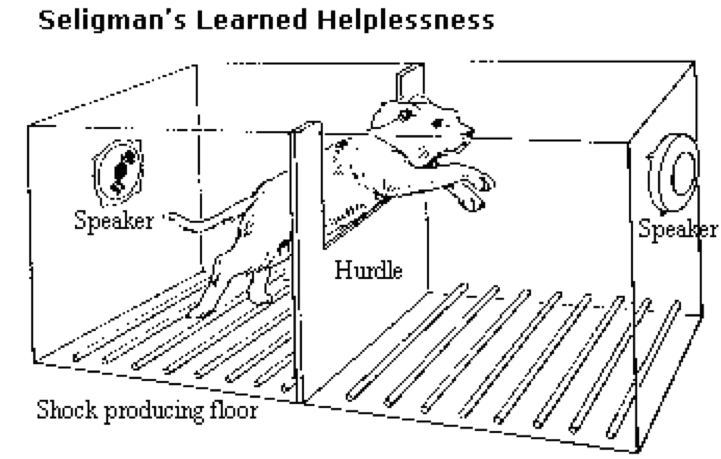
The concept of learned helplessness comes from a series of studies performed with dogs by psychologist Martin Seligman. The dogs were placed into boxes and given electric shocks until they learned that there was no escape from the suffering. At this point, a strange apathy came over them. These animals later refused to escape the shocks even when an obvious opportunity was presented to do so.

The dogs that refused to escape electric shocks were said to be suffering from “learned helplessness”. This was a conditioned state of extreme passivity. Further experiments demonstrated that most people will become depressed if exposed to extended suffering without being able to do anything about it.

Learned helplessness is also seen in elephant training. A young elephant can be tethered by a chain or strong rope, and soon learns that it cannot escape its bonds. Eventually it becomes passive. An elephant can remain so conditioned for the rest of its life, so that even as an adult it can be tethered by a thin cord and will not try to escape, despite being easily strong enough to break free.

When it comes to learned helplessness, humans behave in the same manner as other mammals. Given repeated adverse stimuli with no chance of escape, the human animal will also “give up”. This occurs for the same neurophysiological reasons as in other animals, namely a kind of nervous exhaustion. Learned helplessness feels a lot like depression, and it arises for similar reasons.

Learned helplessness explains, to a major extent, why we don’t resist the rulers of Clown World.

Most people are conditioned into being helpless through schooling. School teaches us – and is designed to teach us – that defying authority can only lead to suffering. Anyone who stands out from the crowd is ruthlessly abused back into position, either through physical or social violence. This is why depressive apathy is so common among high school students.

The purpose of all this abuse is to induce a state of learned helplessness.

School graduates can then be passed over, like broken-in slaves, to those who are effectively their masters. Sometimes these are military officers, who can then command the graduates to charge machinegun emplacements, safe in the knowledge that they would never dare to disobey. More usually, the new masters are employers, who can work the graduate all day for a wage on which they can’t raise a family, likewise safe in the knowledge that no protest will be forthcoming.

The leadup to the Iraq War intensified the widespread sense of helplessness in Clown World. The millions of people protesting the war had no influence on its course. We learned that, no matter how earnestly we expressed our lack of consent for a war being waged in our name, our supposedly democratic representatives would simply do as they liked. Protests and petitions didn’t matter and there was nothing any of us could do about it.

This state of advanced apathy endured for some years. In the end it seemed like war was going to be part of everyday life from then on. We simply got used to daily reports of drone strikes hitting weddings, schools and hospitals, and of Islamic terror attacks.

The rise of Barack Obama brought hope back. Obama campaigned on a ‘Hope and Change’ platform and there was no doubt that a black man, of all things, would mean a definitive change from the status quo. His 2009 Nobel Peace Prize win reinforced these sentiments, leading the whole world to feel that the dark days of George W Bush’s psychotic indifference to human suffering were over.

However, Obama turned out to be just as much part of the Establishment as everyone else. He surrounded himself with the same people as had surrounded the previous Presidents, and continued along an equally megalomaniacal path. With the destruction of Libya and murder of Muammar Gaddafi in 2011, Clown World realised that not even voting the Republicans out of power was going to change anything.

The realisation that Obama was actually another bad guy coincided with the realisation that the Global Financial Crisis had condemned a whole generation to be poorer than their parents were. For so many in that generation to put their hopes in a messiah-like figure, only to have them dashed like that, caused many to simply give up in despair. And that was all part of the plan.

When it comes to the subject of inducing a state of learned helplessness, we almost move out of the realm of psychology and into the realm of black magic. It is by so inducing a state of helplessness that the ruling class manufactures acquiescence. With their psychological hold then established over the population, the ruling class can do as it likes without interference.

This is partly the reason for the ongoing refusal to legalise cannabis. The point of cannabis prohibition – and many similar arbitrary and cruel laws – is to show who’s in charge. Putting someone in a cage for an act that doesn’t harm anyone might be immoral and it might increase the net suffering in the world, but that’s the whole point – they’ll learn to obey next time if they know what’s good for them.

Overcoming learned helplessness is mostly a matter of understanding that we do, in fact, have the agency to prevent our own suffering. This requires that we recondition ourselves to become more optimistic. Although this is a process that may take some time, the key aspects are threefold. One must learn to see problems as external to oneself, as temporary and as specific to the situation one is in at the moment.

*

This article is an excerpt from Clown World Chronicles, a book about the insanity of life in the post-Industrial West. This is being compiled by Vince McLeod for an expected release in January 2021.

*

If you enjoyed reading this essay, you can get a compilation of the Best VJMP Essays and Articles of 2019 from Amazon for Kindle or Amazon for CreateSpace (for international readers), or TradeMe (for Kiwis). A compilation of the Best VJMP Essays and Articles of 2018 and the Best VJMP Essays and Articles of 2017 are also available.

*

If you would like to support our work in other ways, please consider subscribing to our SubscribeStar fund. Even better, buy any one of our books!
Clown World Chronicles: History In Clown World

When George Orwell wrote that “He who controls the past controls the future,” he meant that whoever controls the historical narrative gets to control the direction the entire culture takes. The historical narrative gives us our common ideas of right and wrong, and suggests the direction in which we’re all headed. So whoever controls our culture’s understanding of history also holds the steering wheel of Western civilisation.

When he wrote “He who controls the present controls the past,” Orwell meant that whoever is able to seize power in the present moment gets to dictate what the popular history will be. They will not only control the historians, and decide which of them gets published and which promoted, but they will also control the education system and the history it teaches. One of the main spoils for anyone who seizes power is the ability to dictate what official history is.

The telling of history in Clown World has been twisted to meet the objectives of the current ruling class.

Clown World is under the control of the Globohomo Gayplex. Their control of the present allows them to set the historical narrative. The narrative we’re given is that nationalism led to constant warfare, and so only by uniting under one global system can the world ever know peace. Therefore, all national assemblies must subordinate themselves to foreign decisionmakers, such as the United Nations.

Furthermore, all warfare in the history of the world has been triggered by intolerance, so we have to be maximally tolerant towards everything, even the mass rape of children by foreign grooming gangs. Any discontent with the way things are is a threat to other people’s safety. Just lie back and think of world peace.

This globalist historical narrative is pushed by the globalists’ footsoldiers in the education, entertainment and information systems.

The shock troops of the globalists are the SJWs who now infest teachers’ colleges everywhere. Although history as a discipline has traditionally been resistant to pozzing on account of that it was inherently interested in classical values, the degenerative effect of Clown World is overwhelming. Many history teachers are now SJWs who think it virtuous to push a neoliberal narrative.

The heavy artillery of the globalists are the capital interests who push their version of the historical narrative through the mass media and popular culture, instead of through education. The basics of the narrative are, however, the same. Before neoliberal globalist capitalism, we are told, there was misery. After neoliberal globalist capitalism, there was joy.

The capitalist influence on Clown World history has led to a complete denial of the effectiveness of non-capitalist systems. The Soviet Union did not transform from a quasi-medieval economy to one that put the first man in space in 50 years, and neither did China transform from Africa-level poverty to Argentinan-level personal wealth in 40 years. And the less said about Nazi Germany the better.

The capitalist influence on the historical narrative prevents anyone from asking why it is that no-one can afford a house on a single wage today when that was common a century ago, or how a system that prevents students from graduating because they owe money to the school canteen is anything other than an egregious failure. One might think that the SJWs would criticise this system, but they are more concerned with virtue signalling about the latest trendy issue.

None of this would be so bad if it were easily possible to find honest historians, because then we could simply listen to them.

Unfortunately, the prevalence of honest historians in Clown World is about the same as that of honest people in general: extremely rare. Very few can resist the temptation, when recounting history, to spin the account to suit their own personal moral or political values. Even before Clown World this was the case. But in Clown World, every last aspect of the popular history has been warped.

The most warped takes on history come from the New World. Clown World history has it that the inhabitants of the New World lived in perfect harmony with Nature before the white man turned up. There was never any war or hunger. Not until the white man’s technology disrupted the local power balance was there any disharmony at all. This has been described as the ‘White Man Bad, Brown/Black Man Good’ school of history.

Pretending that everything was great before white people showed up is an example of “white erasure“. The intent is to delegitimise the existing white populations of New World countries, to make them feel guilty for the supposed historical crimes of their ancestors and to make them feel obliged to humble themselves and repent. In New World countries, it also serves to weaken local resistance to globalism.

The emphasis on historical crimes also serves a more nefarious purpose: it conditions people to accept use of the favourite weapon of the globalist – mass immigration. The logic is that, if white people stole the land they’re living on, they can’t rightly object to other people showing up and demanding to share it with them. So there’s no legitimate reason for a white person living in the New World to oppose mass immigration. “Given the historical context”, any such opposition is racist.

The situation is similar, if not quite as acute, in the Old World. In the Old World, there’s no wider narrative of land theft and colonisation, but the masses are still taught that their ancestors were evil and their history shameful. Everyone in the Old World, even if they fought the Nazis, is guilty of the Holocaust, and so none may express any desire for national self-determination. The nation state, they are taught, is to blame for Europe’s bloody history.

If the demands of the ruling class call for it, it’s possible to entirely ignore any piece of history that is inconvenient. In the wake of the Christchurch mosque shootings and the drive to ban firearms, some said that the shootings were “New Zealand’s darkest day“.

Fifty-one foreigners getting shot on New Zealand soil is a tragedy, true, but it is nowhere close to the magnitude of the first day of the Battle of Passchendaele, in which over 800 genuine members of the New Zealand nation were killed, and almost 2,000 more wounded. It’s really an insult to the New Zealand nation to compare the Christchurch mosque shootings to the first day of Passchendaele, but Clown World history is modular – any part can be removed and substituted with any other.

These prevailing historical narratives are not entirely fabricated, but they are grossly inaccurate on account of that they make a number of false assumptions about human nature. The behaviour of the human animal might be highly malleable, but we do not come into the world as blank slates; we are more like possibility trees. Moreover, it is not a historical fact that the modern world has “outgrown” spirituality. These false assumptions lead us to fundamentally misunderstand what history has to teach us.

Solving the problem of bad history in Clown World requires two things: proper education and lack of ego. The first is important because it will enable people to accurately analyse the historical information they are presented with and to determine what’s true and what’s a lie. The second is important because, without it, there is no objectivity, just angry primates asserting tribal interests.

*

This article is an excerpt from Clown World Chronicles, a book about the insanity of life in the post-Industrial West. This is being compiled by Vince McLeod for an expected release in the middle of 2020.

*

If you enjoyed reading this essay, you can get a compilation of the Best VJMP Essays and Articles of 2019 from Amazon for Kindle or Amazon for CreateSpace (for international readers), or TradeMe (for Kiwis). A compilation of the Best VJMP Essays and Articles of 2018 and the Best VJMP Essays and Articles of 2017 are also available.

*

If you would like to support our work in other ways, please consider subscribing to our SubscribeStar fund. Even better, buy any one of our books!

Understanding New Zealand 3: Cannabis Referendum Voters

Calculating the correlations between demographic variables and referendum choice was made difficult by the Electoral Commission’s decision to put the ballots from different electorates into the same box on Election Day. At every polling booth, the referendum ballots for both General and Maori Electorates were put in the same box, and as such we can’t accurately account for how many people in each electorate voted in favour.

The special referendum votes were broken down by electorate, but the total number of such votes was less than 20% of the number of ordinary referendum votes, and so they are not particularly representative of the New Zealand population as a whole. They also don’t overcome the problem that the Maori population is split between the General Roll and the Maori Roll, and so no meaningful correlations between referendum choice and ethnicity can be calculated.

Despite these limitations, we can see the data accurately enough to notice some clear patterns. Five significant trends are apparent.

In short, the major opposition to cannabis law reform in New Zealand is the same people who oppose it everywhere else: old, poorly-educated, religious, antisocial conservatives, i.e. those who fall for fear-based propaganda the hardest and who act to harm other people the most readily.

VariableVoting Yes in cannabis referendumSpecial voting Yes in cannabis referendum
Aged 20-240.510.66
Aged 25-290.460.62
Aged 30-340.330.44
Aged 35-390.090.18
Aged 40-440.02-0.02
Aged 45-49-0.17-0.24
Aged 50-54-0.23-0.40
Aged 55-59-0.16-0.52
Aged 60-64-0.21-0.57
Aged 65-69-0.18-0.53
Aged 70-74-0.19-0.52
Aged 75-79-0.24-0.56
Aged 80-84-0.24-0.58
Aged 85+-0.16-0.50

All of the age groups 34 years old or younger were significantly positively correlated with a will to reform the cannabis laws. This was true both for the ordinary referendum votes and the special ones. The correlation between being aged 20-24 and casting a special vote for Yes in the cannabis referendum was 0.66. Many of these voters would have been young people who enrolled to vote on Election Day.

All of the age groups 45 years old or above were negatively correlated with a will to reform the cannabis laws. As above, this was true both for the ordinary referendum votes and the special ones, although the correlations were only significant in the case of special votes. With the special votes, every age group 45 years old or above was significantly negatively correlated with voting Yes in the cannabis referendum.

Most strikingly, all of the age groups 55 years old or older had negative correlations stronger than -0.50 with casting a special vote for Yes in the cannabis referendum.

The pattern is unmistakable, and easy to explain. Old people who have been brainwashed for decades with Reefer Madness-style anti-cannabis propaganda are generally against it. Young people who have real-world experience with cannabis and who have observed its effects in their friends and/or parents are generally in favour of it.

VariableVoting Yes in cannabis referendumSpecial voting Yes in cannabis referendum
No NZQA qualifications-0.36-0.45
Level 1 certificate-0.33-0.46
Level 2 certificate-0.31-0.33
Level 3 certificate0.410.54
Level 4 certificate-0.30-0.42
Level 5 diploma-0.50-0.46
Level 6 diploma-0.22-0.35
Bachelor’s degree0.340.44
Honours degree0.530.48
Master’s degree0.480.53
Doctorate0.560.45

Another trend is immediately apparent when we look at the correlations between voting Yes in the cannabis referendum and maximum educational achievement. The better educated a person is, the more likely they are to support cannabis law reform.

Belonging to any one of three most poorly-educated groups of people in the country was significantly negatively correlated with voting Yes in the cannabis referendum. By contrast, having any university degree was significantly positively correlated with voting Yes. The strongest correlation was between doctorate degree holders and casting an ordinary vote for Yes – this was 0.56.

The one anomaly in the data – the significant positive correlation between having level 3 NZQA as a highest qualification and voting Yes in the cannabis referendum – can be easily explained. These people are mostly intelligent young people who are at university but are yet to get a degree. So they’re mostly intelligent enough to understand the science of cannabis, but not old enough to have a degree yet.

The reason for the strong correlation between education and pro-cannabis sentiments is fairly obvious. Understanding the effects of cannabis is essentially a scientific enterprise. Those educated enough to understand science understand that cannabis is medicinal. Those not educated enough to understand science have to rely on what they’re told, which is usually by people not educated enough to understand the science.

Education is, at the end of the day, little more than a mental toolbox for determining truth from bullshit. An educated person will be equipped to appraise data and to decide for themselves what is true and what isn’t.

Those unequipped to make such determinations are forced to rely on dictates from authority figures, such as the television or the local priest. Doing so is extremely inaccurate, and is often completely misleading. Those who put themselves forwards as authority figures, and those who are presented as authority figures by the media, are often people with a vested interest in telling lies.

Unfortunately, the cannabis referendum was a national IQ test, and we failed it.

VariableVoting Yes in cannabis referendumSpecial voting Yes in cannabis referendum
Following no religion0.390.22
Following Buddhism-0.050.14
Following Christianity-0.53-0.48
Following Hinduism-0.060.11
Following Islam-0.060.09
Following Judaism0.330.44
Following a Maori religion-0.020.20
Following Spiritualism or New Age religion0.580.25

Many people fail to appreciate the extent to which hating cannabis users is a religious, particularly an Abrahamic, attitude. It was largely Christians who enforced cannabis prohibition in the first place, and it’s largely Christians who argue to continue enforcing it. As such, a significant majority of people who voted No in the cannabis referendum were Christian.

The truth is that cannabis is a spiritual sacrament, and has been used as such for thousands of years. Throughout all time and space, Christians have always sought to destroy all other religious and spiritual traditions, and they have destroyed spiritual practices based around cannabis use in the same way they destroyed spiritual practices based around psilocybin mushroom use.

Christians can’t burn spiritual freethinkers at the stake anymore, but they can still vote for them to be persecuted. And they do, in great numbers. The fact that Christianity is an ideology of hatred is seldom more evident than in the strong negative correlations between being Christian and voting Yes in the cannabis referendum. A correlation of -0.53 between being Christian and casting an ordinary vote for Yes in the cannabis referendum lays bare what many already knew: Christians hate cannabis users.

Buddhists, Hindus and Muslims were generally indifferent to the question of cannabis law reform. This reflects the fact that there are two opposing forces at play in these cultures: the conservative, control-based mentality and the liberal, experience-based mentality. Many voters in these groups, being relatively recent immigrants, are caught between two worlds, unsure of what to accept and what to reject.

Spiritualists and New Agers were the big losers from the referendum result. New Age religion is very fond of cannabis on account of that it facilitates meditation. Spiritualists also like cannabis for the same reason that Rastafarians do: they believe that it enables them to reconnect with God. This explains the strong positive correlation of 0.58 between following Spiritualism or New Age religions and casting an ordinary vote for Yes in the cannabis referendum.

The significant positive correlations between being Jewish and voting Yes in the cannabis referendum are no doubt because of the higher educational attainment of Jews, i.e. most of them voted Yes because they understand the science behind cannabis.

VariableVoting Yes in cannabis referendumSpecial voting Yes in cannabis referendum
Working as manager-0.20-0.20
Working as professional0.510.52
Working as technican or trades worker-0.33-0.48
Working as community or personal service worker0.350.22
Working as clerical or administrative worker-0.200.02
Working as sales worker-0.200.03
Working as machinery operator or driver-0.42-0.28
Working as labourer-0.20-0.31

The fourth apparent trend in the data is that occupations and industries with a lot of human contact tended to vote Yes in the cannabis referendum, while occupations and industries without much human contact tended to vote No.

This mostly reflects differences in empathy. People in social occupations tend to be more open, more closely attuned to other people’s suffering and more sympathetic towards the measures those people take to reduce it. They are also much more likely to support recreational drug use in general, and much less likely to support government measures to interfere in other people’s lives.

There were significant positive correlations between voting Yes in the cannabis referendum and being a professional (0.51) or being a community and personal service worker (0.35). This reflects the fact that people in these occupations are intelligent and empathetic. In the case of professionals, it also reflects a superior reasoning ability.

There were significant negative correlations between voting Yes in the cannabis referendum and being a machinery operator or driver (-0.42) or being a technician or trades worker (-0.33). This might reveal a working-class social conservatism, but more likely follows from the fact that these occupations cannot be performed safely while stoned, and so people in them are concerned about the person next to them being under the influence of cannabis while working.

VariableVoting Yes in cannabis referendumSpecial voting Yes in cannabis referendum
Working in agriculture, forestry or fishing-0.16-0.40
Working in mining0.00-0.16
Working in manufacturing-0.58-0.52
Working in electricity, gas, water and waste services-0.12-0.10
Working in construction-0.38-0.22
Working in wholesale trade-0.56-0.17
Working in retail trade-0.25-0.35
Working in accommodation or food services0.470.40
Working in transport, postal or warehousing-0.42-0.06
Working in information media or telecommunications0.470.57
Working in financial or insurance services0.190.37
Working in rental, hiring or real estate services-0.190.10
Working in professional, scientific or technical services0.370.51
Working in administrative or support services0.050.33
Working in public administration or safety0.460.33
Working in education or training0.290.19
Working in healthcare or social assistance0.18-0.13
Working in arts or recreation services0.600.58

These correlations, between choice of unsocial occupations and voting No in the cannabis referendum, were replicated with choice of industry.

People in social industries heavily supported cannabis law reform, and this was also true of people in creative industries.

There was a significant positive correlation between casting an ordinary vote for Yes in the cannabis referendum and working in Arts and Recreation Services (0.60), Accommodation and Food Services (0.47), Information Media and Telecommunications (0.47), Public Administration and Safety (0.46), Professional, Scientific and Technical Services (0.37) or Education and Training (0.29).

People in industries that are (generally speaking) neither social nor creative heavily opposed cannabis law reform.

There were significant negative correlations between casting an ordinary vote for Yes in the cannabis referendum and working in Manufacturing (-0.58), Wholesale Trade (-0.56), Transport, Postal and Warehousing (-0.42), Construction (-0.38) or Retail Trade (-0.25).

The major distinction here is not obvious, but it is striking, and perhaps summarises the entire cannabis law reform debate: voters working in industries that are focused on people supported cannabis law reform, while voters working in industries that are focused on things generally opposed cannabis law reform.

VariableVoting Yes in cannabis referendumSpecial voting Yes in cannabis referendum
Voting Labour 20200.36-0.11
Voting National 2020-0.50-0.49
Voting Greens 20200.850.68
Voting ACT 2020-0.25-0.43
Voting New Zealand First 20200.03-0.21
Voting New Conservative 2020-0.46-0.66
Voting The Opportunities Party 20200.740.42
Voting Maori Party 20200.340.39
Voting Advance NZ 2020-0.06-0.06
Voting Sustainable NZ 20200.120.05
Voting ALCP 20200.080.23
Voting TEA Party 2020-0.36-0.08
Voting Heartland NZ 2020-0.10-0.09
Voting Social Credit 20200.14-0.30
Voting NZ Outdoors Party 2020-0.04-0.26
Voting ONE Party 20200.05-0.14
Voting Vision NZ Party 2020-0.170.26

The fifth apparent trend in the data involves the strong positive correlations between voting for progressive parties and voting Yes in the cannabis referendum, and the strong negative correlations between voting for conservative parties and voting Yes.

Unsurprisingly, voting for any of the parties that campaigned specifically for cannabis law reform had the strongest correlations with voting Yes on the cannabis referendum. Casting an ordinary vote for Yes in the cannabis referendum had a correlation of 0.85 with voting for the Greens in 2020, and 0.74 with voting for The Opportunities Party in 2020. The correlations with casting a special vote for Yes and voting for these parties were only slightly weaker.

Cannabis law reform supporters will be invigorated by the fact that the correlation between voting Labour in 2020 and casting an ordinary vote for Yes in the cannabis referendum was significantly positive, at 0.36. This suggests that a significant majority of Labour supporters want legal cannabis and so Labour, if they take the will of those supporters into account, should change the law.

National and the New Conservative Party, who explicitly campaigned against cannabis law reform, had the least cannabis-friendly voters. The correlation between voting Yes in the cannabis referendum and voting National in 2020 was -0.50, and with voting New Conservative in 2020 it was -0.46. To a large extent, this reflects the fact that those voters are old, and in the case of New Conservative voters it also reflects a lack of education.

Many will be surprised by the significant negative correlations between voting ACT in 2020 and voting Yes in the cannabis referendum. David Seymour wrote about his support for cannabis law reform in Own Your Future, and openly stated before the referendum that he was voting Yes. ACT is also associated with libertarian urban types who are generally favourable towards drug use of all kinds. So understanding why their voters oppose cannabis law reform is not straightforward.

The reason is that many of the people who voted ACT in 2020 voted National in 2017, and are still conservatives at heart. They voted ACT in 2020 mostly to protest the National Party leadership of the time, and are not really libertarians. This is supported by the fact that ACT voters were much, much older in 2020 than they were in 2017.

The weak correlations between voting for the Aotearoa Legalise Cannabis Party and voting Yes in the cannabis referendum will also surprise many.

First it has to be understood here that ALCP voters are very few in number, and represent the top 1% most fanatical about cannabis in the entire country. Second, many of these cannabis fanatics were unhappy with the Cannabis Legalisation and Control Bill because they either felt that it didn’t go far enough, or because they didn’t want the cannabis industry to become commercialised. So many of them cast No votes despite supporting cannabis law reform in general.

Their reasons might sound paradoxical, but nothing about the cannabis debate has been rational from the beginning.

*

This article is an excerpt from the upcoming 3rd Edition of Understanding New Zealand, by Dan McGlashan and published by VJM Publishing. Understanding New Zealand is the comprehensive guide to the demographics and voting patterns of the New Zealand people.

*

If you enjoyed reading this essay, you can get a compilation of the Best VJMP Essays and Articles of 2019 from Amazon for Kindle or Amazon for CreateSpace (for international readers), or TradeMe (for Kiwis). A compilation of the Best VJMP Essays and Articles of 2018 and the Best VJMP Essays and Articles of 2017 are also available.

*

If you would like to support our work in other ways, please consider subscribing to our SubscribeStar fund. Even better, buy any one of our books!