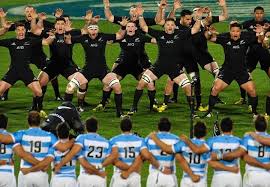
Why the All Blacks Will Do Kapa O Pango Against Argentina

The All Blacks will play the Argentinian Pumas this Saturday night in Nelson. This is the first time the All Blacks have played in Sun City, and as a result it’s expected to be the biggest thing ever to happen here. Only one thing is more certain than an All Black win – and that’s the fact that the All Blacks will do Kapa O Pango and not Ka Mate on Saturday night.

As most people are aware, the All Blacks have two hakas: the traditional Ka Mate, composed by Te Rauparaha around 1820, and the modern Kapa O Pango, composed this century. A smaller number know that Te Rauparaha was some kind of warlord and that Kapa O Pango came in during Tana Umaga’s time as All Black captain.

Te Rauparaha was indeed a war hero – to some. To others, he was every bit the war criminal as other war leaders tend to be viewed as by the people they attacked. He played a leading role in the Musket Wars as a war chief of the Ngati Toa. Armed with musketry, Te Rauparaha’s forces swept all the way down to Kaiapoi, and along the way he carried out some of the most ruthless genocides ever seen in Polynesia.

As this article luridly describes, the existing residents of the South Island were exterminated in a campaign of brutality that would have appalled even the men who destroyed the Aztec Empire under Cortez. Mass murder followed by cannibalism and enslavement of any survivors was the standard practice of war parties in the New Zealand of the 1820s, and the forces under Te Rauparaha were not an exception.

By the early 1840s, the Northern South Island was almost completely depopulated, which made it ripe for European settlement. Nelson and Blenheim were early growth centres on account of this; the road between them, where the Maungatapu Murders took place, was once a relatively busy highway, even if it could only be traversed by horse and cart or by foot.

This is the reason why Nelson has the honour of many national firsts – such as the the location of the first rugby match ever played in New Zealand, an 18-a-side affair at the Botanical Gardens, near the Centre of New Zealand.

So to say that Te Rauparaha is not well thought of by the Maori tribes local to the Northern South Island, or what’s left of them, is an understatement, akin to saying that Adolf Hitler is not well thought of among Poles. For the All Blacks to perform a haka written by him, on the same grounds where he committed possibly the worst atrocities New Zealand has ever seen, would be too great an insult for the local Maori to bear.

Steve Hansen and Kieran Read, ever the master strategists and culturally acute on account of being in charge of New Zealand’s single most successful example of intercultural co-operation, are entirely aware of this, and will no doubt avoid performing the haka that has particular sinister connotations to the local Maoris of Nelson. No surprises: we will see Kapa O Pango this weekend.

*

If you enjoyed reading this essay, you can get a compilation of the Best VJMP Essays and Articles of 2017 from Amazon for Kindle or Amazon for CreateSpace (for international readers), or TradeMe (for Kiwis).

Should A Right to Animal Companionship Be Added to the Bill of Rights Act?

Animal companionship is neither a luxury nor a vice

The next attack by the do-gooders on the freedom of people to live their lives unmolested by government interference seems like it’s going to involve attempts to make companion animals illegal, usually on the grounds of some environmentalist excuse such as protecting wildlife. This essay argues that the control freaks need to be headed off at the pass on this issue, by enshrining the human right to animal companionship in the Bill of Rights Act.

The do-gooders have learned nothing from their failed attempts to ban alcohol, cannabis, psychedelics, and currently nicotine. Wielding the power of the state as if a waterblaster, they have attempted to blast away evil by getting the Police to smash in the heads of anyone dealing in this contraband. As anyone with an IQ over 90 could have predicted, this clumsy and cack-handed administration of punishment has only led to immense resentment and unfortunate unforeseen consequences.

People will naturally disobey unjust laws. So when the control freaks try and ban people from owning cats, as has been suggested by the mad witch Eugenie Sage with regards to Wellington, we decent people need to be ready to take counteraction. In fact, we ought to take pre-emptive action now, and agitate for the right to animal companionship to be added as a amendment to the Bill of Rights Act.

There are three major reasons why this should happen.

The first reason is that cats and dogs, and the presence of cats and dogs, are part of the natural life of humans. As described at length here, humans have lived with cats for so long on account of needing the cats to control the rodents that attacked their grain supplies, that we have essentially formed a symbiotic relationship with them. We have lived with dogs for even longer.

Cats are effectively a technology that has developed for the sake of pest control. Dogs are effectively a technology that has developed for the sake of hunting and security.

There are tens of thousands of rural dwellers who could tell you about the consequences of not owning a cat when you live in the country, as many Kiwis do. The consequences are to have everything in your house destroyed by rodents. The situation is not much better in the cities, because wherever people live they store food and throw away rubbish, and either action attracts rodents.

Because rodents and disease are constant companions, owning a cat is an essential part of home hygiene. People who are aware of the hygiene benefits of cats would no sooner not own one than they would stop washing their own hair.

The second major reason why a right to animal companionship ought to be enshrined in the Human Rights Act is because of the mental health benefits of animal companionship. These benefits are so great that any attempt to take them away from people ought to be construed as cruelty, the same way that it is illegal to withhold a medicine from people.

Loneliness is one of the biggest killers in our modern societies, and is a main driver of suicide. The natural tribal model has collapsed under the pressures of industrial capitalism and the population explosion brought about by the Green Revolution, and there is ample evidence that a lack of healthy social relationships is what is responsible for the increasing rates of youth suicide.

Science has shown that for people with compromised social support networks, such as the elderly or the unwell, animal companionship has a massive positive effect on their mental health. For people in these situations, quality time with a cat or a dog might be the only quality time they spend with any sentient being, and can easily be the difference between psychological good health and mental illness.

The third major reason to write something about animal companionship into the Bill of Rights Act is to pre-empt Government overreach. We already know that the kind of person who runs for Parliament, and who succeeds in becoming a lawmaker, is usually a power-crazed control freak with little to no respect for the free will of the voting public.

The thought that these overpaid bureaucrat-psychopaths in Wellington are sitting around thinking up new excuses to take rights away from people is enough to stoke outrage. Where does it end? Do we get told how many calories of food we’re allowed to consume per week, or how many hours we’re allowed to spend on the Internet?

The control freaks need to be pre-empted with a clearly defined and explained law that makes it illegal to ban either cats or dogs from a given neighbourhood, or to discriminate against a potential property tenant on the grounds that they own a pet. The Bill of Rights Act should be amended to state that New Zealanders have the right to animal companionship.

New Zealand has, sadly, destroyed our hard-won reputation as a human rights leader with our complete failure to deal with cannabis law reform. We could win that reputation back by taking intelligent and progressive measures to combat mental illness. One of these measures could be the entrenchment of the right of New Zealanders to have animal companionship in their place of dwelling.

*

If you enjoyed reading this essay, you can get a compilation of the Best VJMP Essays and Articles of 2017 from Amazon for Kindle or Amazon for CreateSpace (for international readers), or TradeMe (for Kiwis).

Writing Dissociative Identity Disorder

Once known as Multiple Personality Disorder, and known casually by some as “split personality”, Dissociative Identity Disorder (DID) is a condition characterised by more than one distinct personality in the same physical body. The disorder is one of the most misunderstood and mischararacterised of all psychiatric conditions. This article looks at how to write believable and non-cliched characters who have Dissociative Identity Disorder.

People who have DID don’t change personalities whimsically. It usually only happens in response to intense stress or emotional pressure. When it does, however, it can be frightening and confusing for the people who see it. A person who has “switched” personalities might indeed seem to be an entirely different person, with different facial expressions, a different gait, different body language and an entirely different way of talking. Their vibe might feel entirely different, and not just in the sense of a change of mood.

Like many of the conditions in this book, DID is believed to have origins in early childhood abuse. The currently prevailing theory is that particularly intense early childhood trauma can cause the mind to dissociate. If this is severe enough, this dissociation can lead to one part of the mind becoming almost quarantined from the others, as if to protect the whole.

For example, a child might receive such intense physical abuse that their personality splits into a regular child’s personality (or primary identity) and a second, much harder and meaner one, who comes about as an adaptation to the abuse. What this can lead to is a situation where the second personality comes out in stressful situations as if trying to “defend” the primary personality from further trauma and abuse. That second personality might be willing to make decisions and take measures that the first cannot countenance.

Characteristic of this condition is the inability for one persona to remember things that have been said to another persona. Because the various personas are complete personalities with their own set of memories, things that are understood by one persona are not necessarily understood by others. People with DID can also lose track of time very easily, on account of that time that passes for one personality doesn’t necessarily also pass for another.

If the protagonist of your story encounters a character with DID, their first clue might be observing signs of depression in that other character. People with DID commonly also have depression, partially on account of the difficulty of living with the condition, and partially as a result of early childhood trauma and abuse. Other conditions are commonly comorbid with DID, especially the other conditions that are believed to have origins in heavy childhood trauma, such as schizophrenia, borderline personality disorder, anorexia and bulimia.

Your protagonist might find it baffling how that the character with DID sometimes doesn’t remember what’s said to them. Even more baffling is that the character with DID will often react with anger if it is put to them that a certain subject had already been talked about. Your protagonist might conclude that the character with DID is on drugs of some kind, and they might feel like they have good reason to draw such a conclusion.

In other ways, your protagonist might have to tread carefully. The heavy childhood abuse that usually precedes the development of DID can make a character with the condition hard to deal with for reasons not directly related to it. For example, they might be paranoid, suspicious, vicious etc. before the effects of DID are accounted for. This might mean that your protagonist mistakes the separate personalities of a person with DID as them being dishonest. Your protagonist might feel that the character with DID is only pretending not to remember things.

If the protagonist of your story has DID themselves, then telling a story about them automatically becomes a challenge because it isn’t clear who is speaking in the first person and who is speaking in the third. Assuming that there’s a primary personality and a secondary one, the primary one might be the one that is written about in the first person. It’s possible to do both, but care has to be taken not to sound like you are retelling the story of Jekyll and Hyde.

Your protagonist’s encounters with other characters could become extremely difficult if the protagonist has this condition. They might find themselves confronted with repeated accusations of being two different people – an accusation which is, understandably, not simple to deal with. Neither are accusations of being on drugs, or being a bastard, or lying, or just being fucked-up – all things that a protagonist with DID might have to deal with from other characters.

DID is not schizophrenia, but it shares many things in common with schizophrenia. DID is believed to be the single most strongly correlated psychiatric condition with severe early childhood abuse and neglect, with schizophrenia closely behind. So a person with DID might have deep understanding of how schizophrenics think and operate, and may have gone through some parts of the schizophrenia spectrum themselves.

It’s worth noting here that attempting to get off a criminal charge by claiming that one has DID and that one’s alternate personality did the crime has virtually zero chance of success, and that even if it did succeed the consequences would probably entail involuntary psychiatric care every bit as unpleasant as going to prison. Juries and judges are wise to such simple tricks and it won’t succeed outside of an extraordinary setting.

*

This article is an excerpt from Writing With The DSM-V (Writing With Psychology Book 5), edited by Vince McLeod and due for release by VJM Publishing in the summer of 2018/19.

Understanding New Zealand: City vs. Country

The division between city people and country people is one of the most telling in all of ethnography, and has been since the start of history. This is as true for New Zealand as it is for anywhere else. In this study, Dan McGlashan, author of Understanding New Zealand, looks at the statistical differences between people who live in the big cities (Auckland, Tauranga, Hamilton, Wellington, Christchurch and Dunedin, referred to here as “Living Urban”) and people who live in the provinces.

This study defines “City” electorates as any belonging to the following list: Auckland Central, Christchurch Central, Christchurch East, Dunedin North, Dunedin South, East Coast Bays, Epsom, Hamilton East, Hamilton West, Helensville, Hutt South, Ilam, Kelston, Mana, Mangere, Manukau East, Manurewa, Maungakiekie, Mt Albert, Mt Roskill, New Lynn, North Shore, Northcote, Ohariu, Pakuranga, Port Hills, Rongotai, Tamaki, Tauranga, Upper Harbour, Wellington Central, Wigram and Tamaki Makaurau.

These electorates tell a story that seems paradoxical on the surface. City dwellers are wealthier than provincial New Zealanders (the correlation being Living Urban and Median Personal Income was 0.37), but they are disinclined to vote for the wealthy party, National (the correlation between Living Urban and voting National in 2017 was, at -0.01, almost perfectly uncorrelated).

Urban people like to vote for the ACT and Green parties more than any others. The correlation between Living Urban and voting ACT in 2017 was 0.37; for Living Urban and voting Green in 2017 it was 0.36. The main reason for this is that young and trendy people support these parties, and young and trendy people live in urban areas.

The strongest negative correlations with Living Urban and voting for a particular party in 2017 were for New Zealand First (-0.60), voting Ban 1080 (-0.52) and voting Aotearoa Legalise Cannabis Party (-0.40). These three could be said to be the truly rural parties.

The two major parties both spanned the rural-urban divide. As mentioned above, urban dwellers do not vote National any more than rural dwellers do, but the grip of the Labour Party on the urban electorates is overstated. The correlation between Living Urban and voting Labour in 2017 was not significant, at only 0.11.

On a racial basis, it’s immediately clear that most rural people are Kiwis of European descent and Maoris, whereas most Pacific Islanders and the vast majority of Asians live in an urban setting. The correlation between being a Kiwi of European descent and Living Urban was -0.28, and between being Maori and Living Urban it was -0.35. This tells us that rural New Zealand is still very much a bicultural affair.

The correlation between being a Pacific Islander and Living Urban was significantly positive, at 0.33, and for Asians the correlation was strong, at 0.60. The reason for this is primarily because these two groups comprise the most recent waves of immigrants, and immigrants tend to establish themselves in major centres first before moving to the provinces. Indeed, the correlation between Living Urban and being foreign-born was 0.61.

Further clues appear when we examine the correlations between living in a big city and age. The correlation between Living Urban and median age was -0.23, on the border of significance, which tells us that the average city dweller is somewhat younger than the average country dweller. However, there were negative correlations between Living Urban and being in either of the youngest two age brackets, between ages 0 and 14 in total.

There were moderately strong correlations between Living Urban and being in either the 20-29 age bracket (0.50) or the 30-49 age bracket (0.51). These are also the age brackets that correlate the most highly with working fulltime and with median personal income. The correlations between Living Urban and being in either of the 50-64 or 65+ age brackets are both significantly negative.

What this tells us is the age-old story of young adults moving to the city for the sake of jobs and wealth, and then moving back out into the provinces again when it’s time to retire or perhaps to raise a family. This pattern of human migration, from country to city and back again, goes all the way back to at least Babylon, so it’s not surprising to find statistical evidence of it in contemporary New Zealand.

Keeping with the theme of employment, we can see that having any of the university degrees is significantly correlated with Living Urban (Bachelor’s at 0.63, Honours at 0.56, Master’s at 0.62, doctorate at 0.48). As described elsewhere, the reason for this is because of the strong correlation between having a university degree and working full-time.

In short, all the capital is in the cities, therefore that’s where the full-time jobs are, therefore anyone wishing to save money (as young, educated people tend to do) must live in an urban area. Indeed, there is a positive correlation (although not a significant one) of 0.18 between Living Urban and working in a full-time job.

This explanation is reinforced if one looks at the correlations between working in capital-intensive professions and living in an urban environment. The correlation between Living Urban and working in a particular profession was 0.58 for professional, scientific and technical services, 0.59 for information media and telecommunications and 0.61 for financial and insurance services. Notably, it was -0.72 for agriculture, forestry and fishing, for obvious reasons.

There was a significant positive correlation between Living Urban and renting one’s house (0.30) and a significant negative one between Living Urban and living in a freehold house (-0.31). This ties in with the observation that people in big cities have a different attitude to wealth generation: they are likely to become educated and earn a large wage with heavy expenses, whereas rural people tend to consolidate and grow wealth by minimising expenses.

Indeed, while there was virtually no correlation (0.01) between Living Urban and being unemployed, there was a significant correlation (0.27) between Living Urban and working for a wage or salary. This also ties in with the aforementioned fact that the jobs on offer tend to be where the major accumulations of capital are.

*

Dan McGlashan is the man with his finger on the statistical pulse of New Zealand. His magnum opus, Understanding New Zealand, is the complete demographic analysis of the Kiwi people.