

A Thought Experiment That Demolishes Materialism

One of the great philosophical debates is between materialists and idealists. The materialists consider their opponents to be mentally ill dreamers, while the idealists consider theirs to be literal-minded children. This essay expounds a thought experiment that shows that materialism is not tenable.

Materialists believe that the consciousness is generated by the brain. The most popular materialist theory is that consciousness is an “emergent property” of the combination of the various senses. Consciousness has evolved as a kind of supervisor of this sensory input, presumably for the purpose of making decisions or similar.

Therefore, materialists believe that the individual’s awareness of the outside world resides in the physical brain. It is the brain itself that is aware of the outside world through the impressions it receives from the various sensory organs. It follows from this that when the brain dies, consciousness also ends.

A simple thought experiment shows that this position is not tenable.

When a person goes to bed and dreams at night, they habitually find themselves exploring alien worlds. They do this while occupying a body that seems very similar to the bodies we occupy here on Earth. This body can see, seemingly through eyes about five or six feet off the ground, and it can also hear, seemingly through ears. In the dream world, these eyes and ears observe other bodies much like the bodies on Earth.

In this dream world, one’s surroundings seem very real. It’s rare for a dreamer to become aware that they’re dreaming – if they do, they usually wake up. While dreaming, it’s no more common for the consciousness to question the reality of the sensory impressions it receives than it is for a consciousness awake on Earth to do so. It seems very much like a real world.

The question that exposes the weakness of materialism is this. When you are dreaming, which brain generates consciousness? Is it the brain of your body here on Earth that generates the consciousness that observes the dream world, or is it the brain of your body in the dream world?

From a materialist perspective, one of those two things must be true – but both put the lie to materialism itself.

If the brain in your body here on Earth generates the consciousness that observes the dream world, then a brain on Earth is not necessary to observe Earth. This is because, if the dream world is being observed by a consciousness that is generated by a brain in a different reality, then the consciousness that observes Earth may be also generated by a brain in a different reality. Or perhaps not even generated by a brain.

This means that it’s possible that the consciousness that observes Earth is generated by a brain somewhere else, perhaps in a reality outside of, or more fundamental than, the one in which Earth resides. In such a case, we have no more reason to think that the death of our body on Earth should be the end of consciousness than we do to think that the death of our body in the dream world should be the end of consciousness.

On the other hand, if it is the brain in the dream world that generates consciousness – perhaps on account of that it is connected to the eyes and ears of the dream world and therefore receives sensory input from the dream world – then a material brain is not necessary in order to observe a world. The brain in the dream world cannot be definitely said to exist, because there is no evidence of the true existence of the dream world (at least none that can be produced on Earth).

But if it is the brain in your body in the dream world that generates consciousness, then there’s no reason to assume that the death of one’s body here on Earth ought to result in the end of that consciousness. If the brain in your body in the dream world generates consciousness, then consciousness cannot be “tied” or “fixed” to a brain. If a brain in a dream world can generate it, then so could many other things, such as other brains in other dream worlds.

The simple fact that it’s possible to be conscious in a dream world while dreaming makes it impossible to state that the brain on Earth generates consciousness. The fact that one is conscious in the dream world must mean that either a brain is unnecessary to generate consciousness, or that there are multiple brains in multiple levels of reality that consciousness can move between.

In either case, materialism is untenable.

This apparent paradox can be resolved in an instant, simply by realising that it is consciousness that is the prima material and fundamental basis of reality. You are not your body, you are consciousness – and, as consciousness, you can travel between worlds. In fact, all worlds are merely dreams, just patterns of perception – as the Buddhists have long known.

Because of all this, there’s no reason to think that the death of the physical body on Earth ought to affect one’s individual consciousness. It’s possible for consciousness to travel between worlds without being bound to a body – dreams are proof of this. Therefore, materialism is untenable, and the fundamental materialist fear – that the death of one’s Earthly body means the extinguishing of one’s consciousness – is unfounded.

*

If you enjoyed reading this essay, you can get a compilation of the Best VJMP Essays and Articles of 2018 from Amazon for Kindle or Amazon for CreateSpace (for international readers), or TradeMe (for Kiwis). A compilation of the Best VJMP Essays and Articles of 2017 is also available.

*

If you would like to support our work in other ways, please consider subscribing to our SubscribeStar fund.

Who Are The Forces Of Evil In The Cannabis Referendum Debate?

Now that the cannabis referendum question has been announced, the real battlelines have finally been drawn. Every decent person understands that the forces of evil are lined up against the Cannabis Legalisation And Control Bill, but the question remains: who are they? Dan McGlashan, author of Understanding New Zealand, describes the opponents to cannabis law reform in New Zealand.

The easy way to tell who is for and who is against cannabis is by looking at the correlations between various demographics and their support for the Aotearoa Legalise Cannabis Party in the 2017 General Election.

This can be done by importing the demographic data from the Electoral Profiles on the Parliamentary website into a statistics program such as Statistica, and then calculating a correlation matrix. Such an approach was the basis of my analysis in Understanding New Zealand, in which I calculated the correlations between all demographics and voting preferences and every other.

The strongest correlation between voting ALCP in 2017 and being in any demographic is the one between voting ALCP in 2017 and being Maori. This was a gigantic 0.91, which suggests that the vast bulk of Maori people are in favour of cannabis law reform. The strength of this relationship can be seen from looking at the ALCP vote in the Maori electorates, which is around twice as high as the ALCP vote in general electorates.

Maoris are strong supporters of cannabis law reform for several reasons. The primary reason is because cannabis suits them better than alcohol, to which they have little genetic resistance. The fact that white people have thousands of years of genetic resistance to alcohol, and Maoris don’t, mean that the normalisation of alcohol culture is grossly unfair.

The other super-powerful correlation with voting ALCP in 2017 was with regular tobacco smokers. This was 0.89, suggesting that if a person is a regular tobacco smoker they are all but certain to be a supporter of cannabis law reform.

The reason for this correlation is that it’s mostly only people with mental problems who smoke tobacco, and these same people smoke cannabis for its medicinal effects. If a person has PTSD or anxiety, it’s often the case that tobacco and cannabis both have a similar medicinal effect.

One less strong, but still powerful, correlation was between supporting the Aotearoa Legalise Cannabis Party and being New Zealand born – this was 0.73. It will come as a surprise to many, but cannabis use is an implicit part of the New Zealand identity. It’s as much a part of who we are as rugby, beaches, barbeques and ethnic confusion. Therefore, people who are born and raised in New Zealand are much more likely to support cannabis law reform than those born elsewhere.

These correlations suggest that the average cannabis user is the salt-of-the-earth working-class Kiwi. This is proven by the correlation between voting ALCP in 2017 and being employed in working-class professions, such as community or personal service worker (0.77), labourer (0.71), machinery operators and drivers (0.70) or technicians and trades workers (0.43).

The pro-cannabis forces, then, are basically the people who are at the coal face of the tough jobs in New Zealand. People who work repetitive jobs or jobs with heavy social contact are the ones who tend to have the strongest need to destress at the end of the day, and it’s for them that cannabis law reform would be the most beneficial.

This gives us a good idea of who the forces of evil are.

Many of the opponents to cannabis law reform are old people. The correlation between voting ALCP in 2017 and median age was -0.57. It’s necessary to note, however, that the correlation between voting ALCP and being on the pension was only -0.18, i.e. not statistically significant. This means that the relation to age and support for cannabis law reform is not linear – it rebounds among pensioners.

This replicates a pattern seen overseas. People tend to be anti-cannabis the older they are, up until the point where they are so old that their life starts to revolve around medicines and doctors. At this point it’s common for people to get exposed to cannabis and to come to appreciate its medicinal effects. So the brainwashing only lasts until there’s an element of personal interest in it, at which point it’s discarded.

Christians make up another strong anti-cannabis bloc. The correlation between voting ALCP in 2017 and being Christian was -0.37. Christians have always hated cannabis users, in particular because cannabis is the natural spiritual sacrament of the Eurasian people. This is why Bob McCoskrie, funded by Church money, is taking the leading role in the anti-cannabis campaign.

Jews, Muslims, Hindus and Buddhists are all significantly opposed to cannabis law reform as well. The correlation between voting ALCP in 2017 and belonging to any of these religious groups was at least -0.30. As mentioned above, this is because cannabis is a spiritual sacrament, and therefore its use is directly against the interests of organised religion.

Predictably, then, there is a strong negative correlation between voting National and voting ALCP. Interestingly, the correlation between voting ALCP in 2017 and voting National in 2017 (-0.70) is more strongly negative than the correlation between voting ALCP in 2017 and voting Conservative in 2017 (-0.40). This underlines the degree to which National voters are not motivated by conservatism so much as actual malice.

The forces of evil, then, in the cannabis law reform debate are the same old, religious bigots who have opposed every other attempt at making society better. They’re essentially the same people who opposed homosexual, smacking and prostitution law reform, and they’ll oppose everything in the future too, because any change makes them piss their pants.

*

If you enjoyed reading this essay, you can get a compilation of the Best VJMP Essays and Articles of 2018 from Amazon for Kindle or Amazon for CreateSpace (for international readers), or TradeMe (for Kiwis). A compilation of the Best VJMP Essays and Articles of 2017 is also available.

*

If you would like to support our work in other ways, please consider subscribing to our SubscribeStar fund.
The Cannabis Legalisation And Control Bill: A Weak But Realistic Compromise

The Government released news this week about the exact form of the cannabis referendum question at next year’s General Election. The Cannabis Legalisation and Control Bill, currently in draft form, will serve as the basis for next year’s referendum question. Long-time cannabis law reform campaigner Vince McLeod, author of The Case For Cannabis Law Reform, gives his thoughts on the proposal.

The proposed law is weak, but it’s a realistic compromise with the forces of evil.

Most importantly, it makes the possession of up to 14 grams of cannabis, a small homegrow and licensed retail cannabis sales all legal. As far as the cannabis-using community is concerned, this achieves most of the long-stated goals of cannabis legalisation. It’s broadly in line with what other states and territories in North America have introduced.

Section 18 of the Cannabis Control Bill will allow up to 14 grams of cannabis to be possessed in a public place, and for cannabis to be smoked at home. People are allowed to possess more than this if they are transporting it from one person’s home to another. There appears to be no limit on how much cannabis one is allowed to possess at home.

This will mean that it will no longer matter if a Police officer smells cannabis on you in public or while during a visit to your house. Evidence of cannabis will no longer, by itself, be a sufficient cause for the Police to attack you. Even if the case of smoking cannabis in public, which will still be illegal, the punishment is only a $200 infringement fee.

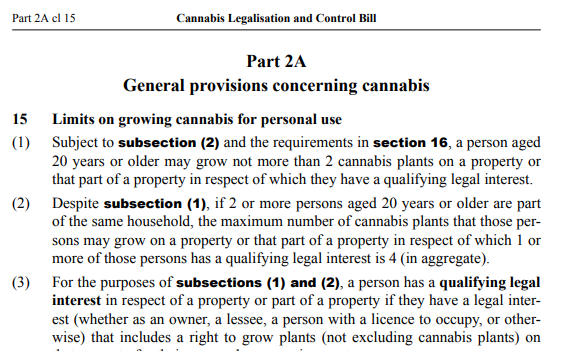
Section 15 of the Bill will allow for two plants to be grown at home per person, and up to four plants to be grown per household.

Two plants is not a lot. However, if you grew four plants in a small grow tent under a 600W light you could get ten or twelve ounces per grow. Assuming that you’re able to get hold of clones, this would mean ten or twelve ounces every eight to ten weeks. In other words, a household could meet its demands for recreational cannabis easily enough by growing it themselves.

Moreover, there is no proposed restriction on the size of the two plants, as has been the case in some North American jurisdictions. This suggests that people will be allowed to put down a couple of honking sativas in an outdoors greenhouse and get them both up to ten feet tall. Such an arrangement would make it legal to grow a year’s worth of cannabis in one season, sparing the need for the environmentally-unfriendly grow tents.

Section 19 of the Bill allows for recreational cannabis sales. Purchases will be limited to 14 grams per day, but this is at least two weeks’ worth by any reasonable measure. Aside from this, it appears the proposed model will be fairly similar to the cannabis cafe model that has existed in the Netherlands since the 1970s.

In other words, it appears that the proposed model is intended to allow for recreational cannabis sales in cafes in a similar fashion to how alcohol is already sold in pubs. Section 49 of the Bill makes reference to “consumption licences” which will allow certain premises to allow people to consume cannabis in public. Such premises will not be allowed to also sell alcohol, and will therefore follow closely to the Daktory model that Dakta Green has already established in New Zealand.

Despite these major wins, the Bill has a number of flaws from the perspective of the average member of the cannabis-using community.

Nowhere in the Bill has provision been made for running a mother plant that clones can be taken from. If one household can only have four plants, it makes having a mother plant that one can take clones off difficult. Against this criticism, however, is that it appears the Bill will allow for retail sale of feminised seeds.

It’s also a mistake to set the legal limit at 20. For one thing, it implies that cannabis is more dangerous than alcohol, which is entirely false. For another, it means two years where young Kiwis will be legally allowed to drink booze but not smoke weed, which will mean two years of exposure to the more destructive of the two drugs. Legal cannabis has been shown to lower rates of alcohol use overseas, and the sooner an alternative to alcohol was available the better.

Perhaps unsurprisingly, the Bill doesn’t address our right to use cannabis for spiritual purposes. Absolutely zero acknowledgement is made of the fact that cannabis is a spiritual sacrament, but this is not unexpected if one considers that New Zealand has been ruled by completely godless people since the turn of the century, and that for their sort spirituality is mental illness.

Also predictably, there is no provision for an official Government apology for conducting a war against them without their consent. The War on Drugs has been the worst human rights violation to occur in the West since World War II. The Government’s role in this war has involved decades of lying to the public about the effects of cannabis and putting people who defy them in cages. Their conduct has been obscene, and an apology should be part of legalisation – but it won’t be.

Perhaps worst of all, the Government is still committed to minimising cannabis use from the standpoint of cannabis use being inherently harmful. It’s possible that they have calculated that legalising cannabis would make it possible to strangle cannabis culture through ever-increasing taxes and red tape, as they have almost successfully done for tobacco. More likely, however, is that they have shifted thinking so that cannabis is now (rightly) grouped with alcohol and tobacco and not heroin and methamphetamine.

There are many possible criticisms of the Bill, but ultimately it is definitely worth supporting. All of the legitimate criticisms relate to aspects of cannabis law that could best be fine-tuned after the referendum has been passed.

Realistically, what the proposed Cannabis Leglisation And Control Bill means is an end to the fear. It would be taking away that dark, nauseating feeling that comes with being marked as a criminal. People smoking or growing cannabis at home will no longer have to fear saying the wrong thing or inviting the wrong person to their house, and the net result will be a reduction in the suffering of the New Zealand people.

*

If you enjoyed reading this essay, you can get a compilation of the Best VJMP Essays and Articles of 2018 from Amazon for Kindle or Amazon for CreateSpace (for international readers), or TradeMe (for Kiwis). A compilation of the Best VJMP Essays and Articles of 2017 is also available.

*

If you would like to support our work in other ways, please consider subscribing to our SubscribeStar fund.

History Is The Patterns Of Conflict Between Master And Slave Moralities

Many historical theories view the world as an eternal struggle between two forces. The Christians call it good and evil, the Communists call it the proletariat and the bourgeoisie, and the Nazis call it the Aryan and the Jew. A previous essay here suggested it was between the K and r-selected. This essay takes a new approach: that Friedrich Nietzsche was more accurate than anyone else, and the true eternal struggle is between those with a master mentality and those with a slave mentality.

In The Genealogy of Morals, Nietzsche described two basic forms of morality.

Master morality judges actions on the basis of good or bad. Nietzsche defines master morality as the morality of the strong-willed: it is championed by the noble and the powerful. This doesn’t mean that master morality is mere domination – it also prizes honesty and an accurate appraisal of one’s own weaknesses. People with this mentality are not concerned with what the herd thinks. They prefer to pursue their own self-defined form of excellence.

Slave morality, by contrast, judges actions on the basis of good or evil. In slave morality, strong people are equated with evil. In slave morality, goodness is equated with passivity, timidity, agreeableness and an insipid kindness. Slave moralists aren’t concerned with accurate viewpoints – they simply believe whatever makes them feel good. Questioning the herd is a great sin, because it requires strength and therefore only someone evil would do it.

The masters are always fewer in number, and the slaves more numerous. In this regard, master and slave morality maps fairly closely to the mentality of the K-selected vs. the mentality of the r-selected. The major differences are that K-selected people are liable to suffer from pathological altruism, whereas the master morality (not feeling pity) does not, and that r-selected people do not lack vitality and are not prudish, whereas the slave morality is neurotic.

The true course of history has been the ebb and flow of these two different forms of morality.

Nietzsche himself wrote that the ancient Greco-Roman culture encapsulated master morality, but was subverted from the inside by Christianity, one of the original forms of slave morality. When Christianity became the official religion of the Roman Empire in 323 A.D., Westerners became slaves, our natural spiritual traditions having been thoroughly destroyed and replaced with superstition.

This victory of slave morality endured until the Renaissance (an event which a previous essay here called the Minor Renaissance). At this time, some of the old master morality returned in the form of the quest for scientific knowledge, previously hidden or taboo philosophy and exploring the world. Unfortunately, this didn’t last.

The 19th Century was a relative high point for master morality (of course, Nietzsche didn’t know this). During this decade, the European Empires reached their greatest extent. The British Empire had achieved such a state of dominance that it was able to settle Australia and New Zealand – lands on the other side of the planet – at the same time as providing most of the settlers to North America, and all this while keep the world’s shipping lanes open.

Unfortunately, there was no Major Renaissance, as the wider Western consciousness kept falling at the first three hurdles of dumb Abrahamism, blind Materialism or deaf Satanism. The West never managed to revive the master spirituality it had before being poisoned by Christianity some 1,700 years ago.

It has long been observed that empires tend to fall from the inside, rather than get smashed by any outside force. The reason for this is the internal rise of slave morality. The reason why the West has fallen into the decrepitude that it has is because slave morality has risen to the point where it is normal. Accordingly, we are weak.

It has also long been observed that good times lead to weak men, who then create hard times, which leads to strong men, who then create good times. This has been discussed here as the Red Pill-White Pill-Blue Pill-Black Pill sequence. New Zealand philosopher Rick Giles describes it as the Dignity Culture-Honour Culture-Victimhood Culture-Slave Culture quadrichotomy.

Hard times lead to strong men by process of selection. When times are hard, there’s not enough surplus to waste any of it. Therefore, the people in charge of resources have to be discriminating. Even more pressing is the fact that, when times are hard, people will fight over what little resources exist. This fighting, being in the realm of iron, rewards the hard and those who can do without.

This Spartan sense of miserliness leads to efficiency and a masterly mindset. When things operate efficiently, life is good. Everyone has their needs met and, as is usually the case when people’s needs are met, they become wealthy. When everyone is wealthy, everyone tends to be happy, and it is as if a Golden Age had descended upon the land.

When everyone has their needs met, they stop being hard. No-one with a full belly wants to fight – better to just wait until the problem goes away. If there’s no food in the cupboards, that’s when it’s time to worry. People in the “fat and happy” mindset tend to ignore challenges rather than respond to them.

This doesn’t only lead to physical softness but, more crucially, it leads to mental softness. This mental softness prevents people from being able to make sharp and accurate distinctions between the phenomena they encounter. Consequently, they become apathetic and indifferent, a malaise that they mistake for the virtue of tolerance.

This apathy and indifference leads to a failure to adequately deal with corruption. Either corruption is ignored, or the corrupt are not punished – a slave’s mindset. Because no-one is strong enough to challenge the corrupt, they come to positions of dominance. When corrupt people are in power, hard times are just around the corner. And so, the cycle repeats.

In today’s Clown World, slave morality has the total ascendancy. We are so apathetic that our politicians can kick us in the guts on a daily basis and we just roll over and take it. The total victory of slave morality is, perhaps, the fundamental explanation as to why Clown World is the way it is. This is a world without masters. The slaves have completely inverted natural morality.

What’s needed is the Major Renaissance. This would constitute a spiritual renaissance that would reconnect the people of the Western World to God. Being reconnected to God, we would then possess the necessary illumination to see the path forward in the darkness. We need a new set of masters for a new age.

*

If you enjoyed reading this essay, you can get a compilation of the Best VJMP Essays and Articles of 2018 from Amazon for Kindle or Amazon for CreateSpace (for international readers), or TradeMe (for Kiwis). A compilation of the Best VJMP Essays and Articles of 2017 is also available.

*

If you would like to support our work in other ways, please consider subscribing to our SubscribeStar fund.