
VJMP Reads: Edward Bernays’s Propaganda I

Fittingly, the Propaganda Ministry turns its attention to the granddaddy of all propaganda literature, Propaganda by Edward Bernays. This short book was written by Bernays, a nephew of Sigmund Freud, by way of explaining his own prodigious insight into the manipulation of mass consciousness in the America of 1928.

He opens in the first chapter, “Organising Chaos”, with a stark declaration that the “organised habits and opinions” of the masses are formed according to the will of men who effectively form an unseen government. These men mold our minds and our tastes, mostly without us knowing who they even are.

Bernays contends that this is necessary, owing to the confusion ordinarily created by the democratic process, with its hundreds of different candidates. People would become confused if they were expected to understand the inner workings of all the issues that politicians are faced with. Therefore, the media narrows things down to a range that can be grasped.

Likewise, Bernays claims that society consents to have its choices relating to commercial products narrowed down by way of media propaganda. Because of reasons like these, there is a constant battle going on to capture the minds of individual people.

Bernays mentions that it may have been better to have had committees of wise men, who made decisions about the best way to do things. But we elected for the opposite of this. We have free competition of ideas, and in order for this to not lead to chaos we have to allow for leadership and propaganda to direct attention. This can be misused, but it is necessary nevertheless.

The advent of mass media has changed the way that the world is organised. At the time of the writing of the American Constitution, the village was the basic unit of society. Thanks to the mass media, it has become possible to be organised alongside people who live thousands of miles away.

Our society, instead of being divided by coherent geographical units, is now cleaved by all manner of social, political, ethnic, religious, racial or moral divisions. It is along the lines of these divisions that propaganda is spread. One influential group leader in any of these domains can soon have all the others in that domain following an idea.

Bernays labours the point that these cleavages are nonetheless comprised of individuals who exist in several groups, and therefore these groups are all interlaced. This is, in Bernays’s view, what society is. It is how democracy has chosen to simplify its decision making.

He summarises the book in the final paragraph of the first chapter. It is to explain how the minds of people are molded in modern democratic society, and how the manipulators of it go about their work.

*

If you enjoyed reading this essay, you can get a compilation of the Best VJMP Essays and Articles of 2018 from Amazon for Kindle or Amazon for CreateSpace (for international readers), or TradeMe (for Kiwis). A compilation of the Best VJMP Essays and Articles of 2017 is also available.

Why Intelligence Can Never Be a Fixed Concept

Intelligence is something that everyone appears to understand, but no-one can agree on a definition. Despite this, people are pretty sure that it can be measured. Although tests that measure IQ have been shown to have a lot of predictive value, a precise definition of term remains elusive. But as this essay will examine, intelligence can never be a fixed concept anyway.

What is intelligence? A common definition of intelligence is “ability to recognise patterns and avoid dangers”. Another is “the ability to apply knowledge and skills”, which assumes that intelligence is an entirely different thing to instinct. Other definitions involve a capacity for learning, logic, reasoning, self-awareness etc. Despite this variety, most people think they know it when they see it.

A previous essay here discussed how there are at least two different spectrums of intelligence, and how both of them might appear to be intelligent in some situations and not in others. Another essay suggested that there is both a masculine and a feminine intelligence and stupidity. What’s apparent from all of these different definitions is that some behaviours are intelligent in some circumstances, and unintelligent in other circumstances, depending on how adaptive they are to the environment.

For example, being able to faithfully repeat what you are told is a sign of intelligence when a student has a good teacher who educates them honestly. When the student is a political cadre being indoctrinated into a dangerous ideology, it’s not a sign of intelligence. However, the underlying neurological and psychological attributes that enable either are roughly the same.

Most people can also accept that intelligence is something that evolved, controversial as that may be when one gets into the specifics of it. The reasons for this evolution are presumably because intelligence provided a selective advantage in either staying alive or finding mates and reproducing.

The first one of these points seems pretty obvious: if you are smart you are better able to avoid the dangers that the natural world has created. Intelligence is highly correlated with pattern recognition, and recognising patterns is the key to recognising dangers. If you notice that the last person who did something died, you are less likely to do it. Therefore, you are more likely to survive to reproductive age yourself.

The second point is more subtle, but equally clear if one thinks about it. The more intelligent a creature is the better shape it will keep itself in, therefore the healthier it will be, and the more attractive a mate it will seem to others of its kind. This greater attractiveness will lead to more mating opportunities, and therefore more offspring (all other things being equal).

However, there’s a hidden paradox in this simple biological definition. If intelligence is biological, then it cannot be a fixed concept, because if it’s an adaptation to the environment it will change along with that environment.

Aside from the odd species like crocodiles, who have found one evolutionary niche and just stayed there, animal species tend to be opportunistic. They tend to range across a number of niches and take food, water and reproductive opportunities when they arise. The most excellent example of this is the human being, who has adapted to many environments and who is capable of anything.

As the environment keeps changing, so too will the optimal behaviours within each environment change.

For instance, much of the behaviour that we currently associate with intelligence has much to do with avoiding impulsive behaviours. Someone who stops and thinks before taking action will be almost universally considered more intelligent than someone who does not. Likewise, someone who saves money will be considered more intelligent than someone who wastes it, and someone who reads books will be considered more intelligent than someone who parties.

This is all well and good in a civilised, industrial society like ours. But if society should break down, then the equilibrium point will shift back from cautious deliberation towards opportunism. If there is no law and order, then there’s no advantage in taking one’s time to consider things. The advantage shifts towards those with the propensity to hit and run before the opportunity is lost. Intelligence would then become a matter of understanding the importance of not hesitating.

Another problem is that the kind of skills and aptitudes that made a person become considered intelligent by their peers in the ancient past are not necessarily the same today. Human survival in the past had a lot to do with astrology, animal husbandry and swordsmanship – all skills that are now only practiced by small minorities. A person might have been considered highly intelligent in the past on account of that their brain made them good at animal husbandry, but the same person might be considered low intelligence today if they can’t find a technological skill.

It might even go the other way. Society might continue to become more and more technological, so that the selective advantage wasn’t in favour of impulsivity but in favour of the kind of semi-autistic gadgetry obsession that distinguishes people who are today considered nerds. Such a society might no longer have any need for social intelligence but would rather operate on computer science aptitude.

In all of these cases, the society that results after massive environmental change will define intelligence as adaptation to it, not as adaptation to some other time and place. Neither will they define intelligence as an adaptation to the natural world in which we evolved, because such a thing no longer exists.

In the end, the concept of intelligence is a biological one, and therefore can only be understood relative to a specific environment, or set of environments. Because the natural world keeps changing – and our social world even faster – the concept of intelligence will keep evolving as humans do. It can therefore never be a fixed and clearly defined concept.

*

If you enjoyed reading this essay, you can get a compilation of the Best VJMP Essays and Articles of 2018 from Amazon for Kindle or Amazon for CreateSpace (for international readers), or TradeMe (for Kiwis). A compilation of the Best VJMP Essays and Articles of 2017 is also available.
Peterson Derangement Syndrome

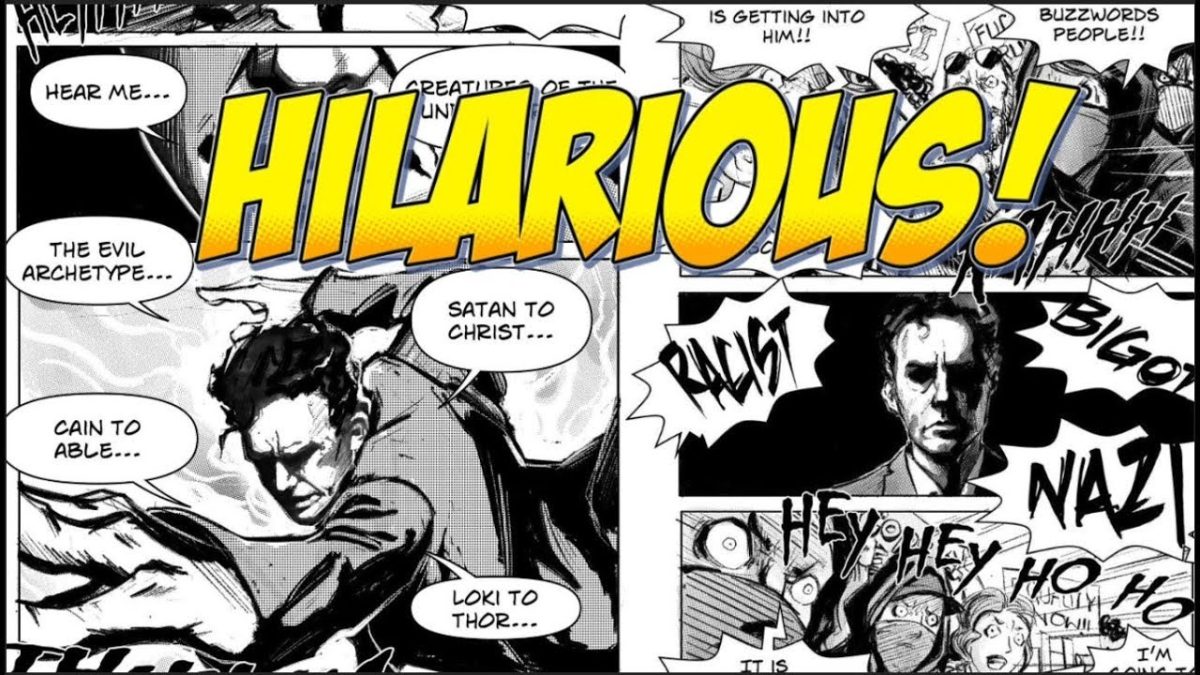
Many words have been written about Trump Derangement Syndrome, and Obama Derangement Syndrome, and Bush Derangement Syndrome. This refers to the ability to cause people, who are otherwise reasonable, to go insane at the mere mention of your name. It’s rare for anyone who is not an American President to achieve this power level, but recently one man has threatened to: Canadian Psychology Professor Jordan Peterson.

Peterson was a minor celebrity among YouTube psychology nerds for his insightful lectures into psychopathology and Nietzsche when he inadvertently decided to tell the world that the emperor had no clothes. This he did in the form of refusing to accede to compelled speech in the form of pronouns.

In particular, he spoke out about a Canadian bill called C-16, which – according to Peterson’s interpretation – would lead to people facing criminal charges for referring to a person with a pronoun other than the one they would prefer to be used. The collective consciousness was shocked, at first, but Peterson insisted that refusing to use a person’s preferred pronoun was a fair thing to do, in cases when that pronoun clearly wasn’t accurate.

It was then the shitstorm began.

Accusations of “literal fascism” began to fly as the social justice warriors demanded Peterson’s head for refusing to meet their demands to dance on command. In response, he threw more petrol on the fire. The psychologist was not content with merely saying that transgender pronouns were bollocks, but that an entire suite of leftist shibboleths were all garbage as well.

Communism was crap, the gender gap was false, most of the racial IQ difference is genetic and – worst of all – he refuted the tabula rasa theory.

Peterson Derangement Syndrome is when an individual is reduced to a hissing, demented rage merely at the mention of the name of Jordan Peterson. Much like the derangement syndromes named after American Presidents, a person with this condition is unable to concede that there might be anything good about Peterson, or that he might have any ideas worth listening to. The mention of his name seems to trigger a limbic hijack in those with the condition.

Unlike the majority of talking heads in the media, Peterson is a legitimate intellectual. Not only does Peterson actually have a Ph.D, but he has also worked for many years as a Psychology lecturer at both McGill and Harvard Universities. On top of that, he has over 10,000 academic citations.

So part of Peterson Derangement Syndrome is believing that a man with a Ph.D and over 10,000 academic citations is not a legitimate intellectual. Sufferers of it are happy to dismiss him as a charlatan and a fraud, someone who simply makes things up with no basis in reality at all. This is clearly absurd when the man in question has passed peer review with such accolades.

The anti-Peterson movement has taken on cult-like properties, in the sense that for people with Peterson Derangement Syndrome, the rest of the world is either with them or against them on the matter. Social media has induced them into believing that Peterson is a Hitler-like figure who campaigns tirelessly for the reintroduction of some kind of fascism. It can be seen from this, that part of Peterson Derangement Syndrome is simple mass hysteria.

Many Peterson haters deride his fans as a horde of incels, desperately looking for a father figure to help them replace their lost masculinity. In this, they have half of a point, but they also betray their own neurosis. Most Peterson haters also hate their own fathers, and usually because those fathers failed to provide a space of order in which those people could grow. This father-hate is then displaced onto the foremost father figure, which is Peterson.

Many of the people who become deranged at the mention of Peterson’s name are living out some unresolved conflict with an authority figure, from some point in their past. Usually this adversary is their father, but it could also be a teacher, guidance counsellor or even a Police officer. To these damaged souls, Peterson represents a force trying to suffocate their free spirit.

At the core of Peterson Derangement Syndrome is a hatred of masculinity, in particular a hatred of order.

Peterson is himself an exceptionally masculine figure, having succeeded in imposing major order upon his own life. It’s extremely difficult to become learned enough to get tenure as an academic professor, especially if you weren’t from a family that groomed you for such a role from youth. It takes incredible amounts of will and commitment, and many people see such a thing and feel self-hatred.

So some of what causes Peterson Derangement Syndrome is simple Tall Poppy Syndrome. The majority of his critics are bleating soyboys who would struggle to read a book, let alone lecture an academic discipline for many years and then write a book. Much of their opprobrium can be chalked up to the simple envy of a lesser towards their better.

At the core of it, though, is a depraved alliance of trans activists, Marxists, fedora-tippers, neo-Luddites, anti-science morons and, ironically enough, actual Nazis, all of who have generated so much collective outrage that encountering someone who likes Peterson is enough to tip them over the edge into derangement. Claiming to be a Peterson fan is to declare yourself the enemy.

Now that Peterson has been invited to speak at a Trilateral Commission meeting we can guess that his influence will be around for a very long time. This will mean that Peterson Derangement Syndrome will only become more intense, pushing up towards Donald Trump levels.

*

If you enjoyed reading this essay, you can get a compilation of the Best VJMP Essays and Articles of 2018 from Amazon for Kindle or Amazon for CreateSpace (for international readers), or TradeMe (for Kiwis). A compilation of the Best VJMP Essays and Articles of 2017 is also available.

The Satanism to Luciferianism Pipeline

Some attention has been given recently to the “Libertarianism to Fascism pipeline”. This concept has it that adopting libertarianism causes many people to eventually adopt fascism. As this essay will examine, a similar pipeline exists from Satanism to Luciferianism, and for similar reasons.

The basic theory goes like this: libertarianism attracts people who are already a bit weird. Often these people are disaffected in some way, and don’t feel represented by the mainstream conservative and mainstream social democrat movements. The article linked in the opening paragraph calls them “kooks and grifters”, and while we wouldn’t go that far, there’s a kernel of truth in that.

If a person intuitively feels that the system is fucked, or that popular culture is meaningless, or that the mainstream media is full of lies, or that society is just a big zoo/prison/slave plantation/mental asylum, they are very likely to start identifying as an outsider. It’s not easy to watch the majority of people obsess over things that have no value to oneself, and anyone with any real spirit soon comes to reject it completely.

But standing aside from the herd like this is inherently difficult for a creature that has evolved to be social.

This leads to a filtering process, in which the people who become libertarian are not representative of the general population. They start to become comfortable with the idea of being outsiders, and may even identify with being an outsider or an opponent to society. From there, it’s a matter of small steps through ever more fringe political ideologies, until one arrives at fascism.

Satanism also attracts people who are a bit weird. Mainstream culture is still very much Christian, with opening prayers to the Christian God a lingering feature of many English-speaking legislatures. Christian morality is still embedded in many facets of our societies, particularly when it comes to laws relating to personal liberty. It’s difficult to speak of God without the assumption being made that you are referring to the masculine God of Abraham.

This means that people who come together in the name of Satanism are, much like libertarians, gathering on the basis of being outsiders. Their love of drugs, taboo thought or sexual exploration could have brought them there, or perhaps it was a refusal to submit to the overbearing social pressure. In any case, they have rejected the mainstream narrative.

When there is a large enough movement of Satanists who have rejected the mainstream narrative, there starts to form a movement within this movement that rejects some of the tenets of Satanism. Not all of them, but just some. A small number of people start to feel that Satanism is falling at the second hurdle, and replacing one set of unnecessary problems with another.

Most of these people go back to being ordinary plebs, and surrender to The Machine. A minority of them, however, find themselves desiring a more refined form of Satanism.

Satanism is a perfectly fine philosophy – for a materialist. Its admonitions against harming animals or small children make it morally superior to the Abrahamic cults, and its declaration that stupidity is the lowest of all vices provides a genuine path forward for lost people. Most people are materialists – at least nowadays – so for most people, this is enough. But for some, it is not.

Over time, some of these disaffected Satanists find themselves drifting into Luciferianism. If a Satanist is intelligent enough, they will soon realise that Satanic solutions, while immensely gratifying, are not very fulfilling. The promise of inner peace offered by Luciferianism then starts to become appealing.

There is a sense in which Satanism could be said to be an exoteric equivalent to the esotericism of Luciferianism. This is very similar to how other religions have an exoteric component that attracts ordinary people, and an esoteric component for those who are true seekers. The Satanism to Luciferianism pipeline, therefore, is powered by multiple causes.

Note that this in no way implies that most Luciferians come to their position through Satanism. As Jiddu Krishnamurti, one of the most exalted of light-bearers, reminded us: “The truth is a pathless land”. The potential avenues that lead people to Luciferianism are more multifarious than all of the different human lives ever lived. A grounding in Satanism is not a prerequisite to grasping Luciferianism.

The fact remains, however, that both Satanists and Luciferians are adversaries to mainstream people, in the same way that Satan and Lucifer are two faces of the adversary. This means that the two have very much in common. Both share a profound contempt for stupidity, but the Luciferian finds more disgust in wilful stupidity than the ordinary kind.

Many people find themselves turning to Satanism out of rebellion against the moral values that are pushed on them by the Church, by the Government and by society. Most of these people find their needs for rebellion and group identity satisfied by such an action. For a very select few, however, it will be necessary to go further, to see the world beyond.

*

If you enjoyed reading this essay, you can get a compilation of the Best VJMP Essays and Articles of 2017 from Amazon for Kindle or Amazon for CreateSpace (for international readers), or TradeMe (for Kiwis).