A Former Black Magician Provides a Magical Analysis of the Christchurch Mosque Shootings

Mass killings almost always have the effect of spreading terror throughout the population that was slaughtered. Most of the time, this terror is the intent of the act. When it is, the killings could be said to be black magic rituals, acts of Greater Magic intended to force the will of the perpetrator onto all the people who observed it. The Christchurch mosque shootings of March 15 can be considered such a deed.

According to one perspective, there are three elementary kinds of magic. The kind that I am interested in here is black magic. This uses the power of fear to cause change in others according to the will of the magician. The other kinds are white magic, which takes fear away, and grey magic, which causes confusion.

The easy way to understand black magic is to understand it as intimidation. It’s why the Police wear uniforms, and caps with black and white chequered bands, and why security guards wear black t-shirts and shoes with thick soles. It’s why the Undertaker wears black, why the Waffen-SS wore black, and why it was said by Gareth Edwards of the All Blacks jersey that “There is something about the blackness of their jersey that strikes fear into your heart.”

Black magic could also be understood as the art of domination. A successful black magician is dominant because of the fear that other people have for them. The best way to intimidate and dominate a person, of course, is to cause them direct physical and personal injury, or credibly threaten to. If they are not able to retaliate to this then they will be forced to submit.

The Christchurch mosque shootings were black magic rituals intended to strike fear into the hearts of certain populations in New Zealand. In this sense, they were much like the John F Kennedy assassination and 9/11. The hope was that the killings would incite submission. This is the most effective way to understand them, and to explain both the actions of the shooter and the response of the nation. Furthermore, it allows us to predict the future.

Jacinda Ardern, and the New Zealand mainstream media, being atheists and non-believers in magic, made a number of grave errors in the aftermath of those shootings. They made these errors because they did not account for being in the domain of magic. Some decisions, although they may have made sense from the perspective of being nice and soothing tensions, didn’t make much sense from the perspective of countering black magic.

When Ardern decided that the name of Branton Tarrant shall not be spoken in polite company, she raised his black magic power to the level of Voldemort from the Harry Potter series. Oddly, there’s a scene from Harry Potter and the Sorcerer’s Stone in which Harry is told: “Call him Voldemort, Harry. Always use the proper name for things. Fear of a name increases fear of the thing itself.”

This is advice that Ardern should really have heeded. When she spoke to Parliament and made a particular effort not to mention Tarrant’s name, she demonstrated that the nation had collectively shit itself in response to the shootings. We showed that they had affected us very deeply and that we were greatly shaken. Tarrant was living rent-free in our heads.

The problem with this, from a black magic perspective, is that is shows vulnerability, and vulnerability attracts more cruelty. I’ll repeat that again: vulnerability attracts cruelty. A lot of people don’t like to accept this, on account of that it is so cruel, but it’s nevertheless how things work. Black magicians like to seek out vulnerability because it means that their magic will have a greater impact.

So any budding black magicians out there, thinking of a way to make their actions as powerful as possible, may have observed Ardern’s response, and taken note of the vulnerability displayed. This is a very bad sign, because it predicts a high likelihood of future attacks, whether follow-up moves by white nationalists or reprisals by Islamists.

After all, Tarrant himself was the victim of a previous act of black magic: the Drottninggatan truck attack in Stockholm in 2015 that left three dead, including an eight-year old girl named Ebba Åkerlund. Images of Åkerlund’s body torn into several pieces left a powerful impression on many Internet dwellers, in particular those on the chans. Tarrant was affected so heavily that he mentioned it in his manifesto.

The downside of black magic, of course, is that if the intended victims of it do not submit then their fear will turn naturally to hatred. When it does, it’s possible for cycles of revenge attacks to arise, and even to become normalised. The horror of the Drottninggatan truck attack was insufficient to cause Tarrant to submit, and as such it turned to the hatred that we saw expressed on March 15.

The way to counter black magic is with fearlessness. London’s response to the 7/7 bus attacks of 2005, which killed 56 people, is the model to follow. Instead of the response that Vince McLeod dubbed “The Great New Zealand Chimpout“, the British response made a point of being business as usual, thereby denying the perpetrators the emotional impact that they desired.

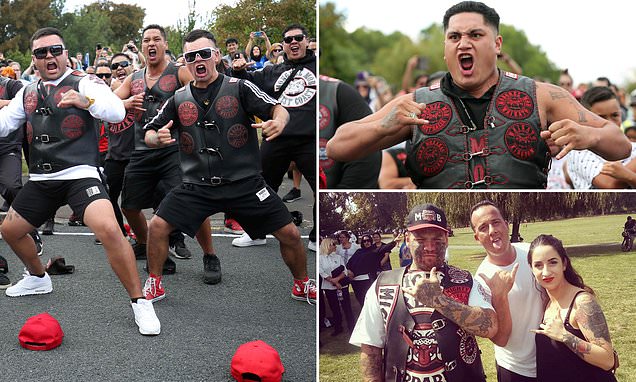
It was noted by all that various criminal gangs, in particular the Mongrel Mob, took a front and centre role in the community response to the shootings. The most visible response involved leading a public haka. The haka needs to be understood, in this context, as a black magic ritual. Its purpose is to demonstrate to the enemy your vigour, determination and unity of purpose. In this, a haka is little different to any other war dance.

The point of performing a haka after such a mass shooting was to demonstrate to the unseen “bad guys” out there that we are strong, we are ready and we are willing to fight. We will not be cowed. This is often the context in which a haka was performed in pre-contact New Zealand: someone would spot a member of an enemy war party in the bush, alert the others, and a haka would be performed to show that enemy that they were going to die if they continued to intrude. This was understood as black magic and called mākutu.

Certainly the New Zealand nation is currently in a state of extreme fear. Acts of national unity are necessary, but they have to be carefully considered owing to the extreme circumstances. In that regard, Tarrant’s actions have to be considered one of the, if not the single most, powerful acts of black magic ever performed in New Zealand. The only real comparison in recent history would be the Rainbow Warrior bombing, which only killed one person.

If the New Zealand nation wants to go forward without attracting further black magicians, and further ritual sacrifices (no matter who conducts them), they need to demonstrate that they are not afraid of death. This is chiefly done by enjoying life, and continuing to enjoy life as we had done before the shootings. Full attendance of Super Rugby games is one example. This will demonstrate to all the black magicians out there that we are not weak and not to waste their efforts on us.

*

Viktor Hellman is a regular contributor to VJM Publishing and author of the upcoming Anarcho-Homicidalist Manifesto.

Red Pill, White Pill, Blue Pill, Black Pill

There are many theories that describe the change in personality traits over generations. The most well-known is the Strauss-Howe conception of generations that gave us terms like “Baby Boomer”. Local anarchist philosopher Rick Giles has expanded on this conception, giving us a spiral idea of history based around the ebb and flow of moral cycles. This essay attempts to map both these theories onto the “pill theory” of modern Internet culture.

The Red Pill-Blue Pill dichotomy is a metaphor seen everywhere on the Internet of today. It is based on the famous scene from The Matrix, the film that made a powerful impression on Generation X and, consequently, Internet culture. In this scene, the character Morpheus offers the protagonist Neo a choice of one of two pills: a blue one that will send him back to the dream world of being a normal person, and a red one that will awaken him to the truth of reality and show him “how deep this rabbithole goes”.

It’s a metaphor that hearkens back to Plato’s Cave and the mystery schools before that. The idea is that anyone who has taken the red pill is someone who has voluntarily accepted the truth of reality, no matter how terrible, and who has escaped delusion. They are therefore enlightened, so much so that their lives are now fundamentally different to the bluepilled. Thus, ‘bluepilled’ is effectively a synonym for ‘unenlightened’, ‘gullible’ or ‘a sucker/pleb’.

A related conception is the dichotomy of the White and Black Pills. These serve as rough spiritual metaphors. The idea is that anyone who has taken the white pill is optimistic, full of life, happy and positive. The blackpilled, by contrast, are pessimistic, morbid, depressed and emo. One way of characterising this axis is using the Bloomer and Doomer images, the former blossoming like a spring flower, the latter seeing death and decay around every corner.

As this essay will now demonstrate, it’s possible to map the Blue Pill-Red Pill-White Pill-Black Pill quadrichotomy from popular Internet culture onto both Strauss-Howe’s and Giles’s conceptions of human generational change.

The generation that fought in World War II are the red pilled. They got redpilled harder than anyone since could really understand. It’s impossible to have any illusions when you are facing an artillery barrage or a Panzer charge – you appraise reality accurately and act accordingly or you die, simple as that.

As the war was winding up, they naturally got together, first in their companies and then in their Returned Services Associations, and asked themselves what the fuck the whole war was really about, and who was ultimately to blame. Eventually, they came to understand that the whole idea of a heroic narrative was a complete sham, designed to manufacture consent for a war that really only benefitted arms manufacturers, bankers and politicians. To understand that the world works like this is to be redpilled.

Commensurate with being red pilled is a somewhat traumatised disposition. As a highly social, highly traumatised generation, they hit the booze, and hard. Theirs is an Honour Culture in Giles’s conception, because they risked everything for what they have, and only very rarely complain or show pain or weakness.

The Silent Generation are the white pilled. They grew up during the Great Depression, and so became accustomed to having very little. This has meant that they instinctively feel gratitude for the plenty that we currently do have. They also grew up hearing about how the previous generation saved the world from terrible evil, so they grew up believing that they lived in a society where their forebears only wanted the best for them and where authorities could be trusted.

They are white pilled because they are naturally the most optimistic. This generation grew up with the suspicion that God may well have favoured the Anglo-American style of governance over its German, Soviet and Japanese alternatives. For them, everything works out in the end, and success is simply a matter of continuing long enough.

Their characteristic drug is tobacco, which is appropriate because they are a social generation, and also for the reason that you have to be whitepilled to smoke tobacco because you have to ignore the likelihood that it will kill you. Theirs is more of a Dignity Culture because they haven’t had the need to fight quite as hard as the World War II Generation. They’re not inclined to butt heads over honour; they would rather let things slide.

The Baby Boomer generation is bluepilled. They are Cypher from the Matrix. They don’t care at all about thinking or struggling to overcome, they just want an easy ride and someone to wipe their arse when they get old. For them, staying informed is a simple matter of switching the television on and being told what the truth is. They have a vague sense that reality is truly terrible, so it’s best to not look too deeply into things.

Their problem is that they are essentially doubly gullible. Not only are they not aware of how reality works, having been raised by televisions in an age of wealth, but their parents weren’t redpilled either, having lived in an age of plenty. The Boomers don’t really get it at all, which is why their characteristic drug is opiates. Preferably administered rectally by cheap immigrant labour.

The bluepilled don’t want to think, they just want their entitlements. This is why they correspond to a Victimhood Culture in Giles’s conception. Every obligation they are made to feel is considered an unreasonable imposition, and they deeply resent the implication that they’ve fucked up the world. Their greatest fear is someone cutting their pensions.

The offspring of the Boomers, Generation X, are the black pilled. This is the natural result of having bluepilled parents. Because their parents wanted nothing but the easiest ride possible, they didn’t end up passing on as much knowledge as they could have. Indeed, Generation X were pretty much left to it, many becoming “latchkey kids” who had both parents working. They felt that their parents not giving a shit, and that led to them not giving one either.

Among Generation X, the highest moral value is not giving a shit. This manifests in an exaggerated sense of coolness. To give a shit about anything is to be uncool, which is to be shunned. This is why grunge was so popular among this generation’s teenage years, and why they have been so apathetic towards politics and religion. Apathy means that you can be trusted; ambition means that you might abandon them like their parents did.

Generation X is a natural slave cohort, which is the result of their apathy towards politics. Because they have shunned those who tried to understand the political world and to organise, they are almost completely bereft of both guidance and power. Their characteristic drug is cannabis, because once you realise that there truly is no hope and that no-one gives a shit, you might as well just spark one up and enjoy your day.

It’s not clear how the Millennials will end up defining themselves, because at the moment they seem to be an extended form of Generation X, replete with nihilism and apathy. At some point, one would expect there to be a revolution so that some kind of Honour Culture reasserted itself, but whether this will come at the hands of the Millennials or of a generation that comes later remains to be seen.

What can be predicted is that the nihilistic apathy of the younger generations today will lead to a cataclysm of some kind. It might be military in nature, it might be climate-related, or it might be simple revenge on the Boomers. Whatever happens, the generation that follows the bloodshed will be redpilled, and the cycle will begin anew.

*

If you enjoyed reading this essay, you can get a compilation of the Best VJMP Essays and Articles of 2018 from Amazon for Kindle or Amazon for CreateSpace (for international readers), or TradeMe (for Kiwis). A compilation of the Best VJMP Essays and Articles of 2017 is also available.

The Great New Zealand Chimpout

New Zealanders have been used to thinking of ourselves as a passionless, even dour people, very calm, very sober and not prone to great emotional displays. Not for us singing at sports fixtures, crying in public or over-reacting to political events. This self-appraisal has been shattered by the events of the past fortnight. The last half of March 2019 will go down in history as the Great New Zealand Chimpout.

The first to chimp out was Branton Tarrant, shortly after lunchtime on March 15th. Driven insane by the ongoing collapse of Western Civilisation and the complicity of politicians, he chimped out with a semi-automatic rifle at the Al-Noor Mosque in Christchurch, to the tune of 51 dead. When the gunshots stopped, people were relieved, but little did New Zealand realise that the chimping out was just beginning.

For a sleepy nation at the bottom corner of the world, the New Zealand reaction was much like being awakened by having a bucket of cold water dumped over one’s head, as most Kiwis had truly believed that such a thing would never happen here. At first, there was the natural shock and horror that accompanies a mass murder, but these perfectly understandable feelings soon gave way to much uglier, cruder and more primitive sentiments. Many of the people holding these sentiments saw an opportunity in the tragedy.

Upon hearing that the shooter was white, leftists rejoiced. In the emotion of the moment, they felt they had a green light to abuse anyone who had ever uttered any misgivings about immigration for any reason. Maori radicals promptly joined in, using the occasion to demonise white people in general, and implicate all of them in collective guilt. Those who mentioned that Tarrant’s anti-immigrant invective was really very similar to the Maori radical anti-immigrant invective found the reaction like kicking a wasps’ nest.

Then the New Zealand Government decreed that our firearms laws were going to get changed. This they did without any consultation with the community – it was simply forced through, as if the emotion of the moment was enough to demand it. Few had the sense to speak out, as the prevailing uncertainly and fear caused most people to fall obediently behind the Government. It was then that the Great New Zealand Chimpout could be said to be hitting its peak.

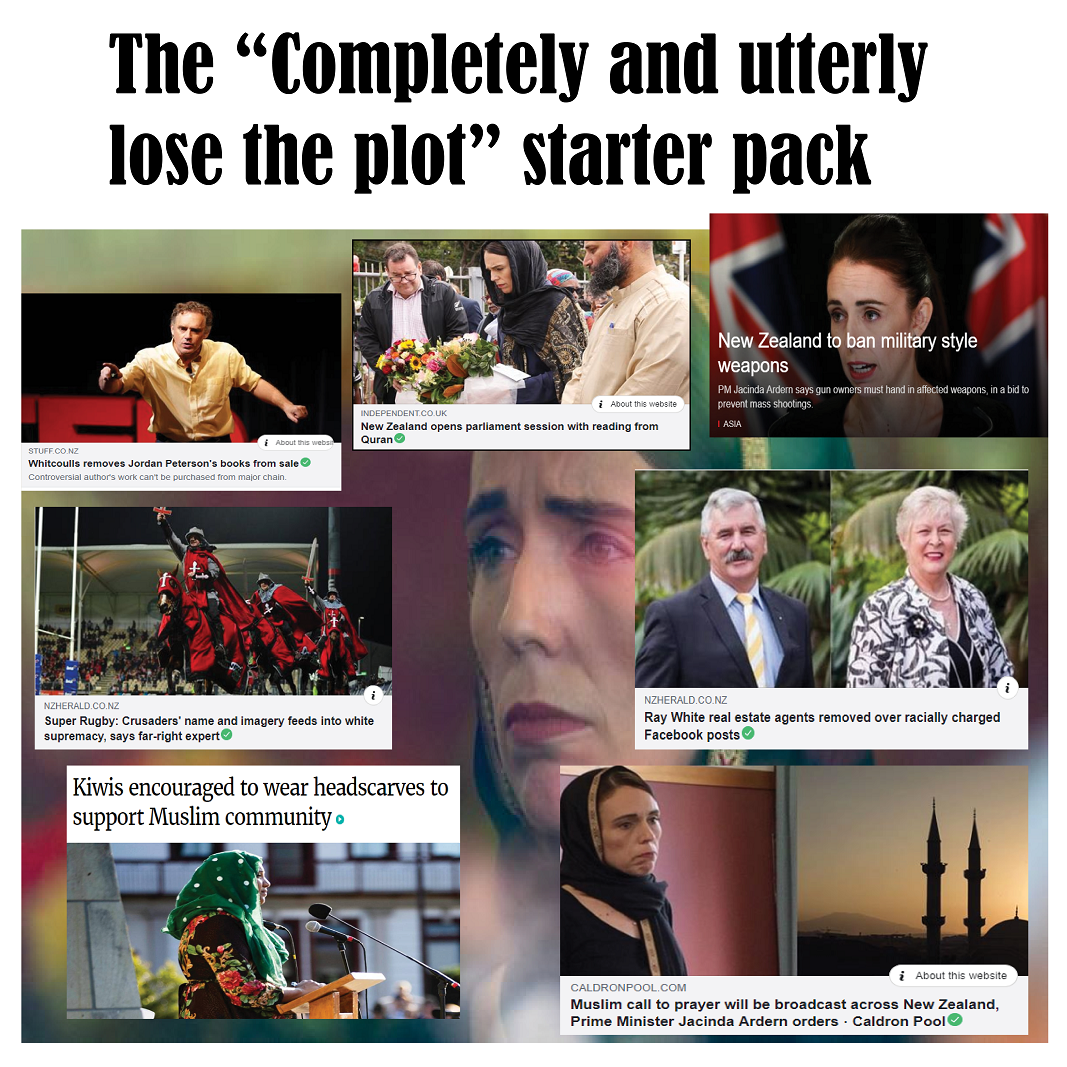
Jacinda Ardern set the national tone, which was to be one of grovelling submission. She was pictured wearing a hijab, probably a signal to the massive Indonesian and Arab export markets to please not take this attack as an indication of wider anti-Muslim sentiment on the part of New Zealanders. What the nation needed was a signal to the New Zealand people to hold fast, to keep their shit together, but in the hysteria of the moment no-one was able to put order to the nation’s emotions.

In line with this grovelling, Massey academic Paul Spoonley was given a platform to spout off about how the name of the Crusaders rugby team was an example of white supremacy. At the peak of the chimpout, everything was decried as an example of white supremacy, and people were discussing the need to ban “online cesspools” such as 4chan. Most ISPs went as far as blocking a number of sites relating to Internet counterculture, including 4chan, 8chan and Encyclopedia Dramatica.

The chimping out wasn’t limited to just Government, academia and their followers. The corporate world decided to lose their minds as well, perhaps characterised best by Whitcoulls. Based on little other than pure panic and a vague sense of association between psychological science and far-right wing extremist terrorism, Whitcoulls made the decision to remove Jordan Peterson’s book 12 Rules For Life from their sales shelves (a decision since rescinded).

Perhaps the crescendo of the chimpout was the decision of the New Zealand Chief Censor Davis Shanks to ban Tarrant’s manifesto, which meant that anyone possessing a copy would be liable for a ridiculously draconian 10 years imprisonment. Like authoritarians and control freaks everywhere, Shanks has apparently never heard of the Streisand Effect: his action caused half of New Zealand to go on FaceBook to reference “the manifesto”, which got the other half curious in it.

Throughout this chimpout, the New Zealand media has played the role of the feces-thrower.

In a complete 180 from the usual narrative when Muslims are the perpetrators of terror attacks, they have cashed in as hard as possible, by running countless pieces demonising white people and attributing to them collective guilt for this attack, for colonialism and for all suffering in the world. There is good money in this – the Alexa ranking for one of the chief feces-throwers, The Spinoff, climbed from the low 60,000s to the high 50,000s in just a few weeks, suggesting a growth in brand value of some 50%.

Even today, almost two weeks after the shooting, rags like The Spinoff were openly discussing the need to eliminate free speech for the sake of protecting minorities, a sign that the country is still thinking with panicked emotions and not reason and logic. As any mainstream media boss could tell you, there’s money in hysteria and division: stoke it up and count the cash as it rolls in.

There’s no way to tell when the Great New Zealand Chimpout will end. Already today it’s possible to observe it running out of momentum, but there is still a trial to be had. There is every chance that Tarrant’s trial will be accompanied by some ridiculous anti-freedom measure, which will be intended to suppress dissent but which will be sold to the public as necessary to fight extremism.

At some point, there may be pushback from the ordinary New Zealander, once they regather their senses. Whether or not this happens, we ought to hope that it does, because the Government and the media both benefit from keeping New Zealanders as confused and afraid as possible, and they both have incentive to keep the chimpout going. Eventually, however, it will either run out of steam or be deliberately ended by civilised people.

*

If you enjoyed reading this essay, you can get a compilation of the Best VJMP Essays and Articles of 2018 from Amazon for Kindle or Amazon for CreateSpace (for international readers), or TradeMe (for Kiwis). A compilation of the Best VJMP Essays and Articles of 2017 is also available.

Banning The Great Replacement Manifesto Violates The NZ Bill of Rights Act

In the wake of the Christchurch mosque shootings, the country has been forced to endure the Great New Zealand Chimpout. This has involved everyone losing their minds, and over-reacting in ways that they may later come to regret. One of these over-reactions was to ban Branton Tarrant’s Great Replacement Manifesto, an action which was – as this article will show – a violation of the basic rights of New Zealanders.

The idea of the New Zealand Bill of Rights Act is ostensibly to “affirm, protect and promote human rights and fundamental freedoms in New Zealand”. Supposedly based on the American model of inherent human rights, the NZ Bill of Rights Act is said to guarantee the rights of Kiwis and delineate areas in which the Government cannot take freedoms away.

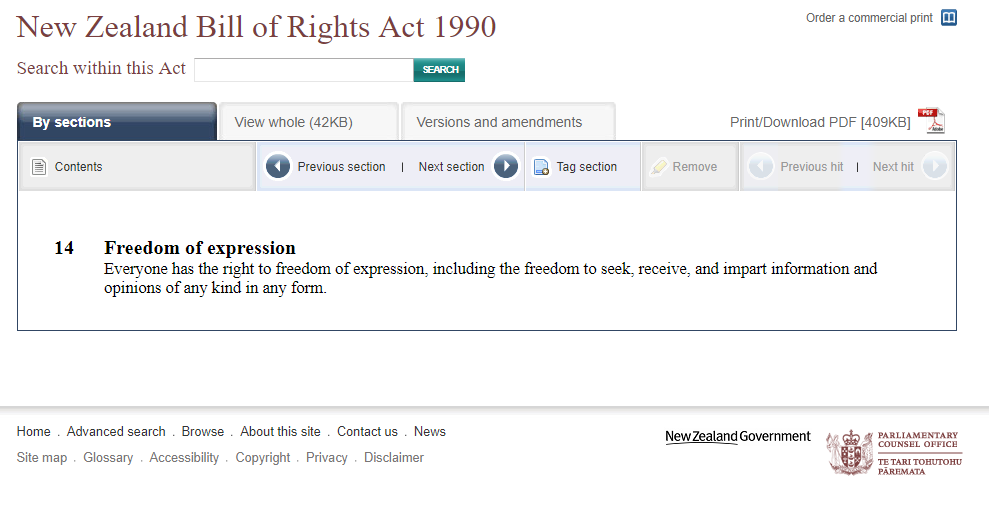
However, the New Zealand Government has just violated this. In deciding to ban the possession of a copy of Tarrant’s manifesto, the Government violated Section 14 of the NZ Bill of Rights Act, which states:

14 Freedom of expression

Everyone has the right to freedom of expression, including the freedom to seek, receive, and impart information and opinions of any kind in any form.

This states, perfectly clearly, that New Zealanders have the right to seek the Great Replacement Manifesto, to receive the Great Replacement Manifesto, and to impart (share) the Great Replacement Manifesto. Consequently, the actions of the New Zealand Government to ban this document are illegal, and are a violation of the human rights of New Zealanders.

So why did they do this?

The Government doesn’t want anyone becoming aware of its failures. Like the psychopathic narcissists they are, politicians are incapable of admitting that they are ever wrong. Therefore, they are incapable of admitting what every working-class Kiwi already knows: that mass immigration has greatly enriched the already wealthy, at the expense of the already poor.

What they really, really don’t want is other working-class people realising that the demographic trajectory of New Zealand appears to be taking them on a path towards Brazil, and then South Africa, and then Haiti. Because, if they do realise this, then the Government either has to take action to prevent it (which will put them offside with their masters in banking and industry), or risk more mass shootings as the position of the working class continues to decline.

Much better to kick the can down the road, and just try not to talk about it, like we did with drug law reform, euthanasia law reform, climate change etc. Otherwise, someone has to point out that the emperor has no clothes. The fear that the charade might soon be over has led to a state of panic among New Zealand’s ruling class.

This atmosphere of panic, coupled with the unusually large number of weaklings in the highest reaches of Government, is why there has been an over-reaction like this. Most New Zealanders are still running around like headless chickens, and in their submission have accepted that the Government can take away any rights it sees fit.

Moreover, there’s a set precedent that the Government can violate the Bill of Rights Act and no-one cares. As a previous article here has pointed out, psychiatrists already violate the Bill of Rights Act by forcing medical treatment on people who have explicitly withdrawn their consent. This has even gone as far as electroshock treatment, but only alt-media sources like VJM Publishing are interested in taking up the issue.

What needs to happen is twofold. The Government first needs to quietly make Tarrant’s manifesto legal for people to read. Second, it needs to address the concerns raised in the manifesto in a more honest and respectful manner than just screaming about “white supremacism”. After all, the bulk of the concerns about the effects of mass Third World immigration are held just as strongly by Maoris as by white people.

If the indigenous people of New Zealand don’t want to be replaced by overseas sources of cheap labour, then this has to be acknowledged and addressed. If they believe that maintaining some level of ethnic homogeneity is better than full globohomo, then this has to be acknowledged and addressed. If they believe that the past conduct of certain ethnic and religious groups is so poor that we would be better off keeping those groups out of the country, this too needs to be acknowledged and addressed.

An honest conversation with the New Zealand working class has been needed since the imposition of neoliberalism. True courage, and true leadership, would see it happen soon. The New Zealand Government has to speak honestly to the people about their vision for the nation. It cannot end suffering by banning information and sending the Police to harass any Kiwi who speaks freely.

*

If you enjoyed reading this essay, you can get a compilation of the Best VJMP Essays and Articles of 2018 from Amazon for Kindle or Amazon for CreateSpace (for international readers), or TradeMe (for Kiwis). A compilation of the Best VJMP Essays and Articles of 2017 is also available.