What’s Mental Damage to You is a Profit Opportunity to Someone Else

Here’s a grim, meathook reality so grim that you might want to sit down for it in case you can’t sit down pain-free for the next week: There is nothing in the whole world as profitable as human suffering. In every time and in every place, human misery offers unparalled opportunity to make dollars.

Understanding this is a matter of understanding some psychology.

A person’s level of motivation to take any given action is a function of the amount of pleasure they expect to gain or the amount of suffering they expect to avoid.

If they come to believe that a previously favoured course of action will lead to a decrease in future pleasure or an increase in future suffering, they will come to change their behaviour.

The psychology of advertising is little more than causing the reader, listener or viewer of the advert to suffer in some way and to then create an association between the product that you are trying to sell and the alleviation of that suffering.

This is done with a simple two-step procedure.

The first is to get the reader to feel bad for some reason. In practice, there are an almost unlimited number of ways that you can make a person feel bad. The really big ticket items, though, are a fear of disease, a fear of low social status and the fear of not being attractive to the opposite sex.

These fears play into the ultimate biological reason why human beings feel fear – namely, when the biological organism calculates, consciously or otherwise, that its potential to maintain or to spread its genes is threatened.

The second is to promote a product as the solution to that feeling bad.

In the case of fear of disease, you can sell medicine and insurance. You can manipulate the target’s fear of germs by exaggerating the prevalence of them to sell cleaning products. You can manipulate the target’s fear of dying by exaggerating the degree of anxiety that a reasonable person ought to feel if they do not have life insurance.

In the case of fear of low social status, you can sell flash cars, expensive clothing, jewellery, houses, golf clubs, yachts and more. Basically anything that appears to compensate for any kind of erectile dysfunction or small penis will attract people who are willing to pay money for it.

In the case of fear of not being attractive to the opposite sex, you can sell just about anything. The use of sex to sell a product is almost universal in advertising. After all, it plays at the fundamental male fear.

The psychologists who conduct advertising campaigns know that the human male – in the vast majority of circumstances – is permanently in a state of subconscious anxiety about his capacity to pass his genes on through a fertile female of his species. This will make him reliably dumb in ways that can be anticipated and profited from.

All the advertiser has to do is to associate the lack of their product with a lack of mating opportunities, and the presence of their product with the presence of mating opportunities. When this is achieved, the male will be willing to pay money for the advertiser’s product in order to alleviate the anxiety the advertiser has created.

It can therefore be seen that the purpose of advertising is literally to make you suffer for money.

This column is no exception. We make a living from telling you when you’ve been lied to – and then selling you what we claim to be the truth. The more we can aggravate your sense of outrage at the lies of politicians, priests and psychiatrists, the more likely you will become to spend money on our books.

Of course, we claim to be doing it out of solidarity, in your own interest – but then so did the priests who burned Giordano Bruno at the stake.

As above; so below – but don’t forget that anyone who is trying to make you suffer is probably not doing it out of sadism but simply for the $$$$$.
Cannabis Cowardice is Punishing Andrew Little in the Preferred PM Stakes

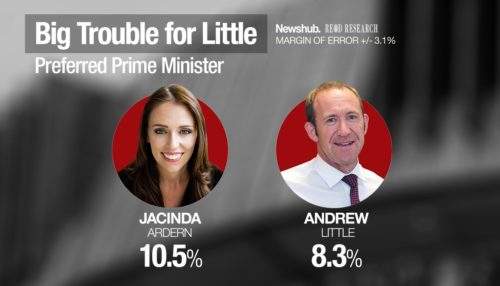
Andrew Little has been the Labour Party leader since 2014, and has struggled so far to gain much traction with prospective Labour voters. A recent poll brought some very bad news for him – namely that he has now fallen behind his deputy Jacinda Ardern in the preferred Prime Minister stakes.

No doubt the Labour Leader will have a team of pollsters working overtime ringing people up to ask why they’re not interested. However, they won’t ask the large numbers of Kiwis who are disenfranchised from the political and economic systems – and this is supposed to be Labour’s constituency and is the key to their recent failure.

These disenfranchised people are mostly the young, the invalid’s beneficiaries and Maori. These three groups will all tell you that they are crying out for a change to New Zealand’s cannabis laws.

The young are crying out for a recreational alternative to alcohol. All young people have had the unpleasant experience of watching people in their parents’ generation destroy themselves with alcohol, while noting that people who preferred cannabis generally had a much better time of things.

Invalid’s beneficiaries are crying out for medicinal relief for their suffering. Huge numbers of invalid’s beneficiaries in New Zealand have found that cannabis is a better medicine for alleviating the suffering that comes with their condition than the pharmaceutical alternatives.

They will point that since medicinal cannabis is now legal in 28 states of the USA there’s no continuing to deny that it is a medicine.

Maori are probably the group worst brutalised by cannabis prohibition, for a number of reasons. The foremost is the lack of genetic resistance to alcoholism that has seen so many Maori come to prefer cannabis as a recreational alternative to cannabis.

Not only Maori – there are many, many New Zealanders whose close family history has a detailed history of either alcoholism or violence related to drinking. All of these people are desperate for a recreational alternative to booze.

Andrew Little’s refusal to even consider a 21st century approach to the cannabis laws is causing him to bleed support among all of the Labour Party’s major demographics – all of which are crying out for some kind of cannabis law reform.

On the cannabis issue, Little appears to hover somewhere between cowardice and supporting a National party-style prohibition. This hits hard against exactly those sort of people who like to vote Labour.

As has been described in an excerpt to Dan McGlashan’s upcoming book Understanding New Zealand, the sort of person who votes Labour is the same sort of person who is likely to be adversely affected by the country’s cannabis laws.

The correlation between median age and voting for the Aotearoa Legalise Cannabis Party in 2014 was -0.55, which tells us that the bulk of ALCP voters were young. The correlation between median age and voting for the Labour Party was -0.70, so that tells us that Labour and the ALCP are competing for the same voters to a large extent.

The correlation between being on the invalid’s benefit and voting for the ALCP in 2014 was a very strong 0.76. This is because many, if not most, people on an invalid’s benefit would be greatly helped by any change to the law that made cannabis more readily available.

Finally, the correlation between being Maori and voting for the ALCP in 2014 was a whopping 0.89. This is not at all surprising considering that Maori suffer by far the worst of the abuse from cannabis prohibition. This is enough to suggest that a mature, intelligent cannabis law reform policy would attract masses of Maori voters.

All three of these groups also have very strong correlations with not voting at all in 2014 – because of the total failure of any of the mainstream political options to represent their needs.

What this tells us is that there are legions of disaffected, disenfranchised New Zealanders who will not support the Labour Party as long as it has a leader who is too timid to support a definitive change to the country’s cannabis laws.

Going by the large numbers of young, sick and Maori non-voters who are desperate for a change, we can predict that the Labour Party will lose the General Election this year unless it adopts an intelligent, modern, compassionate cannabis law reform policy.