The Ten Strongest Positive Correlations in New Zealand Society

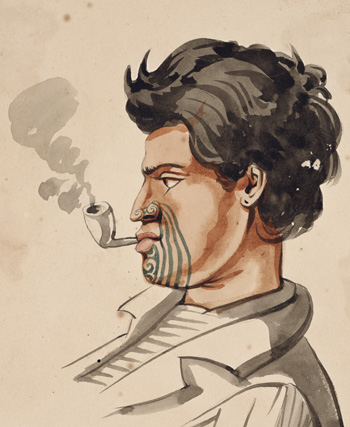
In 1847 most Kiwis smoked all the time, but by 2017 the correlation between being Maori and being a regular tobacco smoker had become 0.922

Dan McGlashan’s Understanding New Zealand is currently undergoing final preparations for publication and release. This means that the most comprehensive demographic survey of New Zealand ever conducted is about to be available to Kiwi readers in paperback form!

As a sample of what is in the full version of Understanding New Zealand, this article looks at the ten strongest positive correlations in this study, out of all 9,870 of them.

10. Working in professional, scientific and technical services and having an income between $100 and $150K had a correlation of 0.918. This is not very surprising at all, because it is well known that working in any of those occupations requires a very high level of knowledge and skill and that is usually well compensated.

9. Working in financial and insurance services and working in professional, scientific and technical services had a correlation of 0.920. Obviously a person can’t work in both, but the reason for this strong correlation is that both industries are almost exclusively confined to the central city electorates of Auckland, Christchurch and Wellington.

8. Being Maori and being a regular tobacco smoker had a correlation of 0.922. This is an astonishingly strong correlation if one considers that there is no known racial inclination to smoke tobacco.

The reason for it is probably because people generally need to be doing it quite hard to smoke tobacco, because its medicinal effects are outweighed by the physical damage unless a person is under severe emotional distress.

For these reasons, because the majority of the people who are doing it the hardest are Maoris, it’s also the case the majority of Kiwis who are currently regular tobacco smokers are Maoris.

7. Being a Hindu and being a Muslim had a correlation of 0.929. Like point 9 of this list, the two categories are mutually exclusive, and therefore the correlation represents the high physical proximity that the two groups live in.

The explanation for it is that both Hindus and Muslims are part of the most recent waves of immigrants, and so the vast majority of both groups live in the same neighbourhoods, in particular poor ones in Auckland.

6. The correlation between voting ACT in 2014 and being born in North East Asia was 0.937. This might seem like a very strange statistic until one considers that much of a person’s voting preference is a function of two factors – their degree of solidarity with other Kiwis and how much that solidarity will personally cost them.

Anyone not born in New Zealand will necessarily have the least amount of solidarity with other Kiwis on account of having the least in common in terms of heritage and culture, and those born in North East Asia are usually earning an income at or above the Kiwi average – and so pay more taxes.

Thus it can be seen that the ACT Party, in that it most unashamedly considers money more valuable than people, attracts the bulk of these voters.

5. The correlation between being Congregational or Reformed and being born in the Pacific Islands was 0.943. This is because this group reflects a religious tradition that is extremely popular in all of the Pacific Islands apart from New Zealand.

4. The correlation between being Buddhist and being Asian was 0.950. Some might find this surprising because they know a lot of non-Asian Kiwis who are “really into Buddhism”.

Few of these people, however, would go as far as identifying with Buddhism when they fill out the census forms – unlike Asians born in Thailand and in other countries where Buddhism is mainstream, of whom there are tens of thousands in New Zealand.

2=. The second strongest positive correlation was between voting National in 2014 and voting to change the flag – this was 0.954. As Section 56 of Understanding New Zealand discusses in detail, the entire flag referendum project was essentially a National Party vehicle.

2=. Equal with this was the correlation between being a Pacific Islander and being born in the Pacific Islands. A correlation of 0.954 here tells us that, not only are the bulk of Pacific Islanders in New Zealand not born here, but that they tend to choose to live in geographical areas full of other Pacific Islanders (in particular South Auckland).

Although many Kiwis of Pacific Island descent are born in New Zealand, many of these have moved out of Auckland and therefore away from the bulk of those born in the Pacific Islands. These two factors explain this extremely strong correlation.

1. The strongest positive correlation in all of New Zealand was that between voters in the first flag referendum and voters in the second flag referendum – this was a whopping 0.985.

This combines the fact that the entire project was a National Party vehicle with the fact that those who like to vote tend to take every opportunity they can to do so.

*

This article is an excerpt from Understanding New Zealand, by Dan McGlashan, published by VJM Publishing in the winter of 2017.

The Fundamental Masculine and Feminine Moralities

People often talk about one singular, monolithic, ideal morality as is God was sitting up in the heavens waiting for us to figure it out. The belief appears to be that if we ever did figure this out, we would all behave according to it and life on Earth would be harmonious forevermore.

This childish magical thinking is, of course, false. The reality is that there are two very different moralities that represent opposite ends of an ethical spectrum upon which all actions fall.

The fundamental masculine morality is to maintain good order, and the fundamental feminine morality is to allow life to naturally express itself.

Maintaining good order and allowing life to naturally express itself might not sound like contradictions necessarily, but they are still poles on an ethical spectrum.

One can convince oneself of this by realising that all threats to good order arise from the natural expression of life, and that all bad order restricts the natural expression of life. Likewise, all good order allows for the natural expression of life, and all unnatural expressions of life lead to bad order.

This means that it is commonplace for adherents of the masculine morality to want to destroy expressions of life that threaten good order, and it is commonplace for adherents of feminine morality to want to destroy bad order that prevents natural expression of life.

For the most part, it’s entirely possible for these two moralities to work together. But sometimes they don’t.

A man might act according to masculine morality when he tends to his garden. A gardener is not at all interested in allowing life to express itself through the form of weeds. His task is to maintain good order by keeping the weeds out, by keeping the plants in correctly spaced rows, to prevent the soil from becoming too wet or too dry etc.

A woman might act according to feminine morality when she raises a child. When raising a child, women are generally not particularly concerned with the degree of order that child has. What she wants is for the child to express itself through growth, to be healthy and strong, to feel joy at being alive, and this is made more difficult by forcing order on it.

Masculine and feminine moralities therefore come into conflict when a given order is considered good by some and bad by others.

In fact, this is how most conflict starts. A king might consider his kingdom’s operation to demonstrate good order, but there may be forces in the kingdom who disagree, and who consider his rulership to be bad order.

These forces will come into conflict because the natural expression of the sentiments of those who disagree with the king’s rule will conflict with the king’s desire to maintain order, and the king will find himself forced to stamp those sentiments out else risk chaos befalling the kingdom.

In the same way that silver is a compromise between clay and iron and more valuable than either on account of its finer balance, so too does the correct course of action in any given situation appear as a balance between the masculine and feminine moralities.

Morally retarded people are those who are unable to find a balance between the masculine and feminine moral orientations, and so they either try and impose maximum order upon everything (penis-worshippers and control freaks) or maximum chaos upon everything (postmodernists and hyperfeminists).

People who go too far down the masculine track start wanting to maintain order for order’s sake. The concept of good order is forgotten.

Our cannabis laws are an excellent example of an excess of masculine moral sentiment. It’s obvious to everyone that the New Zealand cannabis laws are not fit for purpose and must be changed, but those who wish to maintain order for order’s sake are unable to countenance so much as a conversation about the subject.

People who go too far down the feminine track start wanting to introduce chaos for chaos’s sake. The concept of healthy chaos is forgotten. These people essentially “just want to watch the world burn”.

The refugee policy of Europe over the past two decades is an excellent example of an excess of feminine moral sentiment. The refusal to discriminate between the natives and non-natives, usually for what are claimed to be moral reasons, has led to a collapse in good order as all manner of chancers have flooded in to compete with the natives for resources.

The only way out of our predicament will be to find the correct balance between the masculine desire for order and the feminine desire for free expression.

Metaphysically that means choosing the right combination of clay and iron so that the overall structure can be polished into silver.

In other words, the same as it ever was.

Is The New Zealand Government About to See A Repeat of The 1990s?

The 1990s began with the chaos of a disintegrating Labour Government and ended with the chaos of a disintegrating National one

In the leadup to the 1990 General Election, the New Zealand Labour Party appeared to be falling to pieces. They had gone through three leaders in 15 months, with Mike Moore the most recent to wrest control of the jinxed idol, having convinced the hapless Labour Party caucus that he was a better bet for staving off what was looming as an electoral disaster.

The move turned a disaster into a catastrophe – the National Party won 67 seats in the election compared to Labour’s 29, as the Italy-style rapid changes in leadership gave the wider public the impression that Labour had lost the plot entirely.

This majority was enough for the National Party to force on the nation what the people called “Ruthanasia” – a Budget so callously tight-fisted that it appeared that National were trying to cull the poor through starvation.

The Budget was so unnecessarily cruel – in many cases leaving solo mothers unable to feed their own children at the end of the week – that even New Zealanders were appalled by it, and only by demoting the clearly psychopathic Ruth Richardson to the back benches did the National majority survive the 1993 General Election.

By the next election in 1996, the National Party had eroded most of the trust that Jim Bolger had earned in opposition, and they were only able to govern thanks to a rickety alliance with the New Zealand First Party.

When Jenny Shipley rolled Bolger in 1997, New Zealand had another psychopath in an influential position, and this made the alliance with Winston Peters untenable. Being neither a psychopath nor willing to submit to one, Peters was unable to work with Shipley and was duly sacked.

New Zealand First then disintegrated under the gravitational pull of the National Party as it tried to withdraw from its influence, and the New Zealand electorate responded to the wheels falling off the alliance by chucking the whole thing on the scrapyard.

The National Party was duly destroyed by Helen Clark’s Labour in 1999.

Since Helen Clark took the reins at the end of the 90s there has been nothing but orderly Government, but “History, with all her volumes vast, hath but one page…”

Our current situation in the winter of 2017 is fairly precarious, with Bill English having taken the leadership at the resignation of John Key last year. Any development that brought the stability of Bill English’s leadership into question could well lead to a comprehensive National Party loss this September.

The most likely way this would happen is by some scandal being followed by a poll that hinted suggestively at a National Party loss, at which point the National Caucus panics, then Paula Bennett does a Jenny Shipley and convinces the Caucus to support her leadership instead (ironically it was English himself who replaced Shipley as leader of the National Party in 2001).

In other words, Paula Bennett may seize upon any weakness shown by the blundering incumbent PM in order to achieve her own Prime Ministerial ambitions, despite being grossly unfit for the role.

Judith Collins might also play the role of Shipley, depending on who moves first and with what support.

Either would be suicide for the National Party, because there’s nothing less orderly than an involuntary change of leader.

What the public wants, more than anything, is that the Government maintains good order, and what the public needs, more than anything, is that the Government maintains good order.

We don’t actually need it to do much else. If it can simply keep the peace, the rest of us can get on with our lives of commerce and trade. We can make ourselves rich and happy without their help – all we need is for them to not interfere.

From 1840 to the early 1900s New Zealanders developed our country from the Stone Age to first place among all the living standards of the world, and this was achieved without any of the National, Labour, Green or New Zealand First parties existing.

All we need is for the megalomaniacs at the top of the national dominance hierarchy to maintain good order, and we can do the rest.

This is why many political commentators miss the mark when they decry Andrew Little for his lack of charisma.

It’s true that Little has the charisma of a brick, but so what? He’s not going to be personally leading a company of men into battle. He’s going to be inheriting the reins of a civil machine that has been fine-tuned for almost two decades.

His job, as mentioned above, is to maintain order. To that end, being boring is a qualification. He hasn’t said a word about either of the two hot issues stirring up the left at the moment (cannabis law reform and increasing the refugee quota), and this is no doubt a carefully calculated tactic to make him appear suitable as the man to steady the ship.

After all, it’s a heavy increase to the refugee quota that is more likely than anything else to bring a massive amount of chaos to these shores, as both the Green and Opportunity Parties are gagging for it.

Some say that the National Party are the natural ruling party of New Zealand. If there’s any truth to this it’s because the National Party are the best at maintaining good order.

If Little really wants to become Prime Minister this year, all he has to do is what Helen Clark did two decades before him – simply maintain good order in his own party, and wait for the ambition and greed of the National MPs to cause them to devour each other.