The Alchemy of the Evolutionary History of Hominids

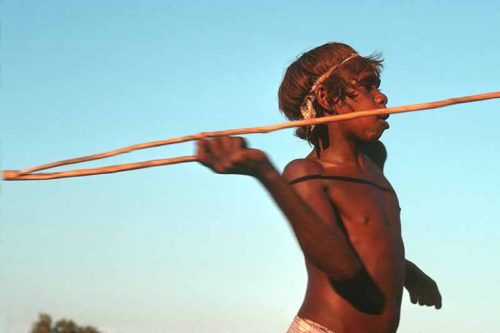
The invention and refinement of the spear was one of the first significant applications of human intelligence

All regular readers of this column will be familiar with four temperaments theory, which is the idea that humans fall into four psychological groups that correspond to the four feminine elements of earth, water, air and fire. As a previous essay discussed, these four elements could be considered to be the four feminine elements of equal value, in contrast to the four masculine elements of varying value. This essay looks at the four temperaments according to the four masculine elements.

The most elementary sort of person is the one that exists in the state of nature. This corresponds to the man of clay. This is how people are when we’re not significantly distinguished from the rest of the animal kingdom – in other words, when we’re just a third chimpanzee.

In esoteric terms, this is a person with no divine inspiration. Such a person will not feel any reason to question the various animal impulses that come through their mind, and consequently they will behave much like an animal. They will be aggressive, vicious, spiteful, brutal, jealous and envious.

Divine inspiration manifests in the man of iron as someone with a concept of discipline. At the most primitive level, this means someone who is able to overcome their fear of physical suffering in order to hold fast and resist an enemy, usually in the form of another man or a predatory animal.

At the most primitive level of humanity, this is how people came to distinguish themselves from the ordinary ape-man, and this is therefore how humanity began to evolve into something higher. Tuning into this frequency of iron meant learning the virtues of bravery and courage which, when applied to death, allow a person to act as something more than just a fear, hunger and sex-based animal.

After a certain critical mass of iron was reached, some of it began, like fusion in the heart of a star, to brighten into silver. This was when people came to learn that intelligent application of discipline was better than discipline for the sake of discipline.

This was also the point at which humans started to use their brains and intellects to secure survival and reproductive advantages. A crucial stage in this process was the invention of the spear. The application of intellect necessary to first realise that a spear is a more effective weapon than a club, and second to improve it by hardening the tip in fire, catapulted humanity forward.

The value of silver is in that it is softer than iron and can therefore be used to direct iron in subtler ways. When humanity started to appreciate this value, then iron was consciously polished into silver for the first time.

This led to a third type of person, one who was neither animal nor knight but somewhere in between. This person carved a niche for themselves out of reality primarily through their minds, i.e. through the application of intelligence. On an alchemical level, this sort of person corresponds to the element of silver.

Music began to develop at this point, as did language more complicated than the growls and hisses that we shared with other mammals like cats and monkeys. Evidently, people decided that they naturally liked that sort of thing because all cultures developed a musical tradition and a tradition of singing.

The real development of silver, however, wasn’t in levity but in lying and cheating and scheming and plotting, either against other people or other animals in hunting or nature itself in agriculture. Silver is not gold, and intelligence is entirely separate from morality.

Most humans don’t develop much past this stage of silver, if they even get that far. But for those who did, the next step was the advent of philosophy, and alongside that came the ritual use of psychoactive drugs.

The first of these drugs to be used ritually was probably psilocybin mushrooms or amanita muscaria, followed by ayahuasca, alcohol and then cannabis. Mushrooms are the obvious choice for ritual use because they require no real preparation (although ought to be dried for reasons of palatability) and because they spring up at at a regular and predictable point in the seasonal cycle.

Once this started to happen, humans started to develop a sense of spirituality. The broader perspectives offered by the altered states of consciousness that were deliberately entered into, often enough for a shaman to learn to navigate in them, allowed for an appreciation of something much greater than oneself, an insight into higher levels of the Great Fractal.

Once insights like this were reached, it became possible for consciousness to affect reality on the level of gold, which is to say, the level of correct conduct.

This led to a fourth sort of person, one who is capable of guiding and influencing all of the other elements despite being soft like the clay. This person was able to lead by example, and therefore did not need to be strong like iron or quick-thinking like silver. This sort of person is rare enough that they are like the gold.

This sort of person took the role of the shaman in ancient society, in that they were a person who experimented with altered states of consciousness for the sake of maximising the breadth of their perspective on reality. This path requires both the courage of iron and the cunning of silver, and in this manner is like a synthesis of the two.
VJMP Reads: Anders Breivik’s Manifesto XIII

This reading carries on from here.

In this section (pages 1068-1152), Breivik writes about a wide variety of topics, including a proposal for a merit system for the society of knights, how to counter state propaganda, an entreaty to European police forces and an argument for the reinstitution of patriarchy.

Again without apparent irony, Breivik writes that “[The media] deliberately portray us as the anti-thesis of the ideal person so that we achieve a minimum of impact when it comes to appealing to the average European.” This is a curious position if it is considered that the average European, being rather civilised, generally finds murderers unappealing.

It’s obvious from reading a document such as this one that a person with Breivik’s mind was clearly capable of carrying out the deeds he was accused of. But it’s hard to know what to make of someone who advises prospective mass killers to “Visit a male salon if possible and apply light makeup” before taking photos of themselves in order to look the best.

Here Breivik gives a very interesting explanation for the phenomenon of the mainstream media describing white mass shooters as “lone wolves” or “mentally unstable”: ultimately, the Establishment wants to avoid having to explain why there is an ideological opposition to the way they are running things, because having to explain this would give that opposition the perception of legitimacy.

This explains why ruling classes of all times and places are so quick to decry their opponents as “mad” – because it delegitimises them.

Yet again, Breivik decries Nazism: “We hate everything Nazi Germany stood for, in fact we view the current EUSSR/Multiculturalist regimes of Western Europe as totalitarian Nazi regimes.” It’s apparent that there will always be people who call him a neo-Nazi, but anyone who has bothered to read this document knows that this isn’t true.

The most difficult thing for most readers of this document to understand will be Breivik’s frequently declared opposition to “all hate-ideologies; communism, cultural Marxism/multiculturalism, Islam and national socialism.” Most people tend to assume that any mass shooter belongs to a hate ideology and will therefore have considerable difficulty putting Breivik in a box.

Also difficult to understand is Breivik’s frank acknowledgement of the success of Islam in honouring those who have martyred themselves for its cause. Perhaps this has occurred out of Breivik’s will to approach the question of nationalism from a military perspective.

When Breivik writes that “It is every Europeans duty to defend their people and country against the ideology of genocide, conquest and destruction known as Islam,” this raises a number of questions. Some of these questions are fair, but many will resist asking them for fear of granting legitimacy to violent nationalist sentiments.

The biggest is this: how do we know that Islam is not an ideology of conquest? Because the only thing stopping more people from following Breivik’s line of reasoning is the pervasive belief that Islam is not an ideology of conquest. If this belief does not accord with reality then it will eventually yield.

This is no trivial point. The fact remains that if a large number of fighting-age men come into your territory with an ideology of conquest then you are literally at war, no matter how much you might deny it or want it not be true. Who decided that these “refugees” came to Europe with a long-term will to peacefully integrate? Who is even qualified to decide such things, and, if no-one really is, how can it have happened?

Certainly if the millions of Muslims who are currently in Europe decide that they don’t want to peacefully integrate – and the experience from everywhere else is that they don’t – then letting them in in such numbers was a catastrophic strategic error from the perspective of European leaders tasked with maintaining the quality of life of their people. It might be a problem that takes a century or more to solve.

Perhaps it’s not unreasonable to declare these leaders traitors?

Interestingly, Breivik explicitly mentions in this section the fact that attitudes to Jews make it extremely difficult for European nationalist sentiments to unify around a common goal. On the one hand are neo-Nazis, who consider Jews the enemy; on the other hand are Christian conservatives, who consider the Jews a common ally against Islam.

At the end of this section, Breivik underlines the strength of his identification with Christianity, making the argument that only the Catholic Church can unite and speak for all Europeans and that conservative Christian governments ought to reflect this in their policy.

In all, it’s clear that the Establishment is, and must be, very uncertain about how to respond to someone like Breivik. They appear to have mostly decided to make the subject of him and his ideas taboo (which is, of course, a red rag to those of us at VJM Publishing), but this strategy is doomed to fail because of the increasing pressure brought about by the political trends mentioned in this document.

Te Reo With Mnemonics: Home Words

Pillow – urunga

A woman goes to lie down with a bright orange-coloured pillow.

Chair – tūru

Balanced precariously on a small chair are two kangaroos (two roos).

Bed – moenga

A bedroom looks photographically realistic except for the bed, which is drawn in Manga-style with Japanese characters on the bedding.

Mat – whāriki

A young man is sitting on a toilet and looking down at the mat in front of him. The mat starts swirling in a range of terrifying colours and he says “Freaky!”

Sheet – hīti

A man is lying in bed on a sweltering night. He cries out “Oh, the heat!” and then strips his bed down to the sheets.

Mirror – whakaata

A woman looks at herself in the hand mirror and notices, in the reflection, Dan Carter, far in the distance. In the mirror is the Far Carter.

The Maori word for ‘pillow’ – urunga – sounds like the English word ‘orange’

Brush – paraihe

A boy holding a large brush in his hands kneels down to pray.

Stairs – arapiki

An arrow walks up a set of stairs outside a house and then peeks through a window. He is the arrow peeker.

Table – paparahua

A young boy is sitting at a beach when a man comes by, rowing on an upended table. The boy says “Papa! Row here!”

Clothespeg – mātiti

A fat young boy puts a clothespeg on his own chest and says “Ow, my titty!”

Telephone – waea

Two people in adjacent houses are talking to each other on telephones, but there is a wire connecting both of the phones and they can’t move further away from each other.

Couch – hāneanea

A man is lying on a couch watching a video of two women fighting MMA-style. From deep in the couch he cheers “Ha! Knee her! Knee her!”

*

The above is an excerpt from the upcoming Learn Maori Vocabulary With Mnemonics, by Jeff Ngatai, due to be published by VJM Publishing in the summer of 2017/18.

Peters Has More Leverage in a Labour-Greens Coalition than in a National One

Winston Peters aleady has a number of achievements in government, and the mana that comes with those. Labour and the Greens are more likely to recognise this than National are

The most important element in any negotiation is each side’s BATNA – Best Alternative To a Negotiated Agreement. In other words, how good or bad it would be for either side to walk away from the table. This article will argue that, ultimately, Winston Peters ought to go with Labour and the Greens, for the reason that he can wring a better deal for himself (and for the nationalists he represents) out of that side.

The deal that Peters ought to offer Jacinda Ardern and James Shaw is this: support Peters as Prime Minister for this next term at least, with Ardern in an apprentice role as Deputy. Let’s have a coalition Government that’s mostly Labour with certain New Zealand First mandarins in high places and James Shaw in Cabinet somewhere, maybe Julie Ann Genter as well.

Peters will be the Prime Minister, so if anything goes wrong he can take the blame for it when he retires. But if everything goes right, we get at least one, hopefully two terms of stable centre-left government, at which point Peters retires triumphant.

This should allow us to undo the game of hot potato that our immigration system has become and whack the minimum wage up to a point at which our working class have a standard of living similar to Australia and the rest of the West.

And if everything keeps going right, Ardern will step naturally into the role after those two terms when Winston rides off into the sunset.

This will achieve several purposes: it will allow for a change in Government from the hyper-neoliberal National Party; it will neutralise criticisms that Ardern is too young and inexperienced to take on the top role; it will help Winston Peters fulfill ultimate career objectives.

For Ardern that’s a pretty sweet deal. There’s no reason to think that this deal will be considered part of the electoral pendulum from Labour to National to Labour to National to Labour to National to Labour to National to Labour to National, which means that if Peters does step down after one or two terms of measured, calm, reasonable and dignified leadership, there won’t be a sense that it’s National’s “turn”.

This would mean that Ardern, at age 43, will be in prime intellectual condition to begin her own three-term reign of Prime Minister.

The BATNA for Labour and Ardern is that Peters throws his support in behind National and the country has to endure another three years of neoliberalism, except this time not under the shrewd cunning of John Key but under the blundering, hamfisted efforts of Bill English, with the baby-eating banshee of Paula Bennett shrieking in his ear all the while.

This is a pretty bad alternative, all things considered. It’s effectively a total loss.

Bill English simply couldn’t accept a deal that was this sweet to Peters. His backers expect nothing less than the Ninth Floor, and there would be howls of outrage from his own party if he gave up the Prime Minister’s Office to the leader of a party that won less than a sixth of the votes of National.

National also has a much better BATNA than Labour does. Even if Peters agrees to go with Labour and the Greens to form an African coalition, that coalition would still have to succeed and to provide stable government, for if it didn’t, the electorate would be only too happy to give National another chance under Bennett.

Some in National might be only too happy to let some kind of Labour-New Zealand First-Greens abomination tear itself to pieces for three years (or less) and then set up a three-term Sixth National Government under Bennett or Steven Joyce or some other half-witted order follower.

For this reason, Peters will understand that Labour will be more incentivised to maintain a stable Government than National will. The National Party social media machine proved itself exceptionally effective at raising an angry mob at the peak of the Metiria Turei affair, and if their working relationship with Winston Peters fell apart it could be predicted that the electorate would put the blame on Peters.

This all means that Peters has much more leverage to use against and with Labour and the Greens than he does with National.