
Should New Zealand Reduce Pensions To The Level of Other Benefits?

When the pension system was introduced in New Zealand in 1898, the average life expectancy was less than 60. Today, it’s closer to 80. Consequently, pension expenses have ballooned. This article discusses whether New Zealand should lower the pension to bring it in line with other main benefits, and what we could afford if we did.

A lot of words are being written lately about universal basic income, but few realise New Zealand already has a universal basic income for the over 65s, known as National Superannuation.

The argument for paying out this universal benefit is that people older than 65 cannot reasonably be expected to earn a living through the workforce, and therefore would starve without a pension. That seems entirely fair. Not many people would argue that a person should be forced to starve, in this age of plenty, just because they were too old to work.

However, the amount of money paid in pensions is taking the piss. $360 per week to every person over 65, when a majority of them own their own house, is an obscenity, when we expect severely mentally ill people to survive on $273 per week, out of which they almost always have to pay rent.

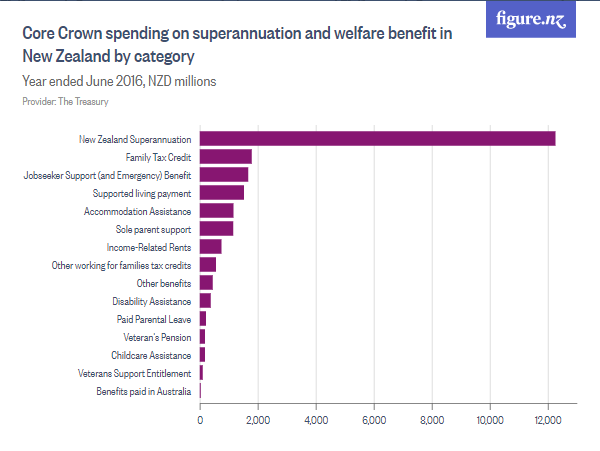
As of June 2019, the New Zealand Government spends over $12,000,000,000 every year on pensions (see table at top of article). This mostly consists of the $20,000 of yearly pension payments per recipient, multiplied by the 600,000+ eligible pensioners in New Zealand. Pension spending is projected to be $20,000,000,000 by 2031.

Although most people can agree that it’s cruel to leave people to starve on account of that they’re too infirm to work, there’s no reason for the Government to be granting pensioners a lifestyle that compares with what people make from working. Indeed, if they’re not working, why should they be paid any more than the unemployment benefit?

A fair compromise between the current luxury pension model on the one hand, and reducing the pension to the level of the unemployment benefit on the other, might be to reduce the benefit to a midway level. This would recognise both that current pension spending is an unsustainable and unfair burden on the under-65s, and that the infirmity of old age demands more expenses than the health of youth.

If the pension was cut by 25%, from its current $360 per week to around $270, this would bring it in line with other main benefits such as the Supported Living Allowance. This 25% reduction would equal a savings of $3,000,000,000 per year in pension expenses.

To give an example of how much money that is, it’s roughly equal to the $3,000,000,000 in tax revenue that the Government gets from the 10.5% tax on the first $14,000 of income. This tax works out to slightly less than $1,500 per person for each of New Zealand’s roughly 2,000,000 wage or salary earners.

So lowering the pension by 25% to bring it in line with other main benefits could be balanced by making all income up to $14,000 tax free. This would be a revenue-neutral move – there are plenty of other ways to spend $3G, but this would be one of the most popular.

Introducing a $14,000 tax-free threshold would make two million New Zealanders much happier about going to work every day. It would revitalise the workforce by giving every worker an extra $1,500 per year. This works out to almost $30 per week. That would make a huge difference to standard of living given the cost of living and cost of housing at the moment.

For two-parent families, such a saving would equal roughly $60 per week. For many Kiwi families on the breadline, this would be enough money to make the difference between survival and disaster some weeks.

There’s no loss to bringing this in, apart from a reduction in luxuries for our current crop of pensioners. None of those pensioners will go hungry because they would still get as much as an invalid’s beneficiary, and considering that these same pensioners had the luxury of being able to buy a house on one income – a luxury that younger generations will never have – there’s no reason for the rest of us to spend empathy on them. We ought to keep it for each other.

At the moment, New Zealand is being sucked dry by a cohort of super-entitled Baby Boomers who feel that they have the right to party it up for 20 years after they reach 65. This was only sustainable when pensioners were a small percentage of the population, but with as much as 20% of the population soon wanting a slice of the pension pie, it no longer is.

We need to bring the pension in line with other main benefits in order to rein in our bloated Superannuation expenses. Reducing it to the same level as the Supported Living Allowance would free up roughly three billion dollars every year. Freeing our economy from this burden would make life a lot easier for the vast majority of Kiwis.

*

If you enjoyed reading this essay, you can get a compilation of the Best VJMP Essays and Articles of 2018 from Amazon for Kindle or Amazon for CreateSpace (for international readers), or TradeMe (for Kiwis). A compilation of the Best VJMP Essays and Articles of 2017 is also available.


The Best Way to Raise Wages Is to Strengthen The Negotiating Position of The Working Class

Low wages are blamed by many for the various social ills befalling the nations of the West. If only wages were higher, a lot of problems with housing, education and healthcare would be solved. Although this is true on the face of it, little thought goes into what actually leads to high wages. This essay explains.

A popular belief, particularly among young leftists, is that the wage being paid reflects the employer’s goodwill. This is true to a minor extent (it reflects the degree of solidarity that the employer has with their employees), but in practice the size of a wage reflects little else than the respective negotiating strengths of the employer and the employee.

These people don’t understand that a person’s wage is the result of a negotiation process, and that this process is determined by economic principles. In particular, the wage reflects what the employer and employee each have for a Best Alternative to a Negotiated Agreement (BATNA) – the alternative that would arise if negotiations failed and both parties walked away from the table.

If the employer’s BATNA is to lose production and fail to fill orders because they are short-staffed, that employer’s negotiating position is weak. Likewise, if the employee’s BATNA is to get a well-paid job somewhere else, that employee’s negotiation position is strong.

Conversely, if the employer’s BATNA is to get the Immigration Minister to import cheap labour from the Third World and to hire them instead of a local, then that employer’s negotiating position is strong. Likewise, if the employee’s BATNA is that his family back in the Third World starves, that employee’s negotiating position is weak.

So it can be seen that a person’s wage is chiefly a function of the demand for that person’s labour and the supply of competing labour. All other factors being equal, the greater the demand for that person’s labour, the higher the wage, and the greater the supply of competing labour, the lower the wage.

If one wishes to raise wages, then, the only thing that will reliably work is to restrict the supply of the labour competing for those wages.

The capital owners of the West have always striven to minimise their labour expenses. The most effective way to do this is through slavery, because then the capital owners get labour (effectively) for free. The American cotton and sugar plantations of the 18th and 19th centuries were profitable because slavery minimised their labour expenses, and the closer a modern company can get to free labour, the better.

In the 21st century, the way to keep wages low is to import cheap labour from overseas. This has the massive benefit of allowing the capital owner to undercut the native working class, and to pay a fraction of their wage to the new imports instead. If the cheap labour is from a poor country, they will often be happy to live 20 to a house so that they can send some of their wages home in remittances.

Many modern enterprises in the West are only profitable because of importing cheap labour, but allowing this is a form of corruption that harms the working class. In a natural capitalist system, companies that can’t pay a living wage to their employees go out of business because they can’t find staff. Under the system we have, those companies import cheap labour and their previous staff go on the dole.

Despairingly, many leftists now think it is “racist” to oppose open borders, on the grounds that it’s mean to tell non-white people they can’t live in the West. These leftists are indifferent to the argument that opening the borders to cheap labour is against the class interests of the working poor. In fact, they often verbally abuse those working-class people for agitating for their own class interests, while the capital owners laugh all the way to the bank.

There is only one reliable way to increase the wages of labour. This way is to improve the negotiating position of the working classes. The negotiating position of the working classes can only be increased in two ways: by increasing the demand for labour, and by decreasing the supply of labour.

Only if the best alternative to a negotiated high wage is another high wage will the employer pay one. If the worker asks for a living wage and cheap labour is available, the employer will go with the cheap labour in almost every case. The employer doesn’t give a shit if this leaves the original worker unemployed – the cheaper the labour, the more profits for them.

The sad truth is that the international capitalist interests who have created this arrangement also own the mainstream media. As a result, this media has convinced us that this state of affairs is natural and that anyone who complains about their wage must be a racist. They don’t care if they’re hated – they still own everything and hate doesn’t stop them. What they do care about is a weakening of their negotiating position.

The New Zealand Labour Party – like neoliberal parties everywhere – has completely betrayed the New Zealand working class by keeping the floodgates of cheap labour wide open. It is by doing this that the Labour Party have kept wages low and contributed to the current social problems. As this magazine has argued previously, this betrayal risks that the New Zealand working class turns to fascism. The only way out is to strengthen the negotiating position of the workers.

*

If you enjoyed reading this essay, you can get a compilation of the Best VJMP Essays and Articles of 2018 from Amazon for Kindle or Amazon for CreateSpace (for international readers), or TradeMe (for Kiwis). A compilation of the Best VJMP Essays and Articles of 2017 is also available.

ACT Could Get 5% If They Became The Alt-Right Party – But It’s Risky

The ACT Party and David Seymour are the darlings of the globalist mainstream media, but despite being soaked in positive coverage, they win little real support from the New Zealand public. Clearly a change in policy is needed. Numbers man Dan McGlashan, author of Understanding New Zealand, explains the considerations of the ACT Party staking a claim for the alt-right territory.

A number of parties larger than ACT have staked their claim for a part of the political landscape. Labour represents the old left and National represents the old right. The New Zealand First Party represents the opportunistic centre, that which seeks to play the old left off against the old right. Peters’s crew are, however, very much part of the Establishment themselves.

The Greens represent an alternative to this arrangement, as can be observed by their unusually young candidates. They are not shy about claiming to represent the left, which makes them the alt-left. Parties like The Opportunities Party and Sustainable New Zealand make up the alt-centre.

The ACT Party has struggled to find a place in this arrangement. For the duration of the Fifth National Government they were content to merely drift along in support in the belief that, no matter how badly National ran the country down, at least it was cheaper than if Labour was in charge.

Looking at the description above, one clear niche presents itself. If the Greens are the alt-left, then the ACT Party is the alt-right.

They have already made large strides in this direction by coming out in favour of laws entrenching our right to free speech. The right to free speech is something that the alt-left is notoriously weak on. They are so weak that this magazine has previously joked about them giving us a list of opinions that we’re allowed to express.

If the ACT Party would properly declare itself a right-wing alternative to the Establishment – i.e. an alt-right party – and adopt a mission statement of opposing the excesses of the left, they could gain a tremendous amount of support from the currently disenfranchised. Despite the television news readers breathlessly telling us how Jacinda Ardern is the most popular leader in world history, there are plenty of people who hate her for her authoritarian style and her commitment to the United Nations before New Zealand.

What ACT will need to achieve is to provide a genuine alternative to both the Establishment (in its form of Labour/National/NZF) and the new parties (in the form of Greens, TOP etc.). This will require that they take policy positions that explicitly repudiate positions that the Establishment has taken on – for example – gun control, free speech, the importation of cheap labour and drug law reform.

To some extent, ACT has done this already, but if they want 5% of the vote they need to go further.

This might require that the ACT Party acknowledges the truth in a number of alt-right talking points, such as some of what figureheads such as Lauren Southern and Stefan Molyneux have to say, particularly when it comes to their criticisms of globalism, the correlation between race and intelligence and the effect of mass immigration on social cohesion and working-class wages.

At this point, it has to be made clear that the ACT Party does not in any way have to align itself with the seedy and hateful side of alt-right culture. They do not have to campaign for a whites-only state and they don’t have to campaign for the release of Branton Tarrant. They don’t need to campaign to remove the Jews or to roll back women’s suffrage.

They just have to provide an alternative to the insanity of the left, and they can do this simply, by deploying what has become like kryptonite to leftists: cold, hard facts.

They may have to come out and state outright, for example, that mass immigration of Muslims and Africans to Europe has been a catastrophe, and that this was all but inevitable on account of their lower IQs, and that ACT opposes it. This doesn’t mean they have to support a white ethnostate – ACT could, for example, take a selectionist approach that would already be broadly in line with New Zealand’s current merit-based approach to immigration.

This synergises well with their pre-existing policies. For instance, ACT’s “Freedom to Earn” policy suggests a flat tax rate of 17.5%. This will certainly demand a sharp reduction in Government spending. Things like importing refugees to live on the benefit forever, as Europe has been doing, will be impossible if public spending is cut to the bone (assuming the ACT Party doesn’t want to start nativist riots).

However, if they did the exact opposite of this, and slashed the refugee quota on alt-right grounds, they could find themselves rewarded with much support. There are tens of thousands of Kiwis in precarious housing situations, and they have watched on bitterly as the Sixth Labour Government doubled the refugee quota and housed foreigners while they went cold. They might support ACT even if ACT did nothing more for them than to reduce competition for housing.

Of course, if ACT should decide to take this path, they will have to contend with a suddenly hostile media. The Establishment media is currently in the hands of the globalists, and for these globalists the more cheap labour the better, and the more pressure on housing the better. Since they own all the capital already, anything that increases the leverage of that capital is a good thing. An ACT shift to nationalism would lose them their current darling status in the eyes of the mainstream media.

However, if they did take a nationalist path, some other policies would become obvious, and they could pick up more votes by becoming more credible on these issues.

Cannabis law reform is perhaps the most obvious. Because cannabis use is an integral part of Kiwi culture, there is a strong overlap between those who want legal cannabis and those who have nationalist sentiments. If the ACT Party would shift to nationalism, they could emphasise this side of their policy more. This would help them make inroads into the large number of cannabis law reform supporters who do not vote.

Shifting the focus of ACT Party representation from globalism to nationalism would be a risky move. There is much to gain, but it risks losing favourable mainstream media coverage. Although the alt-media would step into that breach in such a case (indeed, the VJMP Reads column has already covered Seymour’s Own Your Future), there is no guarantee this would work better for ACT than the current cozy arrangement.

*

If you enjoyed reading this essay, you can get a compilation of the Best VJMP Essays and Articles of 2018 from Amazon for Kindle or Amazon for CreateSpace (for international readers), or TradeMe (for Kiwis). A compilation of the Best VJMP Essays and Articles of 2017 is also available.

The Golden Right, or The Masculine Aspect of the Precious Right

The essay A Sevenfold Conception of Inherent Human Rights expounded seven human rights that are, after a minimum of thought, clearly understandable to any person. These seven rights stem immediately from a basic understanding of yin and yang, and are encoded directly into the flag of Esoteric Aotearoanism. This essay takes a closer look at what is simply known as the Golden Right.

The black stripe at the bottom of the flag of Esoteric Aotearoanism represents the yin, and when combined with the silver stripe in the context of human rights represents what is known as the Base Right, which is the right to physical liberty. This has two aspects, one pertaining to the right to self-defence and the other to the right to bodily autonomy.

The white stripe at the top represents the yang, and when combined with the silver stripe in the context of human rights represents what is known as the Precious Right, which is the right to cognitive liberty. This also has two aspects.

The Feminine Aspect of the Precious Right is the right to cognitive liberty pertaining to the mind and intellect. In particular, this means the right to free speech and to free expression. The Masculine Aspect of the Precious Right is the right to cognitive liberty pertaining to the soul and spirit. In particular, this means the right to religious belief and religious expression.

The Feminine Aspect of the Precious Right is also known as the Silver Right, and the Masculine Aspect of the Precious Right is also known as the Golden Right. This is because it is the most precious of all rights. Without it, individuals and nations lose their moral compass and will fall.

The right to cognitive liberty in the context of the soul and spirit means the right to explore the soul. This means that people have the inherent right to turn away from the material world for the sake of finding God. The Golden Right, therefore, is the right to reconnect with God at any time and place, by whatever means the individual feels necessary.

Being an aspect of the Precious Right, the Golden Right does not confer the right to cause suffering to anyone else for the sake of religion. The Golden Right yields to the right to free speech, to self-defence and to bodily autonomy. Therefore, no methodology for reconnecting to God can ever be above criticism, because this violates the right to free speech, and neither can it impel anyone to do anything, because this violates the right to bodily autonomy.

However, the Golden Right also recognises that impeding another person’s attempts to connect with God causes suffering, and no Government may therefore do it.

This means that people have the right to perform basic acts of spiritual hygiene. Not only does this include meditation, but it also includes chanting, drumming, singing, gathering in communion and entheogenic ritual. All of these activities can make a person more spiritually healthy by causing them to forget the pressures and temptations of the material world. Therefore, the use of cannabis and psychedelics, as well as of all other spiritual sacraments, is a right granted by God.

The fact that cannabis and psychedelics have thousands of years of use as spiritual sacraments all around the world, and that this is heavily documented, is enough to declare that the Government violates the Will of God by restricting their ability to connect with God. In fact, it’s more than enough.

It’s enough that an individual simply declares a particular course of action to be a methodology that enables them to connect with God, and it is allowed under the Golden Right. This means that, if a person believes that taking LSD (or any other modern chemical) is capable of reconnecting them with God, they have the right to do it.

Of course, if in taking these substances a person comes to violate the baser rights of their fellows, they are to be punished accordingly. The Golden Right does not confer freedom from the consequences of misbehaving under an entheogenic substance. The responsibility is on the user to make sure that they understand the dose they’re taking and that they take it in a controlled environment (to the extent this is appropriate).

Ultimately, the Golden Right is one of the inherent human rights granted by God, and is therefore a right no matter what any human Government might say. Anyone trying to take that right away from someone else is trying to enslave them by removing their inherent rights. According to the principles of anarcho-homicidalism, then, people have the right to kill anyone who impedes their right to connect to God.

*

If you enjoyed reading this essay, you can get a compilation of the Best VJMP Essays and Articles of 2018 from Amazon for Kindle or Amazon for CreateSpace (for international readers), or TradeMe (for Kiwis). A compilation of the Best VJMP Essays and Articles of 2017 is also available.