Should We Sell New Zealand to China on A 99-Year Lease?

Many Kiwis are concerned about the amount of New Zealand land being sold into overseas hands. This concern has been heightened by last week’s sale of Westland Milk to China for $588 milllion. This essay asks an extremely controversial and unpalatable question: should we sell the country to the Chinese on a 99-year lease?

Thomas Porter of the Colonial Defence Force was a famously close ally of Ngati Porou war chief Ropata Wahawaha. When a captain, he served with the Ngati Porou contingent under Wahawaha that hunted down mass murderer Te Kooti in the Uruwera ranges. From the 1870s onwards, he was involved with work as a land purchase officer, a job made easier by his fluent command of Maori and his marriage to the daughter of a chief who had once paid for Wahawaha’s release from slavery.

Porter knew that the settler thirst for land was insatiable. The British Empire was possibly the most rapacious enterprise ever created by humans, and it had its eyes set on New Zealand. The Maoris would have to give up most of their land or be annihilated, as the Aborigines had been in Australia and the Native Americans before that on the other side of the Pacific.

However, Porter had a trick up his sleeve.

He was aware of the Highland Clearances, where the relentless desire for maximum profit had led to the evictions of tens of thousands of people from communal land in Northern Scotland from the middle of the 18th century. Some of the original landholders had survived the clearances by giving up their land on 99-year leases rather than selling it. By the time 99 years were up, the original pressure to sell had gone.

A great friend of the Ngati Porou, Porter did them a great favour. Instead of arranging for the land to be sold outright, he arranged for much of it to be sold on 99-year leases. This meant that the land was returned to Ngati Porou control in the years after World War II. Hindsight would prove this to be a stroke of genius.

A 99-year lease, Porter reasoned, would give the leaseholder all the security they wanted, as well as all the freedom they needed to use the land for whatever purpose. Consequently, there would no longer be any pressure on the Ngati Porou to sell it forever. So at the end of the 99 years, much of the original Ngati Porou holdings were still in their hands – and worth a packet.

This decision is part of the reason why the Ngati Porou are doing so well today compared to many other Maori tribes. Rather than accept a windfall that was inevitably squandered, the land was effectively put into a 99-year investment account. When that account matured, the whole tribe shared in the profits.

The Chinese demand for food products to feed their population of 1,400,000,000 is as difficult to meet as the Western demand for land once was. The Chinese population might not be growing any more, as birthrates have declined sharply since 1980, but Chinese wealth has been growing strongly since then, and their demand for food products has increased commensurately. The pressure to sell our land in the coming few decades will be immense.

This was a similar situation to what the Ngati Porou faced in 1870, and the factors that apply to us were considered by Captain Porter in his decision to arrange 99-year leases. We ought to ask ourselves if we should do the same. Would it not be better, instead of selling it for good bit-by-bit, to lease the whole country to the Chinese on a 99-year contract?

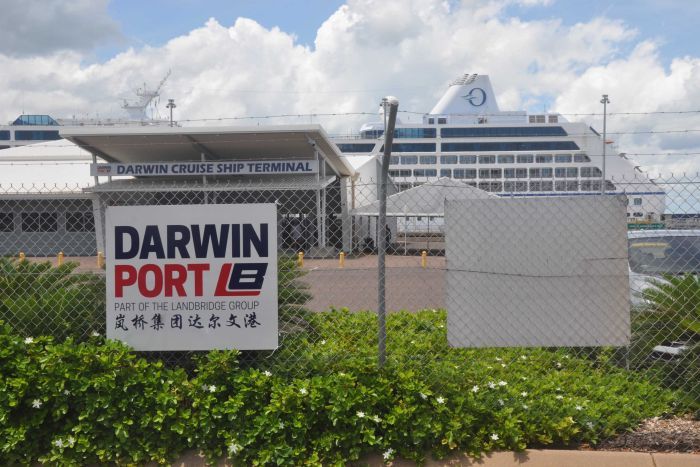
We wouldn’t be the first to have the idea. The Northern Territory Government has leased Darwin Port to the Chinese on a 99-year lease. This move has been criticised severely on account of its strategic implications, but the fact remains that Australia will get the port back after 99 years, the same way that the Chinese got Hong Kong back. So there is precedent, among other places faced with Chinese expansionism, to consider this option.

Some might not like the idea of selling the country into Chinese leaseholdership. They might reason that China is a human rights abuser, a corrupt, totalitarian dictatorship that strangles honest aspirations and which is incompatible with the Western desire for personal freedom.

However, these sentiments have to be balanced with the fact that the whole country is being sold into Chinese ownership anyway. Chinese nationals purchased $1,500,000,000 of New Zealand residential real estate in 2017 alone. Eight-figure sums are not uncommon for land purchases made by Chinese interests, many of which are owned in part by the Chinese Government.

Moreover, the old Western traditions of freedom are gone. Zimbabwe has legal medicinal cannabis, and Malaysia has announced that it will decriminalise it. New Zealanders are, therefore, less free than citizens of either Zimbabwe or Malaysia in important ways. Uruguay, South Africa, Chile, Mexico and even North Korea are further examples of countries with greater cannabis freedom than New Zealand. Our time as a human rights leader is long over.

Perhaps worst of all, New Zealanders are now going to prison for years for sharing videos, or getting harassed by the Police because they might like Donald Trump. There is ample evidence that we are no longer a free people, so there’s nothing to lose on that front.

Maybe it’s time to concede that it’s better to lease the whole country to China on a 99-year term today, get them to build some proper houses and infrastructure, and then to get it back in 2118, than to have it sold piece-by-piece into Chinese hands permanently. We would probably not suffer more under Chinese leadership than we already do under our own.

*

If you enjoyed reading this essay, you can get a compilation of the Best VJMP Essays and Articles of 2018 from Amazon for Kindle or Amazon for CreateSpace (for international readers), or TradeMe (for Kiwis). A compilation of the Best VJMP Essays and Articles of 2017 is also available.
Hate Speech Laws Will Lead New Zealand to Misery and Servitude

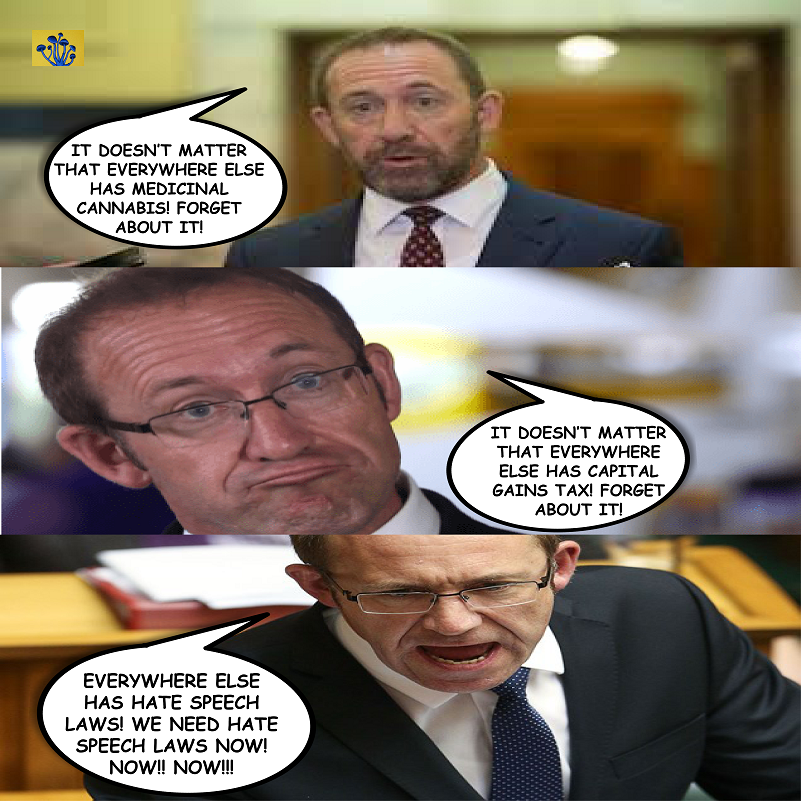
The Sixth Labour Government is in no hurry to change the cannabis laws, which has seen New Zealand fall behind Zimbabwe and South Africa in terms of personal freedom. This reluctant approach to liberty helps explain why Andrew Little is so enthused about bringing in hate speech laws. As this essay will show, hate speech laws will only increase the suffering of the New Zealand people – but that may be by design.

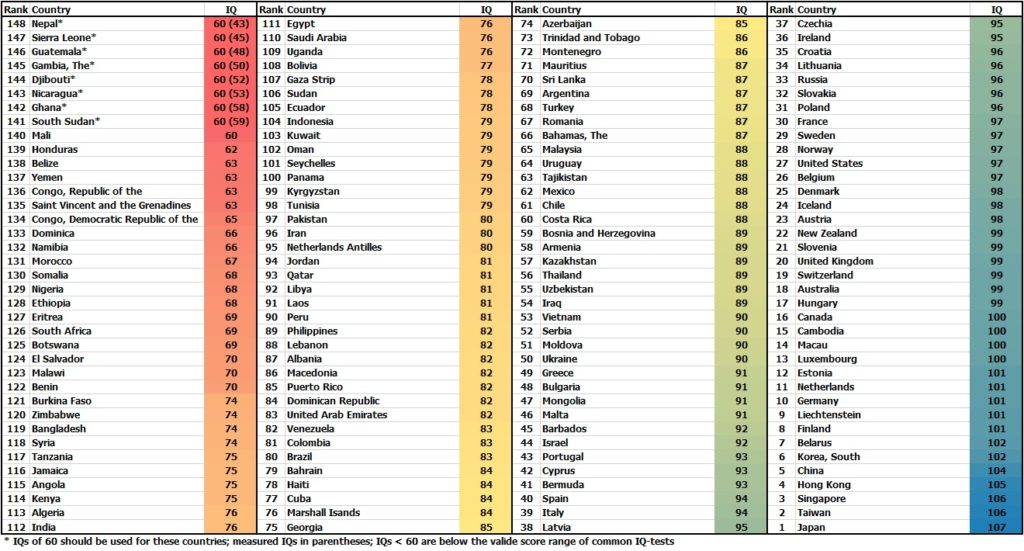
Last week, Danish politician Rasmus Paludan was sentenced to two weeks in prison for breaking the Danish hate speech laws. He received this conviction after speaking in a video where he said that the average IQ of South Africans was 70, and that this intelligence level was too low to properly run the country. The conviction was upheld on appeal.

The video of him saying this was available on the homepage of Paludan’s party, Stram Kurs, and someone who viewed it reported it to the Police (some readers will have already sensed a red flag here – yes, in Denmark you can rat other people out for racism, and they’ll go to prison if they’re found guilty of it).

What Paludan said about the IQ of South Africans is accurate, as shown in the table below, taken from Professor Richard Lynn’s latest book, The Intelligence of Nations. Accuracy and truth, however, will be no defence against a hate speech accusation. The case of Paludan shows that New Zealand risks losing basic freedoms to speak if we introduce hate speech laws.

The scientific facts suggest some unpalatable truths – now stating these truths is illegal in Denmark

If hate speech laws were introduced in New Zealand, we could expect to see headlines like “Don Brash/Brian Tamaki/David Seymour Convicted of Racism” as certain political statements became illegal. It might sound ridiculous, and the Government will deny it, but literal facts will become grounds to put people in prison. This is the inevitable consequence of bringing in hate speech laws.

As shown by Paludan’s example, it won’t matter if you can back up what you say with science. A bunch of politicians and their assorted arse-lickers, none of who have any background in the science of intelligence testing, will decide what you’re allowed to say and what you are not. The definition of hate will be entirely up to them, and they will choose the definition that best suits their interests.

In the judgment against Paludan, the judges decided that it was not illegal to say “neger” (c.f. ‘Negro’), as he does several times in the video. The fact that they considered the possibility, however, is telling. It exposes that such a prohibition is under consideration: there are many who would like to make it illegal to say certain words, or to state certain things.

Imagine a world where it’s a crime to say a word that your Government has forbidden you to say, or a crime to draw logical conclusions that your Government has forbidden you to draw. If you dare do either of these things, you have to go in a cage.

It sounds like the kind of law that might have been parodied by Monty Python or Comic Strip Presents as an example of cruel and unreasonable punishment. But it’s the world that we are heading towards if we let Andrew “The Ditherer” Little and his fellow short-sighted control freaks override our right to free speech.

Hate speech laws mark the death of free speech. Once they are introduced, eventually anything that goes against the Government’s agenda will be classified as “hate speech”. Saying things that are scientific facts, backed up by decades of research and by the experts in the field, will be classed as hate speech if they alert people to the failures of the Government.

The reason why the Government wants to make it a crime to point out facts – like the low IQ of Africans – is because they want to import cheap labour. They are in bed with the globalist corporations. They know that if we’re allowed to openly speak the truth about the effects of globalist immigration policy on the well-being of our nation, more and more people will come to resist that globalist policy.

Every globalist knows that a nation will sooner-or-later go down the toilet if it imports large numbers of people with an IQ of 70. But they don’t care about that. All they want is cheap labour so that they can extract a quick profit from New Zealand. Then they move on, and leave us to clean up the mess. This is parasite capitalism, and it’s the pre-eminent paradigm of our age.

Hate speech laws will lead to people getting sent to prison for pointing out scientific facts that the Government doesn’t want attention given to. They will also lead to a culture of snitching as the Government employs people to handle the complaints. The end result is an East Germany-style hell society plagued by snitches and secret police. We should resist the introduction of hate speech laws at any cost, on the grounds that they are a violation of our inherent human rights.

*

If you enjoyed reading this essay, you can get a compilation of the Best VJMP Essays and Articles of 2018 from Amazon for Kindle or Amazon for CreateSpace (for international readers), or TradeMe (for Kiwis). A compilation of the Best VJMP Essays and Articles of 2017 is also available.
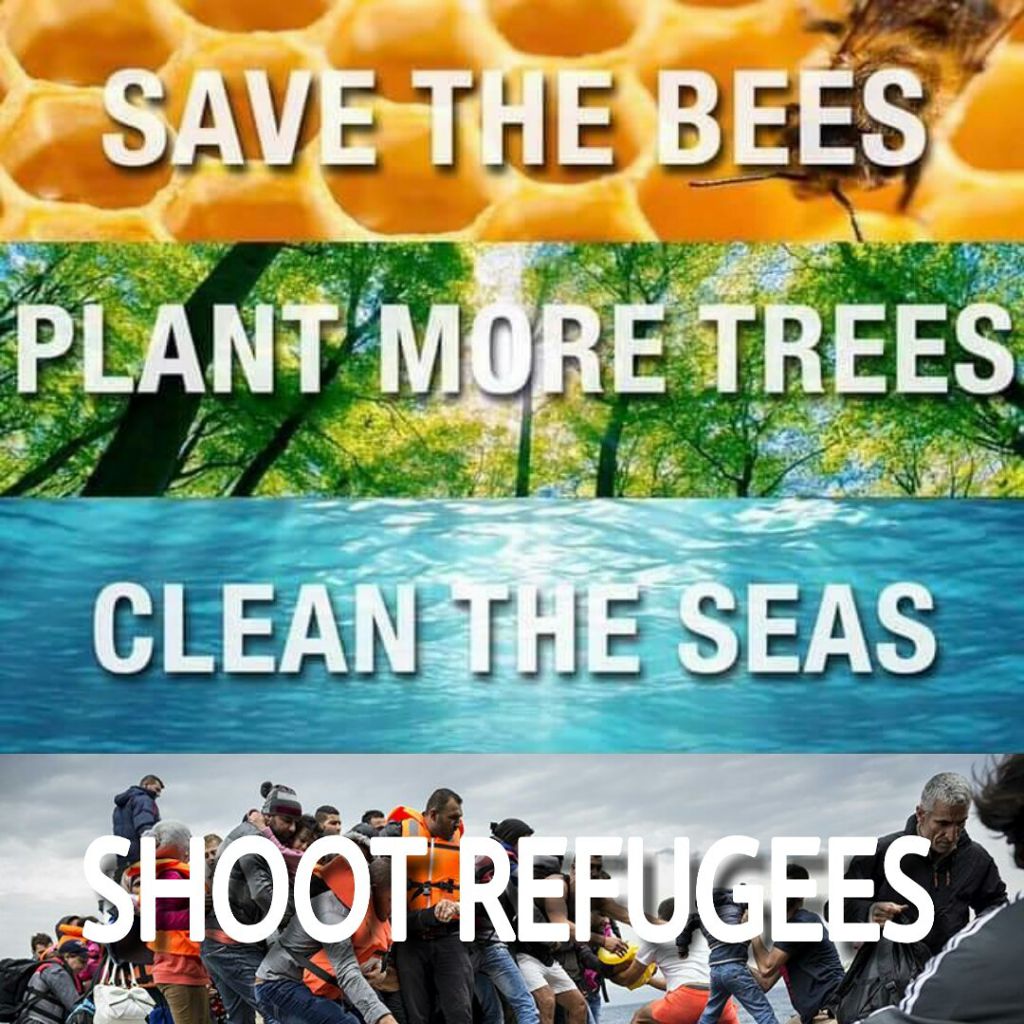
Is There Room For A Nationalist Green Party In New Zealand?

The Green Party of New Zealand, like the other Green parties of the West, is so closely associated with globalism that the two seem inseparable. This, however, doesn’t mean that environmentalist movements are necessarily globalist. In fact, as Dan McGlashan will examine in this article, a nationalist environmentalist movement might get even more support than a globalist one.

The Green parties of the West have grown to occupy a permanent place on the far left of the political spectrum. In New Zealand, the Green Party supports the current Government and is polling at around 5 to 6%. Incredibly however, the Greens in Germany – where the environmentalist movement began in earnest – are now the highest polling party. They could well climb from their current 26%.

There is one striking paradox about the Greens: despite being, on average, considerably wealthier than the average Kiwi, they claim to represent the poor and disadvantaged. The correlation between median personal income and voting for the Green Party in 2017 was 0.36, not that much less than for the National Party (0.49). Despite this, most of their rhetoric is aimed at helping the disadvantaged.

The poor who they claim to represent are not well served by the globalism that the Greens otherwise promote. Importing a great supply of cheap labour can only lead to the deterioration of working-class incomes, but the Greens flat-out deny this fact. The working-class individuals that the Greens claim to be representing, however, are well aware of the economic logic, which is why they are much more likely to vote New Zealand First.

The problem with all of the current Green movements in the West at the moment is that they are globalists. Many of them explicitly so. The logic is that the world’s environment is global, and environmental effects like pollution often cross borders. Because environmental problems are global, global solutions must be required. This means giving more power to, for example, the United Nations and its ancillary bodies.

The problem arises when the Green Party starts to forget whether globalism is a means to the end or the end itself. This can be seen when the New Zealand Greens introduce polices such as raising the refugee quota to 5,000. Such a policy can only bring great suffering to the New Zealand people, as evidenced by the results of similar policies in Europe.

It doesn’t make any sense, from an environmental perspective, to transport people from poor countries to rich ones, especially when those people are to live in the rich countries forever. That would entail that those people start consuming like people in rich countries do – great for the banks, terrible for the environment.

A more logical environmental perspective would reduce the refugee quota to zero. The $130 million this would save could then be used to grant tax-free status to the first $14,000 of every New Zealander’s income. Such a proposal would gain much more support from the working-class that the Greens claim to represent. However, a globalist Green party would never propose this.

If environmentalism is to continue to grow in support (as the current polling results from Germany suggest may happen), then the internal tensions within the Green movement might cause it to split. This would likely entail a split between the urban elites who form the core of the party loyalists (and who are much more likely to be globalists) and the working-class rural dweller who actually lives on the land (who are much more likely to be nationalists).

All of this suggests that there might be room in the electoral landscape for a nationalist environmentalist movement. Such a movement would be similar to that of the pre-existing Greens, but instead of being run by urbanites who place the emphasis on global solutions, it would be run by ruralites who would put the emphasis on local solutions.

This might involve focusing on local beautification programs, or revitalisation of threatened local ecologies. It might even involve collective labour efforts such as mass planting of trees. What it would mean more of is consultation with Kiwis and genuine grassroots movements, and what it would mean less of would be United Nations directives.

Any nationalist environmentalist movement would have to cope with being called Nazis by the globalist-controlled mainstream media. This would especially be true if they made the argument that opening the borders to the undeveloped world was a bad idea from an environmental perspective. It’s all but inevitable that the media would describe such concerns as a ruse to disguise racist sentiments.

However, there are ways around this.

Any nationalist environmentalist movement that would arise in New Zealand would have a high proportion of Maori support. The suggestion given above, to reduce the refugee quota to zero and make the first $14,000 of every Kiwi’s income tax-free, would benefit them heavily, on account of that a high proportion of Maoris are working-class. Their support would counter such accusations.

This hints at another point of divergence: a nationalist environmentalist movement might incorporate a return to native spirituality, celebrating Matariki and the solstices and equinoxes. This suggests an embrace of cannabis, because cannabis is a favourite not only of Kiwis but of the sort of Kiwi who cares about the environment.

They may have to go even further, and allow for the full-scale legalisation of psychedelics such as psilocybin and dimethyltryptamine. This would allow for a unique point of difference with the globalist environmentalist movement, because the United Nations is not at all interested in legalising psychedelics. It would also appeal to the rural voter who makes up a large part of such a movement’s likely target audience.

Environmentalist concerns will likely grow as the old unionism represented by the Labour Party continues to decline. If they become large enough in New Zealand, this will open up space for a nationalist environmentalist movement that appeals to those ignored by the globalism of the existing Green parties. Such a movement could become a major player in an age of mass refugee movements.

*

Understanding New Zealand, by Dan McGlashan and published by VJM Publishing, is the comprehensive guide to the demographics and voting patterns of the New Zealand people. It is available on TradeMe (for Kiwis) and on Amazon (for international readers).

The Conceit of Silver

Alchemically speaking, there are two great conceits – one lesser and one greater. The lesser one is known as the Conceit of Iron, and relates to the arrogance that comes with physical dominance. The greater one, generally speaking, comes with intellectual dominance, and is closely related to the concept of hubris. This essay will examine what is known as the Conceit of Silver.

Silver is the first of the two precious metals, and one arrives in the realm of silver once iron is sufficiently brightened. As one progresses up the alchemical scale, thought moves from the simple bipartite distinction of strong/weak to the new distinction of smart/dumb. As such, there are now two distinct kinds of weak: the dumb-strong, and the dumb-weak.

The Conceit of Silver is not the same thing as simply thinking one is smarter than everyone else, although it is related. If one is intelligent enough to dominate both attractive women and muscular men, it’s very easy to become arrogant. Possessing unusual intelligence can feel like a superpower, because it makes it much easier to create change in accordance with one’s will.

The problem is that silver, by itself, cannot make moral decisions. Intelligence is a great thing, but without wisdom it can only ever be directed towards fulfilling egoic desires. Without the capacity to feel empathy for other sentient beings, an individual cannot act to end the suffering of them. Such a person is unenlightened.

Without at least some of the element of gold, a person acting in the realm of silver will act to accumulate resources or to raise their social standing, not to reduce the suffering of other sentient beings. Much of the moral grandstanding that people of silver engage in claims to achieve the latter, while really achieving the former. It isn’t always clear how much of this is conscious and how much is unconscious.

The Conceit of Silver is, in short, the belief that higher intelligence, education or social standing makes one a moral authority.

This happens in two major ways: by thinking one is gold when one is silver, or by denying the existence of gold altogether. This is a very easy mistake to make if one is of the silver, because if one is aware of such, then it follows as a general rule that most of the rest of the world is baser. Generally speaking, others are dumber, and their desires short-sighted. But this rule does not always hold.

The classic example of the Conceit of Silver is when a person achieves a high position through scheming, inheritance or politics, and then assumes that they must possess a commensurate moral superiority. At its worst, this conceit can lead a person into thinking that their individual egoic desires are the same as the Will of God. Such a person can be extremely dangerous if in power.

The Conceit of Silver is that it assumes itself to be divine. Individuals prone to this conceit are apt to say things like “Intelligence makes humans unique from the rest of the animal kingdom,” inspired by their failure to appreciate the perspectives of others. This will usually reinforce a belief that intelligence confers moral authority, or, even worse, a belief that education or birth station confers moral authority.

In fact, there’s an argument that the only reason why intelligence evolved so prodigiously in the human animal is because our social structure allowed for an unprecedented degree of scheming, lying, backstabbing, cheating and all kinds of general skullduggery. From this perspective, intelligence could even be seen as a moral negative, a sign that one clings to material power.

Finding an example of the Conceit of Silver is easy. All it takes is to go to a university and to find a person who believes that they might be smarter than everyone else there. At any university, there will be plenty of them. In the absence of a university it’s only necessary to find a place where intellectuals gather, or even a professional association.

Almost invariably, when a person becomes intelligent enough, they start to assume that they are a moral authority of some kind. They start to conflate their understanding of how systems are with how systems should be. People who do this are not always wrong – understanding a system often does lead to an understanding of how that system could be optimised to minimise the suffering it causes. But that isn’t necessarily so.

It isn’t easy for an intelligent person to agree that their brainpower is not particularly valuable in comparison to wisdom. The majority of intelligent people make a living out of their brainpower by way of learning a valuable profession. It’s therefore very hard for them to set all of this silver aside, and to admit that possession of it doesn’t make someone a morally superior person.

It takes a mercurial sort of personality to admit that one’s intelligence, however vast, is not sufficient to conclude that one is fundamentally more valuable. That, despite being smarter, one might be of less value than a person of iron or clay if the right circumstances arose, or if one had the wrong moral direction. This element of mercury is necessary for the alchemist to successfully transition from silver to gold.

The truth is that gold is the most malleable of all metals, and that gives it one paradoxical quality: it doesn’t resist when claims to leadership are made by men of silver. Because silver is harder than gold, it’s usually possible for those of silver to force those of gold out of leadership positions by way of intimidation or verbal and social aggression.In today’s degraded age, this has taken place all over the world.

The universities, the religious and spiritual movements and the political movements have all been taken over by materialists pushing some irrational political ideology or other. The element of gold has been pushed to the peripheries, making it possible to ask whether we live in the Kali Yuga. The Conceit of Silver is everywhere.

*

If you enjoyed reading this essay, you can get a compilation of the Best VJMP Essays and Articles of 2018 from Amazon for Kindle or Amazon for CreateSpace (for international readers), or TradeMe (for Kiwis). A compilation of the Best VJMP Essays and Articles of 2017 is also available.