There has been some talk recently about a South Island independence movement, and the initial reaction of most has been to assume it is a joke. If one thinks about it rationally, however, it actually makes more sense for the South Island to become independent than for it to remain part of New Zealand. This essay will argue that North Islanders and South Islanders are a closely related, but fundamentally different people, and therefore that South Islanders ought to have the right to govern themselves separately.
There are five major reasons for this.
The first is legal. The mainstream propaganda tells us all that the Treaty of Waitangi was the founding document of the nation, and that this gave the British the right to settle here in exchange for Maoris being given the protection accorded to British citizens. Like most mainstream propaganda, this is a heavily North Island-centric viewpoint which ignores the reality of the situation for South Islanders.
The truth is that British sovereignty over the South Island was never asserted on the basis of the Treaty of Waitangi. Like Stewart Island, the South Island had so few people living on it that the British asserted sovereignty over it by right of discovery. This occurred on the 21st of May 1840, and is an undisputed matter of historical record.
If the Treaty of Waitangi was not why British sovereignty was asserted over the South Island, then it does not apply. Therefore, those of us who live on the South Island are not bound by it, and neither are we bound to the grievance industry (based on the American model) that has sprung up around it. The Treaty of Waitangi applies to the North Island only – legal recognition of this would require that the South Island becomes independent from New Zealand.
The second reason is historical, and relates to the first. The North Island and the South Island have developed in very separate ways since the first European settlement of these islands. The South Island was not really “discovered”, but, thanks to the efforts of Ngati Toa war chief Te Rauparaha, it was close to empty when settlement began. This meant that immigration from Britain was able to proceed without much of the cheating and swindling that characterised land purchase arrangement up North.
As a consequence, relations between Maoris and white people are mostly respectful on the South Island. There is none of the pointless shit-stirring and separatist hysteria that has poisoned race relations up North. On the South Island, white people and Maoris tend to see themselves and each other as equal participants in a collective battle against the elements and against the ennui inherent to life. North Islanders have a different, darker and more antagonistic history.
Furthermore, South Island independence will give us the chance to avoid the recent monumental historical mistakes of Europe and Canada (it is already too late for the North). We don’t want to become Brazilianised like the North Island, which is now little more than a patchwork of racial enclaves and ghettoes, utterly divided and conquered and incapable of self-determination. We want to keep our own historical character, and independence is the best vehicle to achieve this.
The third reason is cultural, and relates to both the first and the second reasons. The culture of the South Island is much more like large parts of Australia than it is like the North Island. After all, the North Island has by far the densest population of any state South-East of Indonesia with the exception of the ACT, whereas the South Island, like all Australian states (again with the exception of the ACT), is sparsely-populated.
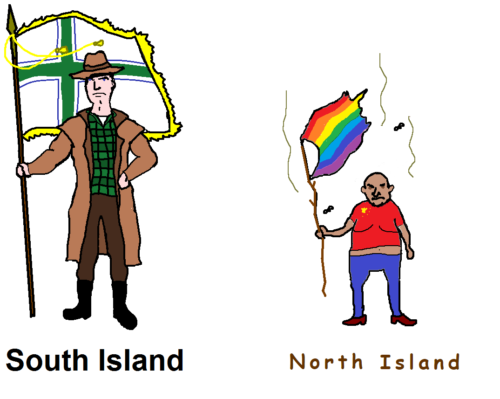
South Islanders aren’t city people. The thought of being crammed into tight suburbs like sardines being presented for consumption is alien to us. Even people who live in Christchurch get out of the city and into Nature most weekends. South Islanders look at the North and see “a greasy take away after the soul is gone”; North Islanders look at the South and see a terrifying, chaotic wilderness. Mentally, we are fundamentally different.
More difficult is the fact that neither Maoris or white people have the same culture in the North and the South. Te Rauparaha is a war hero on the North Island; on the South he is a genocidal maniac akin to Hitler, responsible for the extermination of many peaceful tribes around Nelson and Marlborough. North Island Maoris have a grievance culture where the white man is to blame for everything, whereas South Island Maoris just get on with life (and consequently become considerably wealthier, healthier and better educated than their North Island kin).
White culture is also significantly different. The colonists of the South Island are unrepentant; we don’t have ethnomasochists. Maoris are our equals and anyone who tries to split us apart with rhetoric about unsettled grievances can go fuck themselves. There are very few virtue signallers down here. North Islanders will spend all day crowing on FaceBook about how open-minded they are, and then go to parties where only white people are in attendance – we prefer real people.
The fourth reason is practical. The geography of New Zealand is such that it encompasses a wide range of different latitudes – from 34 in the North to 47 in the South. New Zealand is actually a fairly decent-sized country, roughly the same size as Britain, Japan and Germany, all of which have administrative subunits. The South Island is very poorly served by laws made in Wellington to suit Auckland.
For example, houses on the South Island ought to be built with a fair amount of insulation in order to be safe, but North Islanders write the New Zealand building code, and they did so mostly to suit Aucklanders. Moreover, laws that need to encompass a wide variety of people are sometimes necessary in the North and not on the South. People in the South Island have things in common with each other, such as a strong commitment to genuine environmental guardianship, and this cultural homogeneity must allow for a different degree of freedom.
The alcohol laws are another good example. The South Island has a strong and deeply entrenched cannabis culture. In Nelson, the West Coast and large parts of Dunedin and Christchurch, cannabis is more popular than alcohol. This newspaper has called for cannabis cafes on Bridge Street before, and will continue to do so. Many of us down South have moved on from pisshead culture – but the Wellington-based Government, beholden to major alcohol manufacturers based in Auckland, force cannabis prohibition on us anyway.
The fifth reason is purely selfish. The North Island, by itself, looks like a province of Brazil. The racial ghettoisation and segregation is so advanced that cities like Auckland and Wellington are starting to suffer from pronounced white flight. In the North Island, no-one knows their own neighbours, and there is no sense of community or solidarity. The North Island has no soul; it’s just 3.8 million people trying to make quick money by selling ever more expensive houses to each other.
The South Island has an excellent opportunity to jettison the greed-fuelled, no tomorrow thinking of North Islanders before it drags us down with it. Let’s keep our culture, let’s keep our soul. We don’t have to open the immigration floodgates just to prop up house prices and consumption; we can admit that neoliberalism has not delivered. Let the North Islanders have this insane, rape-the-planet ideology and suffer the consequences of it.
Not only would the South Island free ourselves from what is by any honest measure a failed society, but we could profit immensely from the fees that we would charge on electricity and agricultural produce, which the North Island is far from self-sufficient in. We would naturally keep the immigration channels open to North Islanders, especially Maoris and highly-educated people, but the insanity of letting in hundreds of thousands of Muslims and Africans – currently fashionable among North Islanders – would be avoided.
The details would remain to be worked out. Certainly this proposal will meet with some alarm in certain centres up North, especially those whose waste and inefficiency is subsidised by hard, honest work by Southern people. Nevertheless, the conclusion is inescapable: for both selfish and moral reasons, the South Island ought to break away from the North and become its own country.
SOUTH ISLAND PRAYER (for BT)
God
Don’t let me die in Auckland
Rotting in the heat before your
eyes are closed:a greasy take
away after the soul is gone.
Jessus,no
Let me go with the old southerly
buster:river stones in the grey
flecked sky and that white wind to keep your chin up.
Christ, yes.
– Owen Marshall
*
If you enjoyed reading this essay, you can get a compilation of the Best VJMP Essays and Articles of 2017 from Amazon for Kindle or Amazon for CreateSpace (for international readers), or TradeMe (for Kiwis).