Folksjälvmord

On my first visit to Sweden, from 2001 to 2003, I found occasion to coin a word in the Swedish language. They already had a word for genocide (‘folkmord’) and they already had a word for suicide (‘självmord’), but they didn’t have a word for the sociological phenomenon, widespread at the time, that combined both. This essay discusses ‘folksjälvmord’ and the reasons for it.

If you have 1,000 crowns in one bank account at 6% interest, and 100,000 crowns in another bank account at 2% interest, inevitably the first account will become larger than the second (assuming no withdrawals or changes to the rate). This is a matter of mathematical certainty, and can be proven true in every case where a smaller balance has a higher interest rate than a larger balance. No-one disputes this.

By similar reasoning, we can see that if the population of a minority group is increasing faster than their host population, then the minorities will eventually outnumber their hosts. Assuming no withdrawals (i.e. deportations or genocides), then a population that has a fertility rate of 3.0 plus 50,000 immigrants per year will eventually grow to overwhelm a population that starts out a hundreds times larger, but which only has a fertility rate of 2.0 or less (and no immigrants).

This process is known straightforwardly as “conquest” in any other context, but when the host population has an overwhelming military advantage compared to their invaders it isn’t so simple. If the hosts are willingly paying tax money to import these minorities, and then paying again to have those minorities breed while on welfare, then they’re effectively paying for their own ethnic cleansing.

This process can only be likened to a collective suicide, or suicide at the level of the population – folksjälvmord. After all, politics is little more than the expression of power, and the expression of power is mostly a numbers game, particularly in a democracy. If the host population stops being the majority then they give up power, and giving up power within your own country to a foreign entity that you imported can only be analogised as stabbing oneself in the leg or stomach, perhaps harakiri style.

Swedes didn’t think much of my witty neologism. The thought that it might happen to them seemed to be so unpleasant that it simply couldn’t be countenanced. It didn’t seem to matter to them that the same process of inevitable mathematical conquest was precisely what happened in the New World, where I came from. Better to simply blindly believe that all would be well than to ask how the Africans and Muslims would behave when they comprised 20%, 30%, 40%, 50%+ of the population.

This wilful, oblivious ignorance about the state of their situation might be likened to a delusion-based psychiatric illness, in the same way that someone who is obviously dying but who refuses to admit it.

A man addicted to heroin doesn’t want to hear that the drug will soon kill him; a nation addicted to virtue-signalling and self-righteousness doesn’t want to hear that the mass importation of foreigners with incompatible values will soon destroy them. In either case, a well-meaning observer might be well aware that the behaviour in question was effectively suicidal.

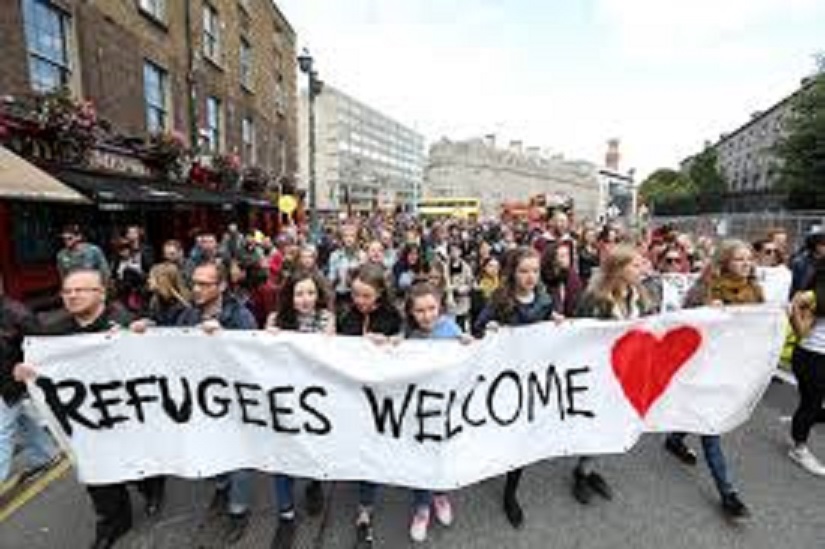
Sixteen years after this first visit of mine, it’s possible to observe the results of the practice of folksjälvmord. Although the decay of the country is yet to reach the elites – and therefore, yet to be officially acknowledged – the Swedish people are certainly aware of it. They responded by giving 18% of their votes to the far-right extremist Sweden Democrats in a General Election last month.

In Germany, which has also recently imported a large number of low-IQ immigrants, a similar phenomenon can be observed. Opinion polls for the next German Federal Election show that the far-right extremist Alternativ fuer Deutschland is now polling higher than the Establishment social democrats. This phenomenon is likely to spread to other nations that let in large numbers of “refugees” against the better judgment of the more sober of their citizens.

Folksjälvmord, then, doesn’t simply refer to a declining population, because populations (historically speaking) tend to resist conquest with as much violence as they can muster. It can also refer to the coming to power, within a nation, of groups of people who are patently unfit to rule, and who wreck the place. Folksjälvmord could, in that context, be considered a symptom of a dark age, or Kali Yuga. The destruction is as much internal, and spiritual, as external and physical.

The state of the world has notably changed since first coining the term ‘folksjälvmord’. The national suicides of the European nations are continuing apace – but now the Far East Asian ones have joined them. Indeed, the fertility rate in Far East Asia is now lower than Northern Europe (China 1.6, Japan 1.4, South Korea 1.2, c.f. Sweden 1.9, Netherlands, Denmark and Norway 1.7), and is continuing to fall there.

Perhaps the most frightening realisation is that folksjälvmord is far from a uniquely Swedish, European or even Western problem. It seems to be a natural part of the ebb and flow of empires and the golden ages of various peoples: as before, so after.

*

If you enjoyed reading this essay, you can get a compilation of the Best VJMP Essays and Articles of 2017 from Amazon for Kindle or Amazon for CreateSpace (for international readers), or TradeMe (for Kiwis).


VJMP Reads: David Seymour’s Own Your Future X

This reading carries on from here.

The ninth chapter in Own Your Future is ‘Personal Responsibility’. Seymour opens here with a stark claim that ACT doesn’t believe in the nanny state or in a paternalistic government. Many of our laws are holdouts from an age of Victorian values, he states, and they are enforced by politicians who transparently do not have a deeper grasp on morality than anyone else.

Breaking rank with the other Parliamentarians, Seymour is willing to admit here that cannabis does less harm than alcohol and tobacco (although he points out that cannabis is not without its own harms). He also echoes a point often made by Kiwi cannabis law reform activists (such as here), that the burden of Police enforcement of cannabis prohibition falls mostly on Maori.

Seymour cites a Treasury study that estimated that cannabis prohibition costs the country $300,000,000 annually, as well as tying up 600,000 hours of Police time. Worst of all, the supposed criminal deterrence doesn’t even work – the overwhelming majority of people convicted for cannabis offences go on to use it. Moreover, the law is applied in a haphazard manner, as can be seen by the 26-month sentence initially handed down to Kelly van Gaalen.

In a distinct break from the right-wing that ACT is usually associated with, Seymour repudiates the moralising that is chiefly responsible for cannabis prohibition, pointing out that not only is there a heavy majority in favour of cannabis law reform, but that majority is steadily growing. This contrasts with the proportion of people who oppose actual crimes, such as murder – this proportion remains constant.

True to the libertarian image that Seymour is trying to stake out, he argues for legal recreational cannabis as well. However, true to the conservative streak that binds his party to National, he is torn, claiming that 80% of the New Zealand public opposes recreational cannabis. He does not cite a source here, and neither does he note that such opposition would be unusual in the context of places like Colorado and California voting by referendum to legalise medicinal cannabis.

Seymour takes pains to seat himself as immovably as possible, right in the middle of the fence. He is open to the possibility that countries that legalise cannabis might “lose their morality” and “become cesspits of unmotivated human squalor” (as if alcohol was not well capable of achieving both), and wants to have a Royal Commission that takes five years before he will consider that we have satisfactory evidence to make a decision.

He rightly pillories the Government for its sharp increase in the tobacco tax, pointing out that the people most sharply affected by this are those who can least afford it. Worst of all, it seems that raising the tax further will not help persuade people to give up smoking. Those who are still addicted are so addicted that they will do almost anything to get hold of tobacco. Sensibly, Seymour would legalise vaping and e-cigarettes.

Euthanasia is another thing that Seymour would legalise, promising an end to “morality-based harassment”. His reason for promoting this is to avoid the indignity of the last weeks of life. Having nursed elderly grandparents to the end of a terminal illness, I can commiserate with him in this regard. He is also in favour of abortion, which makes him less hypocritical than the old right. Seymour doesn’t want to pay for your kid either, but he’s happy to help you get it aborted.

It’s hard to find fault with any of Seymour’s proposals in this chapter. Even if the only right he champions with conviction is the right to die, it’s an excellent thing that these libertarian proposals are even being suggested. It is interesting to note how similar ACT is with the Greens on issues such as cannabis, especially if it is considered that being young is highly correlated with both voting ACT and Green.

*

If you enjoyed reading this essay, you can get a compilation of the Best VJMP Essays and Articles of 2017 from Amazon for Kindle or Amazon for CreateSpace (for international readers), or TradeMe (for Kiwis).

The Case For Cannabis: Cannabis Is An Alternative to Booze

Alcohol is great fun – but it also has its downsides. Severe downsides. Violence, sexually transmitted diseases, mental disorder and verbal abuse: when the booze goes in, it all comes out. This essay will argue that the downsides of alcohol are severe enough that we ought to be permitted a recreational alternative in the form of cannabis.

The downsides to widespread alcohol use are considerable. The New Zealand Police Manager’s Guild Trust states that “alcohol is present in about 30 percent of family violence incidents they attend,” and according to the study The Burden of Death, Disease and Disability due to Alcohol in New Zealand, 3.9% of all deaths in New Zealand can be attributed to alcohol.

Any Police officer, emergency nurse, heart surgeon, barman, oncologist or taxi driver could give you supporting evidence. We are doing tremendous damage to ourselves on a daily basis through widespread consumption of a drug that has a number of highly toxic side-effects. The bashings, the rapes, the bodies wrecked in traffic accidents represent a great deal of human suffering – and we’re not given a recreational alternative.

Alcohol brings a great deal of joy, of course, which is why it should not be banned. The anti-depressant effects of being able to have a good time with friends is incalculable, even if one can measure the physical damage in dollars. Ultimately, we cannot say that any action that causes us to enjoy life without harming anyone else is immoral, and most alcohol use falls into that category.

However, much of it doesn’t. For those of us who do not wish to participate in the weekly debauchery, violence and chlamydia-fest that is the New Zealand alcohol culture, there should be a recreational alternative.

In Amsterdam, where recreational cannabis is effectively legal and sold openly from “coffee shops”, we can get a glimpse of what a cannabis-based recreational alternative to alcohol might look like. On the Rembrantplein on any sunny day, one can see a park full of people peacefully smoking cannabis, with no violence or disorder. This is not just because Dutch people are well-behaved (because Dutch people chimp out on booze much like anyone else) – it is more that non-violence goes hand-in-hand with cannabis use.

The fact is that cannabis is a relaxant and a pacifier, and it tends to make people more quiet rather than boisterous. So one of the best things about repealing cannabis prohibition is that it would give people a recreational alternative to alcohol. This means that anyone wanting to relax and unwind on the weekend wouldn’t be forced to partake in the culture of a drug that was associated with violence.

Indeed, it can be observed that rates of sex and violence crimes decrease in the wake of cannabis legalisation. This has been observed in the American states that legalised recreational cannabis since Colorado was the first in 2014. The obvious explanation for this is the vastly different effects that cannabis has on human behaviour compared to alcohol.

This is of utmost importance to those who are not compatible with alcohol, for whatever reasons. Many people know that they are not well-suited to drinking alcohol, because they tend to end up in trouble with the Police. When fully sober, many people can tell you that if they start drinking they will start fighting. But there’s no recreational alternative.

Legal cannabis would allow people to have options when it came to unwinding and having a good time. If they didn’t want to get messy they would be able to simply go to a cannabis cafe, and get blazed and talk some shit without the risk of violence.

Of course, the fact that cannabis is an alternative to booze is one reason why it’s suppressed. It has been demonstrated previously that political parties are soaked in donations from the alcohol industry, and that the purpose of those donations is to incentivise the politicians to vote against cannabis law reform. In other words, alternatives to booze mean lower profits for the booze industry.

This shouldn’t prevent the correct actions from being taken. Ultimately, the best option is to legalise cannabis so that there is a recreational alternative to alcohol. Those who are compatible with alcohol can drink alcohol, and those who are not have the option of using cannabis to unwind. This is much fairer and safer method of dealing with people’s recreational needs than by forcing them all to drink booze.

*

This article is an excerpt from The Case For Cannabis Law Reform, compiled by Vince McLeod and due for release by VJM Publishing in the summer of 2018/19.

Te Reo With Mnemonics: Parts of Language Words

Word – kupu

An old woman walks up to a box and says “Eh, you words shouldn’t be cooped up in that box.” She opens the box and hundreds of words come out.

Sentence, Saying – rerenga kōrero

A woman reads from a piece of paper: “Rare anger, core ear? This sentence doesn’t make any sense!” The man next to her, who has apple cores for ears, gets angry. It’s a rare anger, core-ear.

Paragraph – kōwae

A boy is writing on a piece of paper, and a second boy reads the paper, and says “Paragraph, paragraph, paragraph.” The first boy says “Go away”.

Consonant – orokati

Two canoes are racing. One is covered in consonants and the other is covered in vowels. One of the rowers in the consonant canoe is a cat, and his partner says “Oh, row, catty!”

Vowel – oropuare

Two canoes are racing. One is covered in consonants and the other is covered in vowels. One of the rowers in the vowel canoe is a very wealthy-looking man, and he says to his partner “Oh, row, Poorer!”

Language – reo

A man says to a cat “Hey, do you speak human language?” The cat replies “Rrreoo!”

The Maori word for ‘lower-case’ – pūriki – shares a p-r-k construction with the English word ‘pork’

to spell – tātaki kupu

On a tarry road covered in tacks, there is a chicken coop. It is the tar-tacky coop. In it, the chickens are busy spelling out words.

to define, Definition – tautuhi

A schoolteacher asks a boy “Can you define the word for the class?” The boy says “Totally!”

Letter (lower case) – pūriki

A lower-case letter is being filmed doing a cooking show. It adds some meat into a frypan and say “This is the case of pork.”

Letter (upper case) – pūmatua

A bunch of upper-case letters are spectating a boxing photo shoot. The bout is between an Argentinan rugby player (a Puma) and David Tua. In upper-case letters above the shoot spell out: “P U M A – T U A

Alphabet – arapū

A man says “Hey I composed a rap. It’s about the alphabet.” The man raps off A-B-C.

Phrase – rerenga kupu

Two men watch a chicken coop in which the chickens are angry and fighting. One says “That’s a rare anger coop.” The other says “You know the phrase: it’s a cold winter when you have a rare anger coop.”

*

The above is an excerpt from the upcoming Learn Maori Vocabulary With Mnemonics, by Jeff Ngatai, due to be published by VJM Publishing in the summer of 2018/19.