
The Case For Cannabis: Drugs Are Not Categorically Bad

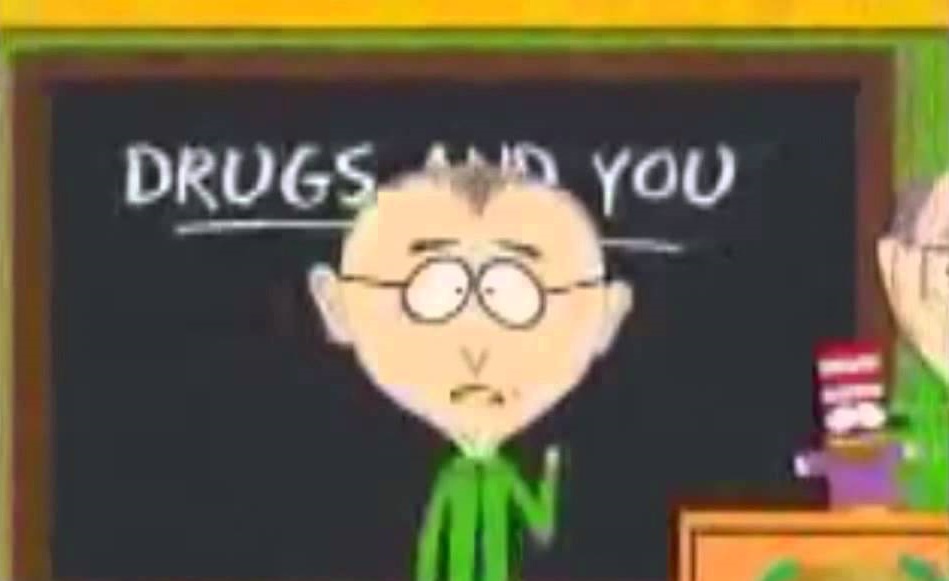
“Drugs are bad, mmmmmkay?” goes the South Park joke. Mr. Garrison’s catchphrase satirises the near-total absence of thought that the Establishment has put into their anti-cannabis rhetoric. The idea is that drugs are bad, and cannabis is a drug, therefore cannabis is bad, and therefore cannabis prohibition is justified. As this article will examine, it’s not that simple.

The popular conception of what the word “Drugs” means is highly variable. Some people consider any foreign substance taken into the body to be drugs. Other people say that anything not prescribed by a doctor is drugs; once it is prescribed it magically becomes medicine. Still others contend that drugs are anything that are bad, and anything not drugs is good.

The kind of person who makes the argument that drugs are categorically bad is usually the sort of person who is obsessed with purity. Inevitably they are a wowser of some kind, and they fit into two categories: the first some kind of physical health freak, the second some kind of religious freak. Their belief is that cannabis disrupts physical and spiritual health, respectively.

The physical truth about many drugs, like most substances that one could put into the body, is that healthy and unhealthy use is a primarily a matter of dosage. The most obvious example is salt, where too much or too little will leave a person in poor health. Some might counter here that a lack of cannabis will not make someone sick, but that’s not true in many medicinal cases.

Another example is amphetamines. There are many amphetamines that are basically the same substance as what one finds in ADHD medicines – in other words. The major difference is that the crackhead takes it in much, much heavier doses than what a doctor would recommend.

A small amount of cannabis will not hurt a person, unless they are extremely sensitive to smoke or similar. In fact, a small amount might greatly help a person, especially if they suffer from one of the hundreds of different conditions that cannabis is known to treat. By the same token, smoking a hundred joints a day will be bad for you almost without a doubt.

In any case, the fundamental point is that this argument is misdirected. If a particular dose of a particular substance is bad, then don’t use it. It’s a simple as that!

It’s possible that a blanket admonition against drugs along the lines of “drugs are bad” is a good idea if you are a parent speaking to a ten-year old child. Someone without the mental sophistication to make good decisions might need it. But it’s no basis for a national law that governs young and old alike.

Adult citizens are not like children, and need to be spoken to honestly. The positive and negative effects of all drugs need to be spoken about honestly, and the citizens need to be informed with reference to reality and science. If this does not happen, then the risk arises that those citizens lose trust in doctors and Government officials, and then movements like the anti-vaxx one start to crop up.

Cannabis should not be illegal because “drugs are categorically bad”. This is a child’s logic, and it should not be informing the national cannabis policy. We need to move on from these simplistic thought patterns, because they do not describe the reality of the situation, and absent that people cannot make correct decisions.

*

This article is an excerpt from The Case For Cannabis Law Reform, compiled by Vince McLeod and due for release by VJM Publishing in the summer of 2018/19.


VJMP Reads: Ted Kaczynski’s Unabomber Manifesto VII (fin)

This reading carries on from here.

The next chapter in Industrial Society and Its Future is ‘Two Kinds of Technology’. Here Kaczynski works to counter the argument that technological progress is so inevitable that revolutionary efforts are futile.

First, Kaczynski distinguishes between two different scales of technology. Small-scale technology is different to organised-scale technology. The former is technology that can be used by communities without outside help, such as simple crafting or metalsmithing. This kind of technology can survive a collapse of the industrial system, unlike (e.g.) refrigerator manufacturing.

Because organised-scale technology is dependent on other organised-scale technology, any collapse of the industrial system would take centuries to rebuild, if it ever happened. In any case, there’s no guarantee that a medieval society would even develop an industrial system again. It didn’t happen in India, China or the Middle East. It is therefore still worth opposing organised-scale technology, even if opposing small-scale technology is meaningless.

The final section in this manifesto is titled ‘The Danger of Leftism’. Kaczynski exhorts anti-technology revolutionaries to take a resolutely anti-left stance from the beginning, otherwise they will get co-opted. Leftism is incompatible with freedom, because it is collectivist and seeks to bind the entire world into a single whole. Because collectivism is only possible with technology, leftists will never really support it.

Some leftists claim to oppose technology, but they only do so as long as that technology and the system is in the hands of non-leftists. Much like censorship and academic freedom, whether or not leftists support it depends on whether or not they are in charge. They cannot be trusted because they will double-cross anyone they work with.

For many people, leftism fills the same psychological niche filled by religion. The leftist needs to believe in it. Kaczynski notes here that leftists are driven by a compulsion to impose their beliefs onto everyone. “Everything contrary to leftist beliefs represents Sin.”

Leftists seek power through identification with a social movement; helping that movement attain its goals helps satisfy that leftist’s power process. However, the desires of the leftist are infinite. They are not satisfied with anything; they demand total control. “…as long as anyone harbors in some corner of his mind a negative attitude toward some minority, the leftist has to re-educated him. And ethnic minorities are not enough; no one can be allowed to have a negative attitude toward homosexuals, disabled people, fat people, old people, ugly people, and on and on and on…”

The leftists will never stop until they have complete control. Even if you gave them everything they wanted, they would soon want more. Ultimately the leftist is not motivated by good, but by the desire to fulfill their will to power by imposing it on society. Most leftists are driven heavily by the desire to impose their own morality on everyone else. Individual tendencies towards liberty don’t change this general trend.

Identifying the leftist is not difficult. They inevitably identify with the victim, and with the collective. They tend to be against individualism, competition and violence, although they readily find excuses for violent leftists. “Maybe the best diagnostic trait of the leftist is his tendency to sympathize with the following movements: feminism, gay rights, ethnic rights, disability rights, animal rights, political correctness.” (a previous article here would describe them as horizontalists.

The manifesto ends with a number of footnotes; there is no conclusion or summary. The reader is left with the feeling that Kaczynski was an extremely intelligent man who saw very deeply into the nature of reality, but who was not necessarily able to pull everything he knew into a coherent worldview, perhaps on account of some psychological disturbance.

This may have been a result of Kaczynski’s apparent lack of spiritual belief. Many of the problems he attributes to the techno-industrial system could just as well be argued to be problems with materialism. Yet, the absence of spiritual knowledge and the consequences of this are not addressed by Kaczynski. It could be said that Kaczynski, despite his immense insight, was fighting his own shadow to a large extent, in the form of materialism.

*

If you enjoyed reading this essay, you can get a compilation of the Best VJMP Essays and Articles of 2017 from Amazon for Kindle or Amazon for CreateSpace (for international readers), or TradeMe (for Kiwis).

Chains of Gold

Previous articles here discussed the difference between chains of iron, which are physical chains that bind the body, and chains of silver, which are psychological chains that bind the mind. There’s a third kind of alchemical metal that can be used to bind humans: gold, which binds the will.

Much like the other chains, anybody enslaved by chains of gold is the slave of the creator of those chains of gold. A person who has enslaved another with chains of gold has not just enslaved their body or mind, but their very spirit. The difficulty is that it’s not always apparent that chains of gold have been placed around a person, because the spirit cannot be sensed by outsiders (at least not directly).

The frightening part is that chains of gold are the most fundamental of all. A person enslaved by chains of gold can be enslaved by chains of silver and then by chains of iron, as a matter of course.

Chains of gold lead quickly to chains of silver. Once a person has been confused spiritually, it’s possible to get them to believe all manner of political insanities, because they will have no accurate moral compass with which to resist them. It will be possible for them to borrow against their children’s inheritance, because they will have lost their connection with such thing. They will fear death, and it will be possible to threaten them.

Chains of silver also lead quickly to chains of iron. The most obvious way is through debtor’s prisons, or through having one’s physical property repossessed to pay debts. Once a person’s mind is tricked, it’s easy to steal from them without them even realising. So we can see that losing touch with God puts one at risk of losing all other freedoms.

There are two elements to slavery by gold. The first is that a person’s natural knowledge of God must be disrupted in some way. The second is that a person must be induced to believe lies about God.

Included in this first element are all the legal prohibitions restricting the natural pathways to discovering God through entheogenic drug use. Because drugs such as cannabis and psilocybin can cause a person to draw closer to God, part of enslaving someone in the realm of gold involves restricting access to these substances, so that they are more deeply and thoroughly enmeshed in the illusion of the material.

Make no mistake: the purpose of drug prohibition is to enslave people by denying them the natural avenues for learning about God. This slavery is what makes chains of silver possible. Denied their natural avenue for learning about God, most individuals will fall deeply into the illusion of materialism, and will consequently come to desire material possessions and pleasures, indifferent to the long-term consequences of this on their happiness.

Also included in this first element are the promotion of ideologies that leave no room for God, like materialism, scientism or racialism. These are promoted as part of the idea that this world is all there is. Forced materialism is the most obvious example of how modern people are enslaved by chains of gold, because it leaves no room for a plausible explanation of consciousness.

The second element refers to lies told about God. This usually takes the form of brainwashing into believing a particular religion, in the guise of that religion being a pathway to meet God, such that the brainwashing victim comes to believe that they know certain things to be true about God. Because God is more fundamental than information, nothing about God can be known, and therefore anything that anyone thinks they know is delusion.

For example, a person who has been brainwashed to believe that only by grovelling before a Catholic priest can he find absolution is doomed to suffer forever. He will always look for absolution outside of himself, and will never find it. He is enslaved by chains of gold, and his Catholic enslavers will use that to extort money and labour out of him.

Likewise, a person who has been brainwashed to hate homosexuals will soon find himself weighed down by chains of silver, because his social and economic opportunities will be restricted if it is widely believed by his fellows that he is irrationally prejudiced. This may lead to chains of iron if he gets into debt or commits a crime on account of that prejudice. This also goes for people who believe that God is masculine, or that “salvation is of the Jews”, or that God hates fornication/music/singing/dancing etc.

A person who is weighed down by chains of gold will feel that only by way of their particular religion can a person find absolution. This is true whether their religion is Abrahamism or materialism, and they will feel terror at all other possibilities. They will feel terror at the thought of anyone opposing their religion, and they will fight to defend it out of fear, just like any Roman Empire auxiliary fights out of fear of future punishment.

Whoever controls the chains of gold can then induce submission through the threat of having that person excommunicated, or by knowing more about the particular religion and becoming a trusted moral authority (a “Man of Gold”).

Chains of gold are the ultimate way of enslaving a person, because they enslave a person’s very soul, separating them from God and making them fear death and the world beyond. With the soul enslaved, enslaving the mind and then the body are very easy. The vast majority of Westerners bear chains of gold, and it’s the main reason for our dire state.

*

If you enjoyed reading this essay, you can get a compilation of the Best VJMP Essays and Articles of 2017 from Amazon for Kindle or Amazon for CreateSpace (for international readers), or TradeMe (for Kiwis).

The Case For Cannabis: Prohibition is a Waste of Money

People often talk about cannabis prohibition as if it was just a law and that was that. The reality is that enforcing cannabis prohibition not only costs a large amount of money, but it also prevents a large amount of money from being made. As this article will argue, cannabis prohibition is a colossal waste of money, so much so that it’s worth repealing it on that basis alone.

The cost of cannabis prohibition is close to half a billion dollars a year. This is comprised of two groups of costs: the direct cost of enforcing prohibition, and the opportunity cost of prohibition.

The direct cost of enforcing prohibition chiefly includes prison costs, court costs and Police costs.

According to an estimate made by the New Zealand Treasury, New Zealand spends about $400,000,000 dollars every year on enforcing cannabis prohibition, and is missing out on $150,000,000 of GST on cannabis sales. This means that, according to the New Zealand Government itself, the opportunity cost of enforcing cannabis prohibition is over half a billion dollars a year.

A study by Harvard economist Jeffrey Miron estimated that the American federal government spends USD8,700,000,000 annually on enforcing cannabis prohibition. Adjusted for population size and currency, this suggests that something in the range of $200,000,000 is spent annually in New Zealand to enforce cannabis prohibition (this includes court and prison costs as well as Police costs).

Potentially much greater than this is the opportunity cost of prohibition.

The Miron report linked above suggested that America loses a similar amount from taxation opportunities to what it loses from having to pay to enforce prohibition. Converted to the scale of New Zealand, that suggests that around $200,000,000 in potential tax revenue from legal cannabis sales are instead funnelled into the pockets of criminal gangs.

Other studies suggest similar figures. According to Shamubeel Equab, who wrote a report commissioned by the New Zealand Drug Foundation, up to $240,000,000 could be claimed in tax annually from a regulated drug market.

This is supported by other calculations. The state of Colorado, with a similar population to New Zealand, sells $2,000,000,000 worth of cannabis a year. If a similar amount was sold in New Zealand, that would mean that $300,000,000 of GST would be collected on it.

So, as mentioned earlier, the combined cost of all of the aspects of cannabis prohibition is about half a billion dollars per year.

This is a lot of money for something that arguably has no benefit at all. Even if one charitably conceded that a majority of people wanted cannabis prohibition (they don’t), or that cannabis prohibition prevented a significant amount of cannabis getting into the hands of young people (it doesn’t), $400,000,000 is a great deal of money, especially when considered on an annual basis. It’s about $150 a year for every taxpayer.

Had the Fifth National Government legalised cannabis at the start of their term in 2008, New Zealand would have already saved at least $4,000,000,000. The asset sales campaign run by the National Party raised barely more than this, and that was at the draconian cost of losing ownership of these assets forever.

It sounds incredible, but it’s hard to deny the maths. If the Fifth National Government had legalised cannabis instead of selling state assets, they would have raised almost the same amount of money – without losing ownership of the assets. They sold the country out from under us for effectively nothing.

Worst of all is that New Zealand is borrowing money from overseas sources to pay for the deficits that we’re running in order to finance this prohibition. So not only did we not save $4,000,000,000, but we’re paying interest on those billions – just to imprison our own young people for growing medicinal plants.

Cannabis prohibition should be repealed because it simply isn’t worth the money. The total losses to the New Zealand economy from cannabis prohibition cannot be justified – even if it was charitably conceded that there was some benefit to prohibition. It would be much better to make cannabis legal, which would save hundreds of millions currently wasted on enforcement, as well as gathering hundreds of millions in tax revenue.

*

This article is an excerpt from The Case For Cannabis Law Reform, compiled by Vince McLeod and due for release by VJM Publishing in the summer of 2018/19.