

The Case For Cannabis: Cannabis is Not Addictive

One of the most common arguments against cannabis is that it is an “addictive drug”. People making this argument raise images of zombie-like addicts burgling houses and selling their bodies in dark alleyways for the money to finance their addiction. Leaving aside the fact that this fear-mongering is bollocks, the argument isn’t even accurate.

The scientific literature warns us of “irritability, anxiety, decreased appetite, restlessness and sleep disturbances“, sleep problems and “a constellation of behavioral, somatic, and mood symptoms.” It’s clear that to stop using cannabis often means that one encounters these problems, but they soon go away. People enjoy using cannabis, but use alone does not count as addiction.

Psychology Today ran an article that stated “The vast majority of those who use marijuana do so occasionally and exhibit no addictive symptoms — no increased tolerance, no cravings and no withdrawal. In other words, they can take it or leave it.”

It’s true that cannabis does not cause meaningful physical addiction. Something that’s really addictive is alcohol. Withdrawals from alcohol are known to cause delirium tremens, a phenomenon known as “the DTs”, which can kill the sufferer. If this is considered an acceptable side-effect of a recreational drug, then the physical addiction potential of cannabis is nowhere near objectionable.

The counter-argument to this is to say that cannabis can still be psychologically addictive. Psychological addiction is a kind of excessive habituation, where a person does not become medically ill but who can suffer “psychological symptoms like anxiety, mood swings and depression”.

At this point, another frightening image is formed. Here, instead of burglars, the stereotype is of slovenly, morbidly obese videogamers who lie around all day drinking Mountain Dew, completely without ambition aside from securing their weed supply, all social bonds long since abandoned in favour of the next puff.

The reality is that it’s not so much a matter of cannabis being addictive, as that people who do not have adequate levels of stimulation search for anything they can to fill the gap, and cannabis fills the gap. Anyone who smokes cannabis every day can tell you this – it’s frequently a matter of having nothing better to do.

As was demonstrated by the Rat Park experiments carried out by Professor Bruce Alexander, addiction is a function of both available addictive substances and a lack of environmental stimulation.

The Rat Park experiments showed that rats that lived in a stimulating and interesting environment, where a variety of exercise, food and mating opportunities were available, were up to 19 times less likely to consume water laced with morphine when compared to rats that lived in a standard laboratory cage. Given that rats are also social (or at least semi-social) mammals, this can teach us some things about the nature of addiction in humans.

The fact is that human society of 2019 has left some people behind to die, and for these unfortunate masses there is not a lot of pleasant stimulation to be had. Some of these people turn to alcohol to fill the gap, some turn to opiates, some turn to tobacco, some turn to cannabis. In all cases, the problem is not the drug itself, but an environment that fails to provide stimulation enough to meet people’s psychological needs.

If sufficiently fulfilling stimulation is available (or at least entertaining stimulation), people don’t tend to smoke cannabis all day. Therefore, the emphasis shouldn’t be on putting people in cages for using cannabis, it should be on creating a society that people freely want to engage in.

Most of the reason why cannabis users have had to take all the blame, instead of the people responsible for constructing society in a way that others want to escape it by using cannabis, is that the people responsible for designing society have all the power. Naturally, therefore, they design society in such a way that all of the other members of it have to take the blame for its failures.

What cannabis addiction ultimately amounts to is blaming cannabis for the problems caused by cannabis prohibition. Just because bored people with nothing to do sometimes smoke cannabis all day doesn’t mean that the cannabis forced them to do it. A healthy society that allowed people to freely use cannabis in (e.g.) coffeeshops, would soon find that people soon get bored of it and drift into other things.

The argument that cannabis is addictive is not sufficient to justify making cannabis illegal. The addictive potential of cannabis is minor, and the withdrawal symptoms from it not severe. Focus should be placed on organising society in a manner that inspires ordinary people to engage with it of their own free will, not punishing cannabis use.

*

This article is an excerpt from The Case For Cannabis Law Reform, compiled by Vince McLeod and due for release by VJM Publishing in the summer of 2018/19.


The Satanism to Luciferianism Pipeline

Some attention has been given recently to the “Libertarianism to Fascism pipeline”. This concept has it that adopting libertarianism causes many people to eventually adopt fascism. As this essay will examine, a similar pipeline exists from Satanism to Luciferianism, and for similar reasons.

The basic theory goes like this: libertarianism attracts people who are already a bit weird. Often these people are disaffected in some way, and don’t feel represented by the mainstream conservative and mainstream social democrat movements. The article linked in the opening paragraph calls them “kooks and grifters”, and while we wouldn’t go that far, there’s a kernel of truth in that.

If a person intuitively feels that the system is fucked, or that popular culture is meaningless, or that the mainstream media is full of lies, or that society is just a big zoo/prison/slave plantation/mental asylum, they are very likely to start identifying as an outsider. It’s not easy to watch the majority of people obsess over things that have no value to oneself, and anyone with any real spirit soon comes to reject it completely.

But standing aside from the herd like this is inherently difficult for a creature that has evolved to be social.

This leads to a filtering process, in which the people who become libertarian are not representative of the general population. They start to become comfortable with the idea of being outsiders, and may even identify with being an outsider or an opponent to society. From there, it’s a matter of small steps through ever more fringe political ideologies, until one arrives at fascism.

Satanism also attracts people who are a bit weird. Mainstream culture is still very much Christian, with opening prayers to the Christian God a lingering feature of many English-speaking legislatures. Christian morality is still embedded in many facets of our societies, particularly when it comes to laws relating to personal liberty. It’s difficult to speak of God without the assumption being made that you are referring to the masculine God of Abraham.

This means that people who come together in the name of Satanism are, much like libertarians, gathering on the basis of being outsiders. Their love of drugs, taboo thought or sexual exploration could have brought them there, or perhaps it was a refusal to submit to the overbearing social pressure. In any case, they have rejected the mainstream narrative.

When there is a large enough movement of Satanists who have rejected the mainstream narrative, there starts to form a movement within this movement that rejects some of the tenets of Satanism. Not all of them, but just some. A small number of people start to feel that Satanism is falling at the second hurdle, and replacing one set of unnecessary problems with another.

Most of these people go back to being ordinary plebs, and surrender to The Machine. A minority of them, however, find themselves desiring a more refined form of Satanism.

Satanism is a perfectly fine philosophy – for a materialist. Its admonitions against harming animals or small children make it morally superior to the Abrahamic cults, and its declaration that stupidity is the lowest of all vices provides a genuine path forward for lost people. Most people are materialists – at least nowadays – so for most people, this is enough. But for some, it is not.

Over time, some of these disaffected Satanists find themselves drifting into Luciferianism. If a Satanist is intelligent enough, they will soon realise that Satanic solutions, while immensely gratifying, are not very fulfilling. The promise of inner peace offered by Luciferianism then starts to become appealing.

There is a sense in which Satanism could be said to be an exoteric equivalent to the esotericism of Luciferianism. This is very similar to how other religions have an exoteric component that attracts ordinary people, and an esoteric component for those who are true seekers. The Satanism to Luciferianism pipeline, therefore, is powered by multiple causes.

Note that this in no way implies that most Luciferians come to their position through Satanism. As Jiddu Krishnamurti, one of the most exalted of light-bearers, reminded us: “The truth is a pathless land”. The potential avenues that lead people to Luciferianism are more multifarious than all of the different human lives ever lived. A grounding in Satanism is not a prerequisite to grasping Luciferianism.

The fact remains, however, that both Satanists and Luciferians are adversaries to mainstream people, in the same way that Satan and Lucifer are two faces of the adversary. This means that the two have very much in common. Both share a profound contempt for stupidity, but the Luciferian finds more disgust in wilful stupidity than the ordinary kind.

Many people find themselves turning to Satanism out of rebellion against the moral values that are pushed on them by the Church, by the Government and by society. Most of these people find their needs for rebellion and group identity satisfied by such an action. For a very select few, however, it will be necessary to go further, to see the world beyond.

*

If you enjoyed reading this essay, you can get a compilation of the Best VJMP Essays and Articles of 2017 from Amazon for Kindle or Amazon for CreateSpace (for international readers), or TradeMe (for Kiwis).

The Case For Cannabis: The Punishment Does Not Fit the Crime

Proportional sentencing is supposed to be a fundamental tenet of our justice system. When a person causes suffering to another, they are given a proportionate amount of suffering intended to discourage: we are told that “the punishment should fit the crime”. As this article will argue, the punishment for cannabis offences is not commensurate with the nature of the crime.

The maximum penalty for possession of cannabis is three months imprisonment, as established by Section 7 of the Misuse of Drugs Act. Most Kiwis can intuitively understand that this is massively disproportionate to any harm caused by the act of cannabis possession, but this law is on the books, and has been for over 40 years without being repealed.

Some might counter here with the fact that essentially no-one gets sentenced to prison for cannabis possession nowadays. This counter-argument misses two essential points.

The first is obvious: if no-one goes to prison for cannabis possession anymore, on account of that society has “moved on” and no longer considers cannabis possession a crime, then it’s an obsolete law. If it’s an obsolete law, then we ought to strike it from the books.

The second is that people still go to prison for cannabis cultivation, which is not any more of a crime than cannabis possession is. Brian Borland was given four years and nine months imprisonment for unrepentantly growing cannabis – an incredible punishment if one considers that no-one was harmed by his actions.

Some people were outraged by the sentence given to Devonte Mulitalo, an Auckland youth worker who groomed and sexually assaulted a 12-year old girl, coercing her to perform sex acts on him. He was given ten months home detention. Many thought this sentence was too light, and in comparison to Borland’s sentence it seems obscene.

Takaka resident Alicia Fulcher-Poole was given three and half years in prison for killing someone while driving high on methamphetamine. It’s incredible that reckless disregard for human life resulting in a death can receive a less severe penalty from the system than growing a medicine without permission. But this is the state of our “justice” system.

It’s apparent to almost everyone that 52 months imprisonment for growing cannabis is a ludicrously disproportionate punishment, when the total suffering caused by growing cannabis is compared to the suffering caused by killing someone through reckless use of a motor vehicle. Even if one assumes the most uncharitable interpretation of Borland’s motives, he didn’t kill anyone.

Borland’s sentence was getting up towards the maximum end of the scale, which is seven years imprisonment. This is a heavier sentence than the sentences that are routinely given out for killing people in motor vehicle accidents.

Moreover, the effect of having a criminal record lasts longer than the sentence, and sometimes much longer. Branding someone a criminal – even if there is such as thing as the Clean Slate Act – is to consign them to a lower class of citizen, one that is precluded from many opportunities that normal people take for granted.

Even a measly cannabis possession conviction is enough to prevent someone from being allowed to enter a variety of countries, most notoriously America. Neither will it be straightforward to work as a Police officer, teacher or other Government employee. This is a heavy, heavy punishment just for being caught in possession of a medicinal flower.

This loss of travel and employment opportunity is enough to significantly lower the quality of a person’s life. Getting involved with cannabis should never mean that a person is consigned to live as a lower class of citizen for the rest of their lives. This is a level of arbitrary cruelty that borders on barbarism.

Cannabis prohibition should be lifted because it’s not right to have such brutal punishments for actions that do not cause suffering. It makes a mockery of the supposed proportionality of the justice system. Using the criminal justice system to deal with cannabis is an absurd over-reaction to something that doesn’t harm others.

*

This article is an excerpt from The Case For Cannabis Law Reform, compiled by Vince McLeod and due for release by VJM Publishing in the summer of 2018/19.
Demographer Dan McGlashan Explains This Week’s Horizon Research Cannabis Poll

My name is Dan McGlashan, and I am the author of Understanding New Zealand, a demographic study of the Kiwi people. In this article, I will explain the results of the recent cannabis law reform poll by Horizon Research, which broke down support for the upcoming cannabis referendum by party affiliation and age.

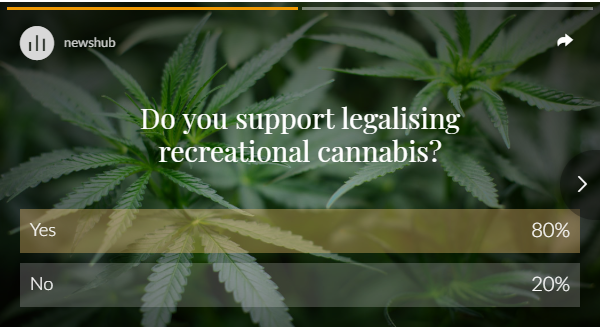
60% of New Zealand adults would vote to legalise the recreational use of cannabis on the upcoming referendum, according to the poll, with only 24% against. 16% had no opinion. Broken down by party support, 84% of Green voters would vote yes, with 63% of Labour, 56% of New Zealand First, 49% of ACT and 33% of National voters doing likewise.

The Green, Labour and National votes don’t need much explaining. The Greens have always been the strongest supporters of cannabis, apart from the Aotearoa Legalise Cannabis Party. Likewise, National has always opposed any effort to reform the laws. Many readers were surprised, however, to learn that support among New Zealand First voters is stronger than support among ACT voters.

In Understanding New Zealand, I showed which demographics were the strongest supporters of cannabis law reform, by correlating those demographics with support for the ALCP.

The average cannabis law reform supporter is – on average – young, poor, Maori, uneducated and with an especially high chance of suffering from a debilitating physical or mental illness. These demographics are all disenfranchised ones, which is why there is a strong association between being a cannabis user and having a difficult life. They are also the ones most heavily impacted by cannabis prohibition.

Some were surprised to see that support for cannabis law reform is very high among New Zealand First voters. 56% of New Zealand First voters would vote yes in the referendum, almost as many as Labour voters. New Zealand First voters are often stereotyped as old, bitter, out of touch racists, which makes it hard to explain their heavy support for cannabis law reform.

In reality, there is a moderately strong correlation between being a New Zealand First supporter and being Maori: one of 0.38. This also helps to explain why there was a moderately strong correlation of 0.40 between voting for New Zealand First in 2017 and voting ALCP in 2017. Many will also be surprised to read that there is no significant correlation between median age and voting for New Zealand First.

In other words, the New Zealand First demographic is much younger and browner than the lazy stereotype would have it. This can be established simply from observing the extremely high levels of support gained by New Zealand First in the Maori electorates. These young, brown and poor people are reliably fans of cannabis use, despite the general social conservatism of the New Zealand First movement.

Many others were surprised to see that only 49% of ACT supporters expected to vote yes in the referendum. ACT markets itself as the party of liberty from government overreach, and one might think that this would be reflected in support for cannabis law reform, but they have traditionally been very weak on the issue, perhaps even cowardly.

The simple truth is that ACT voters are not from the demographics that care about cannabis law reform. The correlation between voting ACT in 2017 and being Asian was 0.46, but the correlation between voting ACT in 2017 and being Maori was -0.51, which suggests that very few actual cannabis smokers are ACT supporters.

Moreover, ACT voters are wealthy: the correlation between voting ACT in 2017 and personal wealth was 0.61, making their supporters their wealthiest of all. ACT voters tend to come from two major groups: rich, old, white people with all the money, and young professional Asians who don’t want to pay taxes. Neither group has any major interest in recreational cannabis.

The cannabis referendum is very likely to end up with a yes vote, because most of the opponents of cannabis law reform are old and dying off. Conservative National voters are being replaced by less conservative ACT voters, and young people mostly support it anyway. It’s enough to compare Chloe Swarbrick with the decrepit Bob McCoskrie to guess that the repeal of cannabis prohibition is inevitable.

*

Understanding New Zealand, by Dan McGlashan and published by VJM Publishing, is the comprehensive guide to the demographics and voting patterns of the New Zealand people. It is available on TradeMe (for Kiwis) and on Amazon (for international readers).