
Would Andrew Yang’s Universal Basic Income Scheme Work In New Zealand?

Of all the candidates for the Democratic nomination for the American Presidential Election later this year, none have the intellectual pedigree of Andrew Yang. From the demented Joe Biden to the snotty Elizabeth Warren to the weakling Bernie Sanders, the Democratic field seems mediocre in comparison. This article discusses one of Yang’s most popular ideas – the Universal Basic Income – and whether it’s applicable to New Zealand.

The maths is hard to escape.

Let’s assume we directly adopt Yang’s proposal of $1,000 per month, no questions asked, for every qualifying adult, with no adjustment made for the exchange rate. This equals $12,000 per year per person over 18. As there are at least 3,667,000 such adults in New Zealand, a UBI would require an expenditure of around $44,000,000,000 per year. This a hefty sum of money – but it’s a good deal for New Zealand if the costs of not having a UBI would be greater.

Yang suggests that he would pay for a UBI mostly by consolidating welfare programs and by introducing a 10% VAT on all goods and services.

Something that many UBI opponents fail to consider is that the introduction of a UBI would obviate the need for almost all benefits, which could then be scrapped. The unemployment benefit, the sickness benefit, the invalid’s benefit, the student allowance and the pension could all be shitcanned in one go. This means all the bureaucracy and expense associated with them would also go.

The Government spent $34,000,000,000 on welfare last year, a figure that includes the cost of running the welfare bureaucracy. The Ministry of Social Development, in a manner of speaking, is the welfare bureaucracy – it employs public servants in over 200 different locations around New Zealand. It’s a titanic institution.

With a UBI, all of those public servants would be made redundant, the bureaucracies that employ them would be wound down, and the 200 locations that currently house them sold off. As the Ministry of Social Development costs $27,000,000,000 a year to run – and that’s only the core expenses – getting rid of all this would provide 70-75% of the required funding for a UBI.

The Government brought in around $22,000,000,000 last year from the Goods and Services Tax, currently set at 15%. The GST is a tax beloved of modern Governments because it’s hard to avoid – pretty much every legitimate business has to account for it. Also, being a consumption tax, it’s all but unavoidable even for the most miserly person. Even if you only spend $200 a week to keep yourself alive, you will pay $30 in GST that week.

America doesn’t have a federal GST, so the introduction of one at 10% would be the equivalent of New Zealand raising ours from 15% to 25%. Most European countries have GST rates of between 20% and 25%, so this would be nothing extraordinary.

It’s not guaranteed that increasing GST to 25% (i.e. a relative increase of 67% compared to the 15% it is now at) would necessarily increase GST take by a proportionate amount. Higher taxes may lead to increasing rates of tax evasion (although, as mentioned above, GST is difficult to avoid).

If it did, however, then 67% of $22,000,000,000 would mean a further $14,700,000,000.

Add this to the sum of $27-34,000,000,000 for obsoleting the Ministry of Social Development, and we have somewhere around $42-48,000,000,000. This is enough to cover the cost of a UBI mentioned above. Once Yang’s other revenue-gathering measures (such as a transaction tax) are accounted for, there might even be enough to grant slightly more than $1,000 per month (which would otherwise only be about as much as the current unemployment benefit).

All of this is before we try to estimate the economic benefits of what would, in practice, amount to a powerful stimulus. The economic benefits of empowering individuals to turn down shitty working conditions, coupled with the physical and mental health savings accrued from sharply reducing the financial stress among the population, could be worth several billions in their own right.

In the end, Andrew Yang’s proposal to get rid of the American welfare bureaucracy could be applied in New Zealand wholesale. We also have the problem that we spend billions of dollars on office staff merely to determine who’s worthy of being allowed to eat and who isn’t. Scrapping the Ministry of Social Development, along with increasing GST by 10%, would allow us to fund a Universal Basic Income for all adult Kiwis.

New Zealand has already embarrassed itself by having less enlightened cannabis laws than 70 other nations. Hopefully we won’t have to wait for 70 other nations to introduce a UBI before the merits of such are understood in New Zealand.

*

If you enjoyed reading this essay, you can get a compilation of the Best VJMP Essays and Articles of 2019 from Amazon for Kindle or Amazon for CreateSpace (for international readers), or TradeMe (for Kiwis). A compilation of the Best VJMP Essays and Articles of 2018 and the Best VJMP Essays and Articles of 2017 are also available.

*

If you would like to support our work in other ways, please consider subscribing to our SubscribeStar fund. Even better, buy any one of our books!

The Four Main Opponents Of Cannabis Law Reform

With the date for the cannabis law reform referendum now set, the battlelines have been drawn. The opposing forces have taken up their positions: the pro-cannabis forces on the side of God, and the anti-cannabis forces on the side of suffering, misery, ignorance and hate. This essay describes the four major groupings of opponents to cannabis law reform.

The first major group of opponents to cannabis law reform are simple cowards.

There’s a certain kind of person who is terrified of anything new, of any change at all – they can be called neophobic. In much the same way that a certain kind of person shit their pants at the sight of their town’s first Indian restaurant, there is a certain kind of person who shits their pants at any thought of a new psychoactive substance.

This teeming mass of sheep-like idiots comprise about half of the opponents to cannabis law reform. They also comprised a large proportion of the people who opposed homosexual and prostitution law reform, and they will comprise a large proportion of those who oppose the next change, no matter how obviously needed or overdue that change is.

The second major group of opponents are the sadists who oppose cannabis because of its healing and medicinal properties.

Hard as it may be to believe, there are many people out there who just want to create as much suffering and misery as possible, usually because it brings them a sense of gratification and power. In much the same way that sadism exists in many of Nature’s creatures, so too does it exist within the human animal. The human sadist recognises the medicinal properties of cannabis – which is why they seek to withhold it from those who would benefit.

Also in this group are the retards who will guzzle alcohol like there’s no tomorrow and belch smoke like a 19th-century factory from their cigarettes, but won’t touch cannabis on account of that it’s a “drug”. There are plenty of alcoholics out there who have boozed themselves into a state of permanent retardation, and some of these people, owing to this brain damage, support harsher sentences for cannabis users.

The third major group of opponents are the turboautists who can’t into anything as mysterious as cannabis use.

Cannabis use, like other spiritual enterprises, can be an extremely humbling experience. It can teach you that you really knew nothing about the world, and about life. The intellectually conceited sort of person, the one who has an egoic need to establish themselves as a recognised intellectual authority, has extreme difficulty with such revelations. They prefer ideological security and safety.

The intellectually arrogant are the same group of people who see all cannabis use as stupefying. They can’t get their heads around the truth of it because there are no recognised peer-reviewed journals on the subject. For these people, all talk of spirituality is mental illness, and so if smoking cannabis leads to a person talking about God, then smoking cannabis drives people crazy. They don’t want legal cannabis because it shows them up as the spoofers they are.

The final major group of opponents are the spiritual liars.

Cannabis is a spiritual sacrament, and has been used continuously for thousands of years for this purpose. Unfortunately, a great number of people in the West today are spiritually dead. Not only do they not believe in God, but they believe that death is the end on account of that the brain generates consciousness. This is not a natural state of affairs – it is because they have been lied to.

There are spiritual criminals out there who earn a living from withholding from people the truth about God and about consciousness, and then selling some watered-down, padded-out, corrupted version of it for a fee. These criminals have always tried to establish themselves as intermediaries between the people and God, and in order to make this profitable they have needed to destroy all true spiritual movements and methodologies.

These criminals recognise that cannabis makes their position untenable, on account of that it’s a spiritual sacrament that leads people to God directly. Consequently, they act to keep cannabis illegal, for the sake of holding people in a state of profitable ignorance.

These four groups cover the basic emotions that motivate people to oppose cannabis law reform: fear, cruelty and ignorance.

Some people fall into more than one of these groups. Many pretentious intellectuals are also cowards who don’t dare to step outside of well-travelled paths; many religious fundamentalists are also sadists. Someone like Bob McCoskrie might fall into all four: the pants-pissing, shit-talking, hippie-bashing religious bigot is almost the archetypal prohibitionist.

Changing the attitudes of anyone in one of these four groups is easier said than done.

There isn’t much that can be done to persuade the cruel and the evil, because the more information you give them, the more power they have to cause suffering. Those who are ignorant can be persuaded of the merits of cannabis law reform by appealing to the successful examples of reform overseas. Those who are cowards can be persuaded by showing them the rest of the herd changing their direction.

Ultimately, cannabis will continue to be used more by Maoris, by young people, by non-Christians and by freethinkers, and so anyone who hates one or more of those groups will tend towards opposing cannabis law reform out of spite. Anyone not motivated by hate, but rather by honest ignorance or naivety, can easily be persuaded to see how cannabis prohibition isn’t in their best interests.

*

Vince McLeod is the author of The Case For Cannabis Law Reform, the comprehensive collection of arguments for liberalising New Zealand’s cannabis laws.

*

If you would like to support our work in other ways, please consider subscribing to our SubscribeStar fund. Even better, buy any one of our books!
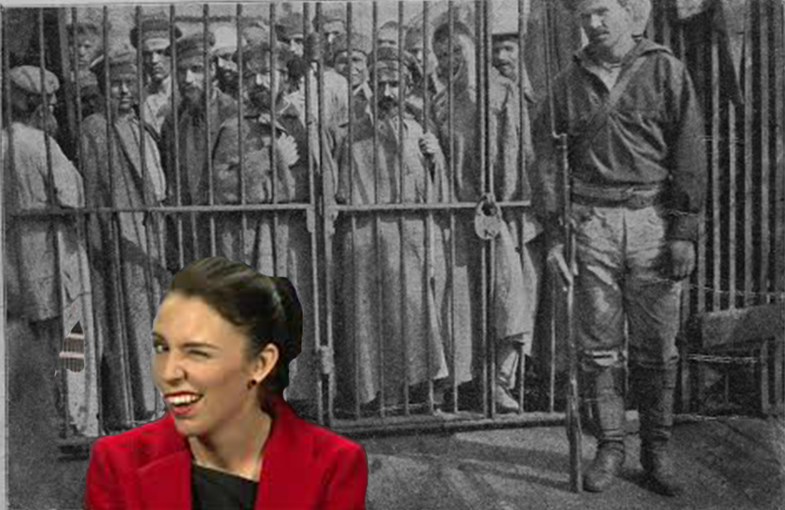
If The Media Wrote About Jacinda Ardern The Same Way It Wrote About Wrongthinkers

The politician accused of masterminding multiple violations of the New Zealand Bill of Rights Act is running for re-election this year.

The 38-year old Jacinda Ardern’s Sixth Labour Government has been accused of violating New Zealanders’ rights to free expression, free assembly and free commerce. She has been recorded on film paying homage to the ideology of Marxism, which subscribes to the same totalitarian far-left ideology as the Soviet Union that starved 100 million people to death in the gulag archipelago.

A constitutional lawyer says the accusations facing Ardern are among the most serious, and he believes that criminal charges laid by Police could follow.

VJM Publishing understands that the politician has refused to answer questions about her loyalty to the New Zealand nation. Last April, VJM Publishing revealed that Ardern was working closely with French President Emmanuel Macron to force globalist policies on the New Zealand people without their knowledge or consent.

It is not known whether the human rights violations that Ardern has allegedly committed were committed to further Marxist ideology.

Neither the Police nor the Labour Government would comment on the accusations.

Since the accusations of human rights violations were levelled against Ardern, she continues to make short films in which she tries to justify her actions, publishing these on FaceBook.

Ardern’s actions were first observed by activists who track members of the far left, Marxists and Communists online. Ardern’s FaceBook account has been used since the accusations of human rights violations were laid.

For several years, Ardern has posted racist, anti-nationalist and anti-white comments on social media, including references to a “white supremacism” conspiracy theory. This racist conspiracy theory claims that the low academic performance of browns and blacks can be explained by white prejudice.

“The response I’ve received has been positive. No tech company, just like no government, would like to see violent extremism and terrorism online,” Ardern is quoted as saying.

The account also showcases Ardern’s hate for the New Zealand people, frequently insinuating that they are racists, bigots and criminals.

A Police spokeswoman declined to answer specific questions about whether they plan to arrest the politician.

“The accused has not been formally charged, which means that she is at liberty to travel as she pleases,” the spokeswoman said.

Wellington barrister Schlomo Goldberg, who has 20 years’ experience working in constitutional law, said Ardern was the first politician he knew of to be accused of violating New Zealanders’ rights to free expression, free assembly and free commerce.

“For a member of the New Zealand Government to use the position she’s been given to prejudice the human rights of New Zealanders, that’s a big deal,” he said.

Goldberg, who has no involvement in the case, said the politician could possibly have access to Marxist publications that could include tactics, techniques, procedures and plans for subverting national cultures.

“But also, if you have someone like the Chinese Communist Party, they might think it’s kind of handy to have, to get their hands on information that shows them how the New Zealand Government conducts operations because they might want to use those sorts of things themselves.

“There’s a whole load of information which an organisation that is intent on violating New Zealanders’ human rights to achieve its ends might find useful, both from a point of view of how it might conduct its own operations and also how you know what it might anticipate the security services are going to do against it.”

He said the Police were likely wanting to keep any investigation into Ardern’s human rights violations out of the public eye, despite the potential for criminal charges in civilian courts.

This would be done so that classified information involved in the case could be presented without revealing it to the public, he said. 

*

This article is a parody of this piece of digital excrement: https://www.stuff.co.nz/national/119231183/arrested-soldier-continues-to-share-white-nationalist-material

*

If you enjoyed reading this essay, you can get a compilation of the Best VJMP Essays and Articles of 2019 from Amazon for Kindle or Amazon for CreateSpace (for international readers), or TradeMe (for Kiwis). A compilation of the Best VJMP Essays and Articles of 2018 and the Best VJMP Essays and Articles of 2017 are also available.

*

If you would like to support our work in other ways, please consider subscribing to our SubscribeStar fund.

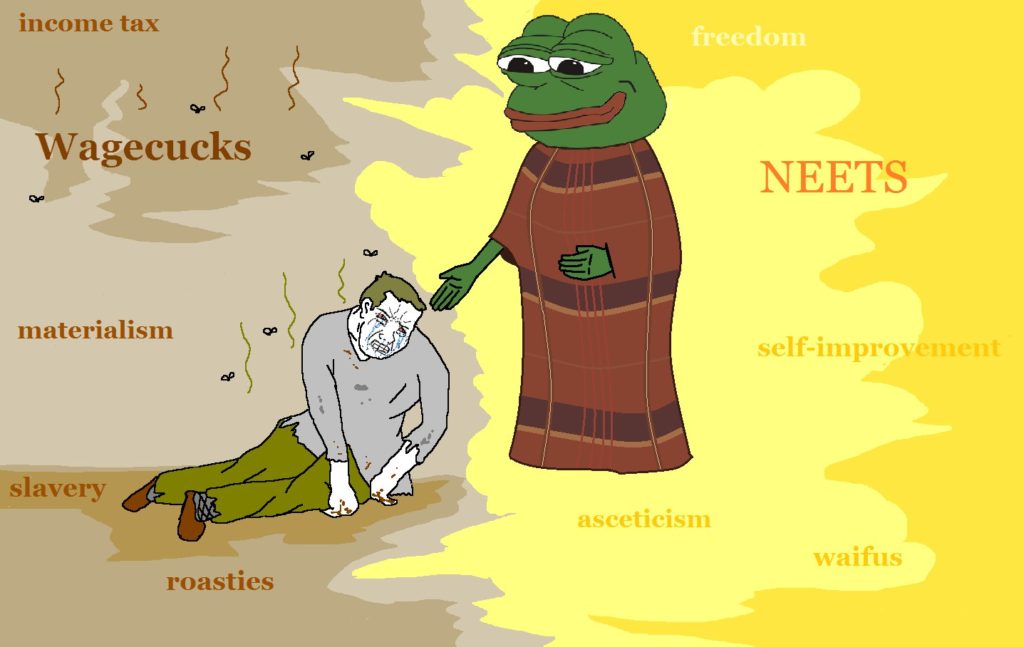
Clown World Chronicles: What Is A ‘NEET’?

As mentioned in the chapter about behavioural sinks, one of the common phenomena of Clown World is withdrawal. When society just seems absolutely fucked, and no effort to fix it seems like it could pay off, the logical thing to do is to withdraw. This article discusses the modern phenomenon of the NEET, and where it might lead.

‘NEET’ stands for ‘Not in Employment, Education or Training.’ It refers to people who don’t have an occupation. There are essentially two ways to be a NEET: live off your parents or live off welfare.

Living off your parents is the middle-class way to be a NEET. Usually, if your parents are stable and successful, they have a spare room at their house that you can live in rent-free. If they have enough income of their own they might even pay for your board. In such situations, a person can live almost indefinitely.

Living off welfare is the lower-class option, on account of the extra grief that comes with it. This is known as “receiving NEETbux”. One way to achieve this involves going on the dole, or unemployment benefit. This is not an easy option, because it doesn’t offer anywhere near enough money to be happy. It’s also not easy to make it permanent, and a permanent passive income is the holy grail of NEET life.

The increasingly popular option is to claim a disability allowance on the grounds of having a mental illness. The bizarre paradox here is that any genuinely sane person, when exposed to Clown World, will become insane. The only people that can cope with Clown World are the ones that were defective from the beginning. Consequently, an element of Catch-22 exists when it comes to who’s sane.

Some kind of “mental illness” accounts for most NEETs. Although these people are labelled mentally ill, their thoughts and behaviours are often rational and logical reactions to living in Clown World. The demands of the modern workplace are such that not everyone’s mental health can cope, and many people don’t even make it that far, having been driven insane by the school system.

A NEET is very similar to what used to be called a recluse. In Japan, where the phenomenon is very common, such people are known as hikikomoris. It’s someone who has withdrawn so much from society that they’re hardly even part of it anymore. Not in employment, education or training is another way of saying “dropped out”. It’s for people who no longer give a fuck.

In practice, most NEETs are men, for a variety of reasons. For one thing, society values young men less than young women, which incentivises young men to withdraw. For another, young men are much more likely to suffer from the autism that is commonly the ultimate reason for NEETdom.

Although the NEET is stereotyped as having a great life, sitting comfortable while wagies slog their gutses out, in reality NEETlife is mostly wretched.

On a metaphysical level, it’s extremely difficult to live without a sense of purpose. The NEET spends much of his time watching porn and playing vidya, and neither of these activities are fulfilling in any sense. NEETlife is kind of like an extended childhood, particularly when it’s adopted by a young person who never gave adult life a serious crack.

On a psychological level, NEETlife doesn’t provide that which is known to make people happy. Sigmund Freud once said that the formula for happiness was to love and to work. The NEET has extreme difficulty on both counts.

Not working makes it really hard to attract women. Consequently, very few NEETs have quality lovelives. It’s possible to tinderwhore as a NEET but, because the vast majority of sexual encounters happen between people in at least semi-committed relationships, and because women don’t like to form relationships with unemployed men, quality sexual encounters are rare.

Not working also makes it hard to have a social life. Because human existence in Clown World has been reduced to little more than an economic production engine, people are defined by their jobs, and social circles are commonly restricted to workmates only. These two difficulties strongly interplay with each other – a great many relationships form through friends of workmates.

The ultimate question for the NEET is: have I dropped out of society because I am too weak to cope with it, or because society is too shit to be worth engaging in? Either answer could be correct, depending on the individual in question. Some people just don’t give a fuck, others make a genuine and prolonged effort to fit in but just find society too fucked.

The NEET epidemic, like the incel epidemic, shows no sign of abating. As Clown World becomes ever more ridiculous, and as society drifts ever further from reason, an increasingly large number of people will end up dropping out. As shown by the behavioural sink studies mentioned in the opening paragraph, Clown World will probably get worse and worse until one final, glorious climax. The NEET epidemic may play a contributory role here.

*

This article is an excerpt from Clown World Chronicles, a book about the insanity of life in the post-Industrial West. This is being compiled by Vince McLeod for an expected release in the middle of 2020.

*

If you would like to support our work in other ways, please consider subscribing to our SubscribeStar fund.