VJMP Reads: The Interregnum: Rethinking New Zealand X

This reading carries on from here.

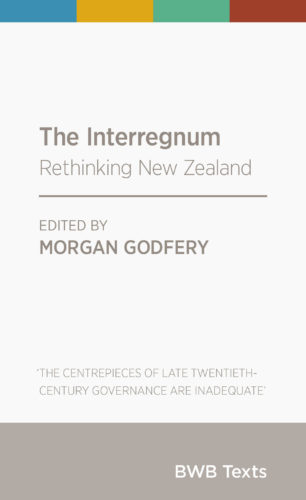
The tenth, and last, essay in The Interregnum is ‘Politics of Love’, by Max Harris. Like the other essays in this collection, it speaks from an unashamed youth perspective, such as when Harris complains of the “stale language” of the current political discourse.

This essay is about the politics of love, and it opens by defining what love is to Harris: “a feeling of deep warmth that is directed outwards towards an object, such as another person.” There is nothing objectionable about his definition of love; indeed it seems fairly comprehensive, especially when he writes that “the idea of love is closely tied to relationships and the connections between people.”

Predictably, given the Marxist leanings of the previous essays in this book, this essay quickly moves on to a declaration that the politics of love would necessitate “a willingness to accept a greater number of refugees.”

But one wonders why it is that emphasising the aspect of love leads naturally to the conclusions that Harris takes it to.

Why not, for example, stop all immigration to New Zealand from the Third World on account of love for the people already in New Zealand, whose living standards drop when Third Worlders move into their locales? Isn’t it entirely possible that my love for the people of New Zealand impels me to want to see them safe from robbery, rape and murder – the crimes that mass Third World immigration has brought to Europe and America?

Doesn’t our love for young New Zealand girls and women drive us to keep them safe from the rampant sexual abuse and harassment that is now part and parcel of the female experience in Europe?

Doesn’t our love for the homeless and mentally ill already in New Zealand drive us to take care of them as a priority, before we spend money importing irreparably damaged people from the other side of the world to jump in front of them in the queue?

Doesn’t our love for the hardworking taxpayer who has busted his back his whole life drive us to ensure that he can retire at a fitting age, instead of having to work into senescence to pay for gibs?

The essay makes a plea for more solidarity, but how is that possible when diversity is also increasing? It points out that New Zealanders already feel disconnected – so how will importing tens of thousands of “refugees” help? It will only add to the ethnic chaos, making us feel even more disconnected.

But Harris, and people like him, would happily call me hateful for asking those questions.
VJMP Reads: The Interregnum: Rethinking New Zealand IX

This reading carries on from here.

The ninth essay in The Interregnum is ‘Religion and the Real World’, by Daniel Kleinsman. It lays out its thematic question in the first paragraph: “does a pope’s ‘apostolic exhortation’ have any weight or relevance in the modern world?”

The scene is set by the usual canards of climate change and inequality. Pope Francis’s recent comments about how the world needs to do its bit to help with such issues is discussed.

Unfortunately, Kleinsman comes across as just another tub-thumper with an agenda. The insight that no relationship exists in isolation is credited to Francis as a “pope’s innovation”, when anyone with even a passing familiarity with comparative religion would know that the interdependence of all things is one of the original insights of the Buddha.

Ironically, even in an essay where Kleinsman has his lips firmly attached to the Pope’s anus, Kleinsman reveals the sham at the heart of Catholicism: the Pope credits evolution with bringing about consciousness, and is therefore a materialist who doesn’t actually understand spirituality.

This essay is poorly-written enough to contradict itself at several major points. The common theme of these contradictions is to demand that the whole world come together in harmony but to also dump all the blame for the condition of the world on a very select group of people.

If we’re all one, what’s the point in promoting this antagonistic dichotomy of “tangata whenua” and “tangata tiriti”, the only possible outcome of which is dividing the population into two opposing groups?

And if we’re all part of an interdependent system, aren’t all of us guilty of upholding and facilitating exploitation – even those being exploited by it?

One wistfully recalls the days when the left stood for solidarity between all people, and when the New Zealand left promoted the idea of Kiwitanga as a way of bridging the gaps between Maori and Pakeha. Now, those who speak the language of unity out of one side of their mouths are seeking to divide the country out of the other by talking about “those who are owed” and “those who owe”.

Kleinsman describes the masculine-oriented language used by Francis as “unhelpful”, but does not mention that the same holy book where Francis is getting all his stories from also commands women to shut up and and be quiet (Timothy 2:12 etc.): “…A woman must learn in quietness and full submissiveness. I do not permit a woman to teach or exercise authority over a man; she is to remain quiet. For Adam was formed first…”

On that line of reasoning, when are we getting a female Pope?

These are questions that the religious will never answer. Theirs is not to reason or to honestly inquire; theirs is to lecture, admonish, guilt trip and harangue. In that, they have something very powerful in common with Marxists, which perhaps hints at a possible alliance this century.

The 10 Most Uncorrelated Pairs of Things in New Zealand Society

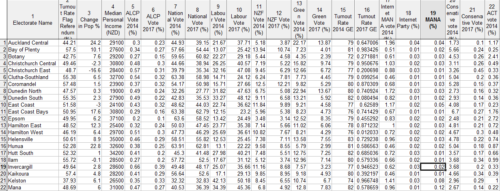
The third part of Dan McGlashan’s Understanding New Zealand contains an index of all the 11,628 correlations considered in the writing of the first two parts of the book. There are so many of these that the index has to go to three decimal places in order to properly distinguish them from each other. Even then, there are some pairs of variables that are so perfectly uncorrelated that they go down to weaker than 0.000 – as this article examines.

This data was collected from the Electorate Profiles that can be found on the Parliamentary Library website, and then entered into a Statistica database from which a correlation matrix was calculated. These ten pairs of variables represent the least correlated things in New Zealand society.

9=. 0.0007, Voting New Zealand First in 2014 and Being of European descent

New Zealand First gets much more support from Maori electorates than most people realise. Their level of support among Maoris declined in 2017 but in 2014 it was strong enough that there was no correlation between voting New Zealand First and being white.

9=. -0.0007, Voting Internet MANA in 2014 and Having an income between $60-70K

Internet MANA voters were a fair bit poorer than average, and so there is no correlation between voting for them in 2014 and having a slightly higher than average income.

8. -0.0006, Having NZQA Level 2 as a highest academic qualification and Working as a sales worker

Leaving school at the end of Sixth Form is a middling sort of academic achievement, and being a sales worker is an extremely common line of employment.

7. 0.0005, Being a Brethren and Working in public administration and safety

Brethrens are indifferent to working for the Government.

6. -0.0004, Voting Internet Party in 2017 and Being a Spiritualist or New Ager

Internet Party voters are young and mostly live in Auckland; Spiritualists and New Agers are a bit older and are distributed reasonably evenly throughout the country.

3=. 0.0003, Voting to change the flag in the second flag referendum and Being in a couple with children

Couples with children probably have more important things to think about than a flag referendum, which was only ever a vanity project for the elderly elite with leisure time.

3=. -0.0003, Being a Christian (not further defined) and Being a sales worker

Christians, when not further defined, are generally a bit poorer than average, and sales workers are moderately wealthy, hence no correlation.

3=. -0.0003, Being a Pacific Islander and Being on the invalid’s benefit

Pacific Islanders are stereotyped as being on the benefit a lot, but the truth is that the sort of Pacific Islander who wanted to go on the invalid’s benefit probably wouldn’t be motivated to immigrate to New Zealand in the first place.

1=. -0.0001, Voting Internet MANA in 2014 and Taking a bus to work

Internet MANA voters in 2014 tended to live in the Far North, and those who lived in Auckland often took a bus to work, the others not so much.

1=. -0.0001, Being a regular tobacco smoker and Being a sales worker

There are no more middle-of-the-road variables than being a regular tobacco smoker and being a sales worker. Both traits point to a very normal, standard sort of person, hence no correlation.

Jacinda Ardern Lied To Us About Changing The Medicinal Cannabis Laws

The Clark Government lied to us about cannabis, the Key Government lied to us about cannabis and the English Government lied to us about cannabis. Today the Ardern Government went back on their word to legalise medicinal cannabis in the first 100 days of taking power

They promised that they would make medicinal cannabis legal in the first 100 days of a new Government. They lied. That’s the long and the short of the medicinal cannabis “reforms” announced by David Clark and Jacinda Ardern today. No doubt it will be spun as a great victory for compassion and justice, but it isn’t.

Home growers will be the most disappointed, because the “reforms” offer absolutely nothing to them. If you grow cannabis at home because you have found it alleviates your suffering – as tens of millions of Americans are legally allowed to do – you will still have to live in permanent fear of the Police knocking on your door and dragging you away to go in a cage.

Basically, under the proposed legislation, home growers are invited to go and fuck themselves. There is no word of any reduction in penalties for home growers, only for those who have less than 12 months left to live, and even they aren’t allowed to grow cannabis. If you have a terminal illness (this being defined as an illness likely to kill you in the next 12 months), then you now have a defence against prosecution.

You can still be arrested, thrown in a jail cell with rapists and murderers and treated like a subhuman piece of shit by the justice system, but should you decide to protest, you will now be permitted to have a defence.

The Bill also “establishes a regulation-making power to set quality standards for domestically manufactured and imported cannabis products.” In other words, the Labour Party intends to give full control of the New Zealand medicinal cannabis supply (if we ever get one) to the same pharmaceutical industry that has lobbied for decades to keep medicinal cannabis illegal. This is further underlined when the Bill declares “Most cannabis products produced internationally do not meet the quality and efficacy requirements of therapeutic product regulators such as Medsafe.”

It sounds like the best result is that medicinal cannabis will become available through a pharmacy, at some indeterminate point in the future, once a Byzantine process of bureaucracy has first been established and secondly navigated. In other words, medicinal cannabis is still not legal, and there is no sign of home grow ever becoming legal.

Most worryingly of all, the Bill states that “no pure cannabidiol product made to reliable quality standards is currently available.” This means that, according the quality standards enforced by this Bill, none of the medicinal products produced by the $20 billion cannabis industry in America are good enough, a clear sign that the “quality standards” demanded are not necessary or reasonable.

Clearly, this is another Psychoactive Substances Act – a piece of legislation intended to keep something fully illegal while giving politicians a plausible reason to claim that they are trying to make it legal. Peter Dunne successfully blocked cannabis law reform, while evading media heat, for over a decade using this method.

In summary, Jacinda Ardern is nothing but another vacuous corporate whore, exactly like John Key. She is lipstick on a pig. Just a pretty face on the same disgusting corporate agenda that has engorged itself on the New Zealand people for the past 30 years. Labour lied about signing the TPPA, and now they’ve also lied about reforming the medicinal cannabis laws.