VJMP Reads: David Seymour’s Own Your Future VIII

A Liberal Vision for New Zealand in 2017

This reading carries on from here.

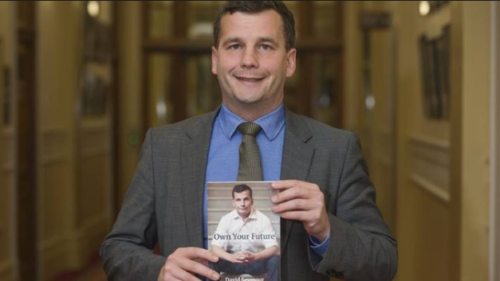
The seventh chapter in Own Your Future is ‘Public Safety’. Here Seymour opens the chapter with one of the non-sequiturs that seems to be characteristic of his style. He talks about visiting a prison, and seeing the downcast faces on the prisoners there. For some reason he lurches directly from this to stating his belief in deterrence being the primary solution to the crime problem.

It’s hard to believe that Seymour is writing this chapter with a straight face. He claims to be tough on the causes of crime – yet his party supports National every step of the way in ripping down the social welfare that people need to get out of the poverty that causes crime.

Indeed, the facade soon slips, and he openly admits that ACT Policy is based around “making the consequences of committing crimes sufficiently bad that people will decide not to do it in the first place.” Within the space of a few sentences he goes from complaining about the cost of prisons to crowing about ACT success in keeping people in prison for longer through their three strikes policy.

From there, Seymour launches into a rant against burglary. Fittingly for a party that values property more highly than people, he wants to add burglary to the list of crimes that involve the three strikes law, the third offence being punished by a minimum three years without parole. Helpfully, he informs us that “The aim [of burglary] is getting more money or goods without working for them or being given them.”

At this point, Seymour serves up a genuinely good idea. Prisoners often find it difficult to return to civilian life after their sentence on account of poor literacy and numeracy, so Seymour proposes that they can get time knocked off their sentences by completing adult reading and maths courses while in prison. Any prisoner who is already educated can get time off for helping to tutor the other prisoners.

This is actually a really good policy, but it’s incredible that Seymour, as a supposedly principled libertarian, doesn’t mention cannabis law reform here. If it costs $105,000 a year to keep a person in jail, we could save tens of millions immediately just by letting cannabis growers and dealers out. He doesn’t suggest this, even though it seems like such an obvious thing for a principled, libertarian party to suggest at this juncture.

This newspaper wondered some time ago if perhaps David Seymour is the biggest coward in the New Zealand Parliament. It’s astonishing that ACT, who barely get more votes than the Aotearoa Legalise Cannabis Party, aren’t willing to support cannabis law reform as their libertarian counterparts everywhere else have done, when the entire country is crying out for it. They could take votes off the Greens and the Opportunity Party simply by offering a right-wing alternative to how to legalise cannabis.

*

If you enjoyed reading this essay, you can get a compilation of the Best VJMP Essays and Articles of 2017 from Amazon for Kindle or Amazon for CreateSpace (for international readers), or TradeMe (for Kiwis).


Te Reo With Mnemonics: Truth and Falsehood Words

Truth, to be true – pono

An adolescent boy’s parents are scolding him for his computer use habits, asking “Is it true that you watch all these pornos?”

Lie, to lie, Bullshit – teka

A salesman is asked by his boss how the day has gone. “Any takers?” the boss asks. The salesman shakes his head, and the boss accuses him of lying.

Secret – toropuku

A man reads something in a book, and shows it to another man. The other man rips the book into pieces, and says “Now it’s a secret.” He tore a book up.

Belief, to believe – whakapono

At a camping ground, a woman points to a cabin on a hill and says to a family “I believe yours is the far cabin, yo.”

Claim, to claim – kerēme

A woman appears on television and claims that “The claim of the country is that this is our best cream.”

to admit, confess, disclose – whāki

A man shows a strange looking contraption to some friends, and says “Now, I admit that this looks a bit fucky.”

The Maori word for ‘fact’ – meka – sounds like the English phrase “me car”

to confirm, confirmation – whakaū

Some spies are holding a man’s head underwater. They pull it out and say “Can you confirm what we told you?” The man says “Fuck you!”

to deny – whakahore

In a courtroom, a judge asks the defendant “So you deny that on the night of 12 August you did fuck a whore?”

honest – matatika

Some policemen show a video of a holdup at a supermarket to a seated suspect. They say “Be honest. Are you the mart attacker?”

dishonest – hīanga

A twenty-dollar note blows along the ground, and a man picks it up. Another man comes along and says “Did you see my twenty?” The first man says “Here? Nah.”

Fact, to be true – meka

Beside an expensive car, a man is pleading with a skeptical policeman. “It’s true that it’s me car! It’s a fact!”

to pretend, deceive – hangarau

A lady is hanging some clothes in rows on a clothesline. She says “I’m pretending to be a laundrywoman! Come, hang a row!”.

*

The above is an excerpt from the upcoming Learn Maori Vocabulary With Mnemonics, by Jeff Ngatai, due to be published by VJM Publishing in the summer of 2018/19.

VJMP Reads: David Seymour’s Own Your Future VII

A Liberal Vision for New Zealand in 2017

This reading carries on from here.

The sixth chapter in Own Your Future is ‘Immigration’. It starts with an attack on Winston Peters’s “twenty year racist dogwhistling campaign”, in which Seymour takes the opportunity to position himself as a crusader against racism and bigotry. This is a wise strategic move on Seymour’s part, considering that his party gets more votes from the foreign-born than any other. The Greens are also accused of racism for wanting to lower immigration levels.

Astonishingly, Seymour makes a passionate appeal to New Zealand’s moral obligation to help displaced refugees – but at no point in this book so far has he made any appeal to New Zealand’s moral obligation to help its own people, especially its poorest and most disadvantaged. Here Seymour comes across as the out-of-touch, highly privileged urban dweller who is horrified by a tennis ball to the head.

Ironically, Seymour pillories those who cry “racist” at everyone who claims that we need some immigration restrictions, despite doing the same thing himself on the previous page. This he does in an attempt to position himself as the supporter of a “smart” immigration policy, pointing out that no-one wants no immigration and no-one wants open borders.

He lists at length what he perceives to be the good things about New Zealand, as a way of explaining why so many people want to come here. He claims that New Zealand has a “generous” welfare system, no doubt by way of comparison to Samoa or India. Noting that New Zealand would be swamped tomorrow if we decided to throw open our borders, he seems to think it’s good enough for New Zealand to be doing better than the global average. No word about our domestic violence, child abuse or teen suicide rates.

He also makes some fair criticisms of the current immigration system, such as the absurdity of getting an investment visa from buying and holding for a few years a couple of million dollars’ worth of Government bonds. He laments the shortage of workers at tech companies and hospitals, but manages to resist the temptation of arguing that we need to attract them through lower tax rates.

New Zealand First comes in for special criticism here, with Seymour going as far as to claim that their “poisonousness” is “intended to hurt those who want to bring their skills and settle in New Zealand”. Seymour might not be aware that Maoris vote New Zealand First much more often than white people, so one wonders what he makes of this. Are Maoris racist for not wanting mass immigration? No-one knows.

There are many contradictions in this essay, many of them glaring. Possibly the most grievous encountered so far is when he complains that previous Governments have failed to make sure that the immigrants coming there are those who will integrate and contribute to economic growth, but in the very next sentence complains that those Governments only “reluctantly and begrudgingly” increase the refugee quota when concern about overseas suffering becomes “overwhelming”.

Anyone with the most passing familiarity with the situation in Europe knows that refugees are precisely the sort of person who are least likely to integrate, and who will offer negative economic growth. This contradiction is so glaringly incredible that it’s unclear if Seymour is being dishonest here or if this essay is simply poorly written.

Hilariously, Seymour is willing to grit his teeth and write that New Zealand doesn’t need “upper middle class foreign citizens flashing their bank accounts at us on their way through customs to get to a beach house” – when those people make up most of ACT’s voters. Also, we don’t need more Pacific Islanders “taking the piss” by using family migration to get their extended family “to come and live and take advantage of our generous welfare system”. Seymour writes this, apparently completely unaware that, earlier in the chapter, he pilloried New Zealand First and called them racist for saying much the same thing.

Seymour concludes this chapter with some virtue signalling about how our refugee quota is an “embarrassment”. He doesn’t appear to understand that keeping the number of Muslims and Africans low is the only way that the New Zealand population will remain favourable to immigration in general – this has been the lesson of the last twenty years in Europe. This contradiction is typical of what has so far been the most poorly written and argued essay in this book so far.

*

If you enjoyed reading this essay, you can get a compilation of the Best VJMP Essays and Articles of 2017 from Amazon for Kindle or Amazon for CreateSpace (for international readers), or TradeMe (for Kiwis).

Te Reo With Mnemonics: Rugby Words

Hooker – kaikape

A gorilla stands over a fry pan and stovetop. He is the cook ape. Someone calls out for him so he puts on a number 2 jersey and joins a scrum as hooker.

Fullback – haika

A team is waiting to receive a kick off, when suddenly the fullback breaks into a haka.

Scrum – kakari

A bunch of schoolboys form a scrum to break their way into a classroom. On the door of the classroom it says “Cookery”.

Drop goal (verb) – whana whakapiro

A player drop kicks a ball, and it goes through the goal but hits a row of fans and they all fall over. The drop goal was a fan fuckup.

Penalty goal (noun) – hāmene whakapiro

A player successfully kicks a penalty goal while a choir sings behind the goal posts. They try to sing in harmony, but they sound terrible – the penalty goal was a harmony fuckup.

Penalty kick (verb) – whana whiu

A player kicks a penalty goal, but the touchjudge is busy fanning himself as if it was too hot to pay attention. He says “I thought I’d just fan a few (minutes)”.

The Māori word for ‘penalty’ – hāmene – shares a h-m-n-e sound with the English word ‘harmony’

Penalty kick (noun) – whana hāmene

The kicker lines up a penalty kick while a choir sings behind the goalposts. Dancing girls come and fan the choir – they fan a harmony.

Referee – kaiwawao

A fight breaks out on the pitch and the referee runs in, blowing his whistle and shouting “Okay, whoa, whoa!”

Lineout – whakarārangi

A Maori boy runs through a carpark. His friend yells, “To the far car, rangi!” and throws a ball as if into a lineout. The Maori boy, when reaching the far car, leaps in the air to catch it as if a lineout.

Kickoff – tīmata

A player stands waiting to kick off, and an old lady yells at him to hurry up. The player says “I can’t kick off until I get the tee. Mother.”

Penalty – hāmene

The referee awards a penalty, and the crowd starts singing in perfect harmony.

Try – piro

A player scores a try and celebrates with a pirouette that a ballet dancer would be proud of.

*

The above is an excerpt from the upcoming Learn Maori Vocabulary With Mnemonics, by Jeff Ngatai, due to be published by VJM Publishing in the summer of 2018/19.