
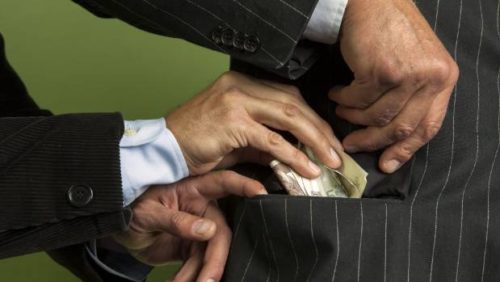
New Zealand is Corrupt as Shit

If a politician is bribed, but the people are too stupid to realise that a bribe has been made, is it really bribery?

In the midst of the worst homelessness and mental health crises this country has ever known, the Labour-NZ First coalition Government has decided to double the refugee quota, placing incredible strain on already thinly-stretched resources. On the face of it, this seems insane, but there’s a very precise method to this madness. This article explains the truth.

The truth, in short, is that New Zealand is corrupt as shit.

You don’t know it’s corrupt as shit, because they don’t admit that on the television news, and anything not stated as fact on the television news is not considered a fact here. As a consequence, New Zealand does well on measures of perceived corruption. There are two significant effects of this: New Zealanders seldom try to bribe officials, and New Zealanders are almost completely unaware of blatant cases of actual corruption.

We are so naive that the ruling class can pull off ham-fisted scams that 99% of the world would immediately recognise as crooked, and Kiwis will believe them without question.

The MethCon meth house scam, for example, even had ‘Con’ in the name and Kiwis still fell for it. Anyone with even a passing knowledge of chemistry knows that it’s impossible for a house to become contaminated to the point of being unsafe to live in merely from people smoking methamphetamine inside. Nevertheless, a hysteria was created in the media that led to people stampeding to test their houses for methamphetamine contamination.

There was huge money to be made through the meth testing business. Gullible landlords were suckered into paying thousands to cowboy chemists who were purportedly checking to see if their house was fit for human habitation. Equally gullible journalists were induced into stoking the fires of the meth house hysteria, and they did so with glee, encouraged by bribes from the meth conners.

The granting of consents to foreign companies to export bottled water is another such scam. The only real explanation for the granting of these valuable water consents to foreign companies is backhanders to Council officials, but most Kiwis do not perceive anything untoward.

None of this is to even mention the numerous immigration scams, or foreign land sale scams, or the total bullshit story that is cannabis prohibition.

Regarding the illegal foreign land sales, the Radio NZ article states “Land Information Minister Eugenie Sage could not answer many of RNZ’s questions, referring back to Land Information, who subsequently refused an interview.” Every other people in the world, apart from the sheep-like Kiwis, would recognise this as a blatant case of corruption. Obviously someone is getting personal benefit out of selling off New Zealand here.

The increase in the refugee quota, then, can be explained as simply another example of this widespread theme of public officials deriving personal benefit out of making decisions that harm the country as a whole. It’s simple corruption at work.

Jacinda Ardern knows that if she sells New Zealand out to globalist Marxist interests, in particular the United Nations, she will be amply rewarded by the UN after her tenure as New Zealand Prime Minister. If she opens the door to the Third World now while she’s in charge here, she will be at the front of the queue to receive UN patronage in her later career. This is the context in which the raising of the refugee quota has to be viewed.

From Ardern’s perspective, it’s not important that increasing the refugee quota will lead to more homelessness among Kiwis and worse mental health outcomes for them. The important thing is to earn brownie points with the globalists, so that the rewards can be reaped post-office. This is very similar to how Helen Clark focused on homosexual law reform, which was then fashionable among the global left, when the nation was demanding cannabis law reform.

We Kiwis have to accept the truth: our country is corrupt as shit, and our leaders do not represent us. Our leadership class are more like a herd of pigs with their snouts in the trough of our common wealth.

*

If you enjoyed reading this essay, you can get a compilation of the Best VJMP Essays and Articles of 2017 from Amazon for Kindle or Amazon for CreateSpace (for international readers), or TradeMe (for Kiwis).
The West is Undergoing A Cultural Revolution

The goal of destroying a population’s links with their past is – as it was in Maoist China – to make them more amenable to the imposition of a new ideology

The stated goal of the Chinese Cultural Revolution was to purge all trace of capitalist and traditional elements from Chinese society, clearing the slate for the imposition of Maoism. This was soon regarded as a catastrophic mistake, for predictable reasons. This essay argues that the West is, right now, undergoing a similar cultural revolution.

The Communists of the West have now completed their Long March through the institutions. Their control of the education system is now so total that Western schools could hardly be more effective brainwashing institutions if they had been designed with that objective in mind. The social pressure to conform to a politically correct worldview is so great that the vast majority succumb, simply becoming repeaters of indoctrination.

These repeaters go on to repeat the politically correct worldview they are programmed with, and they do this with all the fervour of a person raised in a fundamentalist religion. And so, it is now assumed that, in every conflict, the side with the least amount of power is automatically the morally correct side, which is Marxist morality in a nutshell.

This moral value has now driven out most of the others. It is now widely believed that it’s immoral to have a decent life, and that the more decrepit one is the more moral one must be. All winners are now losers, and vice-versa. The Western Cultural Revolution is under way.

Our ancestors, who built this decent life for us to enjoy, are no longer to be seen as heroes who crossed mighty oceans to carve nations out of forests and mountains with sweat and toil. No longer are they to be venerated for passing down a niche for us to survive in. Instead they are to be despised for the damage they did to those forests and mountains, and to the primitives that may have lived there before them.

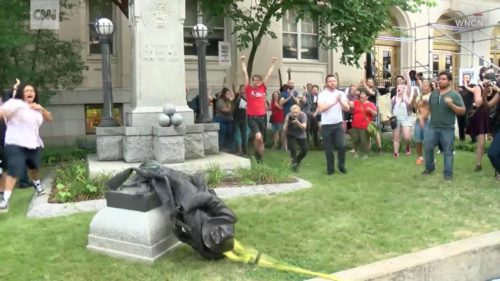
We are destroying all of our contacts with the old, and signs of this painfully fashionable iconoclasm can be seen everywhere.

In the New World, it’s evident from the tearing down of statues and the reinterpretation of history to cast white settlers and pioneers as oppressors and other ethnicities as victims. The noble savage mythology has seen a resurgence; it has become politically incorrect to point out the horrific rates of homicide and easily preventable deaths in native societies before European contact. The tribal warfare and mass slaughters that occurred before the land was pacified by Europeans are taboo to mention.

In Europe, it’s evident from the shattering of national identities that has transpired in the wake of mass Muslim and African immigration. Propaganda inviting Germans to consider ethnic non-Germans to be “typisch Deutsch” has the effect of shattering the bonds that Germans have with their ethnic ancestors, who have of course been German for thousands of years.

The purpose of this Western Cultural Revolution is the same as it was in China: before Communism can be imposed on a population, all of their traditions must be destroyed, so that they have no solid ground from which to resist. Totalitarianism is total. The citizens must learn nothing from their parents or grandparents – all knowledge, all wisdom comes from the State and only from the State.

Part of this cultural revolution is the rejection of historical narratives that were inherited from the elders. For instance, the narrative that European people and Maoris co-operated for centuries to collectively raising these islands from the Neolithic Age to the highest standard of living in the world, is gone. It has been replaced by a narrative of exploitation and grievance, revenge and resentment.

This new narrative is intended to drive a wedge between white people and Maoris, disorientating, weakening and confusing them both – and making them both optimally conducive to instruction from authorities such as Government and corporate media (who are now working hand in glove to milk the cattle class of everything). Destroying the people’s historical narrative of what it means to belong to their nation makes those people more malleable.

This Cultural Revolution is also Communism – not on the scale of China, but on the scale of the West. The traditional narratives of all Western nations are to be destroyed so that the populations will be maximally amenable to the mass immigration that the corporate class demands for the sake of pushing down wages. As this newspaper has investigated elsewhere, it’s already impossible for the majority of young people to ever own a house on the wages that are being paid nowadays. But the corporate class will go further.

As ecological pressures lead to a shrinking economic pie, the ruling classes of the West need to find some way to convince the masses to accept a lower standard of living, and ideally without having to accept a lower standard of living themselves. They will do this by way of imposing a new ideology on us – likely some kind of globalist envirototalitarianism. To make us accepting of this new doctrine, they will destroy all contact we had with our national past and with our ancestors.

This is the Western Cultural Revolution, and it will be no less destructive and ruthless than the Chinese one.

*

If you enjoyed reading this essay, you can get a compilation of the Best VJMP Essays and Articles of 2017 from Amazon for Kindle or Amazon for CreateSpace (for international readers), or TradeMe (for Kiwis).
Understanding New Zealand: Demographics of Maori Speakers

With the uptick in interest in Maori language recently, there has also been an interest in understanding who speaks the language. A large correlation matrix based on electoral and Census data can tell us a great deal. In this article, Dan McGlashan (author of Understanding New Zealand) tells the statistical story of Maori speakers.

There are two different ways of telling the story of the Maori-speaking demographic. The first is by comparing them to the population as a whole, and the second is to compare to them to the general Maori demographic. This article will do both because it is worthwhile to look at the two separately.

The correlation between being a Maori speaker and being a Maori is 0.99. Essentially this means that virtually everyone who speaks Maori in New Zealand is ethnically Maori. It also means that all of the correlations with being a Maori speaker will be close to the respective correlations with being a Maori, so that any differences between the two groups will be subtle ones (but hopefully instructive).

Curiously, the correlation between median personal income and being Maori (-0.48) was exactly the same as the one between median personal income and speaking Maori, but if we go down a level we can see a wider pattern in this data. For the most part, the voting patterns of Maori speakers mirrored that of Maoris, but there are patterns in the differences.

The average Maori speaker is slightly less likely than the average Maori to have voted Labour in 2017 (0.56 to 0.58). This is a small difference and it remains a fact that the average Maori speaker is strongly inclined to vote for the Labour Party. This is mirrored for National: the average Maori speaker is slightly more likely than the average Maori to have voted National in 2017 (-0.72 to -0.74).

The average Maori speaker was also slightly more likely to vote Green than the average Maori. The correlation between voting Green in 2017 and being a Maori speaker was -0.12, compared to -0.14 for the correlation between voting Green in 2017 and being Maori.

But if being a Maori speaker made one slightly more inclined to vote for the Greens, it made one slightly less likely to vote for New Zealand First. The correlation between voting New Zealand First in 2017 and being a Maori speaker was 0.35, compared to 0.38 for being Maori.

Because the Greens and National are the parties that tend to attract the most well-educated people, we can guess from this that the average Maori speaker is slightly better educated than the average Maori. Indeed, this proves to be the case.

The correlation between being a Maori speaker and having a university degree was -0.42 for all of Bachelor’s, Honours and Master’s degrees and -0.38 for a doctorate, whereas the correlation between being Maori and having a university degree was -0.45 for both Bachelor’s and a Master’s degrees, -0.46 for an Honours degree and -0.41 for a doctorate.

This tells us that the average Maori speaker is slightly better educated than the average Maori, despite being more poorly educated than the New Zealand average.

The correlations with age brackets tell us that the average Maori speaker is a bit older than the average Maori. The correlation between being in the 0-4 age bracket and being Maori was 0.82, whereas the correlation between being in that bracket and being a Maori speaker was 0.78. Conversely, the correlation between being in the 65+ age bracket and being Maori was -0.48, compared to a correlation of -0.47 between being aged 65+ and being a Maori speaker.

The correlations with the various industry types tells us in which industries we are more likely to find Maoris who speak Maori.

The correlation between working in the education and training industry and being Maori was 0.43, but the correlation between working in that industry and being a Maori speaker was 0.48. This tells us that a very high proportion of the Maoris working in that industry speak te reo (possibly because they work in whare whananga or similar).

On the other side of the equation, Maoris in some professions were less likely than average to be a Maori speaker. These were usually working-class professions. The correlation between working in the transport, postal and warehousing industry and being Maori was 0.47, whereas the correlation between working in this industry and being a Maori speaker was only 0.41. From this we can conclude that very few of the Maoris working in transport, postal and warehousing are Maori speakers.

In summary, this suggests that the average Maori speaker is a Maori who is a bit older and better educated than the Maori average.

*

Dan McGlashan is the man with his finger on the statistical pulse of New Zealand. His magnum opus, Understanding New Zealand, is the complete demographic analysis of the Kiwi people.

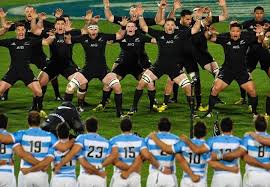
Why the All Blacks Will Do Kapa O Pango Against Argentina

The All Blacks will play the Argentinian Pumas this Saturday night in Nelson. This is the first time the All Blacks have played in Sun City, and as a result it’s expected to be the biggest thing ever to happen here. Only one thing is more certain than an All Black win – and that’s the fact that the All Blacks will do Kapa O Pango and not Ka Mate on Saturday night.

As most people are aware, the All Blacks have two hakas: the traditional Ka Mate, composed by Te Rauparaha around 1820, and the modern Kapa O Pango, composed this century. A smaller number know that Te Rauparaha was some kind of warlord and that Kapa O Pango came in during Tana Umaga’s time as All Black captain.

Te Rauparaha was indeed a war hero – to some. To others, he was every bit the war criminal as other war leaders tend to be viewed as by the people they attacked. He played a leading role in the Musket Wars as a war chief of the Ngati Toa. Armed with musketry, Te Rauparaha’s forces swept all the way down to Kaiapoi, and along the way he carried out some of the most ruthless genocides ever seen in Polynesia.

As this article luridly describes, the existing residents of the South Island were exterminated in a campaign of brutality that would have appalled even the men who destroyed the Aztec Empire under Cortez. Mass murder followed by cannibalism and enslavement of any survivors was the standard practice of war parties in the New Zealand of the 1820s, and the forces under Te Rauparaha were not an exception.

By the early 1840s, the Northern South Island was almost completely depopulated, which made it ripe for European settlement. Nelson and Blenheim were early growth centres on account of this; the road between them, where the Maungatapu Murders took place, was once a relatively busy highway, even if it could only be traversed by horse and cart or by foot.

This is the reason why Nelson has the honour of many national firsts – such as the the location of the first rugby match ever played in New Zealand, an 18-a-side affair at the Botanical Gardens, near the Centre of New Zealand.

So to say that Te Rauparaha is not well thought of by the Maori tribes local to the Northern South Island, or what’s left of them, is an understatement, akin to saying that Adolf Hitler is not well thought of among Poles. For the All Blacks to perform a haka written by him, on the same grounds where he committed possibly the worst atrocities New Zealand has ever seen, would be too great an insult for the local Maori to bear.

Steve Hansen and Kieran Read, ever the master strategists and culturally acute on account of being in charge of New Zealand’s single most successful example of intercultural co-operation, are entirely aware of this, and will no doubt avoid performing the haka that has particular sinister connotations to the local Maoris of Nelson. No surprises: we will see Kapa O Pango this weekend.

*

If you enjoyed reading this essay, you can get a compilation of the Best VJMP Essays and Articles of 2017 from Amazon for Kindle or Amazon for CreateSpace (for international readers), or TradeMe (for Kiwis).