
Demographer Dan McGlashan Explains This Week’s Horizon Research Cannabis Poll

My name is Dan McGlashan, and I am the author of Understanding New Zealand, a demographic study of the Kiwi people. In this article, I will explain the results of the recent cannabis law reform poll by Horizon Research, which broke down support for the upcoming cannabis referendum by party affiliation and age.

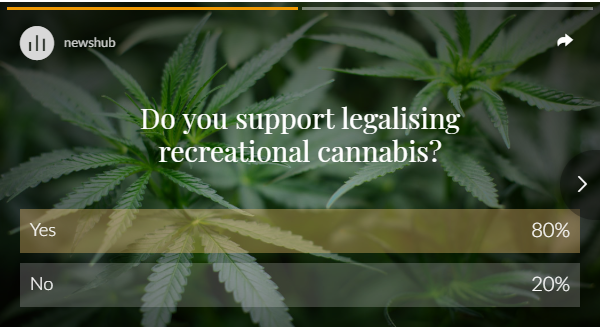
60% of New Zealand adults would vote to legalise the recreational use of cannabis on the upcoming referendum, according to the poll, with only 24% against. 16% had no opinion. Broken down by party support, 84% of Green voters would vote yes, with 63% of Labour, 56% of New Zealand First, 49% of ACT and 33% of National voters doing likewise.

The Green, Labour and National votes don’t need much explaining. The Greens have always been the strongest supporters of cannabis, apart from the Aotearoa Legalise Cannabis Party. Likewise, National has always opposed any effort to reform the laws. Many readers were surprised, however, to learn that support among New Zealand First voters is stronger than support among ACT voters.

In Understanding New Zealand, I showed which demographics were the strongest supporters of cannabis law reform, by correlating those demographics with support for the ALCP.

The average cannabis law reform supporter is – on average – young, poor, Maori, uneducated and with an especially high chance of suffering from a debilitating physical or mental illness. These demographics are all disenfranchised ones, which is why there is a strong association between being a cannabis user and having a difficult life. They are also the ones most heavily impacted by cannabis prohibition.

Some were surprised to see that support for cannabis law reform is very high among New Zealand First voters. 56% of New Zealand First voters would vote yes in the referendum, almost as many as Labour voters. New Zealand First voters are often stereotyped as old, bitter, out of touch racists, which makes it hard to explain their heavy support for cannabis law reform.

In reality, there is a moderately strong correlation between being a New Zealand First supporter and being Maori: one of 0.38. This also helps to explain why there was a moderately strong correlation of 0.40 between voting for New Zealand First in 2017 and voting ALCP in 2017. Many will also be surprised to read that there is no significant correlation between median age and voting for New Zealand First.

In other words, the New Zealand First demographic is much younger and browner than the lazy stereotype would have it. This can be established simply from observing the extremely high levels of support gained by New Zealand First in the Maori electorates. These young, brown and poor people are reliably fans of cannabis use, despite the general social conservatism of the New Zealand First movement.

Many others were surprised to see that only 49% of ACT supporters expected to vote yes in the referendum. ACT markets itself as the party of liberty from government overreach, and one might think that this would be reflected in support for cannabis law reform, but they have traditionally been very weak on the issue, perhaps even cowardly.

The simple truth is that ACT voters are not from the demographics that care about cannabis law reform. The correlation between voting ACT in 2017 and being Asian was 0.46, but the correlation between voting ACT in 2017 and being Maori was -0.51, which suggests that very few actual cannabis smokers are ACT supporters.

Moreover, ACT voters are wealthy: the correlation between voting ACT in 2017 and personal wealth was 0.61, making their supporters their wealthiest of all. ACT voters tend to come from two major groups: rich, old, white people with all the money, and young professional Asians who don’t want to pay taxes. Neither group has any major interest in recreational cannabis.

The cannabis referendum is very likely to end up with a yes vote, because most of the opponents of cannabis law reform are old and dying off. Conservative National voters are being replaced by less conservative ACT voters, and young people mostly support it anyway. It’s enough to compare Chloe Swarbrick with the decrepit Bob McCoskrie to guess that the repeal of cannabis prohibition is inevitable.

*

Understanding New Zealand, by Dan McGlashan and published by VJM Publishing, is the comprehensive guide to the demographics and voting patterns of the New Zealand people. It is available on TradeMe (for Kiwis) and on Amazon (for international readers).
The Case For Cannabis: Drugs Are Not Categorically Bad

“Drugs are bad, mmmmmkay?” goes the South Park joke. Mr. Garrison’s catchphrase satirises the near-total absence of thought that the Establishment has put into their anti-cannabis rhetoric. The idea is that drugs are bad, and cannabis is a drug, therefore cannabis is bad, and therefore cannabis prohibition is justified. As this article will examine, it’s not that simple.

The popular conception of what the word “Drugs” means is highly variable. Some people consider any foreign substance taken into the body to be drugs. Other people say that anything not prescribed by a doctor is drugs; once it is prescribed it magically becomes medicine. Still others contend that drugs are anything that are bad, and anything not drugs is good.

The kind of person who makes the argument that drugs are categorically bad is usually the sort of person who is obsessed with purity. Inevitably they are a wowser of some kind, and they fit into two categories: the first some kind of physical health freak, the second some kind of religious freak. Their belief is that cannabis disrupts physical and spiritual health, respectively.

The physical truth about many drugs, like most substances that one could put into the body, is that healthy and unhealthy use is a primarily a matter of dosage. The most obvious example is salt, where too much or too little will leave a person in poor health. Some might counter here that a lack of cannabis will not make someone sick, but that’s not true in many medicinal cases.

Another example is amphetamines. There are many amphetamines that are basically the same substance as what one finds in ADHD medicines – in other words. The major difference is that the crackhead takes it in much, much heavier doses than what a doctor would recommend.

A small amount of cannabis will not hurt a person, unless they are extremely sensitive to smoke or similar. In fact, a small amount might greatly help a person, especially if they suffer from one of the hundreds of different conditions that cannabis is known to treat. By the same token, smoking a hundred joints a day will be bad for you almost without a doubt.

In any case, the fundamental point is that this argument is misdirected. If a particular dose of a particular substance is bad, then don’t use it. It’s a simple as that!

It’s possible that a blanket admonition against drugs along the lines of “drugs are bad” is a good idea if you are a parent speaking to a ten-year old child. Someone without the mental sophistication to make good decisions might need it. But it’s no basis for a national law that governs young and old alike.

Adult citizens are not like children, and need to be spoken to honestly. The positive and negative effects of all drugs need to be spoken about honestly, and the citizens need to be informed with reference to reality and science. If this does not happen, then the risk arises that those citizens lose trust in doctors and Government officials, and then movements like the anti-vaxx one start to crop up.

Cannabis should not be illegal because “drugs are categorically bad”. This is a child’s logic, and it should not be informing the national cannabis policy. We need to move on from these simplistic thought patterns, because they do not describe the reality of the situation, and absent that people cannot make correct decisions.

*

This article is an excerpt from The Case For Cannabis Law Reform, compiled by Vince McLeod and due for release by VJM Publishing in the summer of 2018/19.

The Case For Cannabis: Prohibition is a Waste of Money

People often talk about cannabis prohibition as if it was just a law and that was that. The reality is that enforcing cannabis prohibition not only costs a large amount of money, but it also prevents a large amount of money from being made. As this article will argue, cannabis prohibition is a colossal waste of money, so much so that it’s worth repealing it on that basis alone.

The cost of cannabis prohibition is close to half a billion dollars a year. This is comprised of two groups of costs: the direct cost of enforcing prohibition, and the opportunity cost of prohibition.

The direct cost of enforcing prohibition chiefly includes prison costs, court costs and Police costs.

According to an estimate made by the New Zealand Treasury, New Zealand spends about $400,000,000 dollars every year on enforcing cannabis prohibition, and is missing out on $150,000,000 of GST on cannabis sales. This means that, according to the New Zealand Government itself, the opportunity cost of enforcing cannabis prohibition is over half a billion dollars a year.

A study by Harvard economist Jeffrey Miron estimated that the American federal government spends USD8,700,000,000 annually on enforcing cannabis prohibition. Adjusted for population size and currency, this suggests that something in the range of $200,000,000 is spent annually in New Zealand to enforce cannabis prohibition (this includes court and prison costs as well as Police costs).

Potentially much greater than this is the opportunity cost of prohibition.

The Miron report linked above suggested that America loses a similar amount from taxation opportunities to what it loses from having to pay to enforce prohibition. Converted to the scale of New Zealand, that suggests that around $200,000,000 in potential tax revenue from legal cannabis sales are instead funnelled into the pockets of criminal gangs.

Other studies suggest similar figures. According to Shamubeel Equab, who wrote a report commissioned by the New Zealand Drug Foundation, up to $240,000,000 could be claimed in tax annually from a regulated drug market.

This is supported by other calculations. The state of Colorado, with a similar population to New Zealand, sells $2,000,000,000 worth of cannabis a year. If a similar amount was sold in New Zealand, that would mean that $300,000,000 of GST would be collected on it.

So, as mentioned earlier, the combined cost of all of the aspects of cannabis prohibition is about half a billion dollars per year.

This is a lot of money for something that arguably has no benefit at all. Even if one charitably conceded that a majority of people wanted cannabis prohibition (they don’t), or that cannabis prohibition prevented a significant amount of cannabis getting into the hands of young people (it doesn’t), $400,000,000 is a great deal of money, especially when considered on an annual basis. It’s about $150 a year for every taxpayer.

Had the Fifth National Government legalised cannabis at the start of their term in 2008, New Zealand would have already saved at least $4,000,000,000. The asset sales campaign run by the National Party raised barely more than this, and that was at the draconian cost of losing ownership of these assets forever.

It sounds incredible, but it’s hard to deny the maths. If the Fifth National Government had legalised cannabis instead of selling state assets, they would have raised almost the same amount of money – without losing ownership of the assets. They sold the country out from under us for effectively nothing.

Worst of all is that New Zealand is borrowing money from overseas sources to pay for the deficits that we’re running in order to finance this prohibition. So not only did we not save $4,000,000,000, but we’re paying interest on those billions – just to imprison our own young people for growing medicinal plants.

Cannabis prohibition should be repealed because it simply isn’t worth the money. The total losses to the New Zealand economy from cannabis prohibition cannot be justified – even if it was charitably conceded that there was some benefit to prohibition. It would be much better to make cannabis legal, which would save hundreds of millions currently wasted on enforcement, as well as gathering hundreds of millions in tax revenue.

*

This article is an excerpt from The Case For Cannabis Law Reform, compiled by Vince McLeod and due for release by VJM Publishing in the summer of 2018/19.

Why the New Zealand Working Class is Destined to Turn to Fascism

With the signing of the UN Compact on Migration, the Sixth Labour Government all but assured that the New Zealand working class will turn to fascism. They won’t do so straight away, and many will claim that they won’t do so at all, but the snowball has been set in motion. This essay will explain why.

From the turn of the century in Europe, a new pattern started to emerge: the resurgence of anti-globalist sentiments. Globalism had dominated the world for the previous half-century. Nationalism was comprehensively defeated in World War II, and the next fifty years were characterised by anti-protectionist trade agreements that liberalised commerce and trade all over the world.

Western workers were promised that this liberalisation would lead to better living conditions, as their wages would be able to buy goods and services more cheaply and efficiently. The reality turned out to be the opposite. Western workers turned out to be the product, and trade liberalisation simply meant that international companies could play workers in different countries off against each other, bidding their wages down to the floor.

Eventually the globalist propaganda stopped being effective, as people started to see through it. They realised that they had been cheated – not only were they not richer, but they now had to live with the effects of the mass importation of cheap labour into their communities. This meant increased violence, increased property crimes and increased sex crimes, all of which the elite were safely inured from by virtue of living in wealthy neighbourhoods.

The European working class were brutalised by globalism. Their wages went down, their neighbourhoods became less safe, and on top of it all, they were regularly humiliated by the same political class who claimed to represent them. Leftists habitually dismissed working-class concerns as “bigoted” or “motivated by racism”, as if it were unreasonable to complain about the destruction of one’s community or of the possibility of raising a family on one wage.

This sentiment has found increasing expression in fascism. At the last Swedish General Election, the Sweden Democrats won 17.6% of the vote. The globalist parties refuse to co-operate with them, and as a consequence the country has been ungovernable for the last 100 days. In Germany, opinion polls are suggesting that the Alternative Fuer Deutschland now has as much support as the major social democratic party, which suggests that the government of Europe’s largest economy risks falling into a similar state of paralysis.

New Zealand is merely a few decades behind on this same miserable path of social decay.

You’d have to be insane to vote National as a working-class person. Not only do they want to cut all of your social assistance, but they also want to import the same hordes of cheap labour that has destroyed Europe over the last 40 years.

But you’d also have to be insane to vote for Labour. The New Zealand Labour Party has long ago replaced all of its working-class sentiments with bourgeois ones. As a result, they’re right behind the UN’s Global Compact on Migration. This follows in the same vein as the recent increase in the refugee quota, and is commensurate with Jacinda Ardern’s ambition to become a highly-ranked UN official.

As a working-class person, an increase in the refugee quota, and an liberalisation of the ability of cheap labour to move here, have a number of terrible consequences.

The first and most obvious is the destruction of the economic position of the working class. The economic position of those who sell their labour for a living is entirely dependent on the supply of that labour. Basic economics tells us that if the supply of cheap labour goes up, the wages go down. So the more people who are let into the country to compete with the working class, the lower the standard of living becomes.

Even worse is the destruction of the social position of the working class. Instead of being seen as economically disadvantaged individuals who might need extra social assistance, the working class (especially the white working class) are now seen as enjoying privilege that refugees don’t have. They now find themselves facing verbal abuse for defending their own class interests by opposing globalisation.

These consequences come on top of the changes brought by the last 30 years of neoliberalism, which has changed the position of the working class from an essential part of the nation to a disposable commodity to be bargained down to the cheapest possible price. The net result of it all is a deep sense of humiliation, rage and betrayal.

If the working class feels like the left has abandoned them (perhaps because the left has become captured by bourgeois interests), they will find an alternative from outside the right-left liberal democratic dichotomy. There is ample historical precedent for this – indeed, it was a deep sense of anger among the working class that led to Mussolini and Hitler taking power in their respective countries.

The Maori working class will be the most receptive to the fascist message. This is apparent from their existing high level of support for the (supposedly) nationalist New Zealand First party. This particular group has already lost their social position from colonisation, and are not at all keen to lose it again to what is effectively more colonisation. They will be among the strongest supporters of fascism in New Zealand.

If the left react to this intensifying sense of abandonment by lecturing the working class about how they are racist, and how they are selfish, and how they need to sacrifice more to do their share of helping out, then a fascist resurgence is all but guaranteed. As Emmanuel Macron recently proved in France, nothing will amplify the fury of the working class more than to inflict moral lecturing on top of their economic and social suffering.

The New Zealand working class will turn to fascism because the two mainstream parties are co-operating – and will continue to co-operate – to take measures that will destroy the economic and social position of that class. The inability of the working class to find expression within the liberal democratic system will lead to them destroying it by supporting a fascist alternative as soon as one arises. The New Zealand Establishment will not heed the lessons of history.

*

If you enjoyed reading this essay, you can get a compilation of the Best VJMP Essays and Articles of 2017 from Amazon for Kindle or Amazon for CreateSpace (for international readers), or TradeMe (for Kiwis).