New Zealand Alcohol Culture
for those who have seen beyond

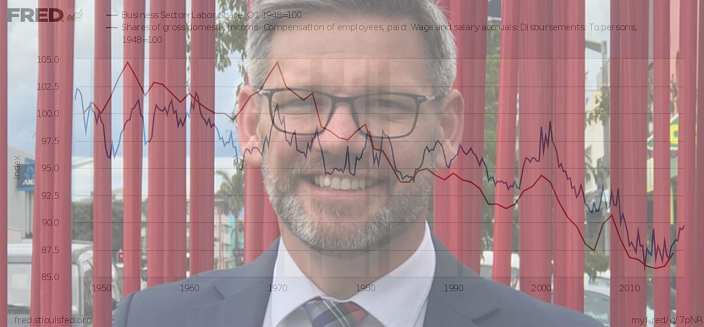
Any last hope that the Sixth Labour Government was still operating on behalf of the New Zealand working class was dashed earlier this week by the announcement of new working visa rules. “Up to 30,000 businesses across the country will benefit” from Labour’s latest kick to the guts of the marginal workforce. This essay explains.
Immigration Minister Iain Lees-Galloway claims that the new work visa rules will “assist between 25,000-30,000 businesses to fill shortages.” Unsurprisingly, the mainstream media is spinning this as a victory for New Zealand businesses, which it undoubtedly is. What they don’t mention, however, is how it’s a commensurate loss for the New Zealand working class.
As this page has previously pointed out, the wage of working-class people is a function of the supply of cheap labour. Increase the supply of cheap labour, as the “Labour” Party have done here, and you weaken the bargaining position of the working class. The more cheap labour there is, the greater the choice for the employers – and they will choose the cheapest labour they can, this being one of their greatest expenses.
The way the economy is supposed to work is that labour shortages force businesses to increase the wages they pay, which leads to marginal workers becoming attracted to those offers. The way the economy works in Clown World is that labour shortages cause employers to go crying to the Minister of Immigration, who fast-tracks visas for cheap labour to move here and undercut the native working class.
The sad truth is that the Labour Party is just as neoliberal and just as beholden to corporate interests as the National Party is – and neoliberals love mass immigration. The only difference is that the Sixth Labour Government is willing to throw the working class a bone in the form of a Winter Heating Allowance, a referendum about cannabis law reform or a bit of money to our mental health system (or what passes for it).
When it comes to actually running the country, however, they’re still very much in bed with the large New Zealand employers, and they still run the country more or less on instruction from those employers. The sad irony is that there was once a time when the Labour Party did stand for the New Zealand worker, and would have heavily criticised a move like this had it been National who brought it in.
Today’s Labour Party is unrepentantly the heir of Rogernomics. Protecting the negotiating position of the New Zealand worker is of no interest to them. Neoliberalism is still very much the way forwards, and the ever-rising suicide rate just something to be shrugged off, despite that adverse economic conditions contribute greatly to it.
The New Zealand media plays an essential role in manufacturing consent among the public for moves like these. Being entirely owned by foreign finance companies and banking interests, the media is beholden to people who profit handsomely from mass immigration driving up housing prices, increasing demands for mortgages and lowering wages.
This is why the media constantly runs stories with titles like “Growers say fruit will rot unless govt speeds up migrant worker decision,” “Labour shortage as Auckland construction ‘goes off’,” and “Why horticulture industry is facing a labour shortage.” These stories are effectively propaganda pieces, run on behalf of corporate interests, to massage the New Zealand population into accepting the mass importation of cheap labour.
Notably, no trade unionist was asked for their opinion on the Government’s move.
One of the stories linked above quotes ACT Party leader David Seymour as saying there simply aren’t “enough New Zealand workers willing to pick [the fruit].” This is a complete lie, because it leaves out half of the equation. Seymour’s sentence makes no mention of the wages being offered. The full sentence should read “enough New Zealand workers willing to pick at the wages being offered.”
Seymour, the consummate neoliberal, loves nothing more than importing cheap labour for the benefit of capital interests and at the expense of the native working class. As Dan McGlashan showed in Understanding New Zealand, no other party has a higher proportion of foreign-born voters than ACT, with a correlation of -0.74 between being born in New Zealand and voting for ACT in 2014.
Short-term opportunism can be expected of Seymour, who knows no loyalty other than to the dollar. It’s a real shame when this mentality guides the actions of the supposed social democrats. If the Labour Party won’t take measures to strengthen the negotiating position of the New Zealand working class, then who will?
The alliance of politicians, corporations and media make it all but impossible for the New Zealand worker to get a fair deal today. Given that the cost of housing is rising much faster than wages, which are already nowhere near high enough to buy houses on, a fair deal seems like it’s getting even further away. An entirely new socioeconomic arrangement is becoming necessary, perhaps one based around a universal basic income.
*
If you enjoyed reading this essay, you can get a compilation of the Best VJMP Essays and Articles of 2018 from Amazon for Kindle or Amazon for CreateSpace (for international readers), or TradeMe (for Kiwis). A compilation of the Best VJMP Essays and Articles of 2017 is also available.
If you would like to support our work in other ways, please consider subscribing to our SubscribeStar fund.
Money – pūtea
A mafia godfather is on the phone in his office. An underling comes up to him and says “I’ve got your money.” The mafia godfather points to the top of his desk and says “Put ‘er here.”
Money (II) – moni
A bank robber is making a get away in a car with a back seat full of cash. The cash in the back seat keeps complaining about being stolen money, so the robber says “Can you guys stop being so moany?”
Bank – pēke
A man is climbing a mountain range, and as he comes close to the top he discovers a bank hidden among the peaks. He found the bank once the mountains started getting peaky.
Cash – ukauka
A man walks into a brothel, and says to the madam “I want two women at the same time.” The madam motions to a room where two women are waiting and asks “Cash or card?” The man hands over a sheaf of twenty dollar notes. He pays cash for hooker hooker.
Account – kaute
A man walks up to a bank teller, who is in the process of putting on a heavy lambskin coat. The man says “I’d like to check my account.” The teller says “Sure, just let me get coated.”
Loan – pūtea taurewa
Two women are sitting beside each other on a tour bus. One of them says “I’m going to have to end the tour soon because I’m running out of money.” The other woman says “I got an enormous loan so I won’t have to end the tour ever.”
Savings/Investment – pūtea penapena
A tribe of pens elect one of their number, the greatest, as their leader. He is the pen of pens. The first thing he does is go into a bank and opens a savings account.
to save – whakaputu
A woman walks through a shopping mall with two demons on her shoulders telling her to buy this and buy that. They want her to buy everything. She says to them “Fuck up, you two, I’m trying to save.”
to spend – whakapau
A woman looks at a bank of computer equipment as a man explains his security camera arrangement. She says “You must must have spent a lot of money.” The man says “I spent money on professionals because I wanted to avoid a fuckup.”
Overdraft – tarepa
A man dressed as a fur trapper enters a bank. He is carrying some fur traps in one hand and some furs in the other. He puts the furs on the counter and says “I’d like to pay off my overdraft.”
Mortgage – mōkete
A man walks into a house with an armful of kettles. His wife is inside, and she asks him “Did we get the mortgage?” The man replies “Yes, so I thought I’d celebrate with more kettles.”
EFTPOS card – kāri utu ā-hiko
A woman is trying to buy something at a dairy. She is holding out her EFTPOS card and waiting. The girl behind the counter is trying to hiccup and this is preventing her from setting up the EFTPOS terminal. The EFTPOS card won’t get used until the girl behind the counter can carry out a hiccup.
*
This wordlist is an except from Learn Te Reo With Mnemonics, a book being compiled by Jeff Ngatai for an expected release at the beginning of 2020.
If you would like to support our work in other ways, please consider subscribing to our SubscribeStar fund.
With news that the New Zealand Government will make the teaching of New Zealand history compulsory in schools from 2022, many are wondering what form this history will take. Napoleon said “History is a set of lies agreed upon,” and many Kiwis are skeptical that this new history will be accurate and fair. These concerns are warranted. This essay summarises the New New Zealand History in six words: White Man Bad, Brown Man Good.
The move by the Sixth Labour Government has been heavily criticised by commentators such as Anarkiwi, and for good reason. Government initiatives to “tell the real truth about history” always end up being indoctrination campaigns, launched to brainwash the population into supporting a particular agenda. The history that will be taught in New Zealand schools will be a set of lies agreed upon (although your input will not be sought).
Central to the New New Zealand history is the idea that there was no benefit to the Maori from colonisation, only losses. Maoris did not benefit from medicine, or a justice system, or from sanitation, or from infrastructure, or from technology. All of these things are either presumed to have no value, or it is assumed that Maoris would have developed them anyway without British help.
This New History will follow a Rousseauean conception of human nature, in which uncivilised man is a “noble savage”, morally superior to civilised man. The civilised man is, according to this conception, much like the stereotypical Jewish merchant. He schemes, he swindles, he extorts and steals, and he does so without shame or scruple. Uncivilised man, by contrast, lives in a state of perfect harmony with his environment.
In the New New Zealand History, civilisation descended on these isles like a black wave of corruption and evil. Technology, law and order are considered to be negative things that lured the Maori out of his state of innocence. This allowed for land to be swindled out of the Maori tribes much like candy from an innocent baby in the crib.
Part of this New New Zealand History will be the enshrinement of the special status of Maoris as those people who live here by right, whereas every other race has a conditional residency status contingent on “upholding the Treaty”. The idea is that the continued presence of non-Maoris in New Zealand is dependent on the permission of Maoris. This will see an increase in the use of vocabulary like ‘tangata whenua’ and ‘tauiwi’ (the latter being the Maori equivalent of ‘goyim’ or ‘kaffir’).
Anything that doesn’t fit the White Man Bad, Brown Man Good narrative will simply not be taught.
The Musket Wars, during which 40,000 Maoris were killed by intertribal wars launched by Ngapuhi chief Hongi Hika, will be glossed over, summarised or simply ignored. One can confidently predict that the New New Zealand History will begin in 1840, as if New Zealand had come to Earth already perfectly formed, a last-minute addition direct from the mind of God.
Another thing that won’t be taught is that some 150,000 Maoris have emigrated away from New Zealand to Australia, which offers the same wealth and prosperity that colonisation brought to New Zealand, only more so. Neither will it be taught that Maoris are, on average, five times wealthier than the average Tongan.
Tonga was never colonised, and the fact that Tongans willingly move to New Zealand in far, far greater numbers than Maoris willingly move to Tonga is solid evidence that Polynesian natives prefer the benefits of Western life to the sort of life that existed previously. Actions speak louder than words, after all, and Polynesians have clearly shown with their migration decisions that the Western life is better.
Neither will the ecological consequences of Polynesian settlement get a mention. We won’t hear a word about the extermination of pre-existing megafauna such as the moa and the Haast Eagle. Neither will we hear anything about the fact that Maori settlers in the South Island destroyed 40% of its forest cover within the first 200 years.
The Parihaka story (or at least the Green Party version of it), on the other hand, will play a central role. This story paints Maoris as Gandhi-like figures of peace, and the British as Genghis Khan-like murderers and rapists, and is therefore emblematic of the New New Zealand History. Doubtlessly we will see renewed calls for a Parihaka Day, which is to be another grievance day.
Genuine grievances will not be mentioned if that doesn’t fit the agenda. The destruction of Maori religious and spiritual traditions by Abrahamists suits the Government fine, as does the imposition of recreational alcohol culture on a people who had no genetic resistance to it (and the criminalisation of the recreational cannabis culture that they preferred). Both of those things serve the agenda of tightening control on the thoughts and behaviours of the people.
The actual purpose of the New New Zealand History is manyfold, but it achieves two major objectives from the point of view of those bringing it in.
First, it divides Maoris between those who are New Zealand nationalists and those who are Maori nationalists. The New Zealand nationalists tend to be assimilationists who would rather get on with things and declare old history to be water under the bridge. The Maori nationalists tend to be separatists who understand that their power comes from stoking grievance and dissatisfaction.
The New New Zealand History splits these two groups apart by teaching a grievance narrative that has white people and Maoris at each other’s throats. Those Maoris who are New Zealand nationalists are made to feel as if they are betraying “their own people” by remaining loyal to New Zealand. On the other side, white people with sympathies to Maoris will have them tested by a narrative that places Maoris in the role of accuser and prosecutor and white people in the role of defendant.
Second, it divides the rest of the population between those who tell the truth and those who are on board with the new fashion. Inevitably, those who maintain that Maoris benefitted from colonisation will be decried as old-fashioned and out of touch with the “new learning”. They will be pilloried as racists and bigots and we will hear that society would be better without them.
The New New Zealand History is, like most United Nations-driven novelties, a set of lies intended to further a globalist agenda. It’s closely related to the movement known as Brown Communism, which is a form of slave morality intended to divest white and Far East Asian people of their wealth. Like most sets of lies, the way to counter it is to remain steadfast to the truth, no matter how unfashionable that becomes.
*
If you enjoyed reading this essay, you can get a compilation of the Best VJMP Essays and Articles of 2018 from Amazon for Kindle or Amazon for CreateSpace (for international readers), or TradeMe (for Kiwis). A compilation of the Best VJMP Essays and Articles of 2017 is also available.