
Nationalists Won 10% in Aussie – Could They Do The Same in New Zealand?

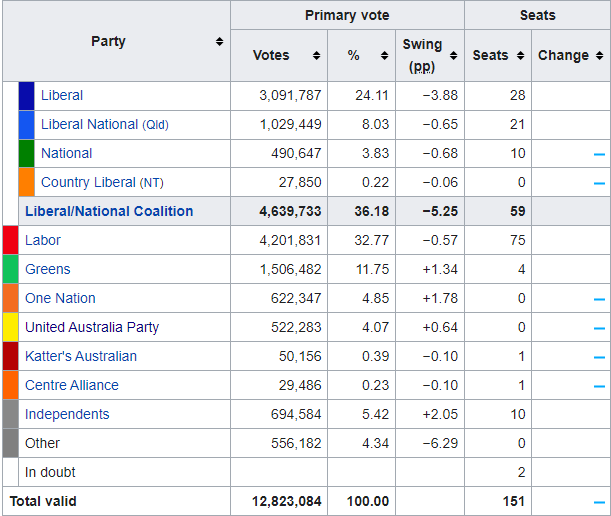
The Australian Federal Election earlier this month saw incumbent Prime Minister Scott Morrison thrown out for Labour Leader Anthony Albanese. Although this was predicted by many, few predicted how little support the two major Establishment parties would get. Even fewer predicted such a strong nationalist vote.

Australian dissatisfaction with the ruling class has not been this high ever. In 1910, Labor and the Coalition combined won 95.1% of the vote. In 1949 they won 96.3%. As recently as 1993 it was 89.2%. But after the advent of neoliberalism, support for Establishment parties has collapsed.

By 2010 the combined vote for the Establishment Left and the Establishment Right had fallen to 81.3%. By 2013 it was 79%, by 2016 it was 76.7%, by 2019 it was 74.7% and by 2022 it was 68.9%. The pattern is stark and unidirectional. Support for the Establishment in general is falling fast in Australia, as it is in most other Western countries.

This falling support for the Australian Establishment reflects the falling standard of living across the Western World. People are less satisfied than ever about the way their countries are being run. Housing is rapidly becoming unaffordable even in countries as wealthy as Australia – the average house price in Sydney is now AUD1,600,000, which is an enormous amount of money even with Aussie wages.

Like most Westerners, Australians feel like they’re getting poorer, and have done for a while. Not only is the increasing cost of living making it hard for Australian families, but there is no sign on the horizon of things getting any better. Elections are often won or lost on economic perceptions. As such, it’s not surprising to have seen a swing against the incumbent powers this year.

A more surprising feature of the 2022 Australian election was the resurgence of nationalist movements.

Pauline Hanson’s One Nation Party was the 4th biggest party, with 628,254 votes, and Clive Palmer’s United Australia Party was 5th with 522,283. Adding Bob Katter’s Australian Party takes the nationalist vote to over 9%. Considering the nationalist sentiments of some of the independents it is fair to suggest that the full nationalist vote was around 10%.

This nationalist vote is the result of increasing awareness of the failures of globalism. Australians, like most Westerners, have now figured out that globalism just means lower wages, higher rents, and more crime. All the benefits that we were promised accrued to those who already had wealth. The rest of us just lost out.

The globalist Establishment doesn’t care about the electorate swinging back and forth on the left-right spectrum. They control both the left and the right anyway. What they’re really worried about is a resurgence of nationalism. This creates the possibility of putting someone in power who the Establishment doesn’t already control.

The two major nationalist movements in Australia together won about 10% of the total vote, which raises the question: could a similar nationalist movement win 10% of the vote in New Zealand?

The collapse of the New Zealand First Party (polling at a mere 1% according to latest numbers) means that nationalist narratives have fallen out of the popular consciousness in New Zealand. The mainstream media, on behalf of its globalist owners, presents us with a choice between the globalist left and the globalist right. Nationalist ideas are unthinkable.

But if nationalist movements can get 10% of the vote in Australia, there’s every reason to think they could do similarly well in New Zealand. Kiwis have also been poorly served by globalism, which has also sent our productive capacity overseas while flooding our neighbourhoods with cheap labour. We have very similar attitudes to Australians when it comes to such things.

It would certainly be an uphill struggle.

Because nationalism is equated so closely to Nazism in the propaganda and brainwashing machine that is the mainstream media, any new nationalist movement in New Zealand could expect to get smeared as white supremacists immediately, and compared to Brenton Tarrant.

But nationalist movements have done well in New Zealand before. New Zealand First won 10% of the vote as recently as 2002, as voters realised that Helen Clark was happy to destroy the New Zealand working class through the mass importation of cheap Third World labour, and sought an alternative.

The Establishment has worked hard to smear New Zealand First as a racist party (despite Dan McGlashan showing that pro-NZF sentiments are stronger among Maoris than among anyone else). If Peters’s party makes a resurgence, as some are predicting it to, or if a new nationalist movement rises up, the wrecking machine will surely swing into action again.

If one unified nationalist movement won 10% of the seats in the New Zealand, they could easily draw concessions from either of the globalist right or the globalist left blocs. An end to the War on Drugs as well as an end to the mass importation of Third World cheap labour might be possible.

*

If you enjoyed reading this essay/article, you can get a compilation of the Best VJMP Essays and Articles from 2021 from Amazon for Kindle or Amazon for CreateSpace (for international readers), or TradeMe (for Kiwis). A compilation of the Best VJMP Essays and Articles of 2020, the Best VJMP Essays and Articles of 2019, the Best VJMP Essays and Articles of 2018 and the Best VJMP Essays and Articles of 2017 are also available.

*

If you would like to support our work in other ways, subscribe to our SubscribeStar fund, or make a donation to our Paypal! Even better, buy any one of our books!

Own Or Be Owned

Most Westerners are starting to realise that their positions are little better than those of chattel slaves. The average Western worker now understands that they will never own their own home, no matter how hard they work, because the house price to income ratio is too high. Awareness of this state of affairs is causing widespread misery.

If you control land, you also control the people on that land. It follows that anyone who doesn’t own land is the slave of those who do. Non-landowners, as a class, are effectively put to work by the landowner class. Proof comes from the fact that the average hours worked to pay rent alone is not much less today than the average hours worked full stop during the medieval era, despite centuries of labour-saving technological advancements.

If you don’t own land, you have to pay rent to someone who does, otherwise you die of exposure to the elements. If you try to live on land that you don’t own without paying rent, the Police will come to smash you and throw you out into the street. So in order to make money to pay rent, you have to labour for a second landowner, who takes profits out of your productivity. Then you have to pay income taxes to the Government, representing the landowner class in the abstract.

This arrangement was tolerable when the worker had enough money left over, after profits, taxes and rents, to enjoy a decent standard of living with a decent amount of leisure time. But this hasn’t been the case for decades now. Moreover, it is getting worse. The average worker now labours all week, often 50-60 hours, and is left with almost nothing after the landowners have taken their cuts.

The reason why this state of affairs is so heavily resented is because it’s reminiscent of a state of barbarism. To labour all week and be left with nothing is similar to the system that existed when we were earlier primates, where might makes right and anything you can extort out of another person is legitimately yours.

In a state of Nature, your options are: own or be owned.

Males of sexually reproducing species compete for territorial dominance, because this implies control of the resources in that territory. Whoever can establish that he is willing and able to kill the other also wins the ability to control all the resources of that other. Because females of sexually reproducing species are primarily concerned that their mates demonstrate a capacity for resource acqusition, there is a strong incentive for males to own as much as they can.

In human society, the most valuable thing you can own is other people. Ownership of women allows you to control reproduction. Ownership of men allows you to control resources. Ownership of both allows you to control society. Owning people is heavily incentivised because the more people you own, the more secure your position.

Most people in our supposedly free societies are owned, little different from livestock. This is especially true of those who labour all week but are left with nothing after profits, taxes, rents and basic living expenses are paid. This isn’t categorically different to how a unit of livestock produces e.g. a certain volume of milk but is not paid for it.

Some other people are owners. In every stable society, this ownership class raises a police force from among the owned. This police force is then paid, and paid well, to enforce the ownership claims of the ownership class. Without such a system, a society will collapse into violence over control of land. As such, a police force that smashes anyone who questions land ownership rights is essential for stability.

Wealth, throughout history, was primarily a matter of how many other people you owned. If you were the patriarch of a large family, you might control a dozen other people. A chieftain of an average village might control a dozen dozen. The lord of a fiefdom might control a dozen dozen dozen.

Today, people are owned indirectly, through owning the land underneath them. This allows for great profits without having to go through the hassle of managing people. The owners of tenement housing don’t have to worry about what their tenants do with their days, as long as they pay the rent and don’t damage the housing stock.

If life as a non-human animal is kill or be killed, life as a human is own or be owned. Class and caste systems can be seen as ways to formalise the ownership arrangement so that societies suffered less internal conflict.

*

If you enjoyed reading this essay/article, you can get a compilation of the Best VJMP Essays and Articles from 2021 from Amazon for Kindle or Amazon for CreateSpace (for international readers), or TradeMe (for Kiwis). A compilation of the Best VJMP Essays and Articles of 2020, the Best VJMP Essays and Articles of 2019, the Best VJMP Essays and Articles of 2018 and the Best VJMP Essays and Articles of 2017 are also available.

*

If you would like to support our work in other ways, subscribe to our SubscribeStar fund, or make a donation to our Paypal! Even better, buy any one of our books!

VJMP Anzac Day Address 2022: A Foundation Myth for the Anzac Nation

With the news that America intends to respond to China’s move towards militarising the Solomon Islands, it seems apparent that Northern Australia will now become a militarised zone. If China does establish a base there, America will inevitably establish one to counter it in Far North Queensland. The Anzac nation seems to be preparing itself physically for war.

The Anzac nation also needs to prepare itself metaphysically for war. This must involve reflection upon why divine forces would have called us into existence in the first place.

In the opinion of this author, the Fall of Singapore could serve as a kind of origin myth for the Anzac nation. This was the closest we ever came to destruction at the hands of a hostile outside force. But thanks to the exceptional bravery and warfighting skills of our ancestors, and assistance from some close friends, we overcame that challenge.

That the Fall of Singapore was followed by Japanese defeats, at the Battle of the Coral Sea and at the Battle of Milne Bay, can be attributed to divine favour protecting the nascent Anzac nation. The foundational myth of the Anzac nation holds that this divine favour is still with us, and will guide us safely through the 21st Century and beyond.

An element of our national myth ought to be that we are inherently more likeable than our enemies, and as such have a moral right to triumph. This is because we are originally good, honest men and women who stood up to corrupt power structures and were exiled for it. This shared history is the basis of our national moral imperative of a “fair go”.

If there is to be war in or around Northern Australia, we will need to make sure to win the propaganda war at the same time. Winning this soft war will heavily influence the extent to which we are to gather support for the hard war. So we need to establish in the minds of the world that we are more likable than other nationalities.

For the most part, this will not be too difficult, because many people have had experience with Anzac travellers, and most of those experiences have been positive. For every drunken bogan we send overseas we send several cultured and educated people. So those of us who cannot contribute to the hard war can still contribute to the soft war.

The foremost work in this soft war ought to be spiritual. The most heavily-armed and most well-liked force can still lose if they don’t have spiritual wealth. Manifesting this wealth into the material world is the true work of the Anzac nation in the 21st Century.

The Anzac nation should hold, as part of our foundation myth, that we are destined the lead the rest of Planet Earth into a spiritual Golden Age. We are uniquely suited for this role owing to the fact that psilocybin mushrooms grow plentifully here, including the world’s most potent version, the psilocybe subaeruginosa.

That the world’s most powerful subspecies of arguably the world’s most powerful spiritual sacrament is endemic to the Anzac islands can only mean one thing: that divinity itself has chosen us for spiritual leadership in this new age of the world.

Australia and New Zealand already have some of the world’s most psychedelic-friendly populations. Apart from the West Coast of North America, there are few places with the widespread experience of using psychedelic sacraments that Aussies and Kiwis have. Psychedelic sacrament use is an established element of our festival culture, and any Anzac who has ever truly wanted a psychedelic experience has been able to have one.

Fittingly, Australia is the location of the world’s first psilocybin mushroom trial. Subconciously, it may be that many Anzacs understand the role of magic mushrooms in the future spiritual health of this nation. Let it be said that our role is to bring a new understanding of the perennial spiritual philosophy to the entire world.

Supporting this sentiment is the fact that Aussies are the 18th and Kiwis the 15th heaviest users (out of 164) of that other common spiritual sacrament of the Indo-European people: cannabis. We Anzacs love our spiritual sacraments, which is why we are able to produce genius-tier animated film like Choomer Island 2, one of the greatest explications of spiritual truth produced this century.

Let us let it be said that God spared the Anzac nation during World War II because God wished for us to play a role in promulgating God’s Will in the next Great Age of the Earth. In return for this favour, the Anzac nation is tasked with spreading true knowledge about spirituality and how certain natural sacramental substances can be used to reconnect with the divine.

A foundation myth that explained how we Anzacs have divine favour in all of the past, present and future is something that needs to be added to the national consciousness.

*

If you enjoyed reading this essay/article, you can get a compilation of the Best VJMP Essays and Articles from 2021 from Amazon for Kindle or Amazon for CreateSpace (for international readers), or TradeMe (for Kiwis). A compilation of the Best VJMP Essays and Articles of 2020, the Best VJMP Essays and Articles of 2019, the Best VJMP Essays and Articles of 2018 and the Best VJMP Essays and Articles of 2017 are also available.

*

If you would like to support our work in other ways, subscribe to our SubscribeStar fund, or make a donation to our Paypal! Even better, buy any one of our books!

If You Want An Alliance To Work, Leave Out The Christofascists

Suggestions did the rounds again this week that the minority parties unite under one banner. This has been a perennial suggestion since my first time in the Aotearoa Legalise Cannabis Party in 2007. Now, as then, egos prevented the suggestion from getting anywhere. One thing would make forming an alliance to get over the 5% threshold much easier: leave out the Christofascists.

Ironically, the most recent suggestion to unite was made by Brian Tamaki. But few are willing to work alongside Tamaki on account of his toxic reputation. Tamaki is a classic example of a Christofascist, Christofascism being “the political direction of all attempts to place Christ at the center of social life and history.”

Tamaki, like his fellows Elliot Ikilei and Leighton Baker, wants to use the State to smash people he hates: drug users, homosexuals and prostitutes being the usual targets. The Christian fascist logic is that these people shouldn’t be tolerated. Like other fascists, the Christofascist has a massively overflated opinion of their own moral judgment.

Christian fascists don’t work well with others. Combining the ruthlessness of the authoritarian right with the arrogance of the authoritarian centre, these fascists are everything politics shouldn’t be: narcissistic, pompous fanatics who literally believe they’re appointed by God to rule over the rest of us.

Few others are as obnoxious as the Christofascist. Like their Abrahamic counterparts the jihadists, the Christofascist exists in a perpetual state of war against all outsiders. This puts him in a mindset of antagonistic, spiteful aggression, exemplified by their rejection of cannabis law reform.

As was observed at the Wellington protests earlier this year, co-operating with Christian fascists is extremely difficult. Not only do they want to hog the stage and the PA system, but they have no respect for other points of view, are happy to negotiate on behalf of everyone else without getting their consent for it, and are willing to jump in at the last minute to steal the limelight.

This level of arrogance is not as great as the arrogance that launched the Inquisition or murdered Hypatia, but it’s getting up there. It’s an arrogance that can only be submitted to, not co-operated with. So the proposal of this essay is that we don’t co-operate with them, i.e. we leave the Christofascists to form their own party and let the true freedom movement unite under a separate banner.

This arrangement would leave New Conservative, Advance NZ, ONE Party, Vision NZ and any Brian Tamaki, Elliot Ikilei or Leighton Baker-related vehicles to form their own Christofascist party. This party could then have the policy of banning all drugs, homosexuality, prostitution, music, dancing and levity. They can even freely propose to again make it legal to rape your wife.

The non-Christofascist parties outside of Parliament won 138,455 votes in 2020, or some 4.9% of the total (New Zealand First 75,021, or 2.6%; The Opportunities Party 43,449, or 1.5%; Aotearoa Legalise Cannabis Party 13,329, or 0.5%; NZ Outdoors Party 3,256, or 0.1%; Sustainable NZ Party 1,880, or 0.1%; Social Credit 1,520, or 0.1%). If these parties would combine under one non-Christofascist banner, they could seriously challenge the 5% threshold.

Possibly this would have to be a Winston Peters-led movement in order to get enough votes, and he might reason that he has a better chance by himself with New Zealand First (which is fair, considering that he’s been in Parliament with them before). Some might not think favourably of Peters, but he has one quality that contrasts him with the Establishment – he’s a nationalist.

An anti-Establishment, anti-Christofascist alliance would inevitably be nationalist in character. As such, it’s fitting for Winston Peters and his party to be at the centre of it. This might make it hard to integrate The Opportunities Party, who are led by – of all things – a foreign ex-Goldman Sachs banker. But integration of the others would not be too difficult.

The Aotearoa Legalise Cannabis Party is already nationalist in the sense that the vast majority of their voters are New Zealand-born, and very few of their voters are immigrants. An alliance that explicitly rejected the War on Drugs could easily win the support of ALCP voters, and this would suit a nationalist vehicle, as the War on Drugs was an imported foreign concept from the beginning.

The Outdoors Party, Sustainable NZ and Social Credit have several quality candidates in (among others) Sue Grey, Vernon Tava, Chris Leitch and Amanda Vickers. If candidates like these could ally with the high-IQ Kiwis in The Opportunities Party (like Dr. Ben Peters), with a token representative from the ALCP, and under the paternal guidance of Winston Peters for one last crusade against the Establishment, they could do well.

*

If you enjoyed reading this essay/article, you can get a compilation of the Best VJMP Essays and Articles from 2021 from Amazon for Kindle or Amazon for CreateSpace (for international readers), or TradeMe (for Kiwis). A compilation of the Best VJMP Essays and Articles of 2020, the Best VJMP Essays and Articles of 2019, the Best VJMP Essays and Articles of 2018 and the Best VJMP Essays and Articles of 2017 are also available.

*

If you would like to support our work in other ways, subscribe to our SubscribeStar fund, or make a donation to our Paypal! Even better, buy any one of our books!