The First Acceptance Of Alternative Centrism

The First Acceptance of alternative centrism is the acceptance that the Establishment Right is correct when they speak of the importance of order.

Both forms of the right tend to take a more historical perspective than the left. As such, the right generally understands better than the left that the initial state of the human being is one of chaos. Early man had to contend not with rival kingdoms but with the predations of Nature, in particular the elements and wild animals.

This chaos was deadly. Nature seemed to will the death and dissolution of the bodies of early men. The first order, then, was imposed in a simple effort to survive.

At some point, an intelligent warrior among the early men would have figured out something profound: he was more likely to win battles if he had other men by his side. Through charm and threat, this intelligent early warrior would have marshalled other males in his tribe to form a war band, much like the ones seen today in places like the Amazon Basin or Papua New Guinea. The first war band whose leader commanded two dozen or so males would have quickly dominated the males of other tribes. The organisational structure of this war band would have spread, like a technology. Sooner or later various tribes would have united into a clan.

Thus began a process by which social order continued to increase – with temporary and localised setbacks – until it developed into the political world of today.

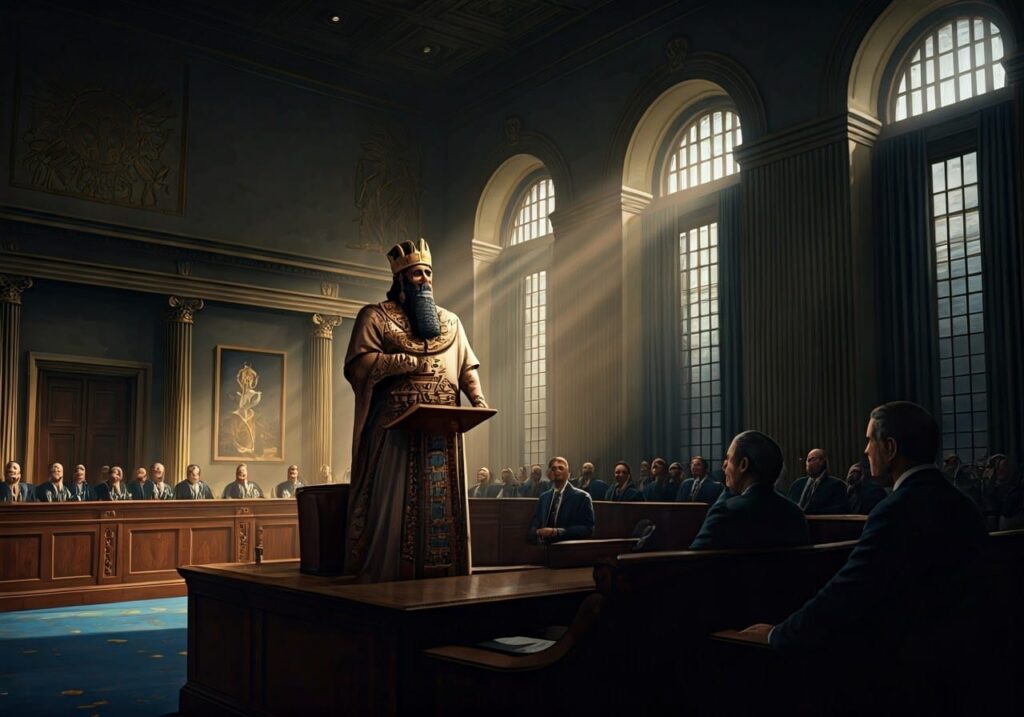
Perhaps the greatest imposition of order in human history was the establishment of law. The first full-scale lawgiving enterprise was that of Hammurabi of Babylonia, who gave us the Code of Hammurabi. The Code of Hammurabi was responsible for the order of Babylonian society – order sufficient to develop into a great empire.

Law and order are in many cases synonymous; one tends to follow the other. The Establishment Right represents the powers that imposed the initial order that created civilisation. In this sense it manifests as the warrior-king or the kshatriya class. In a modern context, the Establishment Right represents The Man, the Big Daddy who imposes order upon society.

A state of Nature is similar to a state of chaos in many respects – the most obvious being the absence of human civilisation. The Establishment Right exhorts us to accept order on the basis that, without it, there is nothing. And they’re right in the sense that, without order, humankind falls prey to the elements and to wild animals again.

Characteristic of the Establishment Right mindset is that order is to be imposed whether people like it or not. It’s too important to worry about whether others agree. The government has the right to run over people who resist the order. The Establishment Right values hierarchy, and therefore does not value consensus. This is why they also value law enforcement. The sort of person who has a “Back the Blue” bumper sticker is very likely a supporter of the Establishment Right.

This is why it’s usually members of the Establishment Right who have the least sympathy for people arrested for victimless crimes. Because order is its own good, people are obliged to obey unjust laws. This corresponds closely to the ‘Law and Order Morality’ that Lawrence Kohlberg considered to be the fourth stage in his six-stage model of moral development. This is also why it’s the Establishment Right who most strongly supports conscription.

This is also why the Establishment Right supports inheritance rights the hardest. The most orderly way to advance through the generations is for each man to inherit his father’s position. Any other sons can go into the military or the clergy. This was basically the feudal model of medieval Europe, a time that many in the Establishment Right look back upon fondly.

Related to all this, the Establishment Right likes to support any aspect of the status quo that maintains order, even if there are obvious flaws with that aspect, and even if that aspect causes immense harm to many. For example, the Establishment Right is the biggest supporter of Christianity in the West. They are also the strongest proponents of the divine right of kings.

The imperative to uphold order is why the armies of the world shoot deserters. If people are allowed to desert, order is lost, and when order is lost so is the battle. Part of the First Acceptance is accepting that the Establishment Right is correct when it says we need to shoot deserters. In fact, many unpleasant things have to be done to maintain social order.

Aristotle wrote in Politics that the purpose of politics was happiness, and that this was mostly achieved by justice. Justice, in turn, is mostly achieved by a well-ordered polis. This (like Aristotle in general) is an argument that the Establishment Right agrees with. Order is understood to be the basis of justice, and therefore of happiness. The alternative centrist is happy to accept that, without order, nothing political is possible.

The basis of the First Acceptance, then, is accepting that the imposition of order makes everything else in society possible. All the wealth and culture that exists is dependent entirely on the initial imposition of order by the first warrior-kings, and the maintenance of that order. Should that order ever be fully lost, so too would society be lost. Order is the great defensive line ensuring human survival against Nature.

To a major extent, order is imposed by fear. There’s a very strong correlation between suffering intense feelings of helplessness and trauma in childhood and growing up to become a control freak. By the same token, its often fear that creates the will to impose order. This is why populations that become afraid often react by putting the Establishment Right back in power.

The dark side of this fear-based will to impose order is, as mentioned above, control freakery. There is an element of the Establishment Right that will go into hysteria if anything changes at all, no matter how minor, believing this to be the first step on the slippery slope to chaos. This element has aspects of childishness and autism to it. The displeasure it causes is the basis of the First Rejection.

There are many historical examples of fear leading to too much order, causing unhappiness: the Inquisition, the War on Drugs, the Satanic Panic and burqas are just some. When this happens, it leads naturally to the First Rejection of Alternative Centrism.

*

This chapter is from The Alternative Centrist Manifesto, the book that offers the answers to the political problems of the West.

*

For more of VJM’s ideas, see his work on other platforms!
For even more of VJM’s ideas, buy one of his books!

*

If you would like to support our work in other ways, make a donation to our Paypal! Even better, buy any one of our books!


Clinical Narcissism: Think Lightly Of Yourself And Deeply Of The World

Guest Post by Thomas S.

According to ancient Greek mythology, Narcissus was a youth of incomparable beauty, born from the coupling of the river deity Cephissus and a nymph named Liriope. Such was his beauty that bewildered and broke the hearts of all those who chanced to see him, that the blind prophet Tiresias cautioned Liriope that her son would live a long life, so long as he never came to know himself.

Followed by wanton eyes and beseeched by the lusts and longings of hopeful lovers, Narcissus would reject all advances made upon him. This eventually led to a curse by Ameinias, who upon rejection was handed a sword with which to commit suicide, but not before appealing to Nemesis, the goddess of revenge, that Narcissus would never be able to obtain the one he would one day fall in love with.

It was after losing his way while out hunting in the forest one day, that this curse of Ameinias, as well as the prophecy of Tiresias, would eventually bear fruit. Tired and thirsty, Narcissus happened upon a pool of water, which he stooped over to drink from.

Meanwhile, a mountain nymph named Echo was weeping nearby, having been the most recent suitress to have been rejected by Narcissus after having fallen in love with his beauty and made shy advances upon him.

Interestingly, the nymph, who had been cursed by Hera, the Queen of Heaven, for having deliberately distracted her with idle gossip in order to prevent her from discovering the affairs of her husband Zeus, was only able to utter the last few words of another, and was otherwise deprived of the ability of speech.

Unable to bear the torment of rejection by Narcissus, the mountain nymph was consumed by grief and her physical form melted away, leaving nothing more than a whisper, capable only of mimicking the words spoken by another, as is our experience of an echo still to this day.

While Echo’s voice trailed away, Narcissus scooped water from the pool in order to quench his thirst. As he did so however, a charming face below the shimmering waters caught his eye and soon became the object of his own heart’s desire – an object, which as per the curse of Ameinian, would remain unobtainable to him.

Forgetting his thirst, Narcissus reached toward his own reflection, while his reflection reached upward in return, only to be dispersed by the splashing until the stillness of the waters resumed between each failed attempt to clasp his beloved’s hand.

Eventually, Narcissus gave up his life due to the torment of being unable to attain himself, and was transformed into the daffodil flower.

Like many Greek myths which are etiological in nature, the story of Narcissus offers an explanation for why observable phenomena within our human experience, have come to be.

Clinical Narcissism

In the modern day, this same phenomenon of excessive self adoration, which was also evident in ancient times and thus deserving of an origin story, has come to be known as the narcissistic personality disorder, which can also sometimes be regarded as being pathological in nature.

While a high degree of variability of character is evident in those diagnosed with the condition, such as being either socially reclusive or highly extroverted, self-loathing or self aggrandising, having a history on the right or the wrong side of the law, and demonstrating all manner of success or failure in the professional field, narcissism can be problematic to diagnose clinically.

Additionally, there are specific clinical subtypes of this condition, and while narcissism is often associated with the grandiose and overtly arrogant and exploitative stereotype, there are also those who are fragile, shy and hypersensitive to the evaluations of others while harbouring deeply envious as well as grandiose delusions.

Both subtypes however, are excessively self-absorbed and it is possible for a narcissist to fluctuate between these states, depending on life’s circumstances.

It is also possible for a narcissist to exhibit a mix of these qualities, as well as for a narcissist to be ‘high functioning’ and able to employ their character traits in order to succeed, while their competitive, attention seeking and sexually provocative traits can often go unrecognised.

Former New Zealand Prime Minister Jacinda Ardern for instance, could be described in this way, for she employed various devices and rhetoric around themes of compassion and kindness, which all turned out to have been self-serving and politically expedient tools, rather than sincere sentiments. The effects soon wore off during the tyranny which ensued during her time in office.

Despite the diversity of narcissistic personalities, there are however, several indicators which have been published by the American Psychiatric Association, which may contribute to such a diagnosis when several exist concurrently in an individual.

These indicators are as follows:

1. Has a grandiose sense of self-importance (e.g., exaggerates achievements and talents, expects to be recognized as superior without conmmensurate achievements).
2. Is preoccupied with fantasies of unlimited success, power, brilliance, beauty, or ideal love.
3. Believes that he or she is “special” and unique and can only be understood by or should associate with, other special or high-status people (or institutions).
4. Requires excessive admiration.
5. Has a sense of entitlement (i.e., unreasonable expectation of especially favorable treatment or automatic compliance with his or her expectations).
6. Is interpersonally exploitative (i.e., takes advantage of others to achieve his or her own ends).
7. Lacks empathy: is unwilling to recognize or identify with the feelings and needs of others.
8. Is often envious of others or believes that others are envious of him or her.
9. Shows arrogant, haughty behaviors and attitudes.

Of course, it is reasonable to expect that most people experience some degree of arrogance, selfishness and other character flaws, although clinical narcissism is a condition deeply affecting an individual’s self-esteem, sense of identity and their relations to others.

While the causes of clinical narcissism are not definitively known, there are indications that several factors, including genetics, childhood trauma and parenting, as well as cultural factors, may all contribute to an individual displaying a narcissistic personality disorder.

In particular, abuse, neglect, or parental overindulgence may inhibit the development of a child’s expectations in regards to themselves and other people. Adoption, divorce and losing a parent prematurely through death are also factors which may put a child at risk of developing a narcissistic complex.

Unfortunately however, many cases of emerging clinical narcissism in childhood and adolescence are left to develop without intervention through counselling or behavioural therapy. And later in life, many narcissists remain wholly unaware of their own character flaws and unwilling to admit that they could do well to improve themselves.

And while many narcissists do eventually self destruct under the weight of their own absurdities, the tragedy is that few are willing to learn from these mistakes, instead placing blame on those around them whenever discrepancies are called to account.

True Wealth Of Character

Unlike the narcissist however, there are those in life who in addition to a high degree of personal achievement, also demonstrate those qualities which may be regarded as wealth of character, such as genuine humility, renunciation, compassion and so forth.

The Japanese swordsman Miyamoto Musashi, who lived in the sixteenth and seventeenth centuries for instance, was a revered martial artist who attained the status of a kensei and was regarded as the most accomplished swordsman of his time, capable even of fighting with a sword in each hand.

After a life of considerable achievement, he eventually took to Buddhism in his later years, retiring from martial arts and taking to deep contemplation and a solitary existence. Musashi produced two works during his retirement, Go Rin No Sho, or The Book of Five Rings, as well as Dokkodo, or The Path of Aloneness.

Both books were passed on to his students in the days prior to his death and have been widely studied in many languages in the centuries since. Most significantly, according to precept four of Dokkodo, Musashi advises one to “think lightly of yourself and deeply of the world”.

As this precept suggests, Musashi was grounded in a higher reality afforded by spiritual practice and practical renunciation, rather than base egoism. And interestingly, the seeds of this worldly detachment had also been tended to and nurtured prior to his retirement, throughout his career as a mendicant swordsman where he was confronted with the impermanent nature of life on a regular basis.

This deep sense of renunciation or detachment is one of six primary opulences in life, and is a precursor to the development of finer qualities of character, beyond the base animalistic ambitions. The opulence of wealth for instance, is rendered more desirable when complemented by detachment and a man who humbles himself despite his status, endears himself to others.

Those who are preoccupied by the low-hanging fruits and the bondage associated with self-absorption and egoism however, whether they be clinical narcissists, or simply those who indulge too frequently in their lower nature, are unable to obtain or sustain true wealth of character, despite their worldly achievements.

*

Thomas S. is a Kiwi writer with an obsessive interest in the truth, especially when it comes to spirituality and politics.

*

If you enjoyed reading this piece, buy a compilation of our best pieces from previous years!

Best VJMP Essays and Articles of 2023
Best VJMP Essays and Articles of 2022
Best VJMP Essays and Articles of 2021
Best VJMP Essays and Articles of 2020
Best VJMP Essays and Articles of 2019
Best VJMP Essays and Articles of 2018
Best VJMP Essays and Articles of 2017

*

If you would like to support our work in other ways, make a donation to our Paypal! Even better, buy any one of our books!

Ending The War On Drugs Would Get People Socialising Again

Everyone is lamenting the lack of sociability among young people in recent years. Even Boomer media like Fox News is asking whether the nightclub scene is dying out. The sociability crisis is being blamed for increasing rates of depression and for plummeting birthrates. No truly effective solutions have been offered yet, so this essay suggests a way to get the party (re)started.

This lack of socialising is not good for society. Socialising is how social bonds are created (hence the name), and these bonds are what prevents us from falling back into a dog-eat-dog pre-civilisational jungle. Successful societies, however large or small, are made up of people who are friends. Absent quality socialising, the stress of proximity makes people into enemies.

The problem is that the usual methods of socialising are either absent (as in third spaces) or no longer desired (as in churches or pubs). So many would-be socialisers have become discouraged from the lack of quality social options, leading them to sit at home on the Internet.

I am an early Millennial, which is not young, but it’s young enough to be tired of pisshead culture. It’s so boring. I’m tired of listening to sad old fools droning on about how great they used to be when they were young. I’m also tired of watching young people turn into chimpanzees, and the general narcissistic toddler vibe. I want a different buzz.

These are common sentiments among people younger than 50. We’re tired of alcohol. Moreover, we know how dangerous it is now. People today have access to research like that of Professor David Nutt, which suggests that alcohol actually does more harm than any other drug. People didn’t know that even 20 years ago.

Many young people know this now, though, which is why they’re increasingly choosing to sit at home, on weed, watching YouTube or Netflix, rather than going to pubs. The vast majority of those young people would rather socialise if they had a decent environment in which to do it, but they don’t. This is not an accidental tragedy, but an inevitable result of bad laws.

There’s one obvious solution: end the War on Drugs.

Already it’s very common among people younger than 50 to socialise on the basis of doing drugs other than alcohol. At the moment, the vast majority of this activity takes place in private, by necessity, owing to the law. An alternative to pubs could bring this activity into the sunlight and, with it, the people who are into those alternatives.

Here I’m not talking about places to do hard drugs, such as injection rooms. My approach is simple: anything recognised as a potential social substitute for alcohol, with a safer harm profile than alcohol, should be made readily available to reduce alcohol harms. This means that heroin, cocaine and methamphetamine would remain underground.

If there was a cannabis cafe in my city it would be ideal. I would love to be able to meet interesting travellers without the ever-present threat of violence that comes with pubs. Dutch-style cafes are all that anyone needs in this regard. Cafes in New Zealand could be even better than Dutch ones, because in New Zealand it’s easier to have a sunny courtyard.

MDMA lounges would also attract a younger crowd back into the cities. Like alcohol, MDMA is an entactogen that makes social interaction easier and more fun. But MDMA doesn’t make people violent or aggressive. As such, it could achieve many of the benefits of alcohol use without so many of the drawbacks. People already use MDMA regularly, so being able to access a safe and measured dose of it would improve life for many.

Of course, psychedelic dens would also exist if the War on Drugs ended. Imagine a place like a bar where one could melt into a sofa for a few hours, listening to Shpongle or Alan Watts drum ‘n’ bass remixes. Or not melt, but have great conversation with intelligent people. Somewhere like this could happily sell a basic solid dose of LSD, psilocybin or mescaline for $20-30 and then sell Vs or Red Bulls for $5-10.

The ideal outcome would be a range of venues that offered various combinations of psychoactive experiences, decor and music. All of these places would be safer than pubs, but all are impossible dreams as long as the War on Drugs continues.

The Boomers who oppose this need to get with modern science. Not modern morality (I’m not arguing that), but science. Whether the use of drugs other than alcohol is degenerate is not relevant, because modern science confirms that many of them are much less dangerous than alcohol. And because no-one – especially not me – is arguing for alcohol to become more restricted, the logic is that these safer alternatives to alcohol should be legalised.

The contention of this essay is that young people want to socialise just as much as young people in previous generations. They just no longer want to do alcohol, which is the only realistic choice in most cases. So they tend to stay at home. This is a great tragedy. The solution is ending the War on Drugs.

*

For more of VJM’s ideas, see his work on other platforms!
For even more of VJM’s ideas, buy one of his books!

*

If you enjoyed reading this piece, buy a compilation of our best pieces from previous years!

Best VJMP Essays and Articles of 2023
Best VJMP Essays and Articles of 2022
Best VJMP Essays and Articles of 2021
Best VJMP Essays and Articles of 2020
Best VJMP Essays and Articles of 2019
Best VJMP Essays and Articles of 2018
Best VJMP Essays and Articles of 2017

*

If you would like to support our work in other ways, make a donation to our Paypal! Even better, buy any one of our books!

The Basic Logic Of Alternative Centrism

The basic logic of alternative centrism is that all other political positions have failed, but that they were tried for logical reasons, and that if those reasons are understood a composite political philosophy can be created that preserves the good aspects of all the previous positions, while avoiding the bad aspects.

The first part of alternative centrism is alternative. This means alternative to The Establishment: in this context the globalist political establishment that has ruled the world since 1945. According to this view, the mainstream left and right parties are just wings of one Establishment that co-operates with itself while creating the illusion of competing.

The reason why the Establishment is opposed is simply because it has failed. The standard of living inherited by the younger generations today is far, far lower than that enjoyed by the Boomers. As such, the younger generations feel no need to be grateful for the status quo. To the contrary – they seek to dismantle it. Sometimes this means to reduce the Establishment to zero; sometimes this means to reverse what the Establishment has done to the people. In either case it means seeking an alternative to how things are usually done.

The second part of alternative centrism is centrism. This means centrist in comparison to the left and the right.

This centrism is – and this must be understood – an alternative centrism, not an establishment centrism. In other words, it’s not an insipid compromise between two weak and irrational positions. The alternative centrist is happy to have left-wing attitudes more extreme than the leftists, or right-wing attitudes more extreme than the rightists. The most important thing is not whether an attitude is consistent with a position on a wing, but whether it is consistent with reason and with the logic of the situation at hand.

A person is an alternative centrist, then, if they can answer Yes to two questions: Do you think the political establishment has failed and needs to be replaced? Do you think the alternative left and alternative right are both dangerous extremists?

The existing political establishment is understood to be comprised of the winners of World War Two, i.e. mostly capitalists and communists. This means that the political establishment is understood to consist of right-wing elements and left-wing elements in roughly equal measure. A person cannot be an alternative centrist if their struggle is against one of rightism or leftism exclusively, or even predominately. It has to be appreciated that both sides contain evil. Alternative centrism embodies Solzhenitsyn when he wrote “the line separating good and evil passes not through states, nor between classes, nor between political parties either – but right through every human heart.”

The alternative centrist understanding of history is elaborated upon in other chapters. Here, it’s enough to say that the alternative centrist considers modern political history to have tried five political positions, all of which have failed: establishment right, establishment left, establishment centre, alternative right and alternative left. However, these positions have not been tried and failed because they were completely false, or because their proponents were stupid and evil.

Alternative centrism holds that each of the previous five positions has an internal logic suited for specific circumstances. The error lies in assuming that this logic applies to all circumstances.

The basic logic of alternative centrism is that one can apply the logic of any of the previous five positions, in whole or in part, in combination or individually, if the specific circumstances permit. Therefore, the alternative centrist seeks to understand the motivations, intentions and aspirations of those who promulgate the previous five positions. Knowing this, they can fluidly switch mindset to whatever is appropriate at the time.

Much of the rest of the first part of this book, then, examines the other five political positions from an alternative centrist point of view. This means from a point of view that sees both the strengths and the weaknesses of all five positions, and the psychology of the supporters of each of those positions.

The second part of this book examines the various policy areas that are influenced by political position, and the alternative centrist view on each of these. In principle, the details of every policy area vary depending on the underlying political position taken. As such, this second part of the book covers a wide range of topics.

The third part of the book deals with the realpolitik of alternative centrism, in particular who constitutes the ingroup and who the outgroup, and how to deal with both. This part explains that alternative centrism is necessarily a revolutionary libertarian nationalist movement, by virtue of its being anti-establishment, the establishment being a status-quo-supporting authoritarian globalist movement.

The ultimate aim of this book is to elucidate a political philosophy fit for the 21st Century and beyond. The belief is that alternative centrism can not only meet the political desires of the vast majority of the population, but also provide a methodology for managing society without the volatility of the previous five positions.

The approach detailed above ought to lead to order, freedom, peace, truth and justice and avoid stagnation, chaos, degeneracy, cruelty and stupidity more effectively than any of the five previous positions could ever hope to do.

*

For more of VJM’s ideas, see his work on other platforms!
For even more of VJM’s ideas, buy one of his books!

*

If you enjoyed reading this piece, buy a compilation of our best pieces from previous years!

Best VJMP Essays and Articles of 2023
Best VJMP Essays and Articles of 2022
Best VJMP Essays and Articles of 2021
Best VJMP Essays and Articles of 2020
Best VJMP Essays and Articles of 2019
Best VJMP Essays and Articles of 2018
Best VJMP Essays and Articles of 2017

*

If you would like to support our work in other ways, make a donation to our Paypal! Even better, buy any one of our books!