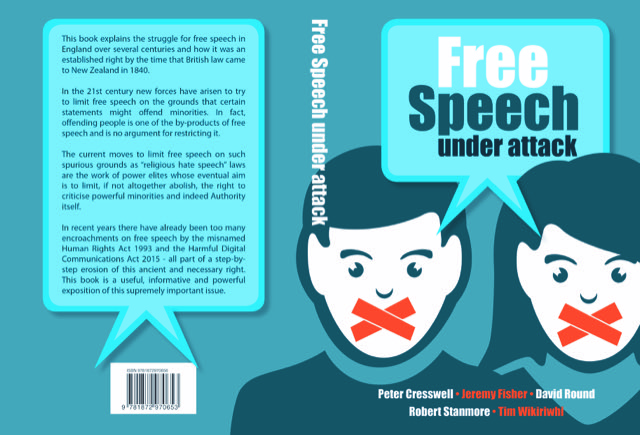
Chapter Four of Free Speech Under Attack is ‘How Speech Became Violence’ by Peter Cresswell. This essay echoes the warnings about leftist totalitarianism that VJM Publishing (among many others) has issued. Here Cresswell outlines the development of the concept of hate speech in New Zealand.
Putting hate speech on the agenda appears to be a leftist plot to introduce mass censorship. The anti-fascists have become the fascists. The modern Left is entirely in opposition to free speech. In fact, they are trying to destroy speech entirely, and with it people’s ability to communicate. Creswell concludes with an admonition to stay vigilant against those who would take freedom away.
Chapter Five is also by Cresswell, and titled ‘Identity Politics: the Threat from the “Azza” Group’. Cresswell begins by talking about the threat of identity politics and how it influenced the Christchurch mosque shootings. Identity politics is a modern tribalism that rejects the power of reason. This tribalism brings with it a savage and primitive way of thinking.
This tribalism has been specifically encouraged as a “formula for dissent, disagreement and disruption” by those who would start a revolution. Cresswell identifies the philosophy of Herbert Marcuse as instrumental in inspiring the attempts to revolutionise language. The concept of intersectionality must also take much of the blame.
Chapter Six is ‘Politicising a Massacre’ by Robert Stanmore. This refers to the Christchurch mosque shootings, after which all kinds of parties painted their enemies with being associated with Brenton Tarrant. Stanmore reflects on the hypocrisy of Jacinda Ardern wearing a hijab when it is a symbol of the subjection of women. The firearms ban was also bad legislation.
VJM Publishing gets a mention here, as one of the bloggers harassed by the New Zealand Police as part of their Operation Whakahumanu intimidation campaign. Stanmore also points out Ardern’s general hypocrisy on the subject of racism, and the danger of Andrew Little’s zeal to introduce hate speech laws. He also makes an argument that VJM Publishing has made before, that shutting down free speech will make terror attacks more likely, not less.
The next edition of the VJMP Reads column is Free Speech Under Attack. This book is a compilation of essays written by New Zealand authors with an interest in liberty.
The book is published by Tross Publishing, who appear to have an interest in anti-Establishment material (much like VJM Publishing).
The first chapter is ‘The Struggle For Free Speech’ by Jeremy Fisher. Here, Fisher outlines the history of speech suppression efforts since the 13the century. The Church has played a major role, requiring that people apply for a licence to print books. 16th century England restricted the printing of books to a guild, lest the wrong person print some.
Fisher recounts that many American colonies were founded by people who had been persecuted for their opinions in Europe. Suppression of speech was sophisticated, using a system of licences and stamp duties to pre-empt dissent. Political parties used the law to suppress the free expression of their opponents.
The second chapter is ‘Preparing the Ground to destroy Free Speech’, also by Jeremy Fisher. Here Fisher describes the authoritarian mindset of the opponents to free speech. The authorities push political correctness to make people easier to control. Thinking follows speech, so if they ban the speech they ban the thoughts.
Fisher labels political correctness as a form of totalitarianism that must be destroyed. He describes the role that organisations such as the Anti-Defamation League, the Southern Poverty Law Centre and Antifa play in suppressing free speech.
The third chapter is also by Fisher, and is called ‘The Deception of Hate Speech’. The chapter recounts the efforts of organisations like the United Nations and the Organisation of Islamic Co-operation to fight free speech under the guise of fighting xenophobia and hatred. Most of the examples of free speech suppression listed here come from Britain, which, as VJMP has previously argued, is fucked anyway.
Many religious ideologies, in particular Islam, have seized upon the hate speech laws to stifle criticism. Islamists have managed to reinstate blasphemy laws under the guise of hate speech laws. Fisher ends the chapter with the conclusion that the purpose of hate speech laws is to stifle dissent.
Everyone knows that the housing situation is bad, but few realise exactly how bad it is. Politicians only propose tinkering around the edges; no-one is willing to propose fundamental change. However, as this article will show, the situation is bad enough that only fundamental change can fix it.
Statistics nerds were overjoyed by the release of the updated Parliamentary profiles last month. These profiles contained information from the 2018 Census, allowing us to update our knowledge of each electorate.
One important thing the Parliamentary profiles tell us is how wealthy each electorate is. We know that 648,537 people out of 3,776,355 aged over 15 in the General Electorates and 66,126 people out of 597,498 aged over 15 in the Maori Electorates make over $70,000 a year. This equals 714,663 people out of 4,373,853, or slightly more than 16%.
Being in the top 16% means that anyone making $70,000 a year is creaming it in comparison to the average Kiwi worker. They’re getting paid much better, and will likely have a commensurately harder job. Either they’re working much longer hours than average, or they have a job with a greater than average level of responsibility, or they are applying much greater than average human or industrial levels of capital.
However, even on this top 16% income, it’s all but impossible to own a house.
If you earn $70,000 a year in New Zealand, you will pay about $15,000 in taxes. That will leave you with $55,000 a year – assuming you opt out of KiwiSaver, otherwise you’d be down to $52,000 a year. That isn’t a lot of money once the high cost of living is factored in.
The cost of living in New Zealand can be estimated by the New Zealand Government’s own cost of living calculator. New Zealand isn’t a cheap country to live in. It can be seen from using the calculator that the average Auckland family of two adults and two dependent children has living expenses of around $2,000 a week.
This means that one working adult in the top 16% of Kiwi wage-earners only makes half of what they need to keep the average family running. If that sounds paradoxical, that’s an indicator of how fucked young people in New Zealand are now.
If we change the calculations to two working adults, each earning a wage in the top 16%, things become a bit easier. But even with two working adults both earning such a wage, it’s extremely difficult for a family with two children to save any money. According to the cost of living calculator, a family of two parents and two children can expect that their living expenses will be in the neighbourhood of $2,000 a week.
This means that a family with two parents and two children, where both parents are in the top 16% of wage-earners, saves no money on a weekly basis. All that work is just to stand still. The family will never own its own home, not even with two adults working and only two children. And that is even if both adults are earning in the top 16% of wages.
Now let’s consider a family with a special talent for living frugally. Let’s say both adults have unusually high levels of determination, willpower and resourcefulness, and they are capable of making do with considerably less than the average family of two children.
In this case, we can take the cost of living calculator and reduce the expenses to the lowest 25% or so of all families of four. This involves taking the sliders and setting them halfway between the average expenditure and the absolute minimum required to survive.
This gives us expenses of $200 per week for food and alcohol, $30 for clothing and footwear, $360 for housing and household utilities, $38 for household contents and services, $13 for health, $121 on transport, $22 on communication, $62 for recreation and culture, $25 for education, $81 for miscellaneous spending and $124 for other expenditure.
This gives us a total of $1,080 per week in expenses for a family of four. So our husband and wife duo of professional workers, both in the top 16% of Kiwi wage earners, if they cut their family expenses down to the bottom 25%, can expect to save around $950 a week, or close to $50,000 a year.
The average house price in New Zealand as of July this year was $739,000. So if a family can manage to have two breadwinners both earning in the top 16% of all wages, and if they can manage to cut their expenses down to the lowest 25% of all families of four, they can expect to own the average house after 14.8 years.
Let’s say, more realistically, that the partner of the main breadwinner works part-time in order to look after the two children, and so makes $30,000 a year. This would leave them $400 a week after expenses, or around $20,000 a year. At such a rate of saving they could expect to own their own home after 37 years.
Let’s say, even more realistically, that their expenses are at the average level for a family of four in Auckland. In such an instance, they will be unable to save money even if both parents are working and earning in the top 16% of wage earners. According to the cost of living calculator, a family of four in such circumstances will have to borrow $50 a week to be able to live. Saving will be impossible.
And that’s for people in the top 16% of earners.
Even if a person and their partner are in the top 16% of earners, they will have to cut their expenses down to less than average merely to save any money at all. They will have to cut those expenses to far less than average to save enough to own a home. Anyone earning less than this, or anyone whose expenses are higher than this, will never own a home, not even if they worked to age 100.
Simply put, you have to earn far, far more than average if you want to own your own home in New Zealand. The dream of home ownership is now only a reality for a fraction of the population. The rest of us are effectively serfs, doomed to labour our whole lives without ever owning land.
To compare this with how the previous generations had it, in 1992 the average New Zealand house price was $105,000. Also in 1992, the average wage was $15. So in 1992, the average house could be purchased for the equivalent of 7,000 hours of labour. Today, with an average house price of $739,000 and an average wage of $34, buying the average house requires the equivalent of over 21,000 hours of labour.
There simply aren’t enough years in one lifetime for the average Kiwi to save enough money to own their own house. Either you inherit, or, failing that, become a professional worker with an income of $150,000+ per year.
Another way of looking at it is that if house prices had only increased in proportion to the increase in the average wage between 1992 and 2020, i.e. 2.25 times instead of 7 times, the average house price today would be around $236,000.
The grim reality is that we are some two-thirds poorer than our parents were. This conclusion is inescapable unless one denies the maths.
In summary, the Millennials and the younger generations have been effectively enslaved by the Boomer generation. The Boomers own everything, and they pay such pitiful wages that we have no chance of bettering our positions. Only two outcomes can give the young of New Zealand basic dignity: wait 30 years for the Boomers to die, or revolution.
Clown World is paradoxical in many ways. On the one hand, there is the disintegration into total chaos, but on the other, there is the imposition of a suffocating degree of order. This paradox can be resolved once it is understood as anarcho-tyranny.
There are many different kinds of anarchism. As anyone who has spent any time with anarchists knows, none of them can agree on anything. This has led to anarchists breaking up into a kaleidoscope of different subgroups: anarcho-communists, anarcho-capitalists, anarcho-syndicalists, anarcho-nihilists, anarcho-homicidalists and more.
Like ‘anarcho-nihilism’, people don’t usually identify with the term ‘anarcho-tyranny’. It’s normally applied from the outside. Anarcho-tyranny was first discussed by philosopher Sam Francis, who attributed the apparent decay of society to mass immigration.
Francis’s logic was that multiculturalism inevitably leads to disputes over moral values, and the discord that follows is exploited by tyrants. Political freedom depends on people having enough in common to agree on what freedom means. Absent those commonalities, law and order can only be kept by force. This echoes the words of Aristotle some 2,300 years earlier, who noted that multicultural societies ended up as tyrannies.
Mass immigration is one of the major causes of Clown World, as it is has led directly to a decrease in kin intensity, and thereby to a major decrease in solidarity between any two randomly-chosen people. This decrease in solidarity has led to an increase in self-interested behaviours. This selfishness has been exploited for votes by a venal ruling class, and they have used the resulting power to enforce anarcho-tyranny.
Whatever its root causes, anarcho-tyranny can be defined as a political and judicial system wherein everything is illegal, but the ruling class only enforces the law if they want to send a message to someone they don’t like.
The ‘anarcho’ comes from that there is no proper law enforcement. Practically any law can be ignored as long as you’re on the right team. The ‘tyranny’ comes from that law enforcement is applied in an arbitrary and biased fashion, and usually to destroy the enemies of the tyrants.
The characteristic feature of anarcho-tyranny is that actual criminals don’t get punished in proportion to the suffering they have caused, but political enemies get punished extravagantly for the smallest misstep.
Perhaps the best recent example comes from New Zealand.
A man named Philip Arps was sentenced to 21 months imprisonment last year for sharing a video of the Christchurch mosque shooting. Even though the act of sharing the video didn’t harm anyone, Arps is a white nationalist and therefore on the wrongthinkers list. As such, he was given an extremely heavy sentence.
In September 2020, by contrast, a man named Marcus Barker was sentenced to home detention for the crime of sex trafficking a child. The sex trafficking of children is an act that causes unfathomable suffering; almost everyone has the wit to tell you that sex trafficking of children is a worse crime than sharing a video.
Under anarcho-tyranny, however, the severity of a crime depends not on the degree of suffering caused, but whether the crime served the interests of the ruling class. The elites don’t share mosque shooting videos, but they are into raping children.
Near New Zealand is the Australian state of Victoria, which also offers an example of anarcho-tyranny.
Victorian Police arrested and handcuffed a pregnant woman in front of her own children for promoting an anti-lockdown protest in Melbourne. This was part of a series of pre-emptive arrests of protest organisers. Police in that state have vowed to stop any and all anti-lockdown protesting, with Assistant Commissioner Luke Cornelius even calling the organisers “the tinfoil hat-wearing brigade”.
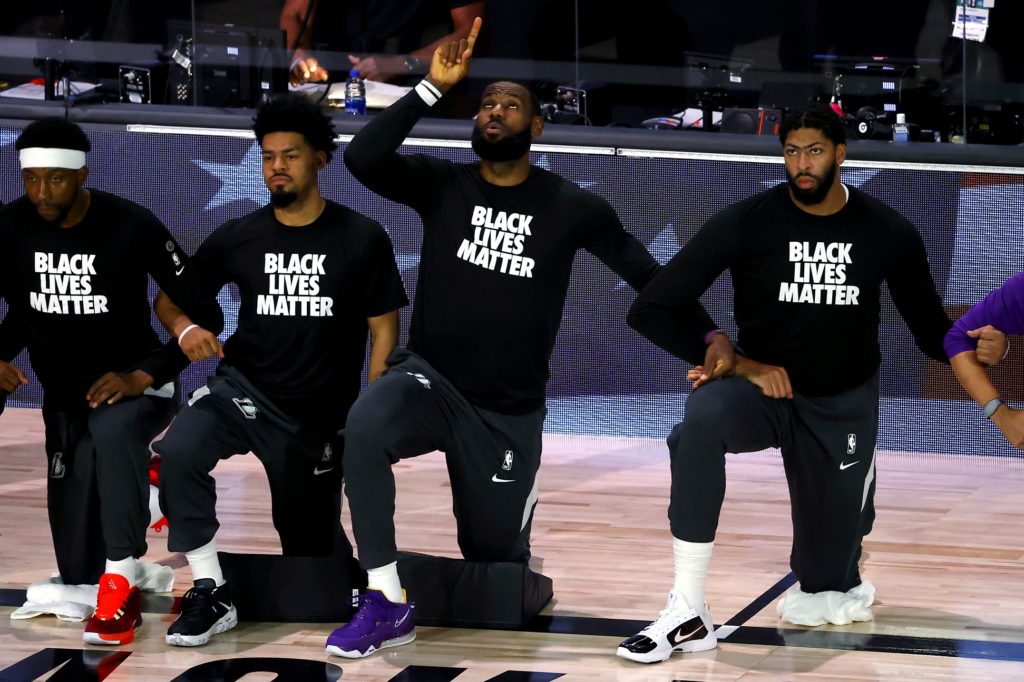
But Black Lives Matter ran a massive Melbourne protest that June, and the Victorian Police didn’t lift a finger. In fact, they took a knee to the protesters. This is despite that the coronavirus pandemic was already in full swing, and therefore that the BLM protests were no less dangerous than the anti-lockdown protests.
Similar situations prevail in Britain and in America. In Britain, people get arrested for offensive FaceBook posts while child grooming gangs escape investigation, and in America BLM mobs are running wild in areas that local law enforcement have abandoned.
This is anarcho-tyranny in practice: anyone pro-Establishment is allowed to assemble and to break the law without sanction, but anyone anti-Establishment is not even entitled to the rights that they are supposedly guaranteed by human rights legislation.
As Clown World intensifies, anarcho-tyranny will get to the point where mobs run rampant in major Western cities with no opposition from law enforcement. At the same time, people will start to get imprisoned for criticism of their government. Both bad chaos and bad order will reign over their good opposites. This could be said to be peak Clown World, and what happens then is anyone’s guess.
*
This article is an excerpt from Clown World Chronicles, a book about the insanity of life in the post-Industrial West. This is being compiled by Vince McLeod for an expected release in the middle of 2020.