
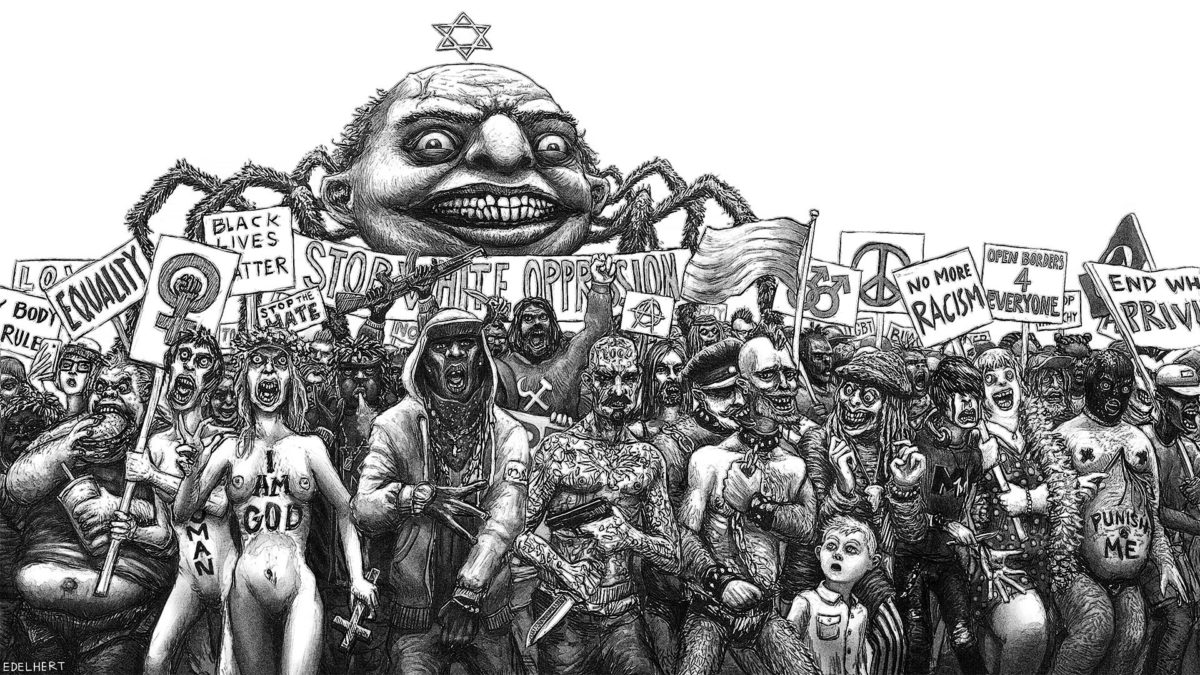
Why Slave Morality is the Future of the World

Master and slave morality is not much more than the alpha/beta positioning of primates on a dominance hierarchy. Master morality comes naturally to primates at the top of a dominance hierarchy, and slave morality comes naturally to those at the bottom. This essay makes an argument for the inevitability of a horrific future world, in which slave morality has come to dominate.

The relentless growth of our societies has led to a problem, and it’s getting worse. Increasing medicinal technology means more people survive to reproductive age, and the world population has swollen. The larger the dominance hierarchy becomes, the greater the number of subordinate positions – but the number of dominant positions doesn’t really increase, because ultimately there is only one of those. This means that, as a dominance hierarchy grows in number, it gets extended past the bottom.

If you are in a war party of 15 men, you have a small but real chance of being the ultimate authority yourself, and if you are not then you could easily become such by displaying greater competence or courage than the other 14. If you are in a tribe of 150 people, you have less than a 1% chance of being the ultimate authority, and now it’s probably not just a matter of fighting ability but also of intelligence, which you may or may not possess. If you are in a clan of, say, 1,500 people, you have essentially no chance. The clan will have a chieftain, and that position is probably hereditary.

Groups of 1,500 people were extremely rare before agriculture enabled large populations to settle down. When this happened, however, it became possible for there to be people who had essentially no chance of ever being at the top of the dominance hierarchy – no matter their personal qualities. Once there were city-states of 15,000 people or more, contesting the dominance hierarchy became so complicated and so sophisticated that it became its own specialised endeavour, and we called this politics, and the people who practiced it politicians.

Slave morality, as Nietzsche recounted in The Genealogy of Morals, came about when some of the people who had no hope of getting off the bottom of the dominance hierarchy became so resentful that they started to extol the personal qualities that had landed them there. There is no slave morality in a war band of 15 men, because anyone sufficiently strong can get to the top. In a city of 1,000,000 – especially when many are literal slaves captured in war – slave morality is commonplace, and this is why degeneracy inevitably follows.

One problem with the modern world is that this basic dominance hierarchy is now so extensive, being global and comprised of billions, that it’s no longer contestable.

If I, as a New Zealander, wanted to overturn my local dominance hierarchy, I would be presented with a number of great problems. First of all, I would have to overcome the power of the local Police forces to keep the peace and to maintain their version of order. This would require at least a dozen men armed with automatic rifles who were willing to use them in defence of whatever ideology I was offering. Finding a sufficiently persuasive ideology would be extremely difficult.

Even if one succeeded here, another task would arise. The problem with overwhelming the local Police is that the New Zealand Government, upon recognising that the Police were insufficient, would send in the Army. This would involve, potentially, a regiment of riflemen with machineguns and close air cover. Defeating a force like this would require a vast amount of territory and population. An area at least the size of Canterbury would be necessary.

Even if one succeeded here, i.e. even if the New Zealand Army was unable to bring you to submission, your actions in fending them off would be considered a civil war. It turns out that the British armed forces are constitutionally obliged to intervene in the case of a civil war in New Zealand – New Zealand is, after all, ultimately a possession of the Crown (like Britain itself).

So getting that far up the dominance hierarchy would mean that you have to come to terms with a naval power that has submarines that carry over a dozen intercontinental ballistic missiles each. Outside of a fantasy novel, this has no chance of happening.

Therefore, more people inevitably means more resentment, as it means more people who can never get to the top. In a system the size of ours, the prospect of any self-direction is minimal, and therefore resentment has become the natural state of affairs. Some moral values, in particularly the value of inclusiveness and diversity, have become normalised on account of this shift to slave morality.

What this has meant is the rise and rise of slave morality. Where there used to be a small and resentful underclass, the proportion of people who effectively have no chance of rising to the top of the dominance hierarchy now comprises the vast bulk of our society. The actual rulers are selected from a minuscule sliver of the population, and the number of people that these rulers actually listen to is also tiny. Encompassing this tiny number are heaving masses who essentially have no say at all in the destinies of their group.

As the populations of cities continue to surge, this wave of increasing slave morality will only grow in fervour. Already we have seen the socially corrosive effects of mass resentment on our culture. Current trends suggest that the human population will continue to expand, and cities will continue to absorb the excess, which means that slave morality will become ever more the default way of dealing with things.

*

If you enjoyed reading this essay, you can get a compilation of the Best VJMP Essays and Articles of 2017 from Amazon for Kindle or Amazon for CreateSpace (for international readers), or TradeMe (for Kiwis).


VJMP Reads: Ted Kaczynski’s Unabomber Manifesto I

Having completed our reading of David Seymour’s Own Your Future, we now turn away from neoliberalism and have a look at anarcho-primitivism. The next subject of the VJMP Reads column will be Industrial Society And Its Future, otherwise known as the Unabomber Manifesto, by Ted Kaczynski.

Sent to the Washington Post in June of 1995, alongside a threat to kill more people with mailbombs if it was not published, the 35,000-word manifesto is broken down into 232 numbered paragraphs. These are grouped in short chapters, each with a subject heading.

The first of these groups is the Introduction. Kaczynski wastes no time shocking the reader: the first sentence is “The Industrial Revolution and its consequences have been a disaster for the human race.” This section pulls no punches: Kaczynski is adamant that the effect of industrial society has been to increase the amount of human suffering, and that it will only get worse as society develops. The only solution is a revolution, which may or may not be violent.

Kaczynski then moves on to the psychology of modern leftism. He writes that “One of the most widespread manifestations of the craziness of our world is leftism,” which is curious if one thinks that this was written in before 1995, when ‘trans’ meant transvestite. What underlies modern leftism, Kaczynski states, are feelings of inferiority and oversocialisation. This ties in with the idea, expressed elsewhere by Nietzsche among others (such as VJM Publishing), that leftism is essentially a slave morality.

To elucidate further, these feelings of inferiority are a group of qualities such as self-hatred, low self-esteem, defeatism etc. that are not only shared by modern leftists but which have collectively come to shape the course of history. Kaczynski is extremely insightful when he points out that the people who most angrily take offence at politically incorrect statements are those from privileged families. Leftists are also dishonest. They are outraged when a Western country performs a certain action but are indifferent when a Third World or socialist country does so.

Leftists identify intensely with anyone weak, repellent or otherwise inferior, hence they take offence on their behalf. They hate anything good and successful. This makes them feel like losers, so that they have no faith in their own personal ability to provide. As a consequence, they become collectivists. They hate science and rationality because these mindsets consider some ideas superior and others inferior. Leftists hate that, because of their fear of being judged inferior. They hate IQ tests for similar reasons.

Oversocialisation is an extreme form of the process that psychologists describe when they explain how children learn to conform their behaviour to the demands of society. The difficulty with the current world, Kaczynski has it, is that has become so complicated that no-one can act morally anymore. Oversocialisation is the process whereby leftists, “In order to avoid feelings of guilt, […] continually have to deceive themselves about their own motives and find moral explanations for feelings and actions that in reality have a non-moral origin.”

Oversocialised leftists tend to be intellectuals or members of the upper-middle class. What they like to do is to take accepted moral principles, declare them as their own, and then accuse society of violating them. Leftists do not rebel by violating society’s principles, but they express their hostility by accusing society of not living up to them. Their hypocrisy is evident when they claim to support black people, but then insist that these black people live up to the values of the industrial-technological society that imprisons them.

Today’s society seeks to socialise us more than any previous society. As a consequence, oversocialisation has affected us more than ever before. These problems of the leftist are problems of our entire society in microcosm.

*

If you enjoyed reading this essay, you can get a compilation of the Best VJMP Essays and Articles of 2017 from Amazon for Kindle or Amazon for CreateSpace (for international readers), or TradeMe (for Kiwis).

The New Zealand Student Media is Just as Gutless as the Mainstream Media

It’s rare for a Kiwi to look towards the New Zealand media establishment with reverence or even anything approaching respect, on account of that the profession is little more than a bunch of corporate whores cheerleading for neoliberalism. Even so, it is sometimes astonishing to learn quite how gutless the New Zealand media is, as local anarchist Rick Giles found out earlier this week.

The depths to which the New Zealand yellow press is willing to sink can be observed by the treatment of Giles by Auckland radio station bFm. bFM had Giles on their live show, where he was interviewed by Laura Kvigstad. The segment was called “Anarchy in Aotearoa” and featured Kvigstad and Giles talking about Giles’s interest in anarchy and some of the realisations that had led him to anarchism, and some of the things that anarchism had led him to believe.

This was a part of a wider series called “Wire Worry Week”, which was a week at bFM dedicated to “focusing on the concept of anti government; expanding upon how movements that have worked against governmental systems have influence on the current state of the world.” Giles, as the man behind AnarKiwi, was invited onto the show to speak freely about his political opinions. Readers can listen for themselves to decide whether Giles said anything genuinely worthy of specific repudiation.

In response to – presumably – the shrieking of upper-middle-class Social Justice Warriors all over Auckland, bFM made the following statement:

NB: Following the broadcast of this interview it has come to 95bFM’s attention that the subject of this interview, Rick Giles, espouses political and historical views that the station finds particularly unsavoury. We will not be removing or editing the interview, but wish to make it clear to all listeners that 95bFM does not support or align itself with the personal politics of the interviewee. Our decision to provide Mr. Giles a platform during a week-long discussion on anti-government movements was one that, with hindsight, would not have survived greater scrutiny and vetting process. The station, its volunteers and wider associates do not wish to endorse Mr. Giles’ particular brand of historical revisionism in any way, shape or form and we sincerely apologise for any concern or aggravation caused via our negligence in this case.

It is an incredibly pathetic measure for a radio station to go to these lengths to repudiate a New Zealand intellectual who is guilty only of wrongthink. So gutless are bFM that even when they decide to specifically give a platform to the counterculture they can’t bring themselves to allow alternative points of view to pass without condemnation. Even worse, they are not even decent enough to say exactly which of Giles’s political opinions were so heinous as to be worthy of deplatforming.

What’s hilarious is that you know if Hillary Clinton wanted to appear on bFM to speak to the students of Auckland, they would fall over themselves to provide her a platform, despite that she has killed at least 2,500 more people than Giles, and that’s only counting one of her many crimes. After all, they’re happy to happy to give Peter Dunne a platform, despite the fact that the lies he told about cannabis and about synthetic drugs are responsible for the deaths of hundreds of young Kiwis.

The really terrible part about all of this is that bFM, and by extension the University of Auckland, have failed in their primary purpose of being a university. The primary purpose of a university is to provide a safe space for free-thinkers to discuss ideas that might otherwise be too controversial to discuss in public, on account of that the public would chimp out upon being asked to consider (not accept, just consider) some of the assertions that are necessary to discuss such things.

Apparently the fashionable trend in mainstream media circles right now is to take the exact opposite approach to VJM Publishing; we believe that dialogue is the way to destroy ignorance. The mainstream media don’t care about ignorance; they believe that destroying dialogue and virtue signalling is the way to greater profits. bFM, by making a statement repudiating Giles, are simply learning how to be good, obedient corporate whores. This is, after all, what they will be after graduation.

Part of being a corporate media whore is deplatforming anyone not part of the Establishment (such as Giles) while happily platforming anyone who is part of the Establishment, no matter how many people have died as a result of their negligence or dishonesty (such as Dunne). bFM are willing to give a platform to a Government agent whose ham-fisted cruelty caused New Zealanders to die, but Giles is “particularly unsavoury”.

What bFM did to Rick Giles is a microscopic example of what the mainstream media does to New Zealand all day, every single day. They take uncontroversial ideas, and they sell them as rebellious and controversial so that the desire of some individuals to portray themselves as free-thinkers can be satisfied. In every case, genuinely controversial ideas are ignored as “loony” and their purveyors deplatformed, as happened to Giles. They are a pack of absolute fucking whores, and the alt-media will continue to be a thorn in their side.

*

If you enjoyed reading this essay, you can get a compilation of the Best VJMP Essays and Articles of 2017 from Amazon for Kindle or Amazon for CreateSpace (for international readers), or TradeMe (for Kiwis).

How A New Zealand Nazi Party Could Eliminate All Competition Through Existing Mechanisms

Suprisingly few understand that Adolf Hitler’s Nazi Party came to power by winning democratic elections. Fewer still understand that the subsequent march from liberty to totalitarianism was made in a small number of entirely legal steps. This essay suggests something original: that a New Zealand equivalent of the German Nazi Party could assume dictatorial powers by exploiting current New Zealand law.

The German National Socialist Worker’s Party won 33% of the party vote in the November 1932 federal elections, which was eventually enough to get Hitler, the leader, appointed German Chancellor. From there, the Nazis succeeded in having all opposition banned by means of the Reichstag Fire Decree and then, later, the Enabling Act. The effect of these two pieces of legislation was to make Germany into a one-party state, with all political power held in the Nazi Party.

But wait! you cry. The New Zealand system is different to the Weimar Republic. Our Mixed Member Proportional system is designed to prevent extremists from taking power, by making it impossible for parties to get representation unless they get a proportion of votes above a predetermined threshold. This is true – but there’s a catch. The fact is, this threshold is both a precedent and a mechanism for totalitarianism.

A party needs to get at least 5% of the party vote before it is allowed to have any seats in Parliament. Any party that gets less than 5% of the vote gets no seats at all (unless they also win an electorate seat). The logic is that if you cannot command at least 5% of the vote, then it is best to exclude you (and your voters) from Parliament entirely, on the grounds that you represent a radical extremist movement.

This logic is essentially the same logic that Hitler used to ban the Communists, only wrapped up in prettier packaging.

A hypothetical New Zealand Nazi Party that knew that they were going to get, for example, 33%+ of the vote, could simply raise the MMP threshold to 30%. This would mean that a party needed 30% of the total party votes in order to be allowed to have democratic representation. This New Zealand Nazi Party would then be the only party that got over the threshold, and consequently be the only party allowed to have a seat in Parliament.

Some might object this would be undemocratic, on the grounds that it would exclude too many people from having a say. But there are already enormous numbers of people who are excluded from having a say. It is an obscenity that a party can currently get 4% of the party vote and not be allowed any representation, especially when a slimebag like David Seymour can get in with a little over 10,000 votes.

After all, if it’s permissible for a hundred thousand people to have their democratic voice silenced because of some arbitrary threshold set by anti-democratic forces, then what does it matter if that threshold is raised a bit by slightly less democratic forces? The precedent has been set, by the status quo, that such conduct is acceptable. The only question, then, is what proportion of people are to be silenced.

Raising the threshold to 30% would only change the degree of disenfranchisement. There would be no categorical change.

Effectively, those parties that could get over 5% now have colluded, and they have made it impossible for anyone who can’t get over 5% to get into Parliament. It has been decreed that any movement with fewer than 120,000 or so members will have no voice at the table. This is borderline criminal, as it makes it impossible to oppose the political class through the democratic system. If your problem is with neoliberalism, then there’s no point in voting, because the entire political class is neoliberal.

A party has to be neoliberal to get enough attention from the neoliberal mass media to get 5% of the vote in the first place, because electoral financing is doled out in proportion to how many votes a party received in the previous general election, so without already being big enough to get over the 5% threshold it’s impossible to get enough media coverage to get there. The game is completely sewn up.

The major parties can’t even point to the relatively small “wasted vote” count and say that the small size of this voting bloc is evidence that few people are dissatisfied with the system. The fact is that many, many more people might vote for alternative parties if the threshold was low enough for them to have any chance of being allowed to have representation. But when even 100,000 votes isn’t enough to get a single seat in Parliament, the will to start new parties is massively, and artificially, suppressed. So we don’t know how many voters would vote for the National-Labour-New Zealand First-Green Establishment if there was a fair threshold.

The way to get around this is simple. Not only should the 5% threshold be removed, but it should be clearly stated that the presence of such thresholds is undemocratic. As such, not only will there no longer be one but precedent is set for there never to be one in the future. Even better, we could scrap the farce that is democracy entirely – but that’s a topic for another essay.

*

If you enjoyed reading this essay, you can get a compilation of the Best VJMP Essays and Articles of 2017 from Amazon for Kindle or Amazon for CreateSpace (for international readers), or TradeMe (for Kiwis).