
Lessons For New Zealand From the German Electoral System

When New Zealand adopted a MMP electoral system in 1996, we based that system on the German model. Germany had already had decades of experience with MMP, and it was thought that we could learn from their lessons. As demographer Dan McGlashan will show in this essay, there are further lessons to be learned from the German system – including lessons about what the future might bring for New Zealand.

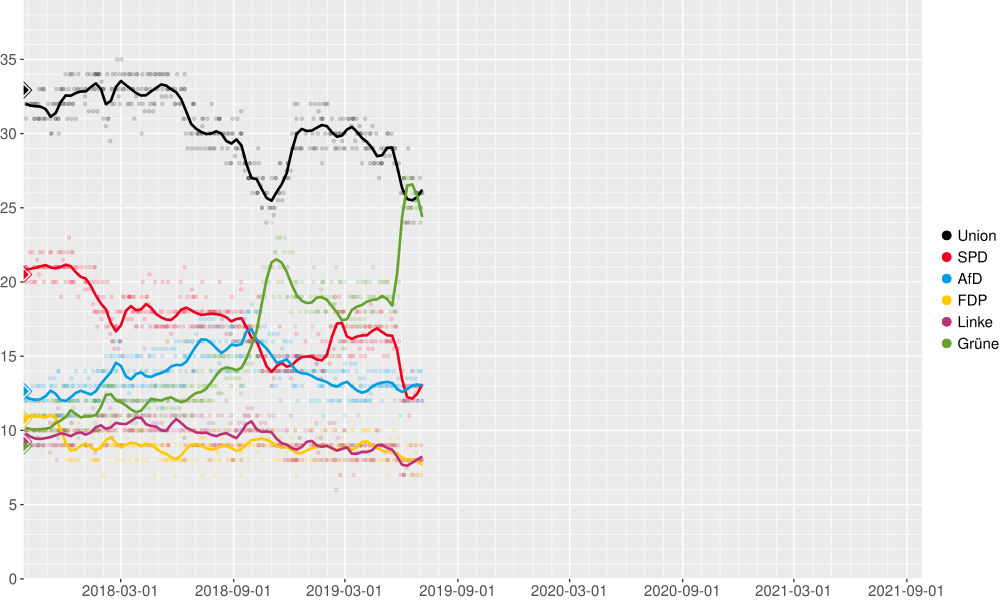
As can be seen from the image at the top of this page, recent opinion polling in Germany shows that the Establishment parties are bleeding support, while the alternative parties gain. Because the German system is more advanced and sophisticated than the New Zealand one, we can predict that phenomena that occur over there will soon be replicated over here. This is not so much true because of MMP as because of the fact that Germany and New Zealand are both part of a wider Western system.

Of concern to the Labour Party would be the fact that their German equivalent is currently polling at about 14%. The reason why the German SPD (Social Democratic Party) is doing so poorly is that they have abandoned the German working class in favour of identity politics – but the New Zealand Labour Party is in the process of making the same mistake.

Of hope to the Green Party would be the fact that their German equivalent is currently polling at about 23%. In fact, the German Green Party was the single highest-polling party in July, a fact that speaks of revolution. The main reason for their rise is the fact that the Greens never even pretended to represent the working class, which means that the large numbers of young people with university degrees have been able to find a home in them.

The major German conservative party, the CDU (Christian Democrat Union), has also seen a fall in fortune, although nowhere near as grievous as that of the social democrats. They are hovering around 27%, which probably reflects the relatively greater unwillingness of conservatives to abandon their party (Understanding New Zealand showed that the National Party had the strongest voting retention rate from one election to the next in New Zealand). It is still a marked decline from previous years.

The decline of the CDU is mirrored by the rise of the alt-right Alternative for Germany (AfD) Party, who are now polling at 13%. This party is frequently derided as being neo-Nazis on account of their strongly anti-Muslim sentiment. Some expect them to supplant the CDU on account of that the globalist parties are not conservative when it comes to cheap labour.

If we look at the German model and how it has turned out, we are able to make several predictions about how the New Zealand model will turn out. Two of these predictions stand out as particularly salient.

One is that the Establishment parties will do poorly – the New Zealand Labour Party will get sliced to pieces in coming years, and National will weaken heavily. The German SPD is already polling in the single figures in some states, and it’s clear that their message is resonating ever less with the electorate. The New Zealand Labour Party are steadfast globalists, despite that globalism destroys working-class wages, and rising nationalist sentiment among the working class will see Labour support decay.

If this happens, it will probably be put down to the incompetence of the Sixth Labour Government, but the truth will be that wider strategic and demographic changes make this all but inevitable. The Labour Party was founded by and for the white working class; having decided to no longer represent the white working class, they are in their death spiral.

This process is likely to heavily benefit the Greens, who will gladly take the now-middle-class young people who don’t identify with National, Labour or ACT. The Greens will also be the beneficiaries of that group of young people who, on account of class interests, would have voted National in previous generations, but who now are more concerned with virtue signalling over class.

In short, what’s happening is that the Establishment parties are losing support as those voters who have been propagandised to have faith in the Establishment die off, and who are then replaced by more cynical young voters who prefer the alternative parties. The Greens and the AfD already get 36% of the vote between them, which is almost as much as what the SPD and the CDU get between them.

The collapse of Labour will likely see its white voters turn to the Green Party on account of that they don’t identify with being working-class any more, its Pacific Islander voters turn to National as their religious sentiments clash with Labour’s globohomo agenda and its Maori voters turn to New Zealand First on account of that they feel abandoned by a Labour that panders ever more to refugees and urbanites.

A second prediction is that an alt-right movement will come to stake a meaningfully large presence.

In New Zealand, the lazy stereotype is that the strongest anti-immigrant sentiments are held by old white people who don’t have much experience in interacting with foreigners. This is mostly true when the anti-immigrant sentiments are held towards Asians and Islanders, which is to say that it was mostly true in the 1990s. By today, things are different.

In Europe, the new generation of anti-immigrant sentiments are held by young people who do have experience in interacting with foreigners. The fact is – although this will be strenuously denied by Marxists, slave moralists and equalitarians – interacting with another group will only improve sentiments towards them if those interactions are pleasant. If the interactions are unpleasant, sentiments towards that group will worsen.

The nature of the interactions between native Westerners and Muslim and African immigrants is radically different to the nature of interactions between native Westerners and immigrants from Asia and the Pacific Islands. Therefore, it can be predicted that, now that New Zealand is opening its borders to Muslim and African immigrants, sentiments towards immigrants in general will sour.

If this does happen, it will create an electoral opportunity for an anti-immigrant party along the lines of the German AfD. The AfD just took 27% of the vote in the regional elections in Brandenburg, and 23% in Saxony. These parts of Germany have fewer immigrants that other parts that have less AfD support, which suggests that at least some of the increasing support for the AfD comes from economic sentiments. But the economic outlook is grim.

Support for this idea comes from Sweden, which opened its borders to mass Muslim and African immigration 20 years ago. Today, the alt-right Sweden Democrats is the party with the best opinion polls. Should a decent alt-right party stand up in New Zealand, they could reasonably expect to get over 5% of the vote straight away.

In Understanding New Zealand, I showed that young conservative people are often more inclined to vote ACT than to vote National. The correlation between median age and voting ACT in 2017 was a mere 0.26, compared to 0.78 between median age and voting National in 2017. This suggests that the ACT Party could potentially surf the crest of this alt-right wave.

This newspaper has previously asked whether ACT would win from refocusing as the alt-right party, but the courage of the current ACT crew cannot be relied upon. One political trend that can be relied on absolutely for certain is that people will age, and for this reason we can predict that the right will eventually evolve into some form of the new right, despite their inherent disinclination to change.

There’s no guarantee that New Zealand will follow the German experience, but the same geopolitical and demographic factors that pushed them in that direction are also at play on us. That will probably mean that, over the coming decade, Labour weakens heavily, National weakens moderately, the Greens surge, and someone fills the demand for an alternative right-wing movement.

*

Understanding New Zealand, by Dan McGlashan and published by VJM Publishing, is the comprehensive guide to the demographics and voting patterns of the New Zealand people. It is available on TradeMe (for Kiwis) and on Amazon (for international readers).

The Three Failed Political Models of Our Time

There are three very popular political models in the West at the moment, each one promising utopia through its own path, if only it is followed. The problem is that these three popular models have all failed catastrophically, and furthering any of them only brings more misery into the world. This essay explains these models, why they have failed and what we can do about it.

Elementalism holds that there is an ideal form of everything, and a practically infinite number of degraded forms all throughout the Great Fractal. The ideal form and the degraded forms exist along the Great Masculine Axis, which is itself divided into the masculine elements.

If we take a perspective that divides the Great Masculine Axis into four masculine elements, we can see one ideal political form and three major groups of degraded political forms. These three groups correspond to the three sub-golden elements of clay, iron and silver.

Clay refers to Communism or Democracy. These two terms can be equated because the masses will always tend towards desiring the redistribution of resources, and will always vote for people who promise this when given the opportunity. This is essentially the hyperfeminine model, or the slave morality model. According to this model, the collective – and the needs of the collective – are paramount.

Iron refers to Fascism or Ethnosupremacism. This is the political model that has failed because is it hypermasculine. Like a severely autistic child, the iron model seeks to put the rest of the world to order by force, and doesn’t care if the world consents. The resentment and resistance that this model provokes is usually its downfall.

Silver refers to the hedonistic consumer capitalism that the vast majority of VJM Publishing readers live in (whether they wish to or not). This model is neither hyperfeminine nor hypermasculine, but is characterised by being an insipid compromise between the two. Its fundamental problem is that it is not enough of either. Hence, people who follow this model are usually nihilists or hedonists of some sort.

All these models oppose each other, and so the world seems to be forever at war, pulled between three different poles depending on which primitive instinct holds the most sway at the time.

The clay model of Communism, true to the slave morality that motivates it, resents those who follow the iron model (who are dismissed as “racists” or “fascists”) and those who follow the silver model (who are dismissed as “greedy”). The basic motivation of those who follow this model is to rip down those who distinguish themselves either physically, mentally or socially.

This model could be described as extremist horizontalism. It fails by destroying itself, because once all the capable people are sufficiently hindered then the society becomes incapable of anything. If anyone making an effort is ripped down, people come to adapt by not making any effort for any reason. When they do this, society can no longer be maintained by the free will of its members.

The iron model of Supremacism opposes both the clay model and the silver model for being soft – the former for being natural weaklings (“subhumans”), the latter for being moral weaklings (“degenerates”). The iron model is not compromising, and people who follow it intend to kill their opponents rather than work with them. Failing that, it’s enough to intimidate them into submission.

This model could be described as extremist verticalism. In this sense, it’s naturally very similar to military rule, in which every participant knows their rank and therefore their place. As mentioned above, this model fails because of the massive resentment it provokes. It seems to be human nature to seek revenge for acts of cruelty, and the iron model eventually falls under the weight of its many enemies.

The silver model of neoliberal Capitalism is a very centrist mentality in all sorts of bad ways. This model considers the clay model and the iron model to be two poles of the same axis – the axis of brain-dead, brutal state authoritarianism. Neoliberal Capitalism, therefore, is the path of freedom. The silver position has a lot of merit – but their solutions are far from complete.

This model sees the followers of the clay model as dumb and weak, and the followers of the iron model as dumb and strong. The latter may be more dangerous as individuals and in small groups, but the former are capable of gathering by the multitude and enforcing their will through sheer numbers. It isn’t entirely wrong – followers of ethnosupremacist or collectivist ideologies tend to be dumb. For this reason, the silver model tends to destroy itself rather than get destroyed from the outside.

It was neoliberal Capitalism that arose first from the carnage of World War II, the iron model having exhausted itself, and the clay model having been crippled in the process. As a consequence, we are currently living under the silver model. It’s certainly much nicer than being in a deathcamp or gulag, but unfortunately for we who live in it, the silver model is currently hitting its limits in every sense.

The American opioid epidemic is currently killing 150 people every day, a body count that cannabis and the psychedelics put together haven’t managed in over a century. In New Zealand, the suicide rate gets higher every year, and this upwards progression shows no sign of stalling. A sense is spreading that we are living in the End of Times, as when the Western Roman Empire was falling.

These political models may all have great differences, but they also have one quality in common – they are all materialist. This is why they have all failed.

The three great political models of our age have all sought materialist solutions to the problem of human dissatisfaction, not realising that spiritual suffering is equally as important as material suffering. The clay and the iron fight each other while the silver looks on from a pile of cheeseburgers – but none are happy.

What’s missing is the gold model, one that takes into account the Will of God.

The gold model is not such a thing that can be easily described. Plato had a go, at length, in The Republic, and this essay cannot hope to come close. In short, however, it can be said that the gold model will incorporate knowledge that reflects the true, eternal and untarnishable nature of consciousness. It will return the political realm to its rightful place, under God.

Organising civil society around a ritual that reconnected people with God – something like a reborn Eleusinian Mysteries – would allow for people to suffer less in the spiritual realm. Absent this spiritual suffering, they will be less inclined to attempt to satiate themselves through control of the material world, which is the mentality that underpins all of the three failed political models.

*

If you enjoyed reading this essay, you can get a compilation of the Best VJMP Essays and Articles of 2018 from Amazon for Kindle or Amazon for CreateSpace (for international readers), or TradeMe (for Kiwis). A compilation of the Best VJMP Essays and Articles of 2017 is also available.
The War Criminal’s Apprentice

The great disconnect between the rhetoric and the reality of the Sixth Labour Government has confused many people. Many people have been taken in by the mainstream media’s propaganda about kindness, and are therefore at a loss to explain what’s currently going on in our society. This article seeks to explain the psychology of Jacinda Ardern – the War Criminal’s Apprentice.

It was reported yesterday that New Zealand now has the highest suicide rate in its history, with 685 people taking their own lives last year. This is a figure greater than one Christchurch mosque massacre’s worth of deaths every month, and is almost double the road toll (especially if one considers that many road deaths in single-car accidents are disguised suicides).

This will surprise some, in particular those who expected the rate to go down after the 2017 General Election. After all, the mainstream media has made it very clear to us that the Sixth Labour Government is motivated by kindness, and that fixing New Zealand’s failed mental health system is a priority for them. But not only has Ardern’s Government not taken the correct measures to reduce suicide rates, they have purposefully taken measures that will raise them.

It might seem outlandish to the reader, even horrifying, to hear the claim that our politicians are literally willing to sell their own people out for personal gain. It is, however, true. Although the ideal is that politicians will represent the interests of their nation much as if they were the head of some great family, the reality is that politicians represent their own interests and consider the people and their votes much like a dairy herd and its milk output.

Some are even willing to cosy up to ideologies of hate if those individuals calculate that doing so will advance their career.

Jacinda Ardern has been willing to do this in multiple ways. Right from the beginning of her career, she demonstrated that not even a nine-figure body count was enough to make her willing to repudiate an ideology, whether that ideology be Communism or Islam. This she showed most infamously with her “Comrades” speech to the International Union of Socialist Youth in 2008, the year she was elected President.

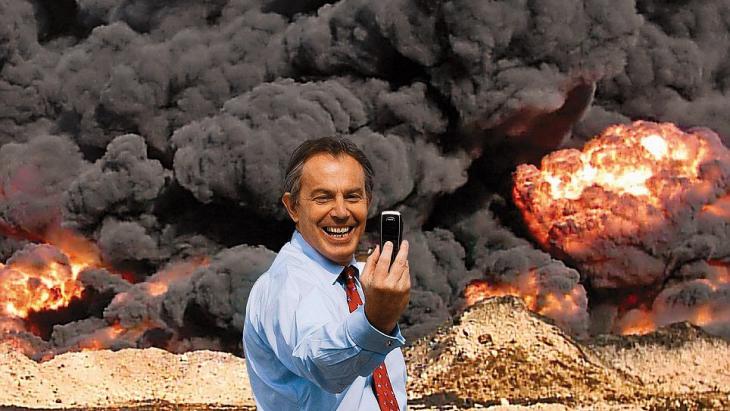
Graduating from university in 2001 with a Communications degree, Ardern took a role as a staffer to Helen Clark. She must have been dutiful in this role, because she quickly ended up in London as a Senior Policy Adviser to Tony Blair’s Labour Government. This is presumably a role in some demand, and therefore not given lightly to people in their 20s unless they show special promise.

British Prime Minister Tony Blair committed the British Armed Forces to the invasion of Iraq in 2003. This was done despite the fact that his plan to do so caused the largest protests in the history of the world – one million gathered in London to voice their disapproval, and three million gathered in Rome.

One million was also roughly the number of people killed by the invasion of Iraq, which means that Blair (alongside fellow warmongers George W Bush and John Howard) takes a position in the second tier of history’s greatest murderers. Ardern knew all this when she offered to work in his office, but it didn’t stop her. This fact is crucial to understanding her mentality.

It might seem incredible that a person supposedly committed to kindness would volunteer to work for a mass murdering war criminal – but Ardern did so in order to study his methods. She is every bit a willing apprentice to a war criminal. Anyone who considers the globalist wrecker of nations Tony Blair a model to base themselves on can only reasonably be treated with the deepest suspicion.

The reason why Ardern is opening the gates to mass Muslim immigration, as Blair did in Britain (Britain’s Muslim population increased 70% during Blair’s ten years in power), is twofold.

The first reason is that it strengthens the electoral position of the Labour Party. As Dan McGlashan showed in Understanding New Zealand, there was a significant correlation between being Muslim and voting for the Labour Party in 2017. Moreover, the average Muslim in New Zealand currently has qualified through normal immigration channels and is therefore more likely than usual to be educated and wealthy, and therefore less likely than usual to be a Labour voter.

Opening the borders to poorer and less educated Muslims than what New Zealand currently has is to all but guarantee that the majority of the newcomers will vote Labour. As has been seen in Britain, most Muslims already vote Labour, and can be relied upon to do so. Opening the borders to them, therefore, is to import a loyal voting bloc.

They also know that the more problems they can create, the more they can justify Government intervention. It’s no secret that mass Muslim immigration will bring with it widespread poverty, violence, property crime and sex crimes like child grooming gangs. This is only a drawback for the victims of those crimes. For politicians, it’s an opportunity to convince the public those politicians are needed to solve the public’s problems.

The second reason is that it promotes Ardern’s personal ambitions for future United Nations honours. Ardern is fully aware that one quarter of the world’s population is Muslim, and therefore that her desire to one day get a powerful role in the United Nations is heavily dependent on Muslim goodwill.

If Ardern’s psychology is to be understood, it has to be understood that she considers herself to be acting on the world stage, not on the New Zealand stage. This is the reason why she is dismissed, in some quarters, as the “Part-time Prime Minister.” Her audience is global, and far more important than mere Kiwis. Trivialities like running New Zealand can be delegated to Andrew Little.

Part of the reason for the brutal free speech crackdowns on New Zealand citizens (crackdowns that are in violation of existing New Zealand human rights law) is to maintain her appeal to the Muslim section of the globe. It’s also why the Sixth Labour Government doubled the refugee quota despite New Zealand’s worst ever housing crisis.

Putting followers of a foreign hate ideology above her own people is all but guaranteed to provoke immense resentment among New Zealanders. The bitter irony – that it’s precisely this kind of favouritism that leads to things like the Brenton Tarrant shooting – is lost in the hubris. So there’s every sign that New Zealand could be in for a tumultuous decade.

The desire to impress globalist interests is also why she doesn’t care about cannabis law reform, despite that there is an extremely strong desire for it among New Zealanders. There are simply no pro-cannabis blocs of voters at the United Nations, therefore no favour to be won by supporting the issue. It doesn’t matter that it would alleviate the suffering of large numbers of Kiwis.

It has to be emphasised at this point that Ardern simply doesn’t care about the human suffering that she causes through her ambition to become World Princess. It’s not an exaggeration to say that Ardern is the closest that New Zealand has ever had to a Hitler or a Stalin. The will to sacrifice any number of their own people to achieve personal goals is the common factor.

Who she most compares to is Blair himself, who was perhaps one order of monster lower than Hitler or Stalin. Nevertheless, like his fellow war criminal George W Bush, Blair is many times worse than even the most destructive serial killer. That Ardern willingly apprenticed herself to such a man, to learn his methods and strategies, speaks to an obscene degree of megalomania, perhaps exceeding anything New Zealand has ever previously produced.

*

If you enjoyed reading this essay, you can get a compilation of the Best VJMP Essays and Articles of 2018 from Amazon for Kindle or Amazon for CreateSpace (for international readers), or TradeMe (for Kiwis). A compilation of the Best VJMP Essays and Articles of 2017 is also available.
Why Beneficiaries Are Morally Superior to Workers

It’s a nearly universal assumption nowadays that people who work are morally superior to people on welfare. People on welfare, we are told, are essentially parasites that do nothing but suck wealth out of the system, and we’d all be better off without them. As this essay will explain, this is almost the exact opposite of reality. People on welfare are, in fact, morally superior to those who work.

The vast majority of human history has been one of deprivation and toil. Having evolved from a common ancestor with chimpanzees and bonobos, the primary survival challenge facing our species for almost the entirety of its existence was finding enough food to meet the metabolic needs of our bodies. For the most part, this was a brutal and bloody struggle against the world – and each other.

This had a powerful effect on the evolution of human behaviour – and our morality.

Because resources are scarce, and the metabolic clock is ticking, humans have always needed to be active. We have always needed to work, whether that be hunting, gathering, fishing or working the land in the form of agriculture. This was how we gathered enough resources to survive. The alternative to activity was death.

Because working was necessary for survival, we have always praised those who did it, and always excoriated those who did not. It was probably necessary to do this, because, had we not done so, the lazy would have dragged all of society down with them. Our culture, especially Northern European culture, came to consider work something almost holy, as if the meaning of life.

Working more and harder is how wealth is built, but as can be seen in the graph at the top of this essay, the planet cannot support the level of consumption that humans are currently subjecting it to. There simply aren’t enough of the necessary resources. The resources that do exist are being depleted at such a pace that we can see hard physical limits approaching, and there’s no escaping it.

The fact is that a profound paradigm shift has taken place over the past few hundred years, and we’ve barely even noticed it, let alone adapted to it.

American agricultural productivity increased 1200% between 1950 and 2000. This was thanks to something called the Green Revolution, which increased agricultural productivity severalfold all across the world. What this means is that it requires far, far fewer people to feed society today than what it took in the past. Therefore, most people are now surplus labour.

We have adapted to this by setting the now-redundant agricultural workers to work in other industries. First was manufacturing, then service industries. This worked out great for a long time, because all of these non-essential workers were able to produce things that raised the human standard of living, even if those things weren’t necessary.

This was pretty awesome for a few decades, and arguably continues to be. However, we are now aware of some things that we once didn’t know. In particular, we are now aware of the pressure we’re putting on the natural environment through shifting those surplus workers into manufacturing all sorts of things. We now know that we can’t keep doing this.

The world doesn’t need hard work and production any more. Those days are over. What the world now needs are people who can restrict their consumption to a level that the world can sustain. As seen on the graph above, that level is about half that of the average Chinese level of consumption, some $15,000 of resources every year.

In other words, a First World standard of living will, necessarily, become a thing of the past sooner or later.

For the average Westerner, restricting one’s consumption to about $15,000 worth of goods and services a year will not be easy. This will demand an extremely sharp curtailment of material desire. It will mean that far fewer international trips can be taken, and far fewer new cars or big screen televisions can be bought. It may require vegetarianism or something like it. It will require great sacrifice.

Without such a great sacrifice, our planet cannot survive, or at least not in a form that can sustain human life. Therefore, doing so is a moral imperative.

The average Western beneficiary has already achieved this. Considering that the average Western beneficiary already survives without the excessive consumption displayed by almost everyone in a job, they are in fact showing the way forward for the rest of the Western World. They are the pioneers of the future, demonstrating the correct way for the rest of us to behave. They are the Men of Gold.

Like the holy ascetic men of the great Eastern religions, the Western beneficiary class has liberated themselves from materialism. They are therefore showing the way forward for the rest of humanity, and ought to be praised as spiritual masters. The rest of us need to follow the path of the beneficiary, and stop following the path of the worker/consumer. The first step is recognising the moral superiority of the welfare recipient.

*

If you enjoyed reading this essay, you can get a compilation of the Best VJMP Essays and Articles of 2018 from Amazon for Kindle or Amazon for CreateSpace (for international readers), or TradeMe (for Kiwis). A compilation of the Best VJMP Essays and Articles of 2017 is also available.