
The Great Replacement And New Zealand

In France, 60% of the population believes that white French people are systematically being erased by mass immigration. This is the belief known as The Great Replacement. The theory that whites are purposefully getting erased is one of the most controversial in the politics of today, not least because Christchurch mosque shooter Brenton Tarrant named his manifesto after the concept.

Great Replacement Theory was initially developed by a French author and philosopher named Renaud Camus. He extrapolated known immigration and demographic data into the medium-term future and realised that French people would soon become a minority in their own country. Camus coined the term “genocide by substitution” for the phenomenon.

Predictably, this analysis provoked a shitstorm on the part of the French ruling class, who colluded to give Camus a two-month suspended prison sentence contingent on paying a fine. This followed a charge of “public incitement to hate or violence on the basis of origin, ethnicity, nationality, race or religion” in reponse to Camus’s statement that “immigration has become an invasion”.

Ruling class mouthpieces such as Wikipedia claim that Great Replacement Theory is a baseless conspiracy theory, apparently pushed by far-right-wing extremists in a bid to panic the masses. But, as with many other theories that the ruling class claims to be false, the facts and evidence backs it up. The numbers show, unequivocally, that white people are getting replaced.
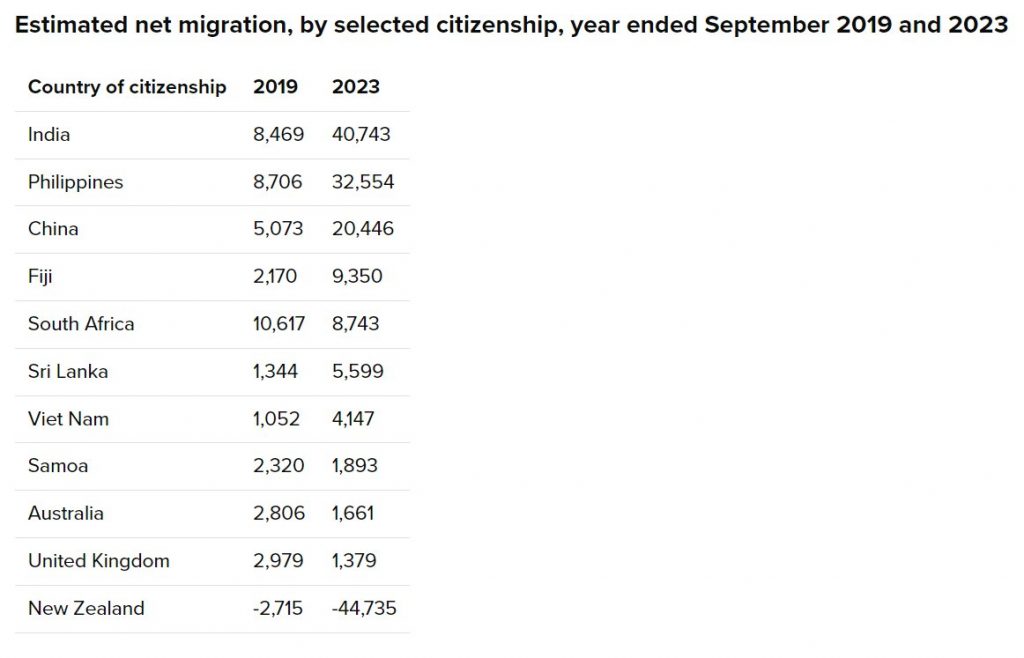
Statistics show that 44,735 New Zealand citizens left the country in the year ended September 2023. That’s about how many New Zealand citizens live in a medium-sized city like Nelson or Invercargill.

In return, New Zealand received over 110,000 cheap labour units from Third World shitholes. These people tend to be desperate, and thereby willing to work for minimum wage (cha-ching!). Often they end up replicating Third World conditions in their housing or workplace safety. Import the Third World, become the Third World goes the classic Internet refrain.

Note that these numbers are for a 12-month period only. The trend need only continue as far as 2030 for New Zealand to lose some 300,000 Kiwis, and for those to be replaced with some 700,000 Third Worlders. This replacement is so vast, so sudden, so total, and so apparently irreversible, that it merits the term Great Replacement.

The benefits of this situation to the New Zealand ruling class are obvious. Getting rid of a Christchurch-sized cohort of uppity Kiwis, who expect wages they can own homes and raise families with, and replacing them with a multitude of cheap labour units, happy to live 20 to a house if it means they can send remittances home, is a recipe for colossal profits.

Various sinister conspiracy theories exist to explain the Great Replacement. Some of them have some truth to them. The fact remains, however, that the major motivation behind it is profit. Jews and the Kalergi plan are unnecessary; white ruling-class capitalists are perfectly happy to destroy their own working classes for profit, and always have been.

The Great Replacement has already happened in New Zealand in microcosm. As recently as 60 years ago, South and West Auckland were the homes of several thriving working-class white communities. Those have all since been replaced by cheap labour imports, mostly from the Pacific Islands.

If white people can be ethnically cleansed from South Auckland, and if most people respond by acting as if the replacements had always been there (and if they haven’t been, it’s not a big deal anyway), why couldn’t that also happen for New Zealand as a whole?

It’s worthwhile noting here that Australia and Canada, also ruled by international banking and finance interests, are following the same path. Net overseas migration to Australia is currently running at 300,000-400,000 per year. In Canada it’s closer to 500,000 per year. Both countries, like New Zealand, already have record housing crises.

Importing record numbers of immigrants, to compete for housing against a native population suffering a record housing crisis, is an act of evil. The Western ruling class is evil, and they are destroying us via genocide by substitution. We have a moral imperative to rise up and stop them. But we have to act fast.

The more immigrants our rulers import, the harder it becomes for us to resist.

Aristotle wrote in Politics that tyrannies prefer to be multicultural, because that makes it harder for the people to come together against their oppressors. Multicultural societies come with built-in fracture lines that the tyrants can use to divide and conquer the masses, thereby keeping them incapable of rising up to resist oppression.

If those of us in the West, therefore, wish to stop the Great Replacement, we have to act before our replacements reach a critical mass. Young Westerners are already priced out of housing in our own countries. If it gets any worse we will be replaced entirely.

*

For more of VJM’s ideas, see his work on other platforms!
For even more of VJM’s ideas, buy one of his books!

*

If you enjoyed reading this essay/article, you can get a compilation of the Best VJMP Essays and Articles from 2021 from Amazon as a Kindle ebook or paperback. Compilations of the Best VJMP Essays and Articles of 2020, the Best VJMP Essays and Articles of 2019, the Best VJMP Essays and Articles of 2018 and the Best VJMP Essays and Articles of 2017 are also available.

*

If you would like to support our work in other ways, subscribe to our SubscribeStar fund, or make a donation to our Paypal! Even better, buy any one of our books!

The Biggest False Assumptions Made By Western Culture

The talking heads representing Western culture like to pretend that we’ve got everything squared away. That our ruling class has an accurate perception of the world and where it’s going, and therefore that everything is in good hands. The truth is far from this. Mainstream Western culture actually makes a number of false assumptions.

One of the most prominent is that nationalism is inherently violent. This falsehood is pushed heavily by the globalist interests who own the mainstream media. They have created the impression that nationalism and xenophobic aggression inevitably go together. This impression is reinforced by history channels full of footage of goosestepping German soldiers and snippets of Hitler speeches.

In reality, pro-nationalist sentiments are no more violent than pro-family ones. Nothing about a general attitude of caring for fellow members of one’s own nation is inherently more xenophobic or aggressive than a general attitude of caring for fellow members of one’s own family. In-group favouritism only implies out-group antipathy in a relative sense, not an absolute one.

Related to this is the delusion that democracy is inherently anti-tyranny. As with the previous false assumption, this delusion has resulted from propaganda in World War II and the Cold War. Democracy fought authoritarian national socialism and then authoritarian communism in the Cold War, therefore democracy is considered to naturally oppose tyranny.

In reality, democracy is just as capable of tyranny as any other system. The concept of “the tyranny of the majority” refers to this. New Zealand saw an blatant example of it with the 2020 cannabis referendum, the end result of which was that 48.4% of the population lost the right to use cannabis because 50.7% of the population voted for authoritarianism.

Underpinning democracy in the 21st Century is the false assumption that there is no genetic influence on behaviour. Humans are blank slates, we are told, and all are much the same as any other. Therefore, it’s possible for any number of them to be swapped out for cheap labour from across the world, and for everything to work out just as well.

It’s true that humans are born closer to a blank slate than any other animal is. However, human behavioural outcomes are still highly restricted by what the genes will allow. Intelligence is some 80% heritable by adulthood, which means that some populations will invariably become wealthier than others. Ultimately, society is a racial construct. As such, changing a society’s racial composition inevitably changes that society.

Another major behavioural false assumption states that behaviour is mostly the consequence of schooling. This assumption is commonly heard in reference to the Australian 501 deportees to New Zealand. The logic is that because these deportees are graduates of the Australian school system, their behaviour is Australia’s fault. But a person’s criminal inclinations are wired into place long before they finish (or even start) their schooling.

Erik Erikson accurately described the psychosocial challenges of human development, explaining that the first 24 months of life are the most crucial. Infants who don’t receive a loving and supportive environment in the first 24 months make up a majority of the world’s criminals. Early childhood abuse and neglect are the ultimate causes of most antisocial behaviour. So the parents are to blame far more often than the schooling.

Related to all the false assumptions about human development is the popular globalist falsehood that all human populations are precisely the same intellectually. Evolution, many believe, may have created a variety of different skin colours, hair colours, eye colours, body shapes and musculatures, but at no point did it play any role in shaping the brain, whether neurologically or behaviourally.

In fact, human populations vary greatly in intellectual capacity. Sub-Saharan Africans have an average IQ of 70, whereas North East Asians have an average IQ of 105. This is over two standard deviations of difference. National IQs correlate more strongly with national distance from the Equator (supporting the late Richard Lynn’s Cold Winters Theory) than with any social measure. As such, the varying economic outcomes among the different human populations can most accurately be ascribed to different IQ levels.

The same over-agreeable fools who believe that particular false assumption also tend to believe another one: that women are happier having careers than families. This falsehood has been engineered by corporate media interests who want women joining the workplace to increase the labour supply. In truth, as anyone who has worked in an office knows, women are only rarely happy in full-time work outside of the family home.

Gaddafi, in his Green Book, lays out the reality about women in the chapter devoted to that topic. Of course women ought to be free to work and to have careers if they so choose. But their natural function is to bear and to raise children. Therefore, if women are prevented from this function on account of that they are forced to work, then they aren’t free, and can’t be expected to be happy. The assumption that career women are happier than other women is nonsense.

Perhaps the most pervasive false assumption of all – so pervasive that even to question it is considered by most people to be tantamount to admitting insanity – is that science has proven materialism. Before Darwin, the common story goes, some people believed that God created everything. But after Darwin, God was disproven.

Scientific proof of evolution is one thing, but scientific proof of consciousness is another. There is no scientific evidence whatsoever that the brain generates consciousness. This means, logically, that there is no evidence that consciousness ends when the brain dies. It follows, therefore, that consciousness is the prima materia, and not the physical world.

This logic is denied by most. Few people today have avoided falling under at least one of the false assumptions listed above. This is one of the primary reasons why life in the clown world of today is so bizarre, frightening and obscene.

*

If you enjoyed reading this essay/article, you can get a compilation of the Best VJMP Essays and Articles from 2021 from Amazon as a Kindle ebook or paperback. Compilations of the Best VJMP Essays and Articles of 2020, the Best VJMP Essays and Articles of 2019, the Best VJMP Essays and Articles of 2018 and the Best VJMP Essays and Articles of 2017 are also available.

*

If you would like to support our work in other ways, subscribe to our SubscribeStar fund, or make a donation to our Paypal! Even better, buy any one of our books!
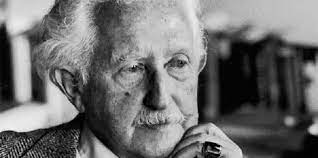
Erik Erikson And The Effects Of Early Childhood Trauma On Healthy Psychological Development

Psychologist Erik Erikson is best known for his theory on psychosocial development, which outlines the various stages of development and highlights their key characteristics and associated conflicts. However, another area that Erikson extensively researched was early childhood trauma and its effects on healthy psychological development.

Early childhood trauma refers to any adverse event or experience that a child experiences before the age of six. This can include various forms of abuse, neglect, loss of a loved one, violence and other experiences that can negatively impact a child’s healthy psychological development. Erikson was keen to address the effects of such trauma on child development, noting how they can affect an individual’s psychological makeup well into adulthood.

One of the key areas of early childhood development that Erikson focused on was the development of trust versus mistrust. According to Erikson, children pass through this stage within the first 18 months of their life, and its central conflict is between trust and mistrust. In this stage, children require consistent care and affection from their primary caregivers to develop a sense of trust in the world around them. Parents and caretakers play a crucial role in shaping the child’s perception of the world through their daily interactions and responses to the child’s needs. If these needs are not met due to early childhood trauma, mistrust may develop, leading to further psychological problems later on in life.

Erikson also emphasized the importance of a child’s autonomy during the second stage of psychosocial development, which occurs between the ages of two to three years. This stage is marked by toddlers’ assertion of their autonomy as they seek to assert control over their immediate environment. Children who experience early childhood trauma may find it challenging to develop a sense of self-trust and autonomy, leading to lower self-esteem, anxiety and feelings of inadequacy that can be long-lasting.

Early childhood trauma can also have profound effects on a child’s social and emotional development, affecting their ability to form secure relationships and attach healthily to others. Erikson posited that children pass through the stage of intimacy versus isolation during young adulthood, where they seek to develop genuine connectedness with others. However, individuals who lack a sense of trust and self-autonomy may find it difficult to establish such connections, leading to social isolation and feelings of disconnect.

Erikson was also concerned about the effects of early childhood trauma on academic achievement, given its critical role in shaping later-life outcomes. He argued that children exposed to traumatic experiences may develop cognitive and behavioural difficulties that can hinder their academic progress. Such difficulties can have long-lasting effects on their future career prospects, social mobility and overall well-being.

One of the most severe consequences of early childhood trauma is the risk of developing mental health issues such as anxiety or depression. This is because such experiences can leave a lasting impression on a child’s psyche, leading to unresolved emotional conflicts and feelings of vulnerability. The effects of childhood trauma can manifest in adulthood, leading to the development of low self-esteem, trust issues, difficulty forming relationships, and a host of other psychological difficulties.

Erikson was keen to emphasise the role of caregivers and parents in providing support and guidance to children exposed to early childhood trauma. Through supportive care, counseling and therapy, individuals can better work through such traumas and minimise their impact on their psychological development.

In conclusion, Erikson extensively researched the effects of early childhood trauma on healthy psychological development, noting how it can negatively impact a child’s perception of the world and their place in it. From issues of trust versus mistrust, autonomy, academic achievement, and social-emotional development, early childhood experiences profoundly shape later life outcomes.

Caregivers and parents play a crucial role in providing support and guidance to children experiencing traumatic events, which can minimise the impact of such events on their psychological well-being. Erikson’s work reminds us of the importance of a supportive and nurturing environment for children to develop healthy psychological development and highlights the long-lasting consequences of early childhood trauma.

*

If you enjoyed reading this essay/article, you can get a compilation of the Best VJMP Essays and Articles from 2021 from Amazon as a Kindle ebook or paperback. Compilations of the Best VJMP Essays and Articles of 2020, the Best VJMP Essays and Articles of 2019, the Best VJMP Essays and Articles of 2018 and the Best VJMP Essays and Articles of 2017 are also available.

*

If you would like to support our work in other ways, subscribe to our SubscribeStar fund, or make a donation to our Paypal! Even better, buy any one of our books!

Religious Trauma Syndrome And Christianity

Christianity, being one of the world’s largest and most widespread religions, has also played a significant role in causing Religious Trauma Syndrome. The ways in which Christianity can cause Religious Trauma Syndrome are vast and vary widely depending on the denomination and intensity of the beliefs in question.

One of the ways in which Christianity causes Religious Trauma Syndrome is through the belief in original sin, the idea that all humans are born with sin because of Adam and Eve’s disobedience in the Garden of Eden. Children are taught from a young age that they are inherently sinful and that needs to be ‘saved’ through faith in Jesus Christ.

This teaching creates an intense amount of guilt and shame within the individual, as they feel that they have done something wrong even when they have not committed any particular act. Believing that humans are inherently flawed can lead to self-loathing and negative self-talk, which can have long-lasting effects on an individual’s mental health.

Another way in which Christianity may lead to Religious Trauma Syndrome is through the concept of hell. Many Christians believe in a very literal hell, a place of eternal punishment for those who live a life of sin or do not believe in Jesus Christ. The idea of a literal hell can cause immense anxiety and fear in an individual, especially when coupled with the belief in original sin.

The fear of going to hell, not only for themselves but also for their loved ones, can cause significant psychological damage and can result in individuals living their lives in constant fear and worry about death and the afterlife.

Furthermore, Christian teachings around sex and sexuality can often cause immense harm to individuals who subscribe to them. Many denominations teach that sex is reserved for marriage, and anything outside of that context is considered sinful.

In addition, many denominations hold strict gender roles and homophobia, teaching that individuals should adhere to binary gender roles, and that same-sex relationships are morally wrong. The shaming and ostracising of individuals who explore sexual possibilities can cause deep emotional and psychological trauma, leading to feelings of self-hatred, worthlessness, and isolation.

Finally, the concept of spiritual warfare is another aspect of Christianity that can cause Religious Trauma Syndrome. Many Christians believe in a literal devil that actively seeks to deceive and ensnare individuals into sin. Actions that can be deemed as following the devil’s path range from anything from watching certain movies to exploring other religions.

Believing that spiritual warfare exists can lead to a constant state of fear and anxiety, with people struggling to feel safe in the world around them. Individuals can become paranoid about every situation in which they find themselves, never sure if they are following the right path.

In conclusion, Religious Trauma Syndrome is a real and important phenomenon that can have long-lasting effects on an individual’s mental health. Christianity, and the ways in which it is often taught, can play a significant role in causing Religious Trauma Syndrome in individuals who have had these beliefs forced on them.

*

If you enjoyed reading this essay/article, you can get a compilation of the Best VJMP Essays and Articles from 2021 from Amazon as a Kindle ebook or paperback. Compilations of the Best VJMP Essays and Articles of 2020, the Best VJMP Essays and Articles of 2019, the Best VJMP Essays and Articles of 2018 and the Best VJMP Essays and Articles of 2017 are also available.

*

If you would like to support our work in other ways, subscribe to our SubscribeStar fund, or make a donation to our Paypal! Even better, buy any one of our books!