
Towards A Demonology Of The Age Of Aquarius

The new age is upon us: its liberating light both warms and burns. In this new age, some things are the same as the previous age, and some other things are different. One thing that is both the same and different is our conception of demonology. The Age of Aquarius has a demonology that upsets the old order.

In the new age, it is understood that the Principle of Evil is none other than the God of Abraham.

The Demon God of Abraham has three High Demons under him, each of who rule over a 60-degree span of the Great Circle. These 60-degree spans can be understood as representing four-hour stretches of nighttime, which itself represents spiritual darkness. The rule of the God of Abraham, which we are just coming out of now as the Age of Pisces is ending, is analagous to a Great Nighttime.

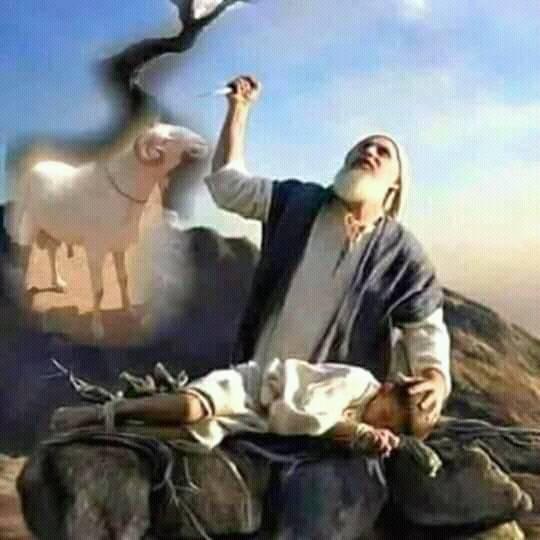
The First High Demon is Abraham himself, the father of lies.

Abraham tells lies for the sake of confusing those he hates (all conscious beings). Wherever you have a malicious lie told for the sake of causing suffering, you have the energy of Abraham. It is also present wherever you have a willingness to follow orders even when they clearly increase human suffering.

Abraham appears as an old man, conspicuously insane, ranting about his god. Knife in hand, he commands people to do evil things in the name of the Principle of Evil. Abraham’s favourite lies are those that encourage parents to destroy their own children. The favourite of all is the lie that male infant genital mutilation is not harmful.

The Second High Demon is Jesus Christ, the father of weakness and slavery.

Jesus Christ preaches weakness in the guise of moral superiority. He tricks people into feeling pathological altruism, often leading to their destruction at the hands of enemies. His energy has the effect of lowering people’s spirits, so instead of being fearless and proud they surrender meekly to tyranny. Anywhere you find slaves meekly obeying their masters you have the energy of Jesus Christ.

Jesus Christ appears as a sickly, trembling hippie. He cries about how everything that everyone does is evil, and how all borders should be opened. His wailing weakens men’s resolve. Jesus Christ often performs masochistic acts in an attempt to trick other people into doing the same. His favourite thing is to cause so much despair that a person surrenders, in desperation, to the Principle of Evil.

The Third High Demon is Muhammad, the father of cruelty.

Muhammad preaches cruelty in the name of order, justice and morality. His energy can be found anywhere there are oppressive laws claiming to be righteous ones. It can also be found anywhere a person unjustly asserts themselves upon another person. All rapists and murderers possess some of the spirit of Muhammad.

It is most common to depict Muhammad as a black-eyed, black-bearded Arab. Usually he is shown serving in the role of judge or executioner. Inevitably he is holding a bloody sword, his favourite thing being the destruction of anything beautiful, especially anything feminine. His favourite thing of all is to rape and impregnate anyone he can take as a slave.

These three High Demons follow in that order. Abraham destroys the Golden Age by telling lies, leading to the weakness of Jesus Christ, who in his turn intensifies the Dark Age, leading to the cruelty of Muhammad. This decline can be understood in elemental terms as a transition from gold, to silver, to clay, to iron.

The suffering of the Iron Age leads, however, to a new Golden Age: the Age of Aquarius.

Each of these three High Demons rules over twelve Greater Demons, who themselves rule over a five-degree segment of the Great Circle. Each of these Greater Demons rules over five Lesser Demons, so that every degree in the lower half of the Great Circle is represented by a particular demonic energy loyal to the Principle of Evil.

In total, then, there are 36 Greater Demons, each of which expresses an energy that is a permutation of three factors: either deceit, weakness or cruelty in the first place, cardinal, fixed or mutable forces in the second place, and earth, water, air or fire in the third place.

For instance, one of the Greater Demons is Quisling, who represents deceit in a cardinal and fiery sense. Quisling is a traitor who imposes a new order at the highest level, without the consent of those ordered. His energy can be found wherever there is political intrigue leading to a revolution that increases the suffering of the masses.

Another of the Greater Demons is Prozac, who represents weakness in a fixed and watery sense. Prozac has the ability to paralyse people through sapping their positive emotions and their will. Wherever you find people who are emotionally stunted and lifeless, but tending towards misery, you have the energy of Prozac.

The Lesser Demons have names like Bonebreak, Kneebender, The Sniveller, Detritus, Axewound, Him Long Dead, Bellycrawler, The Fiddler, Headrot and False Light. There are 180 of these lesser demons, each representing one degree of the lower half of the Great Circle.

Generally speaking, a follower of the Principle of Evil will have an affinity for one of the three High Demons, and will manifest the energies of the various Greater Demons depending on what they wish to achieve in the moment. If their affinity is for Abraham, they will call themselves a Jew; if it is for Jesus Christ, they will call themselves a Christian; if it is for Muhammad, they will call themselves a Muslim.

The Lesser Demons are more for meditative and ritual purposes. A follower of the Principle of Evil might meditate on one of the Lesser Demons in order to gather the energy to perform a particular act of evil. A murderer might meditate upon Bonebreak, for example, before slaughtering their victim.

Collectively, the combined energy of all of these demons serve to increase the amount of suffering in the world. To increase the suffering in the world is the will of the Principle of Evil, and all followers of the Principle of Evil seek to cause as much harm and misery, both physical and mental, as they can.

The Abrahamist will worship one of more of these three High Demons. In doing so, they consecrate some of their psychic energy to the demon, strengthening its egregore. In return, they receive some of that demon’s energy, thereby making certain actions more possible.

In the new age, it is understood that it was the Principle of Evil, not God, who commanded Abraham to kill his own son, and it was the Principle of Evil who inspired Jesus Christ to preach that slaves should obey their masters, and it was the principle of Evil who induced Muhammad to rape a nine-year old.

This is a short summary of the demonology of the Age of Aquarius.

*

If you enjoyed reading this essay/article, you can get a compilation of the Best VJMP Essays and Articles of 2019 from Amazon for Kindle or Amazon for CreateSpace (for international readers), or TradeMe (for Kiwis). A compilation of the Best VJMP Essays and Articles of 2018 and the Best VJMP Essays and Articles of 2017 are also available.

*

If you would like to support our work in other ways, please consider subscribing to our SubscribeStar fund. Even better, buy any one of our books!


Clown World Chronicles: The Clown World Pantheon And How To Use It For Magical Purposes

All throughout history, people have believed in divine forces behind everyday phenomena. Most people have an intuitive sense that the material world is not the only thing that exists. Appearances can be deceiving. Beneath the surface lies a glorious array of elemental forces, many of which are breaking through into popular culture in the form of a new pantheon of gods and goddesses.

The Clown World pantheon represents the elemental forces at work in Clown World. These forces are the same ones that have always been present, in all times and places: good and bad, masculine and feminine. All of these forces, and combinations of forces, have manifested in Clown World in anthropomorphic form.

These forms are the gods and goddesses of Clown World, as described in this third section of the book. All of these have, and continue to be, depicted in the counterculture of Clown World. Chad, Virgin, Coomer, Wojak, Pepe and Corona-chan are some of their names. They appear whenever someone summons them by manifesting the right energy.

In this sense, the Clown World pantheon is little different to the Greco-Roman, Norse or Hindu pantheons. There are masculine and feminine gods, and there are old and young gods, and there are benevolent and malevolent gods. Much like Mercury, Odin, Athena, Haruman, Loki and all the rest, the gods and goddesses of Clown World represent the entire territory of metaphysical space.

This third section of the book is an attempt to map the elemental forces of creation as they manifest in various Clown World figures.

The vertical axis of the Clown World pantheon is the good/bad axis. At the top is Kek, the personification of good will. At the bottom is The Merchant, the personification of malice. In the centre are Pepe and Wojak, who represent the everyday Clown World denizen in their masculine and feminine forms.

The horizontal axis of the Clown World pantheon is the feminine/masculine axis. This stretches from the feminine pole, at the far left, to the masculine pole, at the far right. ‘Feminine’ and ‘masculine’ here mean what a Taoist means by yin and yang: two opposing but complementary forces which are found in all things, but at different ratios.

The vertical axis of the Clown World pantheon can be considered a central pillar. Out of the centre of this pillar come four separate axes. To the lower right goes the Negative Masculine Axis, to the upper right goes the Positive Masculine Axis, to the upper left goes the Positive Feminine Axis, and to the lower left goes the Negative Feminine Axis.

In this sense, ‘positive’ means that the divine beings on these axes exert a beneficent influence upon the denizens of Clown World. ‘Negative’, on the other hand, refers to a malicious or destructive influence.

The Clown World pantheon, as it is presented here, is therefore a map of metaphysical space. All things that exist, no matter what combination of good/evil/feminine/masculine they might embody, have a place somewhere on the diagram at the start of this chapter. If any of those things know where that place is, they can move to elsewhere on the map if they manifest the right energies.

The Clown World pantheon must also be understood radially. This conception has Pepe/Wojak in the centre, where Pepe represents rising forces and Wojak represents falling forces. Together, they represent the cardinal form of all principles. Pepe represents the cardinal force of action and Wojak represents the cardinal force of thought.

Moving out from the centre, one comes to the Younger Gods. They represent the mutable form of each principle, i.e. an energy that has character but which can still change. They are no longer cardinal forces, as previous decisions have committed them to a certain range of action, but neither are they fixed forces. In a sense they represent each elemental force at the prime of its powers.

Furthest out from the centre are the Elder Gods. These represent the fixed form of each force. Spiritual energy that reaches this far out from the centre is difficult to change – it has moved so far in one direction that its course is effectively set. The only way to change it is to die, and then to be reincarnated again in the centre.

Every person starts in the centre when they are born. If they are feminine, they will move outwards towards the feminine pole, and vice-versa if they are masculine. When they stray too far towards one of the extremities, they die, and are reborn again in the centre. This leads to each consciousness naturally making a toroidal motion through metaphysical space.

Using the Clown World pantheon for magical purposes is a rich and rewarding art. There is nowhere near enough space here to go into the details of magic itself. It’s enough to say that the purpose of magic is to cause change according to one’s will, and that the primary target of magic is the frequency of one’s own consciousness.

The simplest way to use the Clown World pantheon to change one’s consciousness is to ritually focus one’s attention on a particular Clown World god or goddess for an extended period of time.

The first way to do this is by entreaty. This is the method best suited to people whose IQs are average or below average. It involves simply praying to one of the Clown World pantheon and entreating them for good fortune. One might pray to Boomer for a slice of his wealth, or to Chad for some of his swagger, or to Waifu to reveal herself.

A hospitality worker might entreat Karen to go easy on the complaining tonight. A person hosting a party might entreat Honkler to give everyone a good time. A psychiatric nurse might entreat Doomer to stay away from their patients. The purpose of such an action is to attract the good will of the pantheon figure in question.

The second way is by meditation. This is the method best suited to people whose IQs are above average. It involves focusing one’s attention on one of the Clown World pantheon and holding it there, until one’s own frequency of consciousness takes on the frequency of the god or goddess. This will lead to the environment of the magician taking on that frequency as well.

Advanced meditation is possible after a person has studied the different pathways from one point on the map to the others. Knowing this, they know the different forces influencing each member of the Clown World pantheon. Meditating on these pathways will confer a degree of mastery over the energies of that part of the map. This mastery can then be applied to real life.

In summary, the Clown World pantheon is yet another example of the age-old practice of representing metaphysical space with a symbolic map. Great fortune, power and lulz await anyone who masters accurate navigation between the various points on this map, because they will be able to live their lives in ways that entertain the gods.

*

This article is an excerpt from Clown World Chronicles, a book about the insanity of life in the post-Industrial West. This is being compiled by Vince McLeod for an expected release in January 2021.

*

If you enjoyed reading this essay, you can get a compilation of the Best VJMP Essays and Articles of 2019 from Amazon for Kindle or Amazon for CreateSpace (for international readers), or TradeMe (for Kiwis). A compilation of the Best VJMP Essays and Articles of 2018 and the Best VJMP Essays and Articles of 2017 are also available.

*

If you would like to support our work in other ways, please consider subscribing to our SubscribeStar fund. Even better, buy any one of our books!
The Elementalist Conception Of The Meaning Of Life

Elementalists believe, much like the Existentialists, that every person is entirely free to choose what the meaning of their life is. Broadly speaking, the meaning of life that a person chooses will fall into one of four categories, each corresponding to one of the feminine elements.

Some people choose domination. This corresponds to fire. These people have the most energy to expend. They strive to become professional sportsmen, business tycoons, politicians or military/law enforcement/security. People who choose this as the meaning of life are likely to see other people as weak.

Some choose exploration. This corresponds to air. These people are masculine, and like to go forward, but they are more subtle about it than the dominators. People in this group are more likely to become backpackers or psychonauts. If someone chooses exploration as the meaning of life, they are likely to see other people as boring.

Some choose pleasure. This corresponds to water. People who choose pleasure are feminine because they will shy away from adversity, but they are not entirely feminine, because they do not shy away from pleasure and are attracted to the possibility of it. If someone chooses pleasure as the meaning of life, they are likely to see other people as masochistic.

Some choose survival. This corresponds to earth. These people are feminine, and are prone to retreating. Life on this planet is hard enough without worrying about things like domination or exploration. Much better to just hunker down. If someone chooses survival as the meaning of life, they are likely to see other people as foolish. ‘Why take a risk if I don’t have to?’ is their motto.

In principle, every person could be assigned to one of these four groups based on how they choose or desire to live, even if they haven’t consciously chosen that group themselves. This is because every person who chooses to go forwards – in other words, every person who chooses to live – must have a reason to do so, and the potential range of those reasons is finite.

However, all of these reasons are only ever a Secondary Meaning to a life.

The Primary Meaning of every life is to entertain the gods.

Elementalists believe in higher dimensions that are populated by beings of higher frequencies. These beings are capable of observing us without our being aware of it, much like we might observe a creature under a microscope. To us, they are the gods: higher frequencies in higher realms of the Great Fractal.

It is to entertain these gods that our lives have meaning. The more righteously one attempts to full one’s Secondary Meaning of life, the more gloriously one fulfills the Primary Meaning. If our futile struggles to dominate or to explore the Great Fractal entertain the gods, then our lives have meaning despite being finite.

It needs to be emphasised at this point that all of us are mortal. So all of us are faced with a dilemma. Domination and survival are impossible because each of us will inevitably weaken with age and decline into death. Infinite pleasure is impossible because the agonies of aging and dying must befall all of us. Even exploration is meaningless because the memories of it will not survive death.

What this means is that every Secondary Meaning, i.e. every meaning that we could ourselves give to life, is ultimately futile and pointless.

Many never overcome this dilemma, withdrawing from life and saying No to it. Such people appall, disgust and bore the gods. Those who fail to overcome this dilemma are soulless; they don’t try to dominate or explore, they don’t seek pleasure and they don’t care if they live or die. These existential zombies have failed to understand the Primary Meaning of life.

Those who do overcome this dilemma behave in ways that entertain the gods. Their example is authentic, passionate acceptance, saying Yes to life. This pleases the gods, who see a spirit that may one day rise to stand among them in a higher dimension. In the Elementalist conception, man lives so that the gods might regard him as they once regarded Alexander.

This conception clashes head-on with others. Some of the most common competing ideas about the real meaning of life are religious ones: that we’re here to overcome evil, to purify our souls or to escape the world of suffering. But Elementalists reject all of these conceptions.

Overcoming evil cannot possibly be the Primary Meaning of life, because evil will always be a part of the world as long as it’s possible for God to will it. Struggling against evil might be a Secondary Meaning to life, especially if that struggle was one of survival, but the Primary Meaning would still be the entertainment value that one’s struggle provided the gods.

Neither can purifying one’s soul (understood by the Elementalist as raising the frequency of one’s consciousness) be the Primary Meaning of life. If it was, then life would be no longer possible once this had been achieved. Struggling to purify one’s soul, if that struggle be heroic enough, can serve as the Primary Meaning of life. Then again, so can struggling to degrade one’s soul. Both the rising beast and the falling angel entertain the gods.

Nor can escaping the world be the Primary Meaning of life. There’s ultimately nowhere for consciousness to escape to, other than reunion with God, and in such a case there’s no going forward without re-entering the world again. The problem with escaping samsara is that nirvana is batshit boring. Of course, however, struggling to escape the world can serve as the Primary Meaning of life should it entertain the gods.

The ancient Greeks understood the overwhelming importance of behaving heroically for the sake of the gods’ attention. They understood that the gods and goddesses watch over us from a higher place. This knowledge has been lost today, which is one reason why we live in such a pitiful manner, struggling for purpose and meaning.

*

If you enjoyed reading this essay, you can get a compilation of the Best VJMP Essays and Articles of 2019 from Amazon for Kindle or Amazon for CreateSpace (for international readers), or TradeMe (for Kiwis). A compilation of the Best VJMP Essays and Articles of 2018 and the Best VJMP Essays and Articles of 2017 are also available.

*

If you would like to support our work in other ways, please consider subscribing to our SubscribeStar fund. Even better, buy any one of our books!

Clown World Chronicles: Who Is Tyrone?

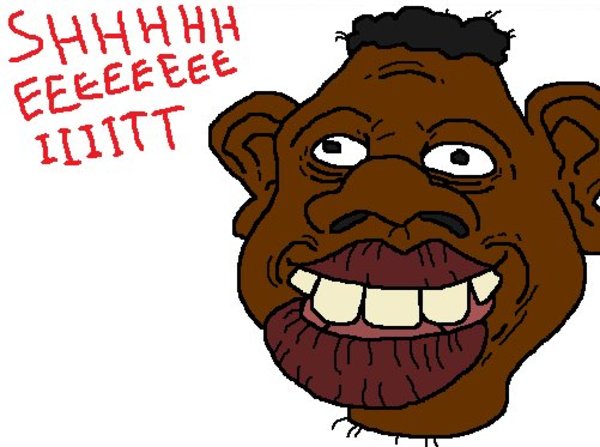
He can be seen shuffling along, his pants low, his limbs elastic, his head bobbing to some random tune. Something remarkable occurs, and he cries out “Sheeeeeittt!” He is Tyrone, one of the many demigods of the Clown World pantheon.

Tyrone is the archetype of not giving a fuck anymore. Mostly because of early childhood trauma, but also perhaps for natural reasons, Tyrone doesn’t think beyond the immediate future. If something happens, he simply reacts to it. Tyrone likes to live in the now, reasoning that there’s something inhuman about scheming for a future that may never come.

Legend has it that Tyrone was conceived when his mother offered her pussy up for a rock of crack. His father then disappeared, never to be heard from again. No-one ever invested in Tyrone’s education, and as such he is an exceptionally unrefined being. Tyrone couldn’t pass the marshmallow test no matter what the schedule of rewards was.

Although many mock Tyrone for being low-IQ, there’s more to him than that. He also represents the spontaneity that brings joy to life. Humour always follows in his wake (even if it’s of the slapstick, wacky variety). Tyrone loves laughing, eating, partying and he especially loves fucking.

Not even Chad enjoys busting a nut as much as Tyrone does. For Tyrone, getting his end away is to ascend into heaven. The excitement of getting laid is so great that the possibility of it gives colour and meaning to all of life. Every attractive woman gets a “Sheeeeiiittt”.

Many a Clown World denizen summons the power of Tyrone to decrease their sexual anxiety. These magicians hold in their minds an image of the person that they would like to make love to and think “Sheeeeeiiittt!” This allows them to relax and to see the sexual encounter as an opportunity to create a lifelong memory.

In the Clown World pantheon, Tyrone represents the space between the Great NPC and Doomer, between the Negative Fundamental Axis and the Negative Masculine Axis. As such, he is more of a demigod than a real god. In a sense, he is a double negative masculine energy, combining the mindlessness of the Great NPC with the nihilism of Doomer.

One consequence of representing double negative masculine energy is that Tyrone commits an enormous amount of sex crimes. The tyronic mentality considers weakness and passivity an invitation. He doesn’t care if a woman is drunk, underage, or incapacitated in some sense – he just ploughs in.

Fitting with this sexual recklessness, Tyrone has a great number of illegitimate children. He is infamous for his hit-and-run mating style. Any citizen of Clown World who does not know their father could be said to possess some tyronic energy. This energy can cause them to behave like Tyrone, making short-term decisions.

The appearance of Tyrone is usually a bad omen. It commonly means that violence and disorder are about to come to one’s neighbourhood. Tyrone has an extremely casual attitude to property crime, which causes him to acquire things without due consideration. His followers have similar attitudes.

However, the appearance of Tyrone can also mean good times and hilarity is coming one’s way. Tyrone is a demigod of disorder, and this can bring much-needed levity. Many people experience a crushing, suffocating sense of excess order in Clown World, thanks to the fact that everything has been monetised down to the last detail, and that every last second of time is accounted for. Tyrone promises release from these strictures.

Tyrone is in it for a good time, not a long time. As such, he’s usually up for any wack-brain scheme that someone comes up with. He is willing to take massive risks for minimal or even negative reward. When it all goes horribly wrong, he just cries “Sheeeeeiitttt.” He never seems to sustain the serious injuries that one expects him to.

Some of the funniest stories in the Clown World pantheon result from the Merchant’s attempts to win the loyalty of Tyrone. The Merchant wants to send Tyrone after his enemies, to destroy their neighbourhoods and perhaps even kill them. But Tyrone, not being pure evil, never fully trusts the Merchant, and so can never totally be controlled.

Other funny stories involve Tyrone trying to impress Stacy, but ending up with Karen. Somehow, Karen got it into her mind that Tyrone has an gigantic penis, so she hooks up with him, hoping that his irrepressible lust will make her feel young again. Sometimes she has to trick him, which can lead to all kinds of consequences.

Tyrone is far from evil – he also sells weed to anyone who might need it. An international traveller who just turned up in a new city might get quality drug hookups from befriending him. Tyrone’s just loose. This looseness can create great joy for those who feel that Clown World is excessively restrictive.

*

This article is an excerpt from Clown World Chronicles, a book about the insanity of life in the post-Industrial West. This is being compiled by Vince McLeod for an expected release in the middle of 2020.

*

If you enjoyed reading this essay, you can get a compilation of the Best VJMP Essays and Articles of 2019 from Amazon for Kindle or Amazon for CreateSpace (for international readers), or TradeMe (for Kiwis). A compilation of the Best VJMP Essays and Articles of 2018 and the Best VJMP Essays and Articles of 2017 are also available.

*

If you would like to support our work in other ways, please consider subscribing to our SubscribeStar fund. Even better, buy any one of our books!