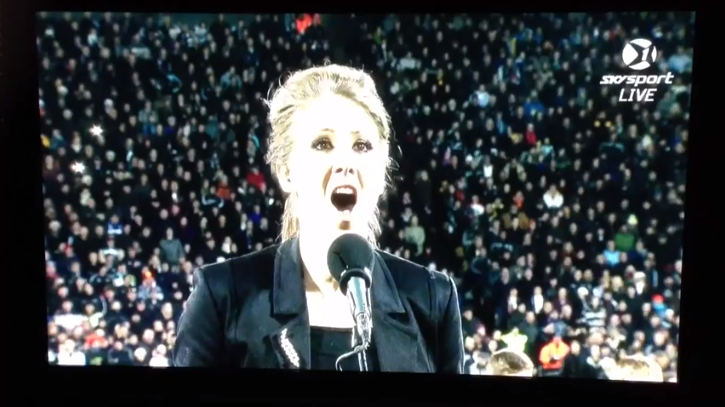
The ceremonies before an All Blacks match are an essential part of setting the mood to enjoy the theatre. But many people sing along to the words of the Maori version of the national anthem without knowing what it means. I don’t sing the words to the Maori version of the national anthem because they are an insult to my people.
The God of Nations referenced in the English version of the national anthem is not the same as the God of Abraham. The English version of the national anthem was written by Thomas Bracken, a Freemason, and as such the God referenced is the true divinity beyond all cultures. It is not Yahweh, the God of the Jews.
Governor George Grey commissioned a Maori translation of Bracken’s poem in 1878. This was performed by Thomas Henry Smith, an English immigrant and a Christian. Being Christian, and following the Christian imperative to destroy all other spiritual and religious traditions, Smith took the opportunity to erase all reference to God in his translation and to replace it with reference to Yahweh.
“E Ihowā Atua”, from the first line of the Maori version of the national anthem, means “O Jehovah God”. The Ministry of Culture and Heritage informs us that “‘Ihowā’ is the standard version of God (Jehovah) and was the one used by Smith.” In other words, Smith, a Christian, twisted Bracken’s nondenominational anthem into an entreaty to the God of the Jews.
Now why would I, as a person who does not worship Yahweh, sing an entreaty to the Jewish God?
As a Ngati Porou, being asked to sing a song about Jehovah is an insult. It was in the name of Jehovah that the spiritual traditions of the Maori people were destroyed and replaced with base superstition. Early Christian missionaries eradicated all knowledge of Io Matua Kore, the god of this part of the world, to replace it with knowledge of Yahweh, the god of a foreign land.
This was a great crime, and one which has never been acknowledged, much less made up for.
I would happily sing the Maori national anthem if it were replaced by a entreaty that praised Io Matua Kore instead of the God of the Jews. The Maori version of the New Zealand national anthem needs to be rewritten, preferably by a Maori and not an English immigrant, and in such a way that removes reference to the God of the Jews and replaces it with the God of Aotearoa.
Then I would sing the Maori version of the national anthem with pride.
The following essay expounds an alt-centrist way of conceptualising political space. The fundamental idea is that the Will of the Divine rules over all the material world, and before this mighty Will stand 24 governors, each one of which corresponds to one of the elementary political positions.
The original conception of political space speaks of a monarchist right and a republican left. This conception dates back to the French Revolution and the composition of the then government, in which supporters of the monarchy sat on the right wing of the French National Assembly while supporters of reform sat on the left wing.
Making the crudest possible distinction, political space is divided into a right wing that wishes to maintain power and privilege and a left wing that wants power and privilege redistributed. These two wings, along with the centre that tries to get them to co-operate, constitute the first three powers before the throne.
In modern Western democracies, this post-monarchical arrangement has evolved into the Establishment. Today, the entirety of the leadership of both the left and the right is comprised of the same ruling class that leads the centre. Economic imperatives have overridden all other concerns; status quo or change matters not at all.
In response to this oligarchical arrangement has risen the anti-Establishment. It first arose in the form of the alternative right that took control of Central Europe after World War I. In the aftermath of World War II rose the alternative left, which currently exerts more social power than any other position. Today the alternative centre is rising.
This political hexad (of the Establishment, the anti-Establishment, and the three divisions of each) has been discussed at length in The Five Rejections and The Five Acceptances. It constitutes the basic foundation of alt centrist thought.
Each of these six positions can themselves be divided into four attitudes. These attitudes answer the two basic political questions, which are essentially: who gets it? and how hard?
Answering the question of “who gets it” divides the six positions into two further positions each: nationalists and globalists.
The nationalists are those who identify with a particular nation, and who believe that the nation is the natural organisational unit of the world stage. They believe that benefits such as welfare ought to be reserved for members of the nation, and that questions around immigration and defence ought to be settled with a view to the benefit of the nation. In short, they believe that only the nation should “get it” (the rewards of the nation’s operation).
The globalists believe that anyone can get it. Globalists have no time for the argument that the resources of the nation belong to the nation. Their position is that any resource, anywhere, is the property of whoever pays to own it. That anyone risked their lives defending those resources in the past is irrelevant. Globalists owe no loyalty to any land or nation.
The majority of the Establishment is globalist right now, but that isn’t inevitable. There are nationalist sentiments within all three Establishment positions – the monarchist right considers itself the representative of its nation, the working-class left wants national borders to prevent the importation of cheap labour from driving down wages, and the rent-seeking centre wants to lock down the national market against foreign competition.
Answering the question of “how hard do they get it” divides the above twelve positions into two further positions each: authoritarians and libertarians.
The authoritarians argue that people ought to get it hard. They don’t care about freedom as a virtue. Authoritarians tend to be verticalists, in that they believe the natural organisational model of the human species is a dominance hierarchy in which the upper ranks have complete authority over the lower ones.
The libertarians, by contrast, argue that the government ought to be gentle. They believe that authoritarianism is inherently unstable because it provokes resentment which leads to disorder. Libertarians are morally appalled by complete authority over other people, and therefore they don’t believe in banning things such as cannabis or homosexuality.
So within all of the six political positions of alt centrism (Establishment Right, Establishment Left, Establishment Centre, Alternative Right, Alternative Left, Alternative Centre), there are four composite attitudes (Authoritarian Globalist, Authoritarian Nationalist, Libertarian Globalist and Libertarian Nationalist). This gives us a total of 24 different political positions, all vying for control of the state.
These are the 24 powers before the throne. At any given time, in any given jurisdiction, one of these 24 powers will govern.
The ruling power in the West right now is the globalist Establishment, which is an alliance of all of the right, the left and the centre. It is currently transitioning from libertarian to authoritarian as its perceived legitimacy collapses. They are firmly globalist, being an alliance of the victorious anti-nationalist powers of World War II.
The anti-Establishment is all four of authoritarian, libertarian, globalist and nationalist. The authoritarians range from tankies on the left to theocrats on the right. The libertarians are rising in opposition to the increasingly authoritarian measures of the Establishment. The globalists generally think that the Establishment hasn’t done enough to open borders. The nationalists recognise that the vast majority of the Establishment are globalists.
All of these 24 powers have risen and fallen in influence at the various times and places in world history. The course of history could be said to be nothing more than the patterns of that rising and falling.
The authoritarian nationalist anti-Establishment is perhaps best represented by Adolf Hitler’s Nazi movement. They rose in opposition to the strictures of the Treaty of Versailles, and to the globalist Establishment that had imposed them.
The authoritarian globalist anti-Establishment left is perhaps best represented by the Communist and Bolshevik movements that swept the world in the early 20th Century. The authoritarian globalist left has now become part of the Establishment, leading to today’s cancel culture.
VJM Publishing represents libertarian nationalist alt centrism. We are an anti-Establishment collective that repudiates both the weakness of the left and the cruelty of the right, as well as the greed of the globalists and the mindlessness of the authoritarians.
Understanding these 24 powers before the throne is the key to understanding the movements of political arena. As some of the powers gain in power, and others lose, the landscape changes.
Many people ask themselves why the mainstream media does so much race-baiting. It’s apparent that there a conscious and widespread effort to divide every Western nation along racial lines, and to promote racial consciousness wherever possible. The mainstream media does all this as part of a deliberate strategy to divide and conquer all Western nations.
The first thing to be understood is that the mainstream media of almost every Western nation is owned and controlled by international banking and finance interests. This is true of New Zealand, and it’s true of almost everywhere else as well, and has been true for over a century now.
These international banking and finance interests don’t permit the journalists of the mainstream media to present the news objectively. Control of the narrative is far too valuable to allow mere journalists to decide what information gets presented to the masses.
The mainstream media serves as the apparatus of propaganda, through which consent for the desires of the ruling class is manufactured. The owners of that apparatus make sure that its every action serves their interests. To that end, every story, article or bulletin is manicured to achieve the maximum possible propaganda benefit to the ruling class.
The major interest of the international banking and finance interests, a.k.a. the ruling class, is to maintain their position at the top of the social dominance hierarchy. Staying at the top, when you are grossly outnumbered, is primarily a matter of dividing and conquering the masses and setting them against each other. That way, they can’t unify and set themselves against you.
It is in serving this interest that the mainstream media does so much race-baiting. Their repeated emphasis on racial issues distracts from the class issues that are harming both working-class whites and working-class non-whites. This is true of every Western country.
Whether it’s whites and blacks, whites and Muslims, whites and Maoris – both or all sides have to be set against each other through constant emphasis of their differences and denial of their similarities. At no point, ever, may it be acknowledged that working-class whites and working-class non-whites have anything in common.
This is why the mainstream media dishes up shit like this week’s report about the Vodafone CEO telling one of his customers to fuck off in Maori, which is not news in any sense. The only purpose of stories like this is to normalise the division of the nation into racial groups, which is achieved by normalising race consciousness.
The Vodafone CEO is a wealthy, ruling class man, who benefits directly from the division of the working class, whose wages are his biggest expense. He is not a friend of Maoris in any sense, especially not working-class ones. But the apparatus of propaganda is willing to present him as an ally for the sake of race-baiting.
This is why New Zealand’s Stuff, the 12th most-visited website in the country (according to Alexa rankings), has an entire section devoted purely to race-baiting. The ‘Pou tiaki’ section runs nothing but race hate stories, usually with a particular focus on demonising white people. Even when white people are not demonised directly, this section propounds the narrative that every New Zealander is their race first and foremost.
Such narratives have an extremely destructive effect on working class solidarity. Working-class whites, many of who are still suffering intergenerational trauma from their ancestors’ participation in World Wars I and II, naturally resent being told that they are privileged. Working-class Maoris, for their part, are torn between loyalty to their fellow working-class whites and their own Maori elders, who tend to push race hate narratives.
This resentment and divided loyalties make it impossible for the working class to present a unified front to the ruling class.
The mainstream media, and the people who own them, don’t care whether the average white Kiwi sees Maoris as an angelic race of innocent victims or as a criminal race of grifters and gang members. All that matters is that they’re seen as an other. There’s a white Us and a brown Them, and class narratives don’t come into it at all, ever.
As long as people think that “we are our race”, they don’t ever think that “we are our class”. That would be the real danger – if working-class whites and working-class Maoris would come together to assert their class differences in the face of the ruling class. It is to prevent this outcome that the ruling class directs its lackeys in the mainstream media to fill the airwaves with race-baiting propaganda.
Normalising racial consciousness also abnormalises the idea that a random working-class white and a random working-class Maori can come together in bonds of solidarity. Racial consciousness means that the first thought of a white upon seeing a Maori, or vice-versa, is suspicion and mistrust. Class consciousness, by contrast, means that working-class people put all their mutual suspicion and mistrust aside to achieve a greater goal.
So the reason why the mainstream media does so much race-baiting is to keep the enemies of their owners divided. The owners of the mainstream media want a divided working class, one that cannot come together to effect any real change to the status quo of the political and economic systems. Every story about racial injustice is a story that distracts from class injustice.
The long-term strategy for building economic wealth appears to be holding house prices steady while waiting for wages to catch up. This article does the maths to answer one question: how long until the average wage has the same housebuying power of the average wage in 1992?
By 2021, the average New Zealand house price has climbed to some $750,000, while the average wage languishes at around $34 an hour. This means that most Kiwis today are looking at putting in 22,000 hours of labour before they can get to the position of homeownership.
Economists predict that the average New Zealand house price will increase by double-digit percentages in 2021. 5% increases are expected for the two years after that, up until March 2024, which is as far ahead as anyone responsible will try to predict.
Let’s make two assumptions: firstly, that these forecasts are broadly correct; secondly, that house prices stop increasing after March 2024, allowing wages to catch up.
This suggests that house prices will top out at a national average of about $910,000 ($750,000 x 1.10 x 1.05 x 1.05). This assumes that they increase by around 10% in the year to March 2022, and then 5% for the two years after that, before remaining stable thereafter. The reality is, of course, anyone’s guess, but let’s say for simplicity’s sake that house prices reach $910,000 by March 2024 and then stay there in perpetuity.
To buy a $910,000 house with 7,000 hours of labour, a worker would have to be getting paid $130 per hour. Assuming that all other things (labour share, taxes, rents, non-rent living costs) are equal, $130/hr is what the average wage would have to be for the average worker to have the same housebuying power as the average worker in 1992.
As mentioned above, the average wage in New Zealand is around $34 right now. This means that it has to increase 3.82 times for the average worker to have the same housebuying power that the average worker had in 1992 – without house prices increasing beyond March 2024.
Wage growth over the past 28 years in New Zealand, from just under $15 an hour in 1992 to around $34 an hour at the end of 2020, has run at about 3% per annum.
If we assume future wage increases of 3% per annum, and no further house price increases beyond March 2024, then we will have to wait around 48 years for the average wage to catch up to the housebuying power that the average wage had in 1992.
In reality, it’s unlikely that house prices will remain exactly the same for the next 48 years. When the Boomers start dying off en masse, beginning in about 15 years, the demand for housing will rapidly fall all across the Western World. At that point, house prices could go in any direction depending on how much immigration takes place.
Of course, if house prices continue to increase beyond March 2024, then wages will simply never catch up. The West will become more and more verticalised until we effectively regress into a feudal-style economy where 99% of people are renters for life.
What can be said with confidence, however, is that it will take around half a century, at current rates, for wages to catch up to the point where the average worker has the same housebuying power they had in 1992. And that is even if one assumes that house prices don’t continue to increase.