
How Far Would House Prices Need To Fall For Young People Today To Have It As Good As The Boomers Did?

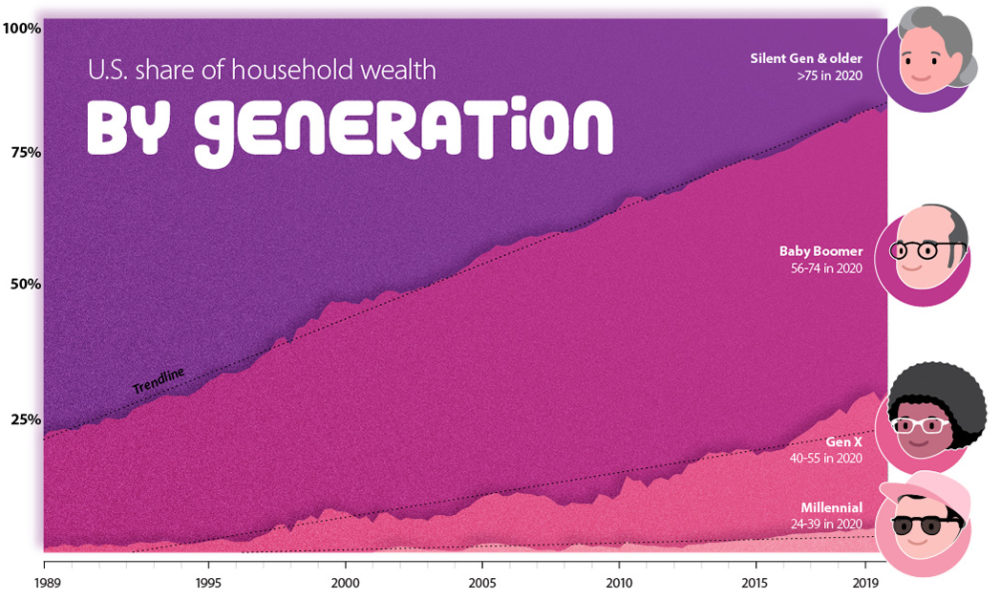
Boomers have been denying it for years, but young people all over the West have now caught on: the Boomers had it much, much better than young people today do. Measuring exactly how much better is hard, but we can guess by comparing how much saved labour Boomers needed to buy a house to how much saved labour younger generations need. Armed with the Reserve Bank’s Inflation Calculator, we can make some educated guesses.

If the last Boomers were born in 1963, graduated high school, then went to university or did a trade apprenticeship, they would have hit the job market – and started looking for a home to raise a family in – in about 1984. Any Boomers older than this would have had an even easier time. So we will compare the house-buying power of a young adult in 1984 with that of a young adult in 2022.

According to qv.co.nz, the average New Zealand house price in October 2022 was $951,040. The Reserve Bank calculator tells us that housing worth $951,040 in October 2022 would be worth $61,854.79 in the first quarter of 1984.

According to the Government’s NZ History page, the average weekly wage in 1984 was $285. This suggests that the average house price was about 217 times the average weekly wage in 1984. In other words, Boomers had to save about 217 weeks’ worth of wages in order to afford the average house.

According to the wage and salary guide at jobted.nz, the average weekly wage in New Zealand in 2022 was $1,093. So the average house price today is about 870 times the average weekly wage. This means that it’s over four times harder for young people today to buy a home they can raise a family in, when compared to Boomers.

The official narrative is that we need to grow wages if we want to bring back the living standards that our parents enjoyed. But there will never be enough wage inflation to bring today’s worker back to that level of prosperity. Our wages would have to quadruple while house prices remained the same. Therefore, if we are to ever enjoy that standard of living ourselves, we have to hope for a house price collapse.

A return to an average house price that was 217 times the average weekly wage would require a fall of 75.1% from current values. This means a fall from around $951,040 to around $236,809. Note that this would not mean that young people today had a better standard of living than the Boomers – it would merely mean that they would have an equal one.

An average house price of $236,809 seems fantastical to young people today.

It’s incredible how much easier life would be for young people in 2022 if the average house cost less than a quarter of a million. It would mean an end to the mortgage slavery that is strangling the West. It would mean that thousands of hours of labour per mortgage holder, currently getting sucked into bank profits, could be redirected to the benefit of families and communities.

That is also why we can’t expect it to happen – there is nothing more profitable than human misery, and mortgage slavery is one of the prime examples of that in the world today. The more expensive houses are, the more human life energy the owners of those houses can absorb from the lower classes in exchange for them. So the ruling class is not likely to change anything anytime soon.

Therefore, the best young Kiwis can hope for, if they want to ever have the same standard of living that the Boomers had, is a house price collapse of at least 75%. The mainstream media will tell us that we’re not allowed to hope for that, because it would mean the destruction of the New Zealand economy. But the status quo is our effective financial enslavement. Something has to give.

*

If you enjoyed reading this essay/article, you can get a compilation of the Best VJMP Essays and Articles from 2021 from Amazon as a Kindle ebook or paperback. Compilations of the Best VJMP Essays and Articles of 2020, the Best VJMP Essays and Articles of 2019, the Best VJMP Essays and Articles of 2018 and the Best VJMP Essays and Articles of 2017 are also available.

*

If you would like to support our work in other ways, subscribe to our SubscribeStar fund, or make a donation to our Paypal! Even better, buy any one of our books!
Nationalists Won 10% in Aussie – Could They Do The Same in New Zealand?

The Australian Federal Election earlier this month saw incumbent Prime Minister Scott Morrison thrown out for Labour Leader Anthony Albanese. Although this was predicted by many, few predicted how little support the two major Establishment parties would get. Even fewer predicted such a strong nationalist vote.

Australian dissatisfaction with the ruling class has not been this high ever. In 1910, Labor and the Coalition combined won 95.1% of the vote. In 1949 they won 96.3%. As recently as 1993 it was 89.2%. But after the advent of neoliberalism, support for Establishment parties has collapsed.

By 2010 the combined vote for the Establishment Left and the Establishment Right had fallen to 81.3%. By 2013 it was 79%, by 2016 it was 76.7%, by 2019 it was 74.7% and by 2022 it was 68.9%. The pattern is stark and unidirectional. Support for the Establishment in general is falling fast in Australia, as it is in most other Western countries.

This falling support for the Australian Establishment reflects the falling standard of living across the Western World. People are less satisfied than ever about the way their countries are being run. Housing is rapidly becoming unaffordable even in countries as wealthy as Australia – the average house price in Sydney is now AUD1,600,000, which is an enormous amount of money even with Aussie wages.

Like most Westerners, Australians feel like they’re getting poorer, and have done for a while. Not only is the increasing cost of living making it hard for Australian families, but there is no sign on the horizon of things getting any better. Elections are often won or lost on economic perceptions. As such, it’s not surprising to have seen a swing against the incumbent powers this year.

A more surprising feature of the 2022 Australian election was the resurgence of nationalist movements.

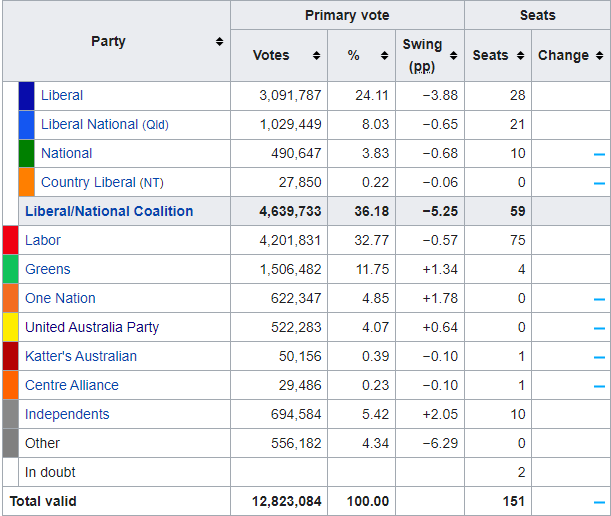
Pauline Hanson’s One Nation Party was the 4th biggest party, with 628,254 votes, and Clive Palmer’s United Australia Party was 5th with 522,283. Adding Bob Katter’s Australian Party takes the nationalist vote to over 9%. Considering the nationalist sentiments of some of the independents it is fair to suggest that the full nationalist vote was around 10%.

This nationalist vote is the result of increasing awareness of the failures of globalism. Australians, like most Westerners, have now figured out that globalism just means lower wages, higher rents, and more crime. All the benefits that we were promised accrued to those who already had wealth. The rest of us just lost out.

The globalist Establishment doesn’t care about the electorate swinging back and forth on the left-right spectrum. They control both the left and the right anyway. What they’re really worried about is a resurgence of nationalism. This creates the possibility of putting someone in power who the Establishment doesn’t already control.

The two major nationalist movements in Australia together won about 10% of the total vote, which raises the question: could a similar nationalist movement win 10% of the vote in New Zealand?

The collapse of the New Zealand First Party (polling at a mere 1% according to latest numbers) means that nationalist narratives have fallen out of the popular consciousness in New Zealand. The mainstream media, on behalf of its globalist owners, presents us with a choice between the globalist left and the globalist right. Nationalist ideas are unthinkable.

But if nationalist movements can get 10% of the vote in Australia, there’s every reason to think they could do similarly well in New Zealand. Kiwis have also been poorly served by globalism, which has also sent our productive capacity overseas while flooding our neighbourhoods with cheap labour. We have very similar attitudes to Australians when it comes to such things.

It would certainly be an uphill struggle.

Because nationalism is equated so closely to Nazism in the propaganda and brainwashing machine that is the mainstream media, any new nationalist movement in New Zealand could expect to get smeared as white supremacists immediately, and compared to Brenton Tarrant.

But nationalist movements have done well in New Zealand before. New Zealand First won 10% of the vote as recently as 2002, as voters realised that Helen Clark was happy to destroy the New Zealand working class through the mass importation of cheap Third World labour, and sought an alternative.

The Establishment has worked hard to smear New Zealand First as a racist party (despite Dan McGlashan showing that pro-NZF sentiments are stronger among Maoris than among anyone else). If Peters’s party makes a resurgence, as some are predicting it to, or if a new nationalist movement rises up, the wrecking machine will surely swing into action again.

If one unified nationalist movement won 10% of the seats in the New Zealand, they could easily draw concessions from either of the globalist right or the globalist left blocs. An end to the War on Drugs as well as an end to the mass importation of Third World cheap labour might be possible.

*

If you enjoyed reading this essay/article, you can get a compilation of the Best VJMP Essays and Articles from 2021 from Amazon for Kindle or Amazon for CreateSpace (for international readers), or TradeMe (for Kiwis). A compilation of the Best VJMP Essays and Articles of 2020, the Best VJMP Essays and Articles of 2019, the Best VJMP Essays and Articles of 2018 and the Best VJMP Essays and Articles of 2017 are also available.

*

If you would like to support our work in other ways, subscribe to our SubscribeStar fund, or make a donation to our Paypal! Even better, buy any one of our books!

The Most Terrifying Statistics You’ve Ever Seen About New Zealand

As a previous essay here has discussed, demography is destiny. The future belongs to those who show up for it. Unfortunately for us, it looks like the future will belong to the stupid. Dan McGlashan, demographer and author of Understanding New Zealand 3, explains the grim details.

The terrifying reality revealed within the correlation matrix above is that dumb people are massively outbreeding smart ones.

There is a very strong positive correlation between having any of the university degrees and having no children – at least 0.69. This means that the best-educated segment of the population and the childless segment of the population overlap to a major extent.

By contrast, the correlation between being in any of the three least-educated groups and having no children was -0.72 or even more strongly negative. This means that it’s very rare for someone with little education to abstain from reproduction. And when people with little education breed, they tend to do so without restraint.

Having no qualifications at all is significantly positively correlated with having three or more children. The strongest correlation in this table is between having no qualifications and having four children – this was a whopping 0.94. The correlations between having no qualifications and having five children (0.87) and between having no qualifications and having six children (0.72) were also very strong.

Having university qualifications is significantly negatively correlated with having three or more children. The strongest correlation in this regard was the -0.92 between having a Bachelor’s degree and having four children. The correlations between having an Honours or a Master’s degree and having four children were almost as strongly negative. Smart people simply aren’t breeding in New Zealand today.

Over the course of two or three generations, these trends will lead to significantly fewer people capable of completing higher education, and significantly more people incapable of doing so. On current demographic trends, therefore, it looks like New Zealand will become dumber and dumber. As it does, it will become poorer and poorer, and consequently more shitty and violent in most aspects.

The reasons why this is happening can be understood if one considers the schedule of social incentives that exist in the various classes.

In upper-class families, females are considered children until they are old enough to handle small responsibilities, at which point they’re given increasingly adult responsibilities, until such a point when they’re responsible enough to parent. Someone raised to think like this will have fewer children and will invest heavily into each one.

Females in lower-class families are considered children until they themselves have children, at which point they are accorded the respect due to an adult. It doesn’t matter if a female is 25 years old with a degree and a full-time job – they are children until they breed. Females without children get no respect, because they don’t know anything about anything important.

Mothers, on the other hand, are part of the inner circle. As soon as you’ve given birth, you’re on equal terms with every other woman who has. This encourages women to aspire to becoming mothers, and very little else. Someone raised to think like this will have more children, and sooner, and will invest less heavily into each one.

This distinction reflects the great division in the human species: between groups whose breeding strategy is to prepare the environment for the success of their offspring before reproducing, and groups whose breeding strategy is to shit out as many offspring as they can as quickly as possible and worry about the details later. These two strategies are known as the K-selected strategy and the r-selected strategy, respectively.

In a natural environment, the greater trust and solidarity of the K-selected allows their families and communities to survive and thrive. The co-operative networks that farsighted people build are more resilient than the “every man for himself” communities of the r-selected. As such, in a state of Nature, the populations of the K-selected tend to increase over time.

Unfortunately for the K-selected, today’s industrial society is one where farsighted hard workers are taxed into the ground to buy off the r-selected before they turn to crime. Anyone with the industriousness to become properly educated will then get taxed so heavily that they only have enough spare resources for a few children.

Meanwhile, the parents who don’t care about the poverty their children are forced to endure just keep shitting them out, knowing that the productive will pay for their survival.

A society with these demographic trends cannot escape going down the toilet. The inevitable long-term consequence of dumb people outbreeding smart ones is a reduction in overall intelligence. The inevitable consequence of that is more stupidity, violence, recklessness and crime.

Society has gone through times like these before. There is a point in every economic cycle when the productive are taxed to the maximum in order to provide bread and circuses for the hordes of unproductive. These productive are much like the character Boxer the horse in Animal Farm. Once they collapse from exhaustion from providing the labour needed to keep the whole system running, that system begins to fall apart.

The next step is for the K-selected to withdraw to easily-defendable fortresses, such as gated communities or island nations. From there it will be easier to weather the storm caused by the collapse of r-selected society, which will be a deluge of chaos that heralds a new age of the world.

All this might sound drastic, but it’s inevitable given the demographic trends outlined in this article.

*

If you enjoyed reading this essay/article, you can get a compilation of the Best VJMP Essays and Articles of 2020 from Amazon for Kindle or Amazon for CreateSpace (for international readers), or TradeMe (for Kiwis). A compilation of the Best VJMP Essays and Articles of 2019, the Best VJMP Essays and Articles of 2018 and the Best VJMP Essays and Articles of 2017 are also available.

*

If you would like to support our work in other ways, please consider subscribing to our SubscribeStar fund. Even better, buy any one of our books!

How Long Until Wages Catch Up To The Housebuying Power Of 1992?

The long-term strategy for building economic wealth appears to be holding house prices steady while waiting for wages to catch up. This article does the maths to answer one question: how long until the average wage has the same housebuying power of the average wage in 1992?

In 1992, the average New Zealand house price was $105,000. The average wage at that time was almost $15 per hour. This means that most Kiwis found themselves able to buy a house after 7,000 hours of labour.

By 2021, the average New Zealand house price has climbed to some $750,000, while the average wage languishes at around $34 an hour. This means that most Kiwis today are looking at putting in 22,000 hours of labour before they can get to the position of homeownership.

Economists predict that the average New Zealand house price will increase by double-digit percentages in 2021. 5% increases are expected for the two years after that, up until March 2024, which is as far ahead as anyone responsible will try to predict.

Let’s make two assumptions: firstly, that these forecasts are broadly correct; secondly, that house prices stop increasing after March 2024, allowing wages to catch up.

This suggests that house prices will top out at a national average of about $910,000 ($750,000 x 1.10 x 1.05 x 1.05). This assumes that they increase by around 10% in the year to March 2022, and then 5% for the two years after that, before remaining stable thereafter. The reality is, of course, anyone’s guess, but let’s say for simplicity’s sake that house prices reach $910,000 by March 2024 and then stay there in perpetuity.

To buy a $910,000 house with 7,000 hours of labour, a worker would have to be getting paid $130 per hour. Assuming that all other things (labour share, taxes, rents, non-rent living costs) are equal, $130/hr is what the average wage would have to be for the average worker to have the same housebuying power as the average worker in 1992.

As mentioned above, the average wage in New Zealand is around $34 right now. This means that it has to increase 3.82 times for the average worker to have the same housebuying power that the average worker had in 1992 – without house prices increasing beyond March 2024.

Wage growth over the past 28 years in New Zealand, from just under $15 an hour in 1992 to around $34 an hour at the end of 2020, has run at about 3% per annum.

If we assume future wage increases of 3% per annum, and no further house price increases beyond March 2024, then we will have to wait around 48 years for the average wage to catch up to the housebuying power that the average wage had in 1992.

In reality, it’s unlikely that house prices will remain exactly the same for the next 48 years. When the Boomers start dying off en masse, beginning in about 15 years, the demand for housing will rapidly fall all across the Western World. At that point, house prices could go in any direction depending on how much immigration takes place.

Of course, if house prices continue to increase beyond March 2024, then wages will simply never catch up. The West will become more and more verticalised until we effectively regress into a feudal-style economy where 99% of people are renters for life.

What can be said with confidence, however, is that it will take around half a century, at current rates, for wages to catch up to the point where the average worker has the same housebuying power they had in 1992. And that is even if one assumes that house prices don’t continue to increase.

*

If you enjoyed reading this article, you can get a compilation of the Best VJMP Essays and Articles of 2019 from Amazon for Kindle or Amazon for CreateSpace (for international readers), or TradeMe (for Kiwis). A compilation of the Best VJMP Essays and Articles of 2018 and the Best VJMP Essays and Articles of 2017 are also available.

*

If you would like to support our work in other ways, please consider subscribing to our SubscribeStar fund. Even better, buy any one of our books!