
Young People Voting For Left-Wing Parties Is Not Evidence Of Marxist Brainwashing Camps

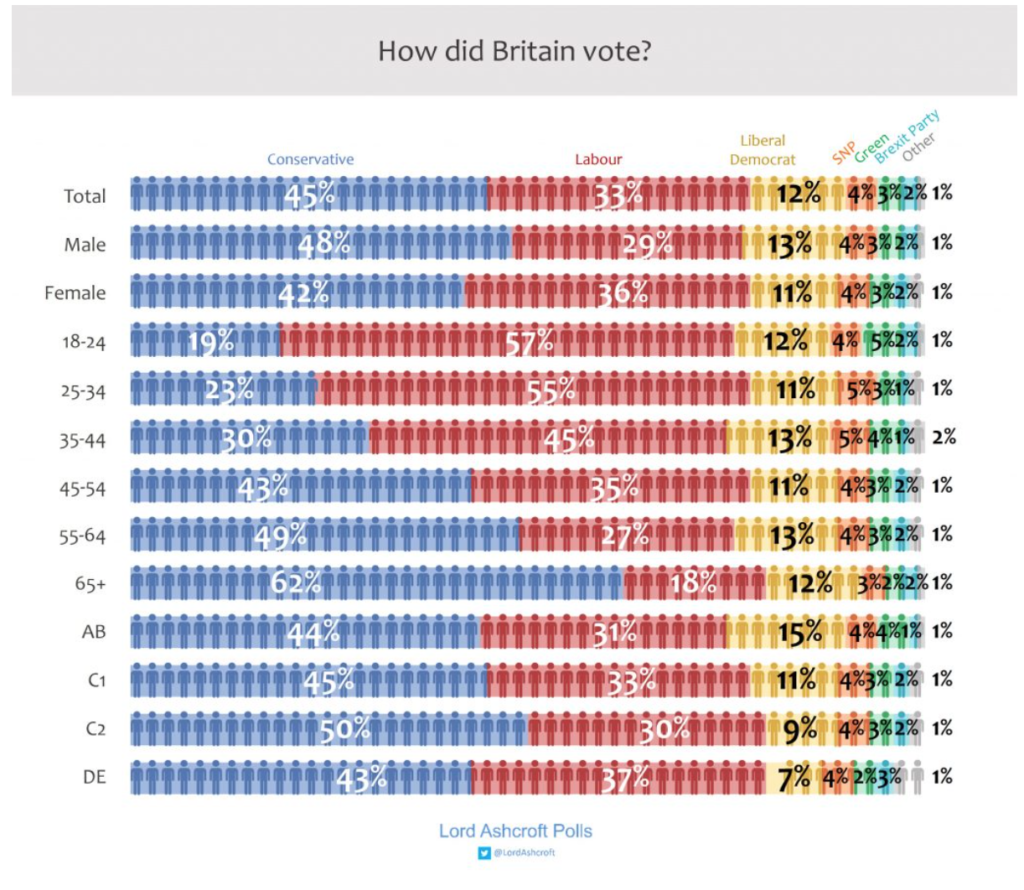
A popular meme going around at the moment shows an electoral map of Britain if only 18-24 year olds had voted in the General Election earlier this month. The map is almost completely red, leading many to conclude that these young people have all been brainwashed into voting Labour, but this conclusion does not follow evidentially. Demographer Dan McGlashan, author of Understanding New Zealand, explains.

Most adults are intelligent enough to know that people don’t cast their votes depending on which set of policies best serve the nation, or even depending on which set of politicians appears to be the most competent. The reality is that politics is pure, naked self-interest, and people cast their vote based on that.

One of the basic rules of democratic elections is that the less resources a person controls, the more they will want resources to be redistributed. This isn’t merely a law of politics, or even a law of psychology, but a law of ethology, brought about by evolution.

It can be observed in primate troops that the primates with the weakest capacity for gathering resources from nature are the same ones that are the most strongly in favour of sharing. This is not surprising, because the weaker one’s capacity for gathering resources, the more reliant one becomes on the gathering capacity of others.

When a person is aged between 18 and 24, it’s almost inevitable that they are poor, at least as an individual. At the absolute most they will have earned a postgraduate degree, and even if they managed to avoid a student loan they will not have had enough time to earn any real money. Assuming they haven’t inherited a fortune already, the best of them will be working an entry-level position and renting, with little real savings.

People in this age bracket find that it’s older people who own everything already. In New Zealand, the correlation between living in a freehold house and being aged between 20 and 29 was -0.60. If one considers that many people in this age bracket will be living in a freehold house owned by a family member, it suggests that very few of them will own their own homes.

Not owning your own home means that you will get extorted out of rent money in order to not die of exposure. Because it’s the old who own most of the homes, society is therefore structured in a way that funnels wealth away from the young workers and into the pockets of the old owners. Because society is set up this way, young people are always likely to vote for the party that promises to give workers a bigger share.

This is no more surprising or immoral than the old voting to not redistribute wealth owing to the fact that they already own everything. Voting for a Conservative party is the same as voting to uphold the Police and their enforcement of property claims, and this is almost always done when a person charges rent. In other words, it’s also voting purely in one’s self-interest.

Further evidence for the statement that young people don’t vote for left-wing parties because of Marxist indoctrination comes from observing young university students. Young people who go to university are more likely to vote for a right-wing party than those who did not go to university. If young people voted for left-wing parties because of Marxist brainwashing camps, then those not exposed to the camps would vote for right-wing parties more often.

The opposite is the case. This is because young people who go to university are more likely to come from the middle class than those who do not, and are therefore wealthier than the average of their age cohort, despite that their age cohort is relatively poor. Consequently, they are more likely to vote Conservative out of self-interest.

On the other hand, it is true that our university system has been reduced to a network of Marxist indoctrination camps. Evidence for this doesn’t come from the voting patterns of young people, though – it comes from the movements against free speech, the promulgation of anti-white philosophies and the distorted views of history and of human nature that are promoted for political reasons and not because of a love of truth.

The voting pattern of young people voting for left-wing parties that promise to redistribute wealth is not because these young people have been brainwashed – it’s because they’re poor. The kind of low-IQ person susceptible to Marxist brainwashing would usually vote left anyway on account of that they were poor.

*

Understanding New Zealand, by Dan McGlashan and published by VJM Publishing, is the comprehensive guide to the demographics and voting patterns of the New Zealand people. It is available on TradeMe (for Kiwis) and on Amazon (for international readers).

*

If you would like to support our work in other ways, please consider subscribing to our SubscribeStar fund.

How Long Until White People Become A Minority in New Zealand?

The recent release of the final statistics from the 2018 New Zealand Census has kept stats nerds across the country busy. One of the busiest has been VJM Publishing numbers man Dan McGlashan, author of Understanding New Zealand, who is compiling the data for a third edition of his demographic masterpiece. In this analysis he asks: how long until white people become a minority in New Zealand?

The New Zealand Stats website is a treasure trove of demographic data. There are thousands of tables of information on this page, many of which are customisable. This makes it easy to compare data between groups or between time frames. Often, the data is extrapolated into the future.

The white proportion of the New Zealand population has been falling for some time, as is true of all Western countries.

At the time of the 1991 Census (around when the average VJMP reader was born), there were 2,783,028 white people in New Zealand, out of a total population of 3,373,929. This means that New Zealand was 82.5% white at this time. Neo-liberalism had all but completed its stranglehold over the New Zealand mindset by 1991, and it was at that point that the mass importation of cheap labour began in earnest.

The New Zealand ruling class had figured out, by this time, that labour costs were their primary expense. The mass importation of foreign cheap labour not only lowered labour costs directly, by introducing what was effectively scab labour into the workplace, but it also lowered labour costs indirectly by destroying the solidarity of the native working class and thereby making it harder for them to organise to negotiate fair wages.

Although the New Zealand people were never asked for their consent to it, the advent of the mass importation of cheap labour would set in motion a course of events that would lead to the Brazilianisation of New Zealand.

At the time of the 2013 Census, there were 3,312,100 white people in New Zealand, out of a total population of 4,442,100. This means that New Zealand was 74.6% white at that time.

At the time of the 2018 Census, there were 3,357,744 white people in New Zealand, out of a total population of 4,793,358. This means that New Zealand was 71.7% white at the time of the most recent Census, a fall of 10.9% over the 27 years since the 1991 Census.

According to the NZ Stats national ethnic population projections, there should be 3,781,500 white people in New Zealand at the time of the 2038 Census, out of a total population of 5,769,800. This will mean that it will be 65.5% white one generation from now.

Over the 25 years from 2013-38, we are expected to see a decline in the white proportion of the New Zealand population, from 74.6% to 65.5%. This is a total decline of 9.1% over 25 years, or 0.36% per year.

So, over the 47 years from 1991-2038, we are expected to see a decline in the white proportion of the New Zealand population from 81.5% to 65.5%. This would be a total decline of 16%, or 0.34% per year.

Thus, the white proportion of the New Zealand population has fallen by about 0.35% per year since the advent of neoliberalism. So extrapolating forwards from 2038, when the white proportion of the population is expected to be 65.5%, the white population would need to fall a further 15.6% before white people become a minority in New Zealand.

At the current rate of falling 0.35% a year, this suggests a further 45 years from the end of 2038.

In other words, white people ought to become a minority in New Zealand sometime in the early 2080s. That means that the bulk of people reading this article should be dead. This prediction is line with when other Western countries are predicted to end up with white minorities, which exposes the fact that the imposition of neoliberalism was a globalist endeavour.

Of course, all of these projections assume that the current rulers of New Zealand – the international banking and finance class – see fit to keep importing cheap labour at roughly the same rate they are currently doing. This importation of cheap labour will likely continue to be profitable because it drives up house prices and causes demand for mortgages. Therefore, the bankers and financiers will keep pushing it on us until they are stopped.

Although it seems unlikely today, a future nativist movement could come to power in New Zealand and turn the cheap labour taps off. In Sweden we have seen the rise of the Sweden Democrats from 3% 12 years ago to 25% today, where they are now the largest polling party. This is despite the fact that some Sweden Democrats are openly neo-Nazi.

This reasoning also ignores the fact that many Pacific Islanders and Asians, and in principle all of the Maoris, will be at least part white, with some of them being more white than anything else. The average Maori is only 80% as Maori as they were the generation previously, owing to heavy interbreeding with other Kiwis. By the 2080s there may no longer be a distinct Maori race.

At the moment though, with current trends the way they are, the idea of a Great Replacement of white people in New Zealand isn’t a conspiracy theory. It’s apparent from the statistics on the New Zealand Government’s own statistics page that white people ought to become a minority in New Zealand some time around 2083.

However, Brenton Tarrant was wrong when he said it was all about the birthrates (at least in New Zealand’s case).

The NZ.Stat website also tells us the projected fertility rates of the various ethnic groups in New Zealand. The Asian fertility rate was 1.61 in 2018, compared to the white fertility rate of 1.82. The Maori fertility rate was 2.36 and the Pacific Island fertility rate 2.4. This Asian fertility rate is well below replacement level, and the Maori and Pacific Islander rates are barely above it.

The Asian fertility rate is expected to fall further, to 1.55, by 2038, whereas the white fertility rate is expected to remain at around 1.8 by this time. By this time the Maori and Pacific Island fertility rates will have fallen to sub-replacement level, at 2.1 and 2.2 respectively. Considering the higher death rate among the Maori and Pacific Island populations, this is hardly a demographic threat.

It’s not about the birthrates – it’s about border control.

There probably isn’t a plan among New Zealand’s ruling elites to commit white genocide, but there doesn’t need to be. White New Zealanders are capable of selling the country out from under their grandchildrens’ feet for the sake of a fat pension. The bankers and finance interests that control the mainstream media, for their part, are more than happy to encourage this short-sighted greed for the sake of the mortgage profits it brings.

*

Understanding New Zealand, by Dan McGlashan and published by VJM Publishing, is the comprehensive guide to the demographics and voting patterns of the New Zealand people. It is available on TradeMe (for Kiwis) and on Amazon (for international readers).

*

If you would like to support our work in other ways, please consider subscribing to our SubscribeStar fund.

The Implications Of Having Two Referendums At The Same Time As The General Election

At time of writing, there are two referendums scheduled to take place on the same day as the 2020 General Election. The referendum about cannabis law reform was scheduled long ago, but this week saw the news that there would also be a referendum about euthanasia at the same time. What will this mean for the election? Numbers man Dan McGlashan, author of Understanding New Zealand, looks at the statistics.

What these two referendums mean, in short, is that a number of people who wouldn’t otherwise have gone to the polling booths on Election Day will do so. While there, they are very likely to cast a vote for a party in the General Election. Those parties, therefore, will get boosted by the extra turnout caused by the referendums. This article looks at which parties are likely to be the beneficiaries of the fact there are two referendums at the same time as the Election.

Let’s deal with the cannabis referendum first.

The cannabis referendum will predictably bring out the sort of voter who votes for the Aotearoa Legalise Cannabis Party. Some people will make the lazy assumption that, because the Green Party has been the one most visibly championing the cannabis law reform issue, many of the people brought to the polls on Election Day will vote for the Greens. This assumption is likely false for at least one major reason.

The foremost reason is that the people who vote Green already vote in large numbers. There are strong correlations between both having a university degree and earning six figures and being a Green voter. There are also strong correlations between all of these things and turnout rate. Therefore, the sort of person who was likely to vote Green probably already did so in the previous election as well, and so a cannabis referendum won’t change much for them.

I refer to this principle as the General Disenfranchisement Rule. This states that the more a person is disenfranchised (by major measures of social status), the less likely they are to vote. Therefore, moves that enfranchise previously disenfranchised people (such as referendums) tend to bring out people from the lower social echelons. They don’t tend to bring out new National, ACT and Greens voters.

These people from lower social echelons are the sort of person who, as mentioned above, tend to support the Aotearoa Legalise Cannabis Party. In Understanding New Zealand I showed who these people are. As a general rule, ALCP voters are heavily Maori and are much more likely to be on the invalid’s benefit. They are doing it worse than supporters of any other party.

In other words, they are from categories that are hitherto heavily disenfranchised. For many of these people, deep resentment has built up regarding the cannabis issue, and if the referendum brings them to the polls they will not vote for Establishment movements. It follows, then, that there will be a considerable boost to the sort of party who already champions the underdog.

The ALCP, Labour, New Zealand First, TOP and the Greens will all split this vote (with the foremost named taking the most).

Regarding the euthanasia referendum, overseas research has shown that supporters of euthanasia tend to be young, left-wing and atheist. This means that this referendum will bring fewer otherwise disenfranchised people to the polling booths than the cannabis one.

The euthanasia idea deeply upsets elderly Christians, who, for whatever reason, feel that the terminally ill ought be forced to suffer as long as possible. However, the vast majority of these people would have come out to vote National or Conservative anyway. Therefore, holding a euthanasia referendum will not bring many extra voters to the ballot boxes on the conservative side.

On the other hand, many of the people who support a euthanasia referendum will be the sort of person who is appalled by Christian morality. These people tend to be young and educated, which means that they are on the margins of voting or not voting. They are less likely to vote Labour and ALCP, but will be more likely to vote Greens and for The Opportunities Party.

Many of these young people will be educated and, therefore, not as severely disenfranchised as the less educated voters who will come out for the cannabis referendum. This suggests that the overall electoral effect of the euthanasia referendum ought to be smaller than for the cannabis referendum.

The combined effect of these two referendums will be to bring a number of young, atheistic people in particular to the ballot boxes.

If the cannabis referendum induces young Maoris to vote and the euthanasia referendum induces young white people to vote, we can predict that this combined youth effect will see increased support for the Labour Party and the ALCP, with minor boosts to the Greens, The Opportunities Party and New Zealand First (who are falsely characterised as an old person’s party).

How large will this number be?

The correlation between turnout rate in the 2017 General Election and voting ALCP in 2017 was -0.63, which speaks to heavy disenfranchisement among cannabis users. Many of these people would not vote under ordinary circumstances. Because the cannabis referendum appeals directly to these heavily disenfranchised people, it could have a noticeable effect on turnout.

This suggests that the combined effect of the two referendums on otherwise disenfranchised voters will be enough to shift the electoral balance towards the centre-left by one to two percent, perhaps accounting for a couple of extra seats for the centre-left bloc. It’s not likely to be enough to decide the balance of power, but if the margins were otherwise thin enough it could be.

*

Understanding New Zealand, by Dan McGlashan and published by VJM Publishing, is the comprehensive guide to the demographics and voting patterns of the New Zealand people. It is available on TradeMe (for Kiwis) and on Amazon (for international readers).

If you would like to support our work in other ways, please consider subscribing to our SubscribeStar fund.

Could The Government Fund Itself With A Georgist Tax?

One of the great political problems is how to fund a government. Governments cannot realistically be funded by donations, so they have to levy taxes. No matter how you slice it, levying taxes on the people will always create discontentment, and not levying them is often no better. This essay discusses whether Georgism might work for New Zealand.

Georgism is a political philosophy named after American theorist Henry George. The essence of it is the belief that, while people should own the value they produce themselves, economic value derived from land (often including natural resources and natural opportunities) should belong equally to all members of society. Income provided by things that are part of the natural world, and which do not depend on human activity to have value, should be the common property of the citizenry.

Georgist ideas were very popular a century ago, before the rentiers used their ownership of the apparatus of propaganda to persuade the population that government should be funded by taxes on labour and consumption. Since then, the mainstream media has normalised the idea of taxing labour and consumption, mostly by not allowing any discussion of Georgism, and by restricting discussion to a narrow range of pro-capitalist models.

Alt-centrism finds much in common with Georgist ideas. Georgism is a very alt-centrist approach to funding a Government, because it rejects the Establishment, and their focus on taxing labour. Georgism stands directly opposed to the Establishment because it is precisely the Establishment who profits the most heavily from charging rent. In taxing the Establishment the most heavily, Georgism accords with alt-centrism the most closely.

An Australian study suggested that heavy taxation of rents could provide up to 87% of the funding necessary to run the Australian Government. The remaining money could be raised according to a similar philosophy – i.e. it could tax other properties whose value did not depend on human labour inputs (such as oil and mineral royalties), or it could charge fees to use common property such as the electromagnetic spectrum and fishery stocks.

Georgism rejects the idea of levying taxes on economic activity that is the result of a direct human labour input. The idea is that tax on ground rents ought to be enough to fund the Government, and therefore that taxes on income would no longer be necessary. For a modern state like New Zealand, the numbers don’t quite add up, but a Georgist tax could be enough to slash income taxes.

According to the New Zealand Household Expenditure Statistics for 2016, rent costs comprised 31.8% of New Zealand’s total weekly housing costs, which were themselves 25.6% of the total weekly household expenditure of $1,300.

31.8% of 25.6% of $1,300 is $105, the average weekly household rent expenditure. Multiplying this by 52 weeks equals $5,460 every year per household on rent. Multiply this by the 1,500,000 households in New Zealand, and we arrive at a figure of $8,190,000,000 charged in rent money every year. This is just from household rents – it does not include commercial rent, rural rent, mineral royalties, banking license fees or fishing licenses.

The Australian study linked above found that the total resource rents of Australia were over two times the size of just the household rents – in fact, household rents are only about 40% of the total resource rents charged in Australia. $8.2 billion divided by 40% gives us a figure in the ballpark of $20 billion dollars every year.

The total operating costs of the New Zealand Government run at about $76 billion per year, so a Georgist tax of 90% on resource rents wouldn’t cover more than a quarter of this.

However, it’s notable that individual income taxes bring in about $37 billion every year to the New Zealand Treasury. A Georgist tax of 90% on all resource rents would therefore provide the leeway to slash individual income taxes by a half.

Another way to look at it is that New Zealanders pay tax of around $7,400 on income up to $48,000. So if there are 2,500,000 taxpayers in New Zealand, this suggests that a Georgist tax on resource rents in New Zealand could replace all income taxes up to $48,000 per annum.

Eco-Georgism is a variant of Georgism that gives special consideration to the environmental challenges facing humanity this century. This involves heavy emphasis on making polluters pay for the externalities that they introduce to the environment. This would combine the heavy tax on resource rents discussed above with e.g. carbon taxes.

21st century Georgism for New Zealand, then, would be the political philosophy of funding government activity through two primary means: heavy taxes on resource rents, and heavy taxes on all activities that cause environmental destruction.

In particular, ground rents on urban locations, such as city-centre shops and rental apartments, would be taxed the hardest. This is because such economic activity amounts to little more than parasitism. Shifting the burden of taxation to this kind of extortionate activity, and shifting it away from labour, will also make the economy not only more fair, but also more efficient.

*

If you enjoyed reading this essay, you can get a compilation of the Best VJMP Essays and Articles of 2018 from Amazon for Kindle or Amazon for CreateSpace (for international readers), or TradeMe (for Kiwis). A compilation of the Best VJMP Essays and Articles of 2017 is also available.

If you would like to support our work in other ways, please consider subscribing to our SubscribeStar fund.